智能养老

Search documents
一群60后,盘活养老机器人
Hu Xiu· 2025-08-09 05:54
Core Insights - The article discusses the emergence of intelligent robots in the elderly care sector, highlighting the growing demand for such technologies due to China's aging population and changing consumer behavior among seniors [6][8][12]. Group 1: Market Dynamics - The elderly population in China is rapidly increasing, with projections indicating that by the end of 2024, there will be 310 million individuals aged 60 and above, accounting for 22% of the total population [6]. - The silver economy is gaining traction, with the elderly shifting their spending from basic needs to health, interests, and experiences, leading to a significant increase in consumption in areas like nutrition and health products [8][9]. - The market for intelligent elderly care robots is expected to exceed 2 trillion yuan by 2030, driven by the increasing demand for care solutions for the elderly [15]. Group 2: Industry Developments - Companies like Fourier are entering the market with innovative products such as the Care-bot GR-3, which aims to provide companionship and support for the elderly [2][4]. - The Chinese government is actively promoting the development of intelligent elderly care robots through various policies and initiatives, including funding for pilot projects and subsidies for technology adoption in care facilities [16][30]. - The number of elderly care robot companies in China has increased by 42% year-on-year, indicating a robust growth in the industry [22]. Group 3: Technological Innovations - Intelligent elderly care robots are categorized into four main types: health monitoring, rehabilitation training, nursing, and emotional companionship, each serving specific needs of the elderly population [23][25][26][27]. - The integration of various functionalities in these robots, such as health monitoring combined with emotional support, reflects a trend towards more comprehensive care solutions [28]. - The development of smart elderly care solutions is being supported by both traditional manufacturing giants and tech companies, indicating a collaborative approach to addressing the challenges in elderly care [18][19][20].


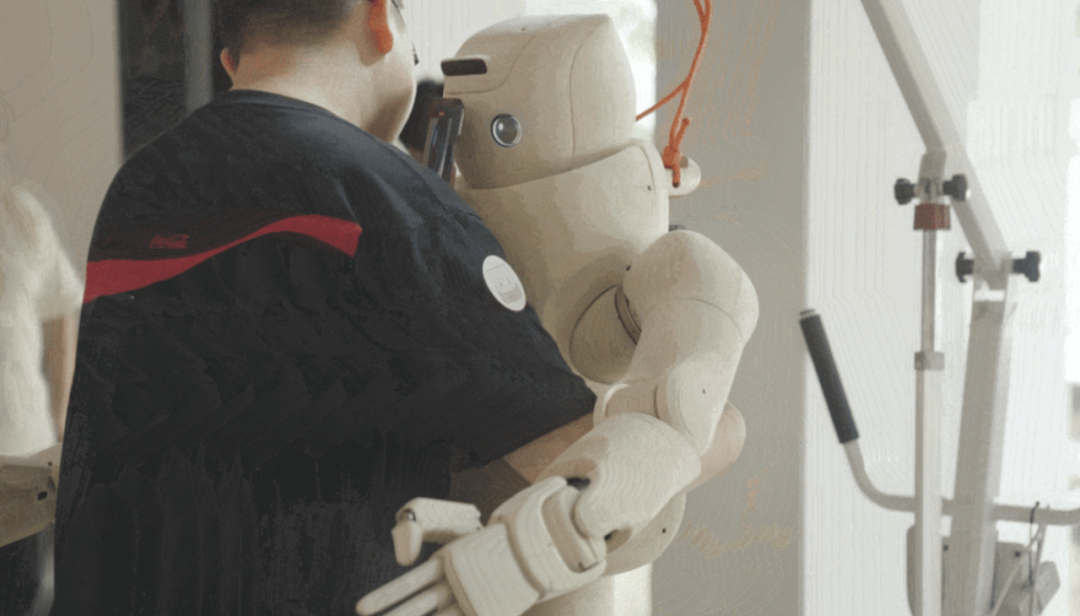
陪伴机器人“大白”走进现实 这家企业加码康养赛道
Zhong Guo Zheng Quan Bao· 2025-08-06 15:56
Core Insights - Fourier has launched its first full-size humanoid robot, Care-bot GR-3, designed for interactive companionship and applicable in healthcare and wellness scenarios [1][4] - The GR-3 robot features a soft skin design and a friendly appearance, inspired by the character Baymax from the animated film "Big Hero 6" [2][3] - The robot is equipped with 55 degrees of freedom, allowing for human-like movements and interactions, including a three-hour battery life and tactile feedback through 31 touch sensors [3] Company Overview - Founded in 2015 and headquartered in Shanghai, Fourier initially entered the market with medical rehabilitation robots and has since developed a product ecosystem centered around the GRx series humanoid robots [3] - The company plans to deliver thousands of robots by 2025, indicating a strong growth trajectory in the humanoid robot sector [3] Industry Trends - The demand for companion robots in public service sectors, such as community health and elder care, is expected to grow, with a focus on enhancing operational efficiency in medical settings [4] - The Chinese government is promoting the application of intelligent elderly care robots, with specific targets for deployment in households and community care settings by 2027 [4][6] - The market for intelligent elderly care robots is projected to exceed 2 trillion yuan by 2030, driven by policy support and technological advancements [6] Competitive Landscape - Companies like Midea Technology and UBTECH are forming joint ventures to focus on healthcare and rehabilitation robots, while Tencent's Robotics X lab is developing general-purpose robots for harmonious living environments [6] - Other companies, including Haier and various robotics firms, are entering the exoskeleton robot market, indicating a competitive and rapidly evolving industry landscape [6]
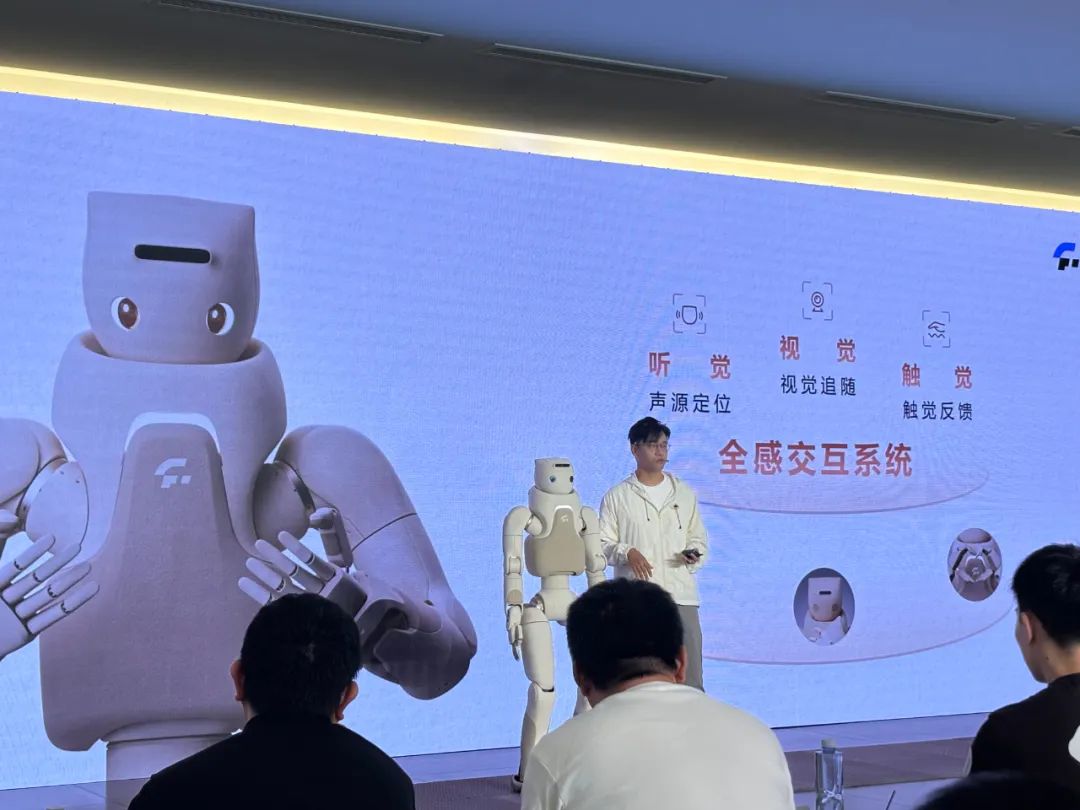
方正证券:养老智能机器人落地加速 市场规模预计将超两万亿
Zheng Quan Shi Bao Wang· 2025-08-06 00:49
Core Insights - China has officially entered a moderately aging society, leading to a significant increase in the number of disabled elderly individuals and a severe shortage of caregiving personnel [1] - The smart elderly care robot market is accelerating due to policy support and technological advancements, becoming a key force in the transformation of the elderly care industry in China [1] Demographic Trends - By 2030, the elderly population in China is projected to reach 380 million, with the number of disabled elderly individuals expected to reach 100 million [1] - The distribution of elderly individuals is anticipated to be 90% living at home and 10% in institutions by 2030 [1] Market Projections - The average prices for various types of smart elderly care robots are expected to decrease by 2030: health monitoring robots to 20,000 yuan, emotional companionship robots to 20,000 yuan, caregiving robots to 30,000 yuan, and mobility assistance robots to 30,000 yuan [1] - The market size for smart elderly care robots is projected to exceed 2 trillion yuan [1] Investment Opportunities - Companies with advantages in elderly care channels and integrated hardware-software solutions are recommended for investment [1] - Firms that offer a diverse range of high-quality products in the elderly care robot sector are also highlighted as potential investment targets [1] - Companies specializing in rehabilitation exoskeletons are suggested as another area of interest for investors [1]

2025年中国智能养老机器人行业概览:从老有所养到老有所乐 智能重构养老体验
Xin Lang Cai Jing· 2025-07-17 14:55
Group 1 - The core viewpoint is that smart elderly care robots, leveraging AI, environmental perception, and human-computer interaction technologies, are evolving from simple mechanical aids to intelligent service devices, enhancing the quality of life for the elderly through various functions such as rehabilitation, health monitoring, and emotional companionship [1][2] - The smart elderly care robot industry in China is supported by a comprehensive policy framework that integrates technological innovation, standardization, scenario adaptation, and ethical safety, covering the entire industry chain from research and manufacturing to service operation and medical care integration [1] - By the end of 2024, the population aged 60 and above in China is expected to exceed 300 million, driving the accelerated penetration of smart elderly care robots into community, institutional, and home settings [1] Group 2 - The policy environment is being shaped by multiple ministries collaborating to create a complete system from technology research and development to application scenarios and industry ecology, focusing on the needs of an aging society [2] - Standards and regulations are guiding the high-quality development of the industry, promoting the deep integration of smart elderly care robots into the elderly care service system as a crucial technological support to address the challenges of population aging [2] - The report aims to analyze the definition, industry chain, and competitive landscape of wearable health monitoring devices to forecast future market development directions [2]
2025年中国智能养老机器人行业概览:从老有所养到老有所乐,智能重构养老体验
Tou Bao Yan Jiu Yuan· 2025-07-17 12:28
Investment Rating - The report does not explicitly provide an investment rating for the intelligent aging robot industry. Core Insights - The intelligent aging robot industry in China is transitioning from simple mechanical assistance to intelligent services, integrating AI, environmental perception, and human-machine interaction technologies to enhance the quality of life for the elderly [2][3]. - The market is driven by the rapid aging population, with projections indicating that the number of individuals aged 60 and above will exceed 300 million by the end of 2024, necessitating diverse services such as rehabilitation training, daily assistance, and emotional companionship [3][4]. - The industry is supported by a comprehensive policy framework that combines technological innovation, standardization, scenario adaptation, and ethical safety, facilitating the integration of intelligent aging robots into the elderly care service system [2][3]. Summary by Sections Industry Overview - Intelligent aging robots are multifunctional devices designed to assist the elderly in daily life, health monitoring, and emotional support, categorized into rehabilitation, nursing, and companionship robots [2][19]. - The market is expected to grow significantly due to the increasing elderly population and the demand for health services, with the elderly population projected to reach 380 million by 2030 [4][25]. Demand Environment - The "9073" elderly care model promotes home-based care as the mainstream choice, with 90% of elderly individuals preferring to stay at home [28]. - The number of elderly care institutions and community facilities has been expanding rapidly, driving the demand for intelligent aging robots to fill the labor gap and improve service efficiency [32][29]. Market Size - The intelligent aging robot market is projected to grow from 90.5 billion yuan in 2020 to 657.9 billion yuan by 2029, with a compound annual growth rate (CAGR) of 32.9% from 2020 to 2024 and 15.2% from 2025 to 2029 [46][43]. - The growth is fueled by the aging population, policy support, and technological advancements, leading to a shift from institutional to home-based services [46][43]. Industry Chain Analysis - The industry chain consists of upstream suppliers providing core components, midstream manufacturers integrating R&D and production, and downstream applications reaching end-users in various care settings [52][55]. - The demand for industrial robot reducers is increasing, with a CAGR of 28.11% from 2019 to 2023, indicating a robust market outlook for the components used in intelligent aging robots [58][59]. Competitive Landscape - The market is characterized by differentiated competition, with rehabilitation robots led by specialized companies, while nursing robots see a mix of leading firms and niche players [5][88]. - The competition will focus on technological compliance and the ability to cover diverse care scenarios, with a trend towards a multi-layered competitive structure [88]. Company Profiles - Siasun Robot & Automation Co., Ltd. is a leading player in the industry, known for its comprehensive product matrix and ability to integrate technology and policy innovation [94]. - The company has shown consistent revenue growth, with an increase from 26.6 billion yuan in 2020 to an estimated 41.4 billion yuan in 2024 [96].
当养老机器人来敲门
Xin Hua She· 2025-07-07 03:11
Core Insights - The article discusses the emergence and potential of smart elderly care robots in response to the increasing aging population in China, highlighting advancements in technology and government support for the industry [3][5][6]. Group 1: Market Demand and Demographics - By the end of 2024, the elderly population aged 60 and above in China is projected to reach 310 million, accounting for 22% of the total population, with estimates suggesting it could exceed 400 million by 2035, representing over 30% [5]. - The demand for elderly care services is rising due to the accelerating aging process, creating a significant market opportunity for smart elderly care robots [8][19]. Group 2: Technological Advancements - Smart elderly care robots are being developed with advanced technologies such as artificial intelligence, brain-computer interfaces, and multi-modal AI, enabling them to learn and adapt to complex care scenarios [8][19]. - The market for smart elderly care robots reached nearly 25 billion yuan in 2023, with projections indicating substantial growth potential, particularly in health monitoring and rehabilitation sectors [15][19]. Group 3: Government Support and Policy Initiatives - The Chinese government has outlined support for smart elderly care in its 14th Five-Year Plan, with various policies being implemented to promote the development and application of intelligent care robots [6][7]. - Recent initiatives include the publication of a directory for smart health and elderly care products, which includes 80 AI-integrated solutions, and pilot programs for intelligent elderly care service robots [6][7]. Group 4: Industry Challenges and Opportunities - Despite the promising outlook, the industry faces challenges such as the lack of high-quality elderly care data, high development costs, and consumer acceptance issues [16][18]. - The article emphasizes the need for a collaborative care model involving robots, professional caregivers, and family members, highlighting that robots should assist rather than replace human care [19][20].
新华网财经观察丨当养老机器人来敲门
Xin Hua Wang· 2025-07-07 01:54
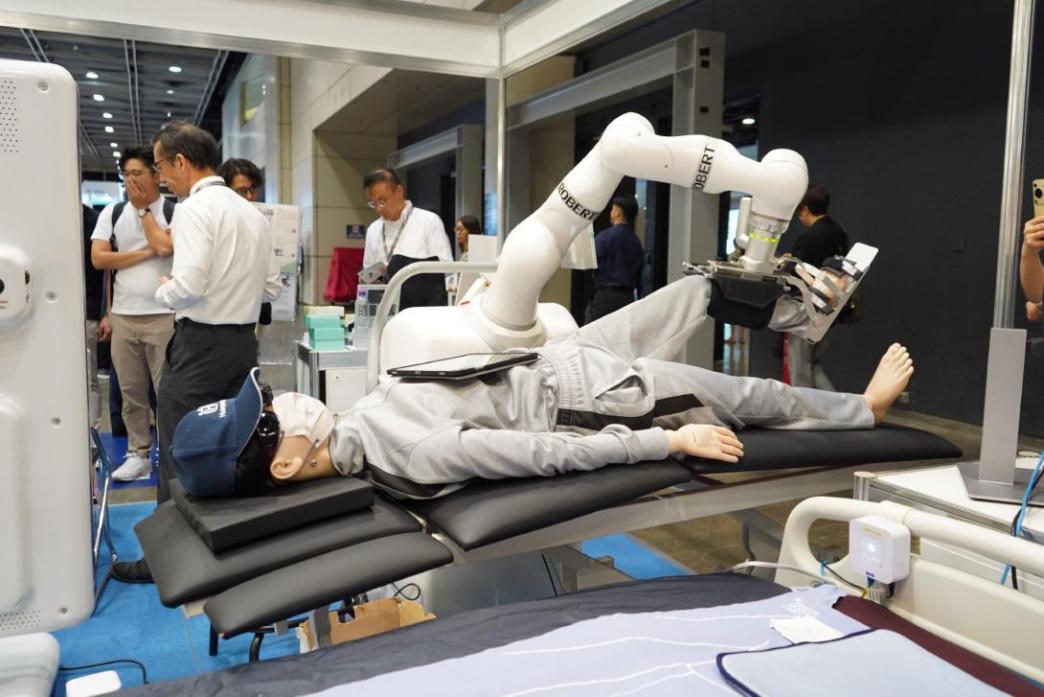
新华网北京7月7日电 题:当养老机器人来敲门 新华网记者 冉晓宁 陈听雨 当晨光透过量子玻璃幕墙,全息投影在老人腕间的养老管家将自动生成当日健康图谱。搭载空间折叠技术的多功能护理舱从天花板缓 缓降落,反重力机械臂悬浮托起老人,纳米级分子重组喷头完成皮肤检测,随即释放携带营养因子的纳米泡沫,同步完成清洁与皮肤修 复。 喂饭机器人搭载意识读取芯片,提前感知老人的进食意愿,用超流体材质勺体包裹食物,以量子纠缠传输方式精准递送至口腔。 神经接驳式外骨骼助行器通过脑机接口读取老人的运动意图,在虚拟现实与增强现实的叠加空间中,实时智能调整引力参数,帮助老 人在安全环境中重塑运动神经。 …… 这是我们对智能养老未来的无限遐想。 现实中,具备养老功能的服务类机器人已悄然落地。据媒体公开报道,近年来,由于人工智能迅猛发展,加之社会老龄化程度加深, 具有护理、喂饭、洗浴、大小便清洁、康复、下肢助行、陪伴等各种功能、分工不同的养老机器人已陆续在全国多地养老院、社区和医疗 机构"上岗",不少陪伴型机器人也已敲响老年人的家门,走进家中开启全天候陪伴模式。 图为第16届香港国际医疗及保健展上的AI康复治疗机器人。新华社发(郭辛摄) 依托 ...


“机器人养老”有望?广东开展2年期智能养老服务机器人试点
Nan Fang Du Shi Bao· 2025-06-17 03:58
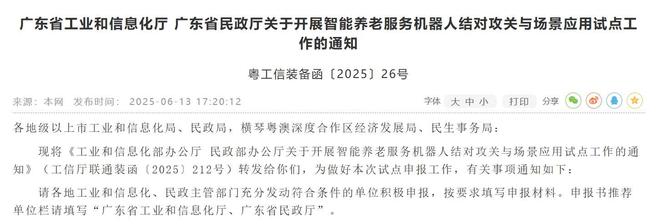
Core Viewpoint - The application of artificial intelligence and robotics in elderly care is gaining attention due to the increasing aging population and concerns about retirement solutions [1] Group 1: Policy and Initiatives - Guangdong Province has announced a call for applications for intelligent elderly care service robot pilot projects, with a submission deadline of June 30 [1][3] - The pilot program is based on a notification from the Ministry of Industry and Information Technology and the Ministry of Civil Affairs, aimed at promoting the development of smart elderly care through robotics from 2025 to 2027 [3] Group 2: Project Requirements - The pilot projects will focus on three types of elderly care services: home, community, and institutional, addressing needs such as care for the disabled, emotional companionship, health promotion, and daily living assistance [3][4] - Home care service robots must complete application validation in at least 200 households and deploy no fewer than 200 units, while community and institutional robots must validate in at least 20 communities or institutions and deploy no fewer than 20 units [3][4] Group 3: Robot Types and Applications - The pilot projects will involve various robot types, including outdoor mobility assistance robots, transfer robots, smart bedside toilets, emotional companionship robots, medication and meal reminders, customized meal preparation robots, and household service robots [4] Group 4: Standards and Evaluation - The notification emphasizes the need to develop standards and evaluation systems for intelligent elderly care service robots, focusing on safety, reliability, and suitability for elderly users [6] - Pilot units are required to complete their tasks within two years of being selected, with evaluations conducted by experts post-completion [6]
“电子孙子”、“爬山搭子”,一大波养老机器人来袭
Nan Fang Du Shi Bao· 2025-06-16 08:59
Group 1: Event Overview - The "2025 Shanghai Elderly Expo" was held from June 11 to 13, focusing on the theme "Technology Empowering Silver-haired Life" with six major exhibition areas [1] - The expo featured nearly 500 companies from 16 countries and regions, covering an exhibition area of 50,000 square meters [1] - The total attendance reached nearly 80,000, marking a nearly 40% increase from the previous year, setting a historical record [1] Group 2: Emerging Technologies in Elderly Care - The expo showcased various "black technologies" in elderly care, including rehabilitation robots, nursing robots, and companion robots, which are the three main categories of elderly care robots currently on the market [2] - According to a report, the market size for elderly care robots in China is expected to reach approximately 7.9 billion yuan in 2024, with a projected compound annual growth rate of around 15%, potentially reaching 15.9 billion yuan by 2029 [2] - A smart elderly care robot was presented, designed to ensure home safety, provide companionship, and facilitate communication between elderly individuals and their children [2] Group 3: Specific Innovations and Applications - A humanoid robot showcased by MediTech focuses on elderly care, capable of performing simple tasks and simulating the voice of children to provide companionship [3] - CloTlab introduced a desktop companion robot that can recognize emotions and aims to replicate the voice of grandchildren, enhancing emotional support for the elderly [3] - Exoskeleton robots are gaining popularity in rehabilitation, with companies like Aibu Technology and Youlong Robotics presenting products aimed at assisting elderly individuals with mobility issues [4][5] Group 4: Government Support and Policy - The Ministry of Industry and Information Technology and the Ministry of Civil Affairs issued a notice to promote intelligent elderly care service robots, focusing on various application scenarios such as home, community, and institutional care [6] - The initiative aims to address user pain points in existing products, enhancing safety, reliability, usability, and service capabilities through practical application trials [6]
多维度织密“养老服务圈” 百姓乐享周边、家边、身边多层次养老服务
Yang Shi Wang· 2025-06-16 08:35
Group 1: Elderly Care Services - The article highlights the importance of elderly care services as a significant social issue, particularly focusing on the innovative solutions being implemented in Shanghai to address the dining challenges faced by the elderly [1] - Shanghai's AI canteen, covering an area of 130 square meters, serves as a "smart kitchen" for the elderly, utilizing robotic arms to automate cooking processes and offering over 2000 recipes across eight cuisines [3] - The AI canteen operates as one of the first "health canteens" for elderly care in Shanghai, providing an average of 700 meals daily, with cost-effective meal options around 20 yuan [5] Group 2: Cost Efficiency and Accessibility - The use of robots in the canteen has reduced operational costs by 50% while enhancing meal delivery efficiency, and it offers discounts for seniors, with meal prices as low as 15 yuan for special packages [5] - The canteen also features a smart payment system that supports facial recognition and digital currency, making it more accessible for elderly patrons [5] - The local government has established 15 elderly meal service points, with a daily supply capacity of 1200 meals, including 200 meals delivered to seniors' homes [7] Group 3: Short-term Care Services - In Nanjing, short-term care services are gaining popularity, allowing elderly individuals to receive tailored rehabilitation plans while providing flexibility for their families [8][9] - Jiangsu province is promoting the normalization of short-term care services across various elderly care institutions, catering to diverse needs [11] - Shenzhen has developed a "10-minute elderly service circle" with 70 elder service centers and 160 service stations, ensuring comprehensive support for the elderly in the community [13]