水资源配置

Search documents
引大济岷工程启动建设 大渡河“牵手”岷江 双水源滋养平原(美丽中国)
Ren Min Ri Bao· 2025-11-10 22:18
Core Points - The Yinda Jimin Project has officially commenced construction, aiming to create a dual water source network with the Dujiangyan water supply project, enhancing regional water resource regulation capacity and supporting ecological protection in the upper Yangtze River [1][2][3] Group 1: Project Overview - The Yinda Jimin Project is a key backbone water network project as outlined in the National Water Network Construction Planning Outline, covering 8 cities and 43 counties, benefiting a population of 34.13 million [1][2] - The project will establish a water supply pattern consisting of a main line and two branch lines, with an annual water diversion capacity of 1.523 billion cubic meters, ending the reliance on a single water source for the Chengdu Plain [3][4] Group 2: Engineering Challenges - The project involves a total water conveyance length of 261 kilometers, with 95% of the route consisting of tunnels and pipelines, facing complex geological conditions [4][5] - Innovative drilling techniques are being employed to minimize environmental disturbance, including horizontal directional drilling and real-time monitoring of geological conditions [5][7] Group 3: Environmental Considerations - The project emphasizes ecological protection, implementing full-cycle ecological monitoring and dynamic restoration during construction [6][8] - Measures such as low-noise operations and green transportation are being adopted to reduce ecological disruption, with plans to enhance regional ecological corridors upon completion [8][9]
潮起川江 兴水利民——写在引大济岷工程启动建设之际
Si Chuan Ri Bao· 2025-11-07 02:24
Core Points - The "Yin Da Ji Min" project has officially commenced, aiming to transport water from the Dadu River to the Chengdu Plain, addressing long-standing water scarcity issues in Sichuan [1][2] - This project is a significant part of Sichuan's water resource management strategy, enhancing connectivity between major rivers and optimizing water distribution across the region [2][3] Group 1: Project Background and Significance - The concept of the "Yin Da Ji Min" project dates back to the 1950s, with formal proposals emerging in the 1990s after extensive research and planning [2] - It is recognized as a key component of the "National Water Network Construction Planning Outline," serving as a crucial water supply channel for Sichuan's economic and social development [2][3] Group 2: Investment and Infrastructure Development - Sichuan's water infrastructure investment has seen historic growth, with total investments expected to exceed 280 billion yuan, marking a shift from single-channel funding to diversified financial sources [3] - Major water projects, including the Xiangjiaba irrigation area and modernization of existing systems, are progressing steadily, contributing to a more integrated water network [3][5] Group 3: Impact on Local Communities - The project aims to alleviate water scarcity in rural areas, significantly improving access to clean water for over 22 million residents through initiatives like the establishment of large-scale water supply plants [4][5] - The "Yin Da Ji Min" project is projected to provide an annual water supply of 1.523 billion cubic meters, enhancing water quality and availability for both residential and industrial needs [6][7] Group 4: Long-term Vision - The "Yin Da Ji Min" project is viewed as a new starting point in Sichuan's ongoing efforts to address water resource challenges, emphasizing the importance of sustainable water management for future development [8]
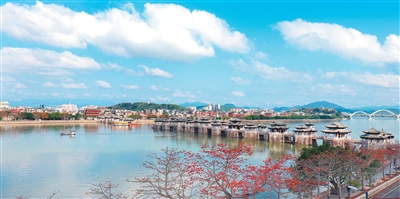
潮起韩江满目新
Ren Min Ri Bao Hai Wai Ban· 2025-11-04 01:08
Core Viewpoint - The article highlights the significant improvements in the ecological health and water quality of the Han River in Guangdong Province, showcasing successful water management practices and community involvement in conservation efforts [6][9][12]. Water Management and Infrastructure - The Han River has undergone a transformation from "partial remediation" to "systematic governance," focusing on both water safety and quality over the past five years [6][9]. - The construction of the Hanjiang Gaozhu Water Conservancy Project, completed in August 2022, serves as a key flood control and water supply facility benefiting approximately 7.5 million people [7]. - The introduction of the Yihanjizhao Water Supply Project in July 2022 has delivered over 76 million cubic meters of water, improving water access for around 600,000 residents [7][8]. Ecological Restoration and Monitoring - The water quality of the Han River has maintained a good rate of over 90% for five consecutive years, with drinking water sources meeting 100% quality standards [9]. - Advanced monitoring systems have been established to ensure real-time tracking of water quality, enhancing the ability to respond to any anomalies [9][10]. Community Engagement and Cultural Integration - The community has actively participated in river conservation efforts, with volunteer groups growing from dozens to over 1,400 members [10]. - Cultural projects related to the Han River have been initiated, promoting historical awareness and environmental stewardship among residents [11][12]. Future Development and Sustainability - The Han River's future development will focus on high standards of systematic governance and sustainable water resource management, ensuring the river's ecological and economic value is preserved for future generations [12].

又一重要水利工程获批!
中国能源报· 2025-11-01 08:39
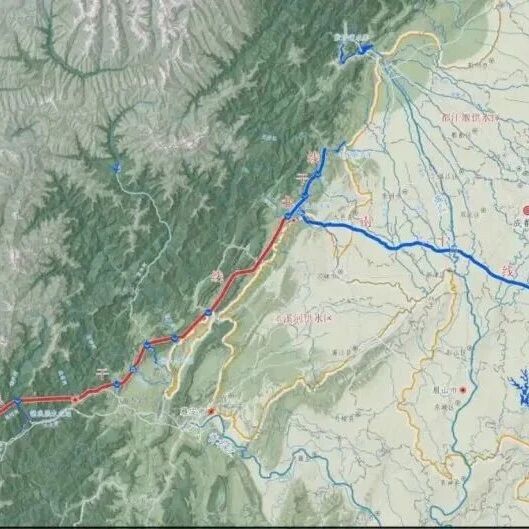
Core Viewpoint - The feasibility study report for the Sichuan Province's Yinda Jimi Project has been officially approved by the National Development and Reform Commission, marking a significant breakthrough in the project's preliminary work [1][6]. Project Overview - The Yinda Jimi Project is the largest and longest water diversion project in Sichuan's history, aimed at diverting water from the Dadu River to the Minjiang River basin, primarily for urban and industrial water supply, with agricultural irrigation as a secondary focus [1][5]. - The project will cover a total length of 260.9 kilometers, consisting of a main line, southern line, and northern line, with an estimated total investment of 57.5 billion yuan [5]. Water Supply Capacity - The average annual water supply capacity is projected to be 1.389 billion cubic meters by 2040 and 1.523 billion cubic meters by 2050 [3][5]. - The project will directly and indirectly supply water to eight cities and 43 counties, including Chengdu, Deyang, and Mianyang, benefiting a population of approximately 3.413 million [5]. Technical Challenges - The project faces 48 technical challenges, including the construction of deep tunnels, with the deepest point reaching 2,040 meters, making it the second-deepest known water conservancy project in China [5]. - The project will also include three energy recovery power stations along the route, with a total installed capacity of 388,000 kilowatts [5]. Future Steps - The Sichuan Provincial Water Resources Department plans to optimize construction plans, enhance geological surveys, and implement ecological protection measures while actively attracting private capital for the project's construction [6].
引大济岷工程可研报告获国家发展改革委批复
Si Chuan Ri Bao· 2025-11-01 01:24
Core Insights - The Sichuan Province's "Yin Da Ji Min" project has received approval from the National Development and Reform Commission, marking it as the largest and longest water diversion project in the province's history [1][2] - The project aims to supply urban, industrial, and agricultural water, significantly impacting water resource allocation and security in the Chengdu-Chongqing economic circle [1][2] Project Overview - The total length of the water diversion route is 260.9 kilometers, consisting of a main line, southern line, and northern line [2] - The main line is 133.3 kilometers long with a designed flow rate of 80 cubic meters per second, while the southern and northern lines are 102.5 kilometers and 25.1 kilometers long, with flow rates of 48 and 37 cubic meters per second, respectively [2] - The project includes three energy recovery stations with a total installed capacity of 388,000 kilowatts and is estimated to take 96 months to complete with a total investment of 57.51883 billion yuan [2] Impact and Benefits - Upon completion, the project will add 1.79 million acres of irrigated land, improve 5.91 million acres, and provide water for 34.13 million people [2] - The Chengdu Plain will benefit from a dual water source system, enhancing water resource management and supporting high-quality development in the Chengdu-Chongqing economic circle [2]
除了“解渴”,南水北调还带来了什么?
Ren Min Wang· 2025-10-26 03:07
Core Insights - The South-to-North Water Diversion Project has significantly improved water supply and quality in northern regions, transforming areas like Liangshan Port into vital logistics hubs [1][2][7] - The project has led to a comprehensive improvement in regional water resource management, enhancing agricultural productivity and urban water supply reliability [2][9] Group 1: Project Overview - The South-to-North Water Diversion Project was initiated in the 1950s and officially approved in 2002, consisting of three main routes to connect major river basins [2] - The Eastern Route specifically addresses water shortages in cities along the Tianjin-Pukou Railway and the Jiaodong Peninsula, improving water supply reliability from below 80% to over 97% [2] Group 2: Coordination and Management - A precise coordination mechanism has been established for efficient water resource management across regions, involving multiple agencies for unified water volume scheduling [3][4] - Monthly meetings and dynamic planning ensure effective water distribution and timely response to any issues that arise [4] Group 3: Environmental Improvements - Significant pollution control measures have been implemented in Jiangsu and Shandong provinces, resulting in a dramatic increase in water quality compliance from 3% to 100% [6] - The South Four Lake, previously known for poor water quality, has seen its standards improve to Class III surface water, showcasing a successful environmental restoration [6] Group 4: Socioeconomic Impact - The project has enhanced the quality of life for millions, transitioning from merely providing water to ensuring safe and clean drinking water [7][8] - Economic benefits are evident, with agricultural practices improving and new income sources emerging for local communities, such as increased revenue from oil sunflower cultivation [9]
“十四五”我国水利建设实现跨越式发展
Yang Shi Wang· 2025-10-22 12:43
Core Insights - During the "14th Five-Year Plan" period, China has achieved significant advancements in water conservancy, establishing the world's largest and most comprehensive water infrastructure system that benefits the most people [1] Group 1: Water Resource Management - As of September 2025, all target tasks for the revival of 88 major rivers have been completed, with 79 rivers fully connected and 9 lakes maintaining effective ecological water levels [3] - The Haihe River Basin has restored flow to 30 previously stagnant rivers and revived 102 dry springs, fundamentally reversing the situation of "dry rivers and polluted waters" [3] Group 2: Investment and Infrastructure Development - Water conservancy construction has seen a leap in investment, surpassing 1 trillion yuan for the first time, with historical records broken for three consecutive years [5] - The water supply capacity of water conservancy projects has reached 900 billion cubic meters, accelerating the formation of a water resource allocation pattern of "south-north transfer and east-west mutual assistance" [5] Group 3: Reservoir and Irrigation Expansion - A total of 95,000 reservoirs have been built, with a total capacity exceeding 1 trillion cubic meters, making China the leader in reservoir types, numbers, and high dams globally [7] - The irrigated area of arable land has increased to 109 million acres, with the effective utilization coefficient of irrigation water rising from 0.565 to 0.58, supporting a projected grain output of over 1.4 trillion jin in 2024 [9] Group 4: Rural Water Supply and Economic Impact - China has established the world's largest rural centralized water supply system, with the national rural tap water coverage expected to reach 96% by the end of the "14th Five-Year Plan" [9] - Despite an average annual economic growth rate of 5.5%, the total water consumption in the country has achieved zero growth, effectively supporting high-quality economic and social development [11]

连云港推广“四水四定”亮点经验 谱写水资源“约束”变“保障”新篇章
Xin Hua Ri Bao· 2025-10-16 21:04
Group 1 - The core viewpoint is that Lianyungang City is transforming water resource constraints into water resource guarantees through the implementation of effective water management practices in Donghai County and Ganyu District [1][2] - Donghai County has implemented a tailwater recycling project that has saved approximately 5 million cubic meters of fresh water while addressing severe drought conditions [1] - The city has developed a detailed implementation plan for agricultural tailwater recycling, covering over 200,000 acres, significantly reducing total water usage and improving water efficiency [2] Group 2 - Lianyungang Port Group has signed an agreement with China Everbright Water (Lianyungang) Co., Ltd. to transport treated recycled water for various uses, including industrial applications [2] - The construction of a high-quality recycled water treatment project in Xuwei New Area is underway, which will supply desalinated water to the Tianwan Nuclear Power Plant upon completion [2] - The city is focusing on enhancing water resource allocation and promoting structural adjustments in agriculture to improve drought resistance and water supply capabilities in the western Gangling area [3]

大藤峡水利枢纽今年首次达到61米正常蓄水位
Yang Shi Xin Wen· 2025-10-15 07:53
Core Insights - The Datiangxia Water Conservancy Project has reached a normal water level of 61 meters for the first time in 2025, enhancing its role as a key control project in the watershed and alleviating flood pressure downstream in the Xijiang River [1][6] - The project has effectively stored over 500 million cubic meters of floodwater during recent heavy rainfall events caused by Typhoons "Bolaven" and "Mekdil," ensuring flood safety in the region [3][6] Group 1 - The Datiangxia reservoir's water resource regulation capacity has reached 1.5 billion cubic meters, indicating the comprehensive benefits of flood control, navigation, power generation, and irrigation [6] - The project utilizes a digital twin system for precise flood management, which has contributed to effective floodwater storage and downstream flood mitigation [3][6] Group 2 - The reservoir's current water level supports water resource allocation for the Guangdong-Hong Kong-Macao Greater Bay Area, ensuring sufficient water supply during dry seasons [1][6] - The project balances multiple water usage demands, including flood control, navigation, ecology, and power generation, while gradually increasing water levels post-flood [3][6]

广西大藤峡水利枢纽2025年首次达到61米正常蓄水位
Zhong Guo Xin Wen Wang· 2025-10-15 07:09
Core Points - The Guangxi Datengxia Water Conservancy Hub has reached a normal water level of 61 meters for the first time in 2025, playing a crucial role in flood control and water resource management for the Guangdong-Hong Kong-Macao Greater Bay Area [1][3][4] Group 1 - The water level was achieved on October 14, 2023, following significant rainfall caused by Typhoons No. 20 and No. 21, which led to severe flood conditions in the region [1][3] - The company has implemented enhanced safety monitoring and inspections of waterworks and river channels, utilizing a digital twin system for precise flood management, successfully retaining over 500 million cubic meters of floodwater [3][4] - With the reservoir at 61 meters, the adjustable water resource capacity has reached 1.5 billion cubic meters, ensuring comprehensive benefits for flood control, navigation, power generation, and irrigation in the Pearl River Basin [4]