
汽车轻量化

Search documents
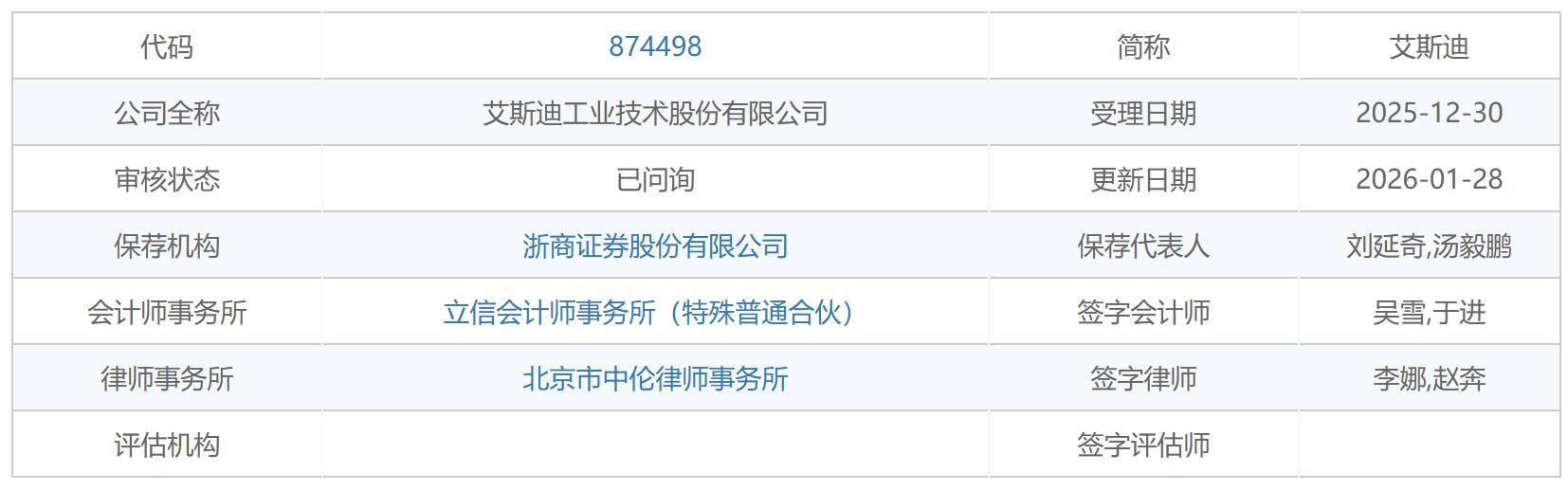
艾斯迪IPO收问询函:实控人向股东借款未清,曾存无真实交易的票据转让
Sou Hu Cai Jing· 2026-01-29 02:15
Core Viewpoint - The regulatory authority has raised concerns regarding the financial practices and governance of Aisidi Industrial Technology Co., Ltd., including issues related to the actual controller's outstanding loans to shareholders, declining gross margins, and irregular financial internal controls [1][3][10]. Group 1: Company Overview - Aisidi Industrial Technology Co., Ltd. was established in August 2017 and focuses on the research, production, and sales of aluminum alloy components for automotive lightweighting, with products used in both new energy and traditional fuel vehicles [2]. - The company is currently undergoing its first round of review for its IPO, with Zheshang Securities Co., Ltd. as the sponsor and Lixin Certified Public Accountants as the auditing firm [2]. Group 2: Financial Performance - Aisidi's revenue for the years 2022 to 2024 and the first half of 2025 was reported as 532 million, 567 million, 739 million, and 379 million yuan respectively, while net profits were 47.82 million, 43.56 million, 55.40 million, and 30.47 million yuan [7]. - The company's gross margin has shown a downward trend, with rates of 19.82%, 22.16%, 19.18%, and 17.25% during the same periods, indicating a significant decline [9]. Group 3: Shareholder and Control Issues - The actual controller, Ding Zhengdong, holds 41.01% of the voting rights in the company, with concerns raised about his outstanding loans to shareholders totaling 6.2 million yuan and 13 million yuan, respectively [3][5]. - Two shareholders have reduced their holdings below 5%, raising questions about potential regulatory evasion through related parties [6]. Group 4: Internal Control and Compliance - The company has been flagged for irregularities in financial internal controls, including issues with timely information transfer between departments and the existence of non-genuine transactions [10]. - Aisidi's procurement practices show a high concentration, with the top five suppliers accounting for over 72% of total purchases, raising concerns about dependency on specific suppliers [10][11].

创近五年新低 2025年汽车行业销售利润率仅4.1%
Jing Ji Guan Cha Wang· 2026-01-28 07:36
Core Viewpoint - The Chinese automotive industry is facing significant profit declines, with 2025 projected profits at 461 billion yuan, a mere 0.6% increase year-on-year, and a sales profit margin of 4.1%, which is below the average of 5.9% for downstream industrial enterprises [2] Group 1: Profit Trends - The automotive industry's profit margin is expected to drop to 4.1% in 2025, marking a five-year low, following a decline to 4.3% in 2024 [2] - In December 2025, the automotive industry reported profits of 20.7 billion yuan, a year-on-year decrease of 57.4%, with a profit margin of 1.8%, significantly lower than the 4.1% in December 2024 [2] - Excluding the pandemic-affected April 2022, December 2025's profit margin is the lowest in five years [2] Group 2: Industry Performance - The automotive supply chain shows a mixed performance, with upstream parts manufacturers experiencing stable growth, while vehicle manufacturing and downstream dealerships face significant challenges [3] - Among 22 A-share automotive companies, 16 reported profits, but major players like BYD and GAC Group saw substantial profit declines, with GAC Group's profit dropping by 3691.33% [3] - The dealership segment is under severe pressure, with only 28% meeting sales targets and a loss rate climbing to 55% [3] Group 3: Cost Pressures - The automotive industry is experiencing increased cost pressures, with lithium carbonate prices doubling and overall raw material costs rising, impacting profit margins [3][4] - The cost of a typical electric vehicle has increased by 4,000 to 7,000 yuan due to rising prices of lithium, aluminum, and copper, which manufacturers struggle to pass on to consumers [4] - Starting in 2026, a 5% tax on new energy vehicle purchases and changes to subsidy policies will further increase consumer costs, complicating demand and supply dynamics [4][5] Group 4: Future Outlook - The China Automotive Industry Association forecasts total vehicle sales to reach 34.75 million units in 2026, a 1% year-on-year increase, with new energy vehicles projected to grow by 15.2% to 19 million units [5] - Some automotive companies are accelerating collaborations with upstream suppliers to address these challenges, focusing on strategic partnerships and new material development [5]





2025年报业绩预告开箱(二):半导体高歌猛进,化工靠涨价赚翻,天价授权照亮全年业绩
市值风云· 2026-01-27 10:09
Core Viewpoint - The report highlights the significant growth driven by technology in certain sectors, while also noting the substantial losses due to cyclical downturns in others [1] Performance Growth Highlights - **Zhongwei Company (688012)**: Expected net profit between 208 million to 218 million yuan, a year-on-year increase of 28.74% to 34.93%, driven by increased recognition of plasma etching equipment and a surge in market demand [5] - **Lianchuang Optoelectronics (600363)**: Expected net profit between 43.5 million to 53.2 million yuan, a year-on-year increase of 80.36% to 120.57%, attributed to significant growth in laser business and improved profitability in traditional sectors [6] - **Ruixin Microelectronics (603893)**: Expected net profit between 102.3 million to 110.3 million yuan, a year-on-year increase of 71.97% to 85.42%, driven by rapid growth in the AIoT market and recognition of new AI technology [7] - **Sangfor Health (688336)**: Expected net profit around 290 million yuan, a year-on-year increase of approximately 311.35%, due to a significant collaboration with Pfizer and advancements in clinical research [8] - **Pulite (002324)**: Expected net profit growth of 155.76% to 194.73%, driven by the demand for high polymer materials in the automotive lightweight trend [9] - **Tonghua Dongbao (600867)**: Expected net profit around 124.21 million yuan, turning from loss to profit, driven by market share gains in insulin products [10] - **Suotong Development (603612)**: Expected net profit between 73 million to 85 million yuan, a year-on-year increase of 167.98% to 212.03%, due to rising prices and demand in the prebaked anode industry [11] Major Performance Declines - **China Shipbuilding Technology (600072)**: Expected net loss between -260 million to -340 million yuan, a year-on-year decline of over 24 times, due to cyclical downturns in shipbuilding and high material costs [12] - **Silver Nonferrous Metals (601212)**: Expected net loss between -45 million to -67.5 million yuan, transitioning from profit to loss due to legal disputes affecting financial performance [13] - **China Metallurgical Group (601618)**: Expected net profit between 130 million to 160 million yuan, a year-on-year decline of 76.28% to 80.73%, impacted by the downturn in the construction industry [14] - **Jindi Group (600383)**: Expected net loss between -1.11 billion to -1.35 billion yuan, with increased losses due to declining sales and inventory impairments [15] - **Jianfa Co. (600153)**: Expected net loss between -1 billion to -520 million yuan, transitioning from profit to loss due to increased impairments in real estate [16] Industry Trend Analysis - **Technology and Innovation-Driven Sectors**: Companies in semiconductor equipment, laser military applications, and innovative pharmaceuticals are experiencing rapid growth due to high demand in AIoT, national defense, and biomedicine [23] - **Traditional Cyclical Industries**: Sectors like coal and engineering machinery are facing significant adjustments due to demand shortages and price declines, leading to widespread performance pressures [24] - **Pharmaceutical Industry Disparities**: Innovative drugs are seeing explosive growth through external licensing, while traditional formulations and raw materials are significantly impacted by procurement policies [24] - **External Environment Uncertainties**: Factors such as international trade tensions and regulatory changes are significantly affecting corporate performance, necessitating enhanced risk management [24] - **Asset Quality Risks**: Many companies are reporting substantial asset impairment provisions, indicating potential inefficiencies in previous investments [24]




山西镁产业调研报告
Ge Lin Qi Huo· 2026-01-27 06:54
Report Summary 1. Investment Rating No investment rating information is provided in the report. 2. Core Viewpoints - China is a major producer of primary magnesium, with its production capacity accounting for about 85% of the global total. Shanxi Province holds a significant advantage in the magnesium industry due to its abundant resource reserves, complete industrial chain, and strong technological innovation capabilities [3]. - The magnesium - to - aluminum price ratio has dropped to 0.7 times, highlighting the cost - effectiveness of magnesium. However, the downstream application of magnesium has not yet been fully launched. The demand for magnesium is expected to gradually increase with the growth of the market for lightweight automobiles, two - wheeled electric vehicles, and new energy vehicles [4]. - Shanxi magnesium enterprises face intensified industry competition, especially from the acceleration of central and state - owned enterprises' entry into the market [4]. - Most Shanxi magnesium enterprises have an open attitude towards futures tools and will gradually strengthen their futures - related team building and the application of these tools after the listing of magnesium futures [4]. 3. Summary by Company Company A - **Enterprise Situation**: Privatized in 2001 and reorganized in 2015. It has an annual production capacity of 65,000 tons of primary magnesium, 30,000 tons of magnesium alloy, and 50,000 tons of deep - processed magnesium products, with 10 production lines for deep - processed products. It has its own mine with a reserve of 2 - 3 million tons per year. Its annual revenue from the magnesium industry is less than 1.5 billion yuan, and the annual R & D investment is about 40 million yuan [5]. - **Business Model**: The domestic mainstream magnesium smelting process is the Pidgeon process. Different from the production in Yulin, Shaanxi, which uses coke oven gas, this enterprise has been focusing on deep - processing since 2020 and has a large environmental protection investment. The pricing model varies, with different payment terms for different customers. Overseas sales account for 10% of the total [6]. - **Production Profit**: In 2025, the sales revenue of magnesium alloy was less than 1.5 billion yuan, and that of the deep - processing sector was more than 200 million yuan. The gross profit rate of deep - processed products varies, with military products at 40 - 50%, general products at 15 - 20%, and magnesium alloy products at 20% [7]. - **Future Plan**: Focus on increasing the deep - processing capacity and market development, especially for high - end products such as magnesium alloy automobile wheels. Continuously invest in the green transformation of smelting technology. Be cautious about entering the automotive industry [8]. - **Futures Participation**: Willing to participate in the futures market after the listing of magnesium futures [9]. Company B - **Enterprise Situation**: Mainly engaged in primary magnesium, extrusion, and control processes. It has an annual production capacity of 50,000 tons of primary magnesium (40,000 tons at full capacity), 30,000 - 50,000 tons of magnesium alloy, and 50,000 tons of precision die - castings. It has a complete industrial chain from dolomite mining to deep - processing of magnesium alloy. Its subsidiary new materials company plans to go public in the future [10]. - **Cost and Price**: The break - even point of the comprehensive cost of magnesium ingots in the industry is about 17,500 yuan/ton, and the current magnesium price is around 16,500 yuan/ton. The magnesium - to - aluminum ratio has dropped to 0.7, but the downstream application has not increased [11]. - **Downstream Application and Customers**: The utilization rate of the production capacity for two - wheeled electric vehicles is 50 - 60% due to the new national standard. The development of magnesium alloy in the automotive industry is slow. There is cooperation with Huawei and SAIC, and there is demand in the aerospace and satellite Internet fields [12]. - **Future Plan**: Plan to expand the primary magnesium production capacity by 50,000 tons after obtaining energy consumption and carbon emission indicators. Aim to increase the local magnesium production capacity from 42% to 50 - 60% of the national total and build a magnesium industrial cluster [13]. - **Futures Participation**: Will train professional futures talents to hedge price risks if magnesium futures are listed [14]. Company C - **Enterprise Situation**: Its market share of magnesium alloy ranks among the top three globally. It has a production capacity of 30,000 tons of primary magnesium, 60,000 tons of magnesium alloy (actual output of 40,000 tons), 6,000 tons of magnesium anodes, and 15,000 tons of magnesium powder. It has a large investment in high - pressure magnesium die - casting [15]. - **Cost and Raw Material Procurement**: It has a short - to - medium - term irreversible disadvantage in energy and environmental protection operation costs compared with northern Shaanxi. It locks in part of the silicon - iron procurement volume at the long - term average price and replenishes the insufficient supply of primary magnesium through waste recycling [16]. - **Downstream Application and Customers**: Automobile parts account for 70 - 80% of the demand for magnesium materials. It is also involved in two - wheeled vehicles, stage supports, household items, 3C products, and medical parts. The domestic demand for magnesium alloy is expected to reach 2 - 3 million tons in 3 - 5 years [17]. - **Future Plan**: Interested in accessing the capital market but has no clear listing plan [18]. - **Futures Participation**: Will consider using futures for hedging if the problems of small industry scale and product preservation are solved [19]. Company D - **Enterprise Situation**: Listed in 2020, it covers multiple industries such as smart home, new energy vehicles, industrial equipment, and power components. Its subsidiary has an annual production capacity of 30,000 tons of various parts and an annual sales revenue of 1.2 billion yuan, and it has a 5G + industrial Internet platform [20]. - **Downstream Application and Customers**: Its customers are mainly in the new energy vehicle, industrial robot, and aero - engine fields. Its aluminum alloy products are mainly for military enterprises. The difficulty of obtaining automobile orders has decreased compared to three years ago [21]. - **Future Plan**: Plan to build a global - scale industrial base for smart home, new energy vehicle, and industrial equipment parts, with an investment of 150 million yuan in 2026 and 300 million yuan in 2027. Also, invest more in military products and is involved in the commercial aerospace field [22]. - **Futures Participation**: Has previously contacted the futures market in pig iron smelting but did not participate due to its small scale [23].
境外投资墨西哥开展汽车轻量化铝合金材料等项目可行性研究报告
Sou Hu Cai Jing· 2026-01-27 05:38
Core Viewpoint - The company has been recognized as a leading player in the aluminum processing industry in China, consistently ranking in various national and regional lists, while also facing challenges due to external market pressures and policy changes [1][4][5]. Group 1: Company Achievements - The company has been included in the "Top 500 Chinese Enterprises" for eight consecutive years, ranking 330th in 2024 [1]. - It has been selected for the "Fortune China 500" list for three consecutive years, ranking 230th in 2025 [1]. - The company has been recognized as a top performer in the Shandong private enterprise sector, ranking 15th in 2025, and is also listed among the top 500 manufacturing enterprises in China [1]. Group 2: Industry Analysis - The domestic aluminum market is experiencing a slowdown in demand and intensified competition, with a reported production of 32.768 million tons in the first half of 2025, a year-on-year decrease of 1.46% [4]. - The U.S. has imposed differentiated tariffs ranging from 10% to 50% on major trading partners starting August 1, 2025, affecting key sectors including new energy and automotive [4]. - The cancellation of export tax rebates for aluminum and copper products effective December 1, 2024, is expected to increase export costs and suppress export enthusiasm, leading to a 10.1% year-on-year decline in aluminum exports to 2.7004 million tons in the first half of 2025 [5]. Group 3: Foreign Investment Progress - The company has received necessary approvals and certificates from various regulatory bodies in Beijing for its overseas investment projects in Mexico [6][8]. - The investment will be executed through wholly-owned subsidiaries, Drayton Management Limited and Gloucester Management Limited, which will establish two companies in Mexico focused on automotive lightweight aluminum alloy materials [8]. Group 4: Investment Objectives and Impact - The investment aims to enhance the company's international competitiveness and solidify its market position in the automotive lightweight supply chain [9]. - The project is expected to expand the company's overseas market presence and deepen strategic partnerships with global clients, thereby increasing market share in the automotive lightweight aluminum sector [9][11]. - This investment aligns with the company's long-term development strategy and is anticipated to have a positive impact on future operations by leveraging Mexico's automotive industry advantages [11].
金固股份:机器人核心零部件对材料的轻量化、强度及耐久性具有较高要求
Zheng Quan Ri Bao Wang· 2026-01-26 11:45
Core Viewpoint - Jingu Co., Ltd. (002488) is leveraging its unique Avatar niobium microalloy materials and expertise in automotive lightweighting to meet the high demands of the robotics industry for lightweight, strong, and durable core components [1] Group 1 - The company has developed proprietary materials that align with the technical requirements of key components in the robotics sector [1] - Jingu Co., Ltd. aims to rapidly integrate new material solutions, such as Avatar niobium microalloy, into the robotics supply chain [1] - The company's accumulated research and development capabilities, forming processes, and engineering experience in automotive lightweighting are expected to drive new business growth [1]

模塑科技
2026-01-26 02:50
Summary of Conference Call on Magic Technology Company Overview - **Company Name**: Magic Technology - **Industry**: Automotive Parts, specifically focusing on plastic components and exterior parts like bumpers - **Position**: Leading private enterprise in the automotive bumper sector in China with over 30 years of experience in the industry [1][4] Key Insights and Arguments - **Market Position**: Magic Technology is positioned as a leading player in the automotive exterior parts market, benefiting from the domestic automotive supply chain's localization and the growth of new energy vehicles (NEVs) [1][2] - **Market Growth**: The automotive exterior parts market is expected to grow at a rate faster than the overall automotive market due to increasing demands for lightweight materials and smart automotive technologies [1][8] - **Competitive Landscape**: The competitive landscape is stabilizing, with leading companies like Magic Technology expected to gain market share as the industry matures [2][9] - **Client Base**: The company serves a diverse client base, including traditional automotive giants like BMW and Mercedes, as well as NEV manufacturers like Tesla [5][6] - **Revenue Trends**: Despite challenges from the pandemic, the company has maintained a solid revenue trend, with expectations for steady growth in profits, particularly from overseas markets [6][10] Additional Important Points - **Innovation in Robotics**: Magic Technology is exploring new growth opportunities in the robotics sector, leveraging its expertise in lightweight materials and manufacturing processes that are applicable to both automotive and robotic components [2][10][12] - **Production Capabilities**: The company has established a robust production network, including factories in various regions and overseas, which enhances its ability to meet client demands [4][9] - **Financial Projections**: The company is projected to achieve a profit of approximately 600 million by 2026, with significant potential for stock price appreciation based on current market valuations [13] Conclusion - Magic Technology is well-positioned for future growth in both the automotive and robotics sectors, with a strong focus on innovation and market expansion. The company’s strategic initiatives and solid client relationships are expected to drive sustained profitability and market share growth in the coming years [1][13]

立中集团再获13.7亿元铝合金车轮项目定点
Zheng Quan Shi Bao Wang· 2026-01-22 10:10
Core Viewpoint - Lichung Group has secured multiple project designations exceeding 2 billion yuan, indicating strong market positioning and growth potential in the aluminum alloy wheel sector [1][2]. Group 1: Project Designations - Lichung Group's subsidiaries received project designations from a well-known international automotive manufacturer for aluminum alloy wheels, with an expected sales amount of approximately 1.37 billion yuan over an 8-year lifecycle starting mid-2027 [1]. - Another project designation was received for a similar aluminum alloy wheel project, with an expected sales amount of about 820 million yuan, set to begin production in July 2027 [2]. Group 2: Business Overview - Lichung Group is a leading domestic producer of aluminum alloy wheels, focusing on three main business areas: functional intermediate alloy new materials, recycled casting aluminum alloy materials, and aluminum alloy wheel products [2]. - The company has a comprehensive production capability that includes research and manufacturing of aluminum alloy materials, mold development, tooling equipment, and wheel product design [2]. Group 3: Financial Performance and Projections - The company anticipates a net profit of 830 million to 870 million yuan for the fiscal year 2025, representing a year-on-year growth of 17.38% to 23.04% [2]. - The growth in profit is attributed to a focus on core business areas, global supply chain expansion, and an increase in high-value-added products [3]. Group 4: Production and Market Strategy - The aluminum alloy wheel segment is expected to produce 23.4 million units, while the recycled casting aluminum alloy segment is projected to reach 1.26 million tons, contributing to an estimated total sales revenue of 32 billion yuan [3]. - The company is enhancing its global supply capabilities with operational bases in Thailand and Mexico, which are expected to boost sales to high-end customers [3].

东山精密跌2.03%,成交额7.52亿元,主力资金净流出8583.61万元
Xin Lang Cai Jing· 2026-01-20 02:47
Core Viewpoint - Dongshan Precision's stock price has experienced a decline of 9.95% year-to-date, with a recent drop of 2.03% on January 20, 2025, indicating potential market concerns regarding its performance and investor sentiment [1]. Financial Performance - For the period from January to September 2025, Dongshan Precision achieved a revenue of 27.071 billion yuan, reflecting a year-on-year growth of 2.28%. The net profit attributable to shareholders was 1.223 billion yuan, showing a year-on-year increase of 14.61% [2]. - Cumulatively, since its A-share listing, the company has distributed a total of 1.544 billion yuan in dividends, with 731 million yuan distributed over the past three years [3]. Shareholder and Market Activity - As of January 9, 2025, the number of shareholders for Dongshan Precision reached 101,400, an increase of 24.12% from the previous period. The average number of circulating shares per person decreased by 19.43% to 13,675 shares [2]. - The major shareholders include Hong Kong Central Clearing Limited, which holds 68.7123 million shares, an increase of 5.2492 million shares from the previous period. New institutional shareholders include Ruiyuan Growth Value Mixed A and Xingquan Helun Mixed A [3]. Stock Performance and Trading Volume - On January 20, 2025, Dongshan Precision's stock traded at 76.23 yuan per share, with a total trading volume of 7.52 billion yuan and a turnover rate of 0.71%. The total market capitalization stood at 139.623 billion yuan [1]. - The stock has shown mixed performance in recent trading periods, with a slight decline of 0.17% over the last five trading days, a gain of 0.81% over the last 20 days, and a notable increase of 10.24% over the last 60 days [1]. Business Overview - Dongshan Precision, established on October 28, 1998, and listed on April 9, 2010, is located in Suzhou, Jiangsu Province. The company specializes in the manufacturing and service of precision sheet metal parts and precision castings, as well as flexible circuit board design, production, and sales [1]. - The main revenue sources for the company include electronic circuit products (65.23%), touch panels and LCD display modules (17.98%), precision components (13.93%), LED display devices (1.69%), and other products (1.17%) [1]. - The company operates within the electronics industry, specifically in the printed circuit board sector, and is involved in various concept sectors such as optical communication, PCB concepts, overseas expansion, 5G, and automotive lightweighting [1].

明泰铝业:2025年净利同比预增12%~14%
Mei Ri Jing Ji Xin Wen· 2026-01-19 08:13
Core Viewpoint - Ming Tai Aluminum (601677.SH) expects a net profit attributable to shareholders of the parent company to be between 1.95 billion to 2 billion yuan in 2025, representing a year-on-year growth of 12% to 14% [1] Group 1: Financial Performance - The projected net profit for 2025 is between 1.95 billion to 2 billion yuan, indicating a growth of 12% to 14% compared to the previous year [1] Group 2: Product Development and Market Strategy - The company has completed SGS carbon footprint assessments for various products, highlighting the low-carbon advantages of its recycled aluminum products, which enhance market competitiveness [1] - The company is focusing on high-end sectors such as new energy batteries, automotive lightweighting, robotics, and low-altitude flight aluminum applications [1] - New products, including all-aluminum pillar robot bodies, drone shielding covers, composite aluminum materials for heat sinks, and aluminum-plastic film foils for batteries, are being launched to accelerate the transition to high-end manufacturing [1] Group 3: Growth Strategy - The company aims to drive high-end products to become a second growth curve, with continuous expansion of profit margins per ton [1]
