
Physical AI

Search documents
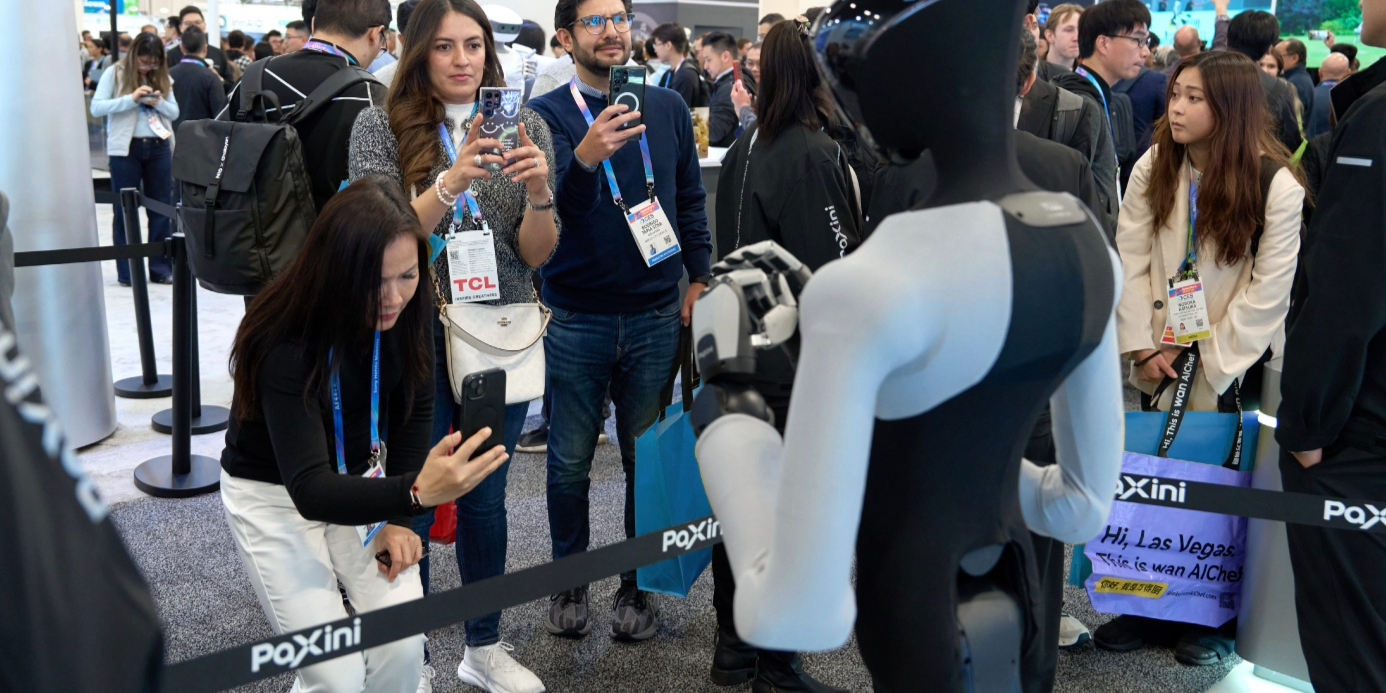
CES 2026观察:“物理AI时刻”要靠中国制造落地
Jing Ji Guan Cha Wang· 2026-01-10 11:01
Group 1: Physical AI and Computing Power - The core theme of CES 2026 is the emergence of "Physical AI," where AI technology is transitioning from generating text or video to interacting with physical hardware [4][10] - AMD's chairwoman, Lisa Su, highlighted the increasing demand for computing power, predicting a 100-fold increase in global computing capacity over the next five years [3][4] - The presence of over 200 Chinese companies at CES indicates a strong support for the "Physical AI moment," showcasing various AI applications in physical products [4][23] Group 2: Robotics Innovations - The robotics sector at CES has shifted focus from mere physical movement to specific job functions and operational scenarios, with Chinese companies leading this evolution [5][9] - Companies like Pasoni and Fourier Intelligence showcased advanced robots capable of performing intricate tasks, such as ice cream making and automotive part sorting, demonstrating significant advancements in robotic dexterity [5][6] - The global sales of robots are projected to reach approximately $45 billion by 2026, with expectations to exceed $60 billion by 2030, driven by rising labor costs and efficiency in Chinese manufacturing [8][9] Group 3: Smart Glasses and AR Technology - Chinese companies are aggressively entering the AR/AI glasses market, aiming to redefine the concept of a "second screen" beyond smartphones [11][12] - Innovations include the launch of the world's first dual-lens AR glasses with eSIM functionality by Thunderbird Innovation, allowing users to make calls and connect to the internet without a smartphone [12][13] - The global market for smart glasses is expected to see significant growth, with sales projected to reach around $10.7 billion by 2026, reflecting an over 80% year-on-year increase [18][23] Group 4: Display and Chip Technology - Companies like Tianma Microelectronics and TCL Huaxing are pushing the boundaries of display technology, with innovations such as large-scale OLED screens and advanced automotive displays [19][20] - Lenovo and NVIDIA announced a partnership to enhance AI infrastructure, aiming to quadruple their business collaboration over the next few years [22] - The trend in AI chip development is moving towards high computing power, low energy consumption, and integration, with significant growth expected in AI terminal sales by 2028 [22][23]





VCI Global’s World’s First NVIDIA Blackwell-Powered Enterprise AI GPU Lounge Becomes Operational, Introducing a New Asset-Light Model for Enterprise AI Infrastructure
Globenewswire· 2026-01-09 20:30
Core Insights - VCI Global Limited, through its subsidiary V Gallant, has launched its first Enterprise AI GPU Lounge in Kuala Lumpur, Malaysia, which is now operational and ready to handle enterprise workloads by late January 2026 [1][2] - The AI GPU Lounge is a co-working data center that provides on-demand access to NVIDIA Blackwell-based compute infrastructure, allowing enterprises to avoid upfront capital investments [2][3] - The facility aims to convert AI infrastructure from a fixed capital expenditure model to a flexible operating expense model, enabling enterprises to scale resources according to workload demand [3] Infrastructure and Technology Highlights - The AI GPU Lounge utilizes NVIDIA Blackwell GPUs, which offer significant performance improvements for large language model inference and advanced AI workloads [3] - Operations are managed through V Gallant's proprietary Intelli-X™ platform, designed to meet data sovereignty, privacy, and compliance requirements for regulated industries [3] - The facility also serves as an IDEX Hub, integrating human expertise with machine intelligence, and is part of VCI Global's strategy to expand AI infrastructure hubs [3] Market Opportunity and Demand Dynamics - The global enterprise AI infrastructure market is projected to grow from approximately US$87.6 billion in 2025 to nearly US$197.6 billion by 2030, with a compound annual growth rate (CAGR) of about 17.7% [4] - This growth is driven by increased demand for high-performance compute and GPU-accelerated systems from enterprises and hyperscalers [4][5] - The AI GPU Lounge represents a strategic response to the accelerating demand for scalable and flexible AI compute environments [5] Strategic Foundation for Physical AI - The operational launch of the AI GPU Lounge is a key milestone in VCI Global's broader Physical AI strategy, supporting robotics, autonomous systems, and drone technologies [5][6] - By combining high-performance compute infrastructure with real-world applications, the company aims to extend AI deployment beyond cloud environments into industrial automation [6][7]


Jensen Huang Says Humanoid Robots are Coming This Year. Which Physical AI Stocks are Best-Positioned?
247Wallst· 2026-01-09 13:53
Core Insights - The robotics revolution and "physical AI" are expected to sustain the AI trade through 2026 and potentially into 2027 [1] Industry Summary - The ongoing advancements in robotics and physical AI technologies are projected to drive continued investment and interest in the AI sector [1] - Companies involved in robotics and physical AI are likely to benefit from this trend, as demand for automation and intelligent systems increases [1]
AMC Robotics Showcases Kyro™ at CES 2026, Embodying the "ChatGPT Moment for Physical AI"
Globenewswire· 2026-01-09 12:30
Core Insights - AMC Robotics Corporation showcased its AI-driven robotics solutions at CES 2026, highlighting its proprietary quadruped robotic platform, Kyro™ [1][2] Industry Context - The demonstration aligns with a significant shift in the industry, as NVIDIA's CEO emphasized a new era of "Physical AI," where machines can understand, reason, and act in real-world scenarios [2] - The industry is moving towards "AI immigrants," robotic systems that can address global labor shortages by performing essential tasks in various sectors [3] Company Strategy - AMC Robotics aims to be a leading provider of integrated, AI-enabled robotics platforms, with Kyro™ designed for diverse applications such as safety inspection, security, and data collection [3][4] - The company is focused on building a global footprint that encompasses product development, manufacturing, and operational support to meet the growing demand for intelligent robotic solutions [4] Product Features - Kyro™ utilizes advanced mobility, autonomous navigation, and AI-enabled perception to tackle complex operational challenges in industrial, commercial, and public-sector environments [2][3] - The platform is modular, allowing it to adapt to various use cases, reinforcing the company's ambition to anchor intelligence in physical infrastructure [4]


10 Best Stocks to Buy for High Returns in 2026
Insider Monkey· 2026-01-09 11:36
Core Viewpoint - The article discusses the outlook for the stock market in 2026, highlighting the expected performance of the S&P 500 and identifying the best stocks to buy for high returns in that year [2][4]. Market Outlook - Brian Belski, CEO of Humilis Investment Strategies, predicts the S&P 500 will end 2026 between 7,300 and 7,500, indicating a transition towards an earnings-driven market [2]. - Belski anticipates that 2026 will be more volatile than 2025, as the third year of a bull market typically experiences increased volatility [3]. Sector Analysis - Belski has neutralized his exposure to the technology sector due to fundamental issues and is overweight on communication services, financials, and utilities, which are expected to show earnings growth driven by secular trends [3]. Stock Selection Methodology - The list of the 10 best stocks for high returns in 2026 was compiled using a stock screener, focusing on stocks with over 25% forward EPS growth and more than 30% analyst upside potential [6]. - Data was sourced from Finviz, Yahoo Finance, CNN, and Insider Monkey's hedge fund database, with all information recorded on January 8, 2026 [6]. Hedge Fund Interest - The article emphasizes the importance of stocks that hedge funds are investing in, as imitating top hedge fund picks has historically led to market outperformance [7]. Company Highlights - **Arm Holdings plc (NASDAQ:ARM)** - Expected EPS growth of 62.37% and upside potential of 55.80%, with 41 hedge fund holders [8]. - Recently reorganized to create a Physical AI unit to expand in the robotics industry, indicating significant growth potential [9][10]. - Management believes advancements in robotics could enhance labor efficiency and contribute to GDP growth [11]. - Analysts have upgraded the stock, with a price target of $170 from Oddo BHF and $145 from Bank of America Securities [12]. - **Marvell Technology, Inc. (NASDAQ:MRVL)** - Expected EPS growth of 26.67% and upside potential of 36.01%, with 77 hedge fund holders [13]. - Recently announced the acquisition of XConn Technologies for approximately $540 million, which is expected to enhance its data center connectivity portfolio [14][15]. - The acquisition will strengthen Marvell's position in accelerated infrastructure, particularly for AI systems requiring efficient connections [15][16].



Qualcomm Tech Now Powers Nearly Every Laptop Price Point: Analyst
Benzinga· 2026-01-08 19:56
Core Viewpoint - Qualcomm is showcasing a strong and competitive PC product portfolio at CES 2026, which is positively impacting its stock performance [1] Group 1: Product Launches and Partnerships - Qualcomm highlighted multiple PC launches in collaboration with brand partners such as Lenovo, Asus, and HP, utilizing X2 Elite SIP chipsets [2] - The current product lineup is said to deliver substantial performance leadership, covering over 95% of PC price points as the rollout progresses [2] Group 2: Performance and AI Capabilities - Qualcomm demonstrated performance benchmarking of its Snapdragon X2 Elite and X Elite chips, showing superior performance compared to key competitors, especially in low-power and unplugged scenarios [3] - The role of the Neural Processing Unit (NPU) was emphasized, which offloads workloads from the CPU, enhancing application performance and user experience [4] Group 3: Enterprise Applications and Long-Term Opportunities - Qualcomm is making progress in enterprise applications, including a fleet management solution for remote device management, supported by an embedded modem [5] - Devices incorporating this solution are expected to launch in the second half of the year, creating additional content opportunities for Qualcomm [6] Group 4: Data Center Strategy and Customer Engagement - Qualcomm's data center strategy focuses on inference workloads, with the company viewing Nvidia's acquisition of Groq as validation of distinct market requirements [6] - There is a significant increase in customer engagement around physical AI opportunities, with activity rising across various robotics applications [7] Stock Performance - Qualcomm shares were reported to be up 1.43% at $182.77 at the time of publication [7]

Tuya Developer Day at CES 2026 Brings Together Global Industry Leaders to Discuss the Future of Physical AI
Prnewswire· 2026-01-08 12:49
Core Insights - Tuya Smart hosted "Tuya Developer Day" at CES 2026, focusing on the theme "Accelerating the Physical AI Era Together," gathering leaders from top tech companies to discuss AI advancements [1] Leadership Dialogue - Alex Yang, COO and CFO of Tuya, discussed the transition of AI from concepts to large-scale applications with representatives from Google Cloud and AWS, emphasizing insights on AI-native devices [2] - Praveen Rao from Google Cloud highlighted the evolution of multimodal capabilities in AI systems, indicating a shift from virtual applications to real-world integration, aiming for proactive AI services [3] - Danny Smith from AWS noted the development of enterprise-scale agentic AI with Tuya, which can process multidimensional data and make optimal decisions rapidly, enhancing business outcomes [3] Panel Discussion - Chuck Sabin from Bluetooth SIG emphasized the importance of connectivity as a driver of innovation, collaborating with Tuya to enhance interoperability across devices [4] - Jeff Platon from the Wi-Fi Alliance discussed how AI is transforming connectivity experiences, ensuring Wi-Fi remains a secure foundation for intelligent applications [4] - Jon Harros from the Connectivity Standards Alliance stressed the need for open standards and collaboration to foster secure, interoperable AI solutions, with Tuya playing a key role [4] - Colin Cureton from Silicon Labs pointed out the challenges of fragmentation in deploying AI-native systems, advocating for partnerships to create robust connectivity platforms [4] Keynote Presentations - Alex Yang presented on how AI is redefining life, focusing on creating intuitive experiences that integrate smart devices and services to enhance daily living [5] - Joe Sun, CEO of Robopoet, discussed emotional companion robots for Gen-Z, highlighting their ability to form deeper emotional connections through Tuya's technology [5] - Olivier Garreau from Wisdom Oasis AI emphasized AI's role in enhancing parent-infant interactions, showcasing Tuya's technology in understanding subtle needs [5] - The event showcased breakthroughs in AI technology, including multimodal perception and emotional companionship, with a commitment to advancing Physical AI through collaboration [5]


From factory floors to offices: Physical AI is ‘going to be massive’
Fortune· 2026-01-08 12:48
Core Insights - The emergence of physical AI represents a significant shift in artificial intelligence, enabling machines to interact with the real world through sensing, thinking, and acting [1][2][3] Group 1: Physical AI Development - Physical AI is expected to be the next major wave of artificial intelligence, as highlighted by Qualcomm's CEO Cristiano Amon [2] - This technology relies on real-time sensor data, allowing machines like robots and self-driving cars to perform complex tasks and adapt to their environments [3] - Qualcomm is positioning itself as a key player in the automotive sector by focusing on power-efficient semiconductor designs that meet the increasing computing needs of modern vehicles [4] Group 2: Robotics and Industry Trends - Qualcomm's advancements in automotive technology are anticipated to translate into success in robotics, with a comprehensive suite of robotics technologies announced at CES [5] - A Deloitte report indicates that robots powered by physical AI are expanding beyond traditional settings, now performing tasks such as inspecting power grids and assisting in surgeries [6] - The report emphasizes that as barriers to deployment are addressed, AI-enabled robots are likely to transition from niche applications to mainstream use [6]


绿的谐波-人形机器人与实体 AI 时代的核心受益者,目标价上调至 233 元
2026-01-08 02:43
Summary of Leader Drive (688017.SS) Conference Call Company Overview - **Company Name**: Leader Drive (LD) - **Industry**: Robotics and Automation - **Specialization**: Production and sale of precision reducers, including harmonic reducers and mechatronic actuators for various sectors such as industrial robots, service robots, CNC machine tools, aerospace, and medical equipment [22][23] Key Points and Arguments Humanoid Robot Market Potential - **Market Position**: Leader Drive is positioned as a key beneficiary in the humanoid robot and physical AI era, with expectations of mass production and commercialization of humanoid robots [1] - **Growth Forecast**: Management indicated that humanoid robot shipments could at least double in 2026, leading to a significant increase in revenue contribution from humanoid robots, projected to rise from approximately 20% in 9M25 to 40-50% in 2026 [4][1] Financial Performance and Projections - **Earnings Forecast**: For 4Q25E, Leader Drive is expected to report a net profit of Rmb27 million, an increase of 11.2 times year-over-year from a net loss of Rmb3 million in 4Q24, driven by humanoid robot contributions and market share gains in industrial robots [3] - **Revised Earnings Estimates**: Earnings forecasts for 2025, 2026, and 2027 have been raised by 1%, 1%, and 2% respectively, reflecting a more positive outlook on the humanoid robot business [1] - **Target Price Adjustment**: The target price has been increased by approximately 25% to Rmb233, based on a revised P/E ratio of 233x for 2026E [1][5] Valuation Metrics - **Valuation Ratios**: The new target price reflects a P/E ratio of 233x for 2026E, adjusted from 281x for 2025E, indicating a more conservative approach due to gross profit margin pressures on the industrial robot side [5] - **Market Capitalization**: As of January 7, 2026, Leader Drive's market cap is Rmb34,994 million (approximately US$5,011 million) [7] Competitive Landscape - **Comparison with Competitors**: While Leader Drive has a higher exposure to humanoid robot revenues, Hengli Hydraulic is preferred due to its cheaper valuation despite Leader Drive's stronger growth potential in humanoid robots [1][4] Risks and Challenges - **Downside Risks**: Key risks include slower growth in the automation market, increased competition, higher raw material costs affecting gross profit margins, and lower contributions from humanoid robots and other emerging applications [25] Financial Summary - **Projected Financials**: - **2025E Net Profit**: Rmb122 million - **2026E Net Profit**: Rmb184 million - **2027E Net Profit**: Rmb248 million - **2026E EPS**: Rmb1.006, with a growth rate of 50.7% [6][12] Additional Insights - **NVIDIA's Role**: NVIDIA's open-source platforms are expected to accelerate the development and deployment of humanoid robots, enhancing Leader Drive's market position [2] - **Capacity Expansion**: Leader Drive is expanding its production capacity from 40,000 units per month to 80,000 units per month to meet the anticipated demand for humanoid robots [4] This summary encapsulates the critical insights from the conference call regarding Leader Drive's strategic positioning, financial outlook, and market dynamics in the robotics industry.


Exclusive-Arm launches 'Physical AI' unit, joining rush to robotics by tech and automakers
Yahoo Finance· 2026-01-07 19:35
Core Insights - Arm Holdings has reorganized to create a Physical AI unit aimed at expanding its presence in the robotics market, coinciding with a significant focus on robotics at CES [1][2] Business Structure - Arm will now operate three main lines of business: Cloud and AI, Edge (including mobile devices and PCs), and Physical AI, which will encompass its automotive business [3] - The Physical AI unit combines robotics and automotive sectors due to similar customer requirements such as power constraints, safety, and reliability [7] Market Potential - The company views robotics as a market with immense long-term growth potential, with expectations that physical AI solutions could significantly enhance labor efficiency and impact GDP [6] - Arm's strategy includes increasing licensing fees and considering full chip design to boost its business [5] Partnerships and Collaborations - Arm collaborates with various automakers globally, including Tesla, and robotics companies like Boston Dynamics, which is owned by Hyundai [7] - A production-ready Atlas humanoid robot was unveiled by Hyundai and Boston Dynamics, set to be deployed in U.S. factories by 2028 [8]