长期投资

Search documents
每经热评|“9·24”行情一周年:118个“万亿日”激活市场 守护信心需多方共同发力
Mei Ri Jing Ji Xin Wen· 2025-09-23 15:47
Group 1 - The core viewpoint of the articles highlights the significant recovery and transformation of the capital market over the past year, driven by increased investor confidence and active participation from both individual and institutional investors [1][2][3][4][5] - The A-share market has seen a remarkable increase in trading volume, with daily turnover exceeding 2 trillion yuan for 29 consecutive trading days and over 1 trillion yuan for 118 consecutive trading days, indicating a strong market sentiment [1] - The total market capitalization of the semiconductor sector has surpassed traditional industries like finance and real estate, establishing itself as a core force in the A-share market [1][3] Group 2 - The establishment of market confidence is supported by four key conditions: a solid institutional foundation, coordinated policy efforts, market dynamism through mechanism innovation, and maintaining fairness in the market environment [2][3][4][5] - The introduction of new regulations and policies, such as the "National Nine Articles" and over 60 supporting rules, has laid a robust regulatory framework for the long-term development of the capital market [3] - Recent measures, including customized monetary policy tools and special government bonds, have provided direct support to the capital market, enhancing the overall economic environment [3][4] Group 3 - Mechanism innovations, such as the "Science and Technology Innovation Board" reforms, have facilitated the listing of unprofitable tech companies, promoting market activity and investment opportunities [4] - The regulatory environment has been strengthened to ensure fairness, with significant penalties for financial fraud, thereby enhancing investor protection and confidence [5] - The ongoing efforts to maintain market confidence are crucial for the long-term stability and healthy operation of the capital market, despite potential fluctuations [5]
投资有Young开学第一课 嘉实基金等多家北京公募基金走进对外经贸大学
Xin Lang Ji Jin· 2025-09-23 09:19
Group 1 - The event "Investment has Young" aims to bridge the gap between public funds and young investors, promoting financial literacy and rational investment among university students [1][9] - The activity featured interactive sessions where fund managers shared their investment experiences and explained complex financial concepts in relatable terms, enhancing students' understanding of public fund operations and A-share market risks [3][5] - A financial literacy interactive experience was included, allowing students to reflect on their risk preferences through scenario-based questions, with fund managers providing real-time feedback to encourage rational investment thinking [7] Group 2 - The event was organized by Jiashi Fund in collaboration with several other funds, emphasizing the importance of high-quality development in public funds as part of a broader initiative [1][9] - The initiative is part of a larger action plan to promote the high-quality development of public funds, aligning with the goals of the "New Era, New Fund, New Value" campaign [1] - Jiashi Fund plans to continue engaging with universities and industry partners to spread the message of rational investment and support young individuals in their wealth management and career planning journeys [9]


BYD's Stella Li on Buffet, Trump & the Trade War
Youtube· 2025-09-23 09:06
Core Viewpoint - The aggressive price war in the Chinese automotive market is leading to potential consolidation and acquisitions among car manufacturers, with BYD focusing on building a strong global business foundation rather than pursuing acquisitions at this time [1][2]. Group 1: Market Dynamics - The Chinese car market is currently experiencing a "bloodbath," but this is not the reason for Warren Buffett's withdrawal from his stake in BYD, as he and Charlie Munger still support the company [2][3]. - The price war in China is expected to stabilize, with government policies discouraging extreme competition and encouraging sustainable business practices focused on technology investment [3][4]. Group 2: BYD's Strategy and Performance - BYD has successfully established a trustworthy service network in Europe, with 1,000 selected dealers providing high-quality service, which has helped the company gain market trust despite not having the lowest prices [4]. - The share price of BYD has fluctuated, but internal confidence in the company's future remains strong, indicating that the market's ups and downs do not reflect a loss of confidence in BYD specifically [6]. Group 3: International Relations and Market Focus - BYD does not sell passenger cars in the U.S. and Canada, focusing instead on other international markets, which mitigates the impact of U.S.-China trade tensions on its business [7][8]. - The relationship between the U.S. and China is complex, and while trade deals are necessary for expanding BYD's presence in the U.S., the company remains optimistic about its future prospects [8][9].


快坚持不下去了,指数天天涨,净值天天跌
集思录· 2025-09-22 15:01
Core Viewpoint - The article discusses the current investment strategies and market conditions, emphasizing the need for adaptive strategies in different market environments, particularly highlighting the role of leverage and the shift in investor behavior. Group 1: Investment Strategies - Different market conditions require different investment strategies, with a multi-strategy approach yielding positive results, including a growth stock strategy with over 250% returns and a "shearing sheep" strategy (new shares + government bonds) with over 30% returns [2] - The use of options with a small amount of capital can achieve results comparable to larger investments in ETFs, suggesting a tactical approach to maintaining offensive positions [3][4] Group 2: Market Dynamics - The current market is characterized as a "water buffalo" driven by leveraged funds, with significant increases in margin financing since October 2022, indicating a reliance on speculative trading in small-cap stocks due to a lack of economic improvement [2] - The influx of retail investors has not kept pace with the rising stock indices, reflecting a shift in market dynamics where traditional methods of profit-taking are becoming more challenging [5] Group 3: Sector Performance - The article highlights the declining performance of certain sectors, such as the white liquor industry, which saw a production decrease of 9% year-on-year from January to August 2025, with an 18.2% drop in August alone [10] - The real estate sector is also discussed, indicating a shift in investor sentiment and expectations, leading to a decline in defensive positions for certain stocks [12] Group 4: Long-term Investment Perspective - The importance of long-term investment is emphasized, with a caution against becoming overly attached to specific stocks, as market conditions can change rapidly [8] - The article suggests that passive index investing may be a more reliable strategy for ordinary investors, given the volatility and unpredictability of individual stocks [8]

巴菲特清仓比亚迪,17年3890%收益的传奇落幕
Jin Shi Shu Ju· 2025-09-22 02:00
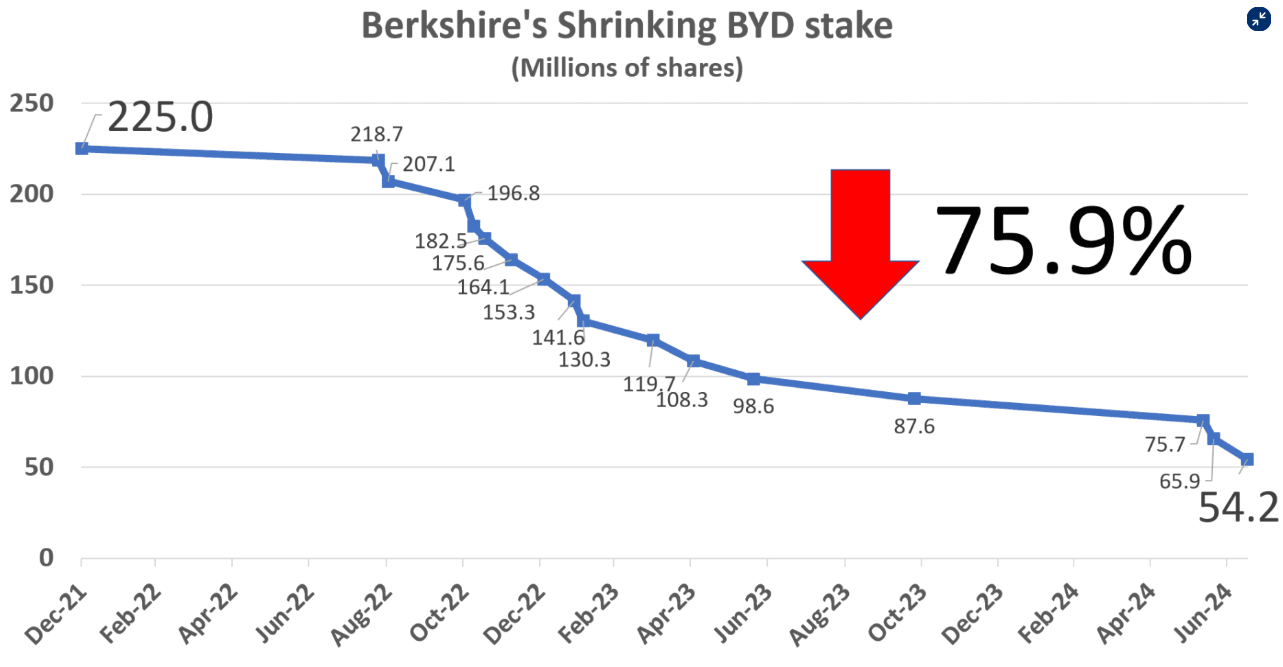
Group 1 - Berkshire Hathaway has completely exited its stake in Chinese electric vehicle manufacturer BYD, which was initially a profitable investment [1][3] - The company began reducing its holdings in August 2022, having purchased 225 million shares for $230 million in 2008, with the value surging by 41% to $9 billion in Q2 of the same year [1][4] - By June of the previous year, Berkshire had sold nearly 76% of its shares, reducing its stake to below 5% of BYD's circulating shares, which allowed it to stop disclosing further reductions [1][4] Group 2 - Berkshire Hathaway Energy reported the investment value as zero as of March 31, confirming the complete sale of BYD shares [3][4] - The initial investment was made 17 years ago under the recommendation of Charlie Munger, who described BYD and its CEO as a "damn miracle" [6] - Warren Buffett acknowledged BYD as an "extraordinary company" but indicated a preference for reallocating funds elsewhere [8] Group 3 - Concurrently, Berkshire sold nearly all of its stake in TSMC (approximately $4 billion), with Buffett expressing concerns about the current economic environment [8] - Buffett and Jamie Dimon have advocated for companies to stop providing quarterly earnings guidance, arguing it leads to unhealthy short-term profit focus at the expense of long-term strategy [9][10] - They emphasize the importance of companies continuing to provide actual performance reports to allow stakeholders to assess progress reliably [10]
基金费改真狠?认申降赎回期延长,利好长期持有
Sou Hu Cai Jing· 2025-09-20 09:13
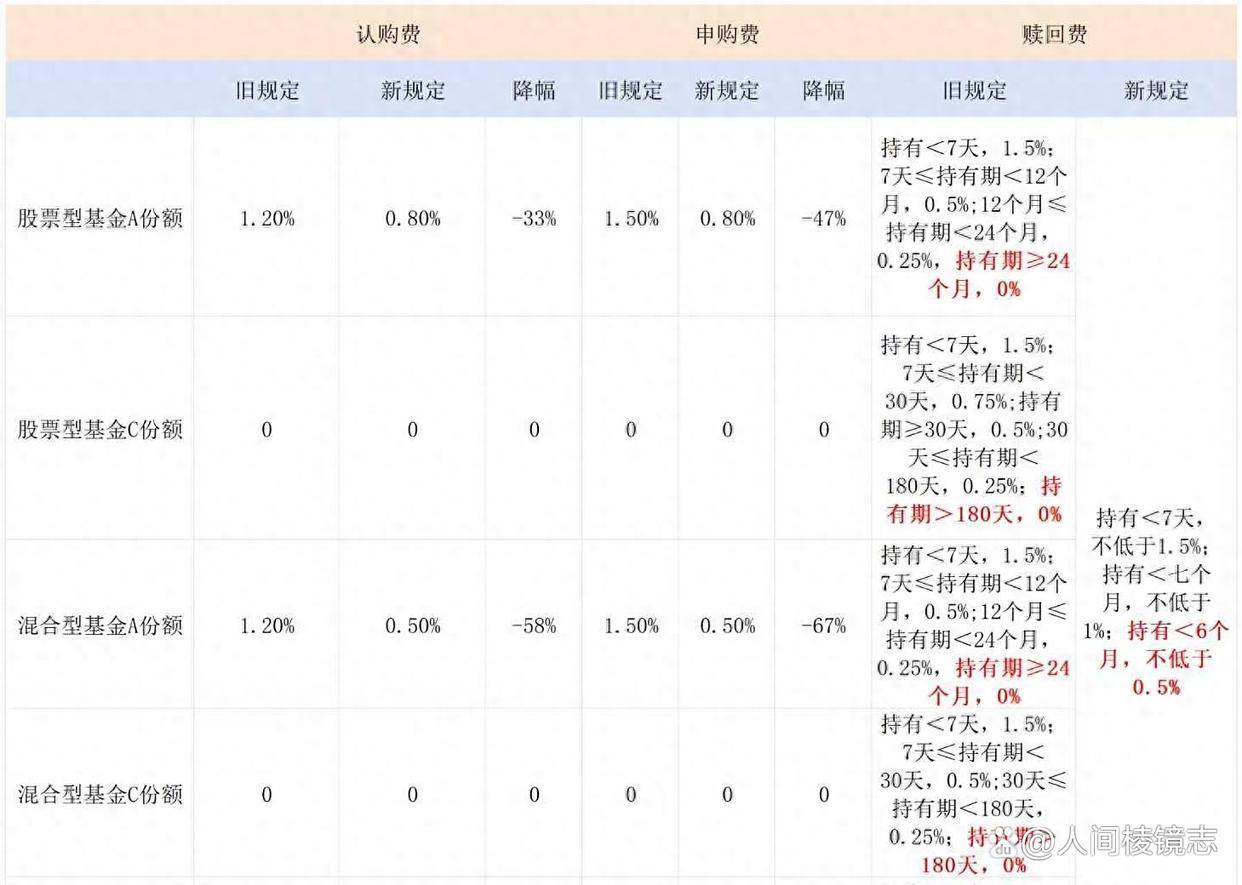
Core Viewpoint - The China Securities Regulatory Commission (CSRC) has released a draft for public consultation regarding the management of sales expenses for publicly offered securities investment funds, marking a significant reform aimed at adjusting various fees and enhancing long-term investment incentives [1][3]. Key Data Overview - The draft proposes a reduction in subscription and application fees for different fund types: approximately 33% and 47% for equity funds, 58% and 67% for mixed funds, and 50% and 63% for bond funds [2]. - The redemption fee threshold has been raised, with a minimum of 0.5% for holdings under six months and a potential 1.5% penalty for holdings under seven days [2]. - As of the end of Q2, there are 8,370 active equity funds with a total scale of nearly 2.15 trillion yuan, while the total scale of public funds is approximately 7.65 trillion yuan [2]. Regulatory Signals - The regulation aims to encourage long-term investment and suppress short-term speculation by increasing the cost of short-term redemptions [3]. - It also seeks to promote market-oriented fee structures and improve service quality, pushing sales channels to focus more on product and service enhancement [3]. Impact Analysis - For equity funds, the reduction in fees and increased redemption thresholds are favorable for long-term holders, particularly passive index funds and ETFs [4]. - Bond funds may face significant challenges as many previously relied on short-term trading strategies, leading to potential capital withdrawals and volatility in fund sizes [4]. - Sales channels dependent on trailing commissions will experience income pressure, prompting a shift towards investment advisory services and scalable management [4]. Practical Recommendations - Individual investors should reassess their holding periods and liquidity needs, favoring money market funds or short-term bond ETFs for short-term liquidity, while opting for passive index or low-fee active funds for long-term investments [6]. - Institutional investors are advised to re-evaluate fund outsourcing and liquidity management strategies, considering direct bond allocations and extending durations to mitigate redemption cost impacts [7]. - Fund managers and distribution agencies should reduce reliance on trailing commissions, enhance research and advisory capabilities, and diversify product offerings to improve customer experience [7].
Warren Buffett Says You Should Invest When the Market Is Down — Here’s Why
Yahoo Finance· 2025-09-19 14:43
Core Insights - The article emphasizes that during market downturns, it is often a mistake to panic and sell investments, as this can lead to missed opportunities for long-term gains [1][2][3] Investment Philosophy - Warren Buffett's investment strategy focuses on buying strong companies at reasonable prices during market declines, viewing these situations as opportunities rather than threats [2][7] - Buffett advocates for a long-term investment horizon, often stating that his favorite holding period is "forever," which allows investments to compound and grow over time [4][5] Risk Management - Long-term investing is presented as a less risky approach compared to short-term trading, as it is less affected by market volatility and provides more time for recovery during downturns [6] - The article highlights that during periods of market fear, such as the 2008 crash and the pandemic, Buffett capitalizes on lower stock prices while others sell off their investments [7]
重构基金销售底层逻辑推动公募与投资者“双向奔赴”
Zhong Guo Zheng Quan Bao· 2025-09-18 20:24
Core Viewpoint - The public fund sales industry is undergoing a transformation to rebuild trust with investors by focusing on long-term value and aligning the interests of institutions and clients [1][6][7]. Group 1: Industry Transformation - The public fund sales sector is shifting from a product-pushing model to one focused on investment solutions and long-term client value [1][7]. - The industry is moving towards a high-quality development phase, emphasizing collaboration between fund managers and sales institutions to enhance investor service capabilities [7][8]. - The core of the transformation involves changing the revenue model from transaction commissions to advisory fees, promoting a buy-side advisory approach [1][7]. Group 2: Investor-Centric Strategies - Companies are implementing strategies to improve investor experience, such as personalized asset planning based on individual goals and risk preferences [2][5]. - The introduction of AI-driven tools for 24/7 online service aims to address investor queries and promote rational investment habits [2][5]. - A focus on long-term investment strategies is being encouraged, with firms providing clients with performance analysis and rebalancing suggestions [3][4]. Group 3: Regulatory and Competitive Landscape - The China Securities Regulatory Commission (CSRC) has introduced guidelines to promote high-quality development in the public fund sector, including reducing fees and establishing evaluation mechanisms for sales institutions [6][7]. - The competitive landscape is evolving from price competition to service capability competition, necessitating a deeper integration of technology in the sales process [7][8]. - Firms are adjusting their assessment metrics to prioritize long-term client retention and satisfaction over short-term sales figures [6][8].

南方基金2.3亿自购背后:一场精致的“追涨杀跌”?
Sou Hu Cai Jing· 2025-09-18 09:49
Group 1 - The core point of the article highlights the contrasting actions of Southern Fund, which publicly announced a 230 million yuan purchase of equity funds while quietly redeeming over 1 billion yuan from bond-related products, suggesting a speculative behavior similar to retail investors [2][3][4] - The high-profile purchase of equity funds is seen as a dual strategy to boost investor confidence and stabilize product scale, especially during a critical period for public funds to increase their size [3][4] - The redemption of over 1 billion yuan from bond products, which was not publicly disclosed, indicates a significant shift in Southern Fund's investment strategy amidst a weak bond market [4][6] Group 2 - The redemption of bond products included significant amounts from various funds, such as 150 million yuan from Southern All-Weather Strategy A and 104 million yuan from Southern Steady Selection Fund, reflecting a clear trend of reducing exposure to fixed income [6][7] - The actions taken by Southern Fund raise questions about whether institutional investors are increasingly behaving like "large retail investors," contradicting their advocacy for long-term and value investing principles [8][9] - The selective disclosure of information by Southern Fund, emphasizing equity purchases while downplaying bond redemptions, creates a narrative that may mislead investors about the company's true market sentiment [9][10]

“新时代·新基金·新价值”|公募机构精准滴灌 走进海淀区红联村社区 筑牢金融安全防线
Zheng Quan Ri Bao Wang· 2025-09-18 04:16
Group 1 - The core viewpoint of the article emphasizes the importance of investor education and community engagement in promoting financial literacy, particularly among vulnerable groups like the elderly [1][3] - The event featured interactive activities such as a "Fraud Prevention Wheel" quiz and traditional games that combined financial knowledge with entertainment, resulting in high resident participation and effective learning [3] - Various educational materials were distributed, covering topics like fraud prevention, investment psychology, and basic investment knowledge, designed to be accessible and practical for residents [3] Group 2 - The theme of the event focused on the "High-Quality Development of Public Funds," with speakers analyzing common scams and introducing the operational logic of public funds and basic asset allocation principles [3] - The initiative reflects the public fund industry's commitment to high-quality development and aims to expand financial education efforts into communities, schools, and business circles [3] - The event serves as a microcosm of the public fund industry's responsibility to enhance financial literacy and contribute positively to the capital market ecosystem [3]