
中小金融机构改革化险

Search documents
半年少了225家银行业金融机构,仅一类数量增加
Xin Lang Cai Jing· 2025-10-13 01:13
Core Insights - The National Financial Supervision Administration has disclosed the latest list of banking institutions, showing a total of 4,070 banking institutions as of June 2025, a decrease of 225 from the end of 2024 [1][3][5] Group 1: Banking Institutions Overview - The list includes 1 development financial institution, 2 policy banks, 6 large state-owned commercial banks, and 12 joint-stock commercial banks among others [3][4] - The most significant reduction was observed in rural financial institutions, which decreased by 222 in total, including 98 village banks, 58 rural commercial banks, 57 rural credit cooperatives, 6 rural mutual aid societies, and 3 rural cooperative banks [5][8] - The only increase in the number of institutions was the establishment of Zhejiang Yin Wealth Management Co., Ltd., approved to commence operations on January 24 this year [5][6] Group 2: Trends in Rural Financial Institutions - As of June 2025, there are 1,505 rural commercial banks, down by 58 from the end of 2024; 20 rural cooperative banks, down by 3; 401 rural credit cooperatives, down by 57; 15 rural mutual aid societies, down by 6; and 1,440 village banks, down by 98 [8][9] - The trend indicates an accelerated reduction in rural financial institutions, with significant reforms and risk management efforts being implemented in recent years [8][9] Group 3: Regulatory Focus and Future Directions - The Financial Supervision Administration has prioritized accelerating the reform and risk management of small and medium-sized financial institutions as a key regulatory task for 2025 [9] - The government work report emphasizes market-oriented and legal principles to address risks in local small and medium-sized financial institutions through various measures, including capital supplementation, mergers, and market exits [9]

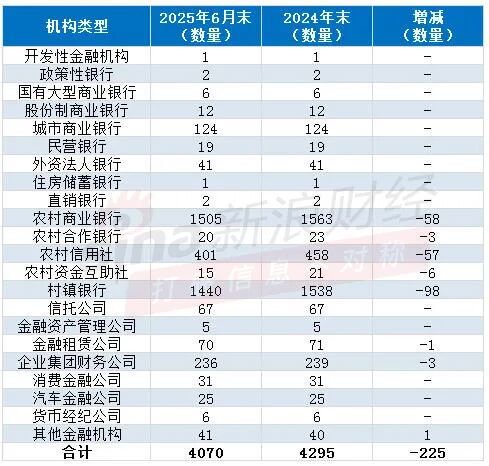
半年减少222家,超去年全年!农村金融机构为何加速消失?
Nan Fang Du Shi Bao· 2025-10-09 10:59
Core Viewpoint - The number of banking financial institutions in China has decreased significantly, particularly in rural financial institutions, indicating a trend towards consolidation and risk management in the sector [2][3]. Group 1: Decrease in Banking Institutions - As of June 2025, there are 4,070 banking financial institutions in China, down from 4,295 at the end of December 2024, marking a reduction of 225 institutions [3]. - The majority of the decrease is attributed to rural financial institutions, with a total reduction of 222 institutions in the first half of the year [3][4]. - Specifically, village and town banks saw the largest decline, with 98 fewer institutions, while rural commercial banks decreased by 58, rural cooperative banks by 3, rural credit cooperatives by 57, and rural mutual aid societies by 6 [4]. Group 2: Acceleration of Reduction - The reduction of rural financial institutions has accelerated compared to previous years, with a total of 283 institutions eliminated from 2022 to 2024, including 27 in 2022, 64 in 2023, and 192 in 2024 [5]. - The acceleration is attributed to intensified reform and risk management efforts by financial regulatory authorities, including mergers, capital supplementation, and structural reorganization of rural financial institutions [5][8]. Group 3: Risk Management and Reforms - The Chinese government has emphasized the need for timely risk management of small and medium-sized financial institutions, with various meetings highlighting the importance of addressing risks in this sector [8][9]. - The financial regulatory authority has set a priority on accelerating reforms and risk management for small and medium-sized institutions, employing strategies such as mergers, market exits, and restructuring [8][9]. - Successful examples include the establishment of provincial-level rural commercial banks and the absorption of village banks by larger banks, which have been approved by regulatory bodies [5][6]. Group 4: Recommendations for Future Actions - Experts suggest the need for a comprehensive top-level design for the reform and risk management of small and medium-sized financial institutions, including the establishment of a financial stability law and a financial stability guarantee fund [10][12]. - There is a call for improved coordination between central and local financial regulatory bodies to enhance the efficiency of risk management and support the transformation of small and medium-sized institutions [11][12].

金融监管总局:坚持防风险、强监管、促高质量发展的金融工作主线,深化中小金融机构改革化险
Zheng Quan Shi Bao Wang· 2025-09-22 11:00
Core Viewpoint - The report from the Central Financial Supervision Administration emphasizes the importance of continuous rectification and improvement in financial regulation, aiming to enhance the quality and effectiveness of financial supervision [1] Group 1: Rectification Progress - The administration will maintain its goals, standards, and efforts in rectification, ensuring accountability and addressing key tasks [1] - Completed rectification tasks will be reviewed to prevent issues from resurfacing, while ongoing tasks will be closely monitored until resolved [1] Group 2: Financial Regulation Enhancement - The focus is on risk prevention, strong regulation, and promoting high-quality financial development, particularly in small and medium-sized financial institutions [1] - The administration aims to strengthen the five major regulatory areas, enhancing the foresight, precision, effectiveness, and coordination of supervision [1] Group 3: Consumer Protection and Illegal Activities - There is a commitment to safeguarding the legitimate rights of financial consumers and rigorously preventing and combating illegal financial activities [1] - The administration will support high-quality economic and social development through comprehensive financial strategies [1]
又一省级农商行获批开业!注册资本346.28亿元,23名管理层已落定
Xin Lang Cai Jing· 2025-09-01 00:41
Group 1 - Jilin Rural Commercial Bank has been approved for establishment with a registered capital of 34.628 billion yuan, primarily funded by Jilin Financial Holding Group at 99.92% [2][5] - The bank will operate 13 branches across various cities, including Changchun and Siping, and will be supervised by local financial regulatory authorities [2][3] - The management team consists of 23 approved members, with a structure of one chairman and four vice presidents, many of whom are from the Jilin Provincial Credit Union [6][7] Group 2 - The bank's business scope includes accepting public deposits, issuing loans, conducting domestic and international settlements, and providing various financial services [3] - The establishment of Jilin Rural Commercial Bank is part of a broader trend where 11 provincial credit unions have transitioned into provincial rural commercial banks or joint banks across several provinces [9][10] - The bank aims to become the strongest local financial institution in terms of capital, service range, and support for agriculture and small enterprises in the province [5][4] Group 3 - The bank has eliminated the supervisory board structure, opting for an audit committee to fulfill its oversight responsibilities, aligning with recent regulatory changes [8] - The establishment of a Chief Compliance Officer position reflects the increasing focus on compliance within financial institutions, following regulatory mandates [7][8] - The ongoing reforms in rural financial institutions are seen as a shift from risk mitigation to sustainable development as the sector matures [10]
顺德农商行,合并广州等地4家村镇银行
Sou Hu Cai Jing· 2025-07-17 10:49
Group 1 - Shunde Rural Commercial Bank has been approved to absorb and merge with several village and town banks, including those in Nanhai, Dongguan, Panyu, and Jiangmen, following the completion of asset and liability verification [2] - This approval marks another step in the accelerated reform process of village and town banks in China, with 89 such banks expected to complete mergers by mid-2025, significantly higher than the 11 completed in 2023 [2] - The rapid reduction in the number of village banks is likely linked to regulatory requirements and inherent risks within these institutions, as emphasized in the 2025 regulatory work meeting by the National Financial Regulatory Administration [2] Group 2 - The People's Bank of China will release the "China Financial Stability Report (2024)," which will assess 3,936 banking institutions and categorize them into risk zones, with a notable number of rural financial institutions falling into the high-risk "red zone" category [3] - The report highlights that rural cooperative institutions and village banks have a significant presence in the "red zone," indicating potential risks within these smaller financial entities [3] - The Guangdong Financial Regulatory Bureau has called for a collaborative effort to expedite the risk resolution process for small financial institutions while promoting governance and business restructuring [3]

广东两家农商行获批 吸收合并多家村镇银行
Zheng Quan Shi Bao· 2025-07-17 00:39
Group 1 - Guangdong Financial Regulatory Bureau has approved the merger of Shunde Rural Commercial Bank with several village banks, including Nanhai Xinhua Village Bank, Changping Xinhua Village Bank, Panyu Xinhua Village Bank, and Xinhui Xinhua Village Bank [1] - Jiangmen Rural Commercial Bank has also been approved to merge with Longchuan Ronghe Village Bank and Raoping Ronghe Village Bank [1] - The approval requires both banks to comply with relevant laws and regulations during the merger process and to report to regulatory authorities after completing the merger preparations [1] Group 2 - Nearly 100 village banks have been officially approved for dissolution this year, indicating a significant increase compared to the same period in 2023 and 2024 [2] - The majority of these dissolutions are due to mergers with city commercial banks and rural commercial banks, which are then set up as branches [2] - The regulatory focus for the year includes accelerating the reform of small financial institutions, with an expectation of continued acceleration in mergers and restructuring of village banks in the second half of the year [2]
中小金融机构“瘦身健体”提速 年内已有84家村镇银行获批解散
Zheng Quan Shi Bao· 2025-07-09 18:37
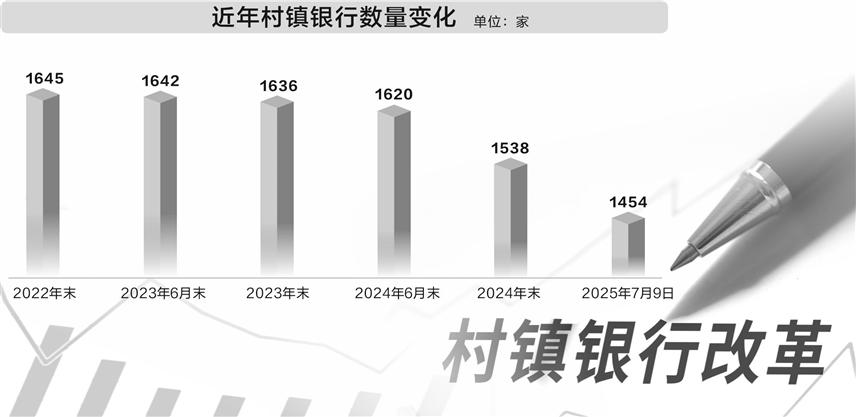
Core Insights - The reform and risk mitigation of small and medium-sized financial institutions, particularly village and town banks, are accelerating as of mid-2025, with a significant increase in the number of bank dissolutions compared to previous years [2][4] - The primary strategy for risk resolution in rural small and medium-sized financial institutions is through mergers and acquisitions, focusing on "reducing quantity and improving quality" [2][9] Summary by Category Mergers and Acquisitions - As of July 9, 2025, 84 village banks have been officially approved for dissolution, a notable increase compared to 98 in 2024 and 9 in 2023 [4] - Inner Mongolia leads the country with 15 village banks approved for dissolution in the first half of the year, followed by Shandong with 14 and Jiangsu with 5 [3] - The majority of dissolved village banks are being absorbed by local city commercial banks or rural commercial banks, often being restructured as branches [5][6] Regulatory Environment - The National Financial Regulatory Administration has prioritized accelerating the reform and risk mitigation of small and medium-sized financial institutions as a key regulatory task [2] - The first instances of cross-province mergers and acquisitions of village banks have occurred, indicating a potential shift in regulatory approaches [6][7] Involvement of Major Banks - For the first time, state-owned banks have entered the village bank merger and restructuring arena, with the Industrial and Commercial Bank of China acquiring a village bank in Chongqing [8] - Despite this involvement, other major banks are unlikely to replicate this model due to their limited ownership of village banks [8][9] Future Outlook - Experts predict that the restructuring of small and medium-sized banks will continue to accelerate, leading to a further reduction in the number of village banks [9] - Regulatory guidance is expected to be introduced to help village banks refocus on their core missions and mitigate risks while supporting rural revitalization and small enterprises [9]

地方国资密集增持中小银行 优化银行治理体系提高银行经营效率
Jin Rong Shi Bao· 2025-06-18 01:44
Group 1 - Qingdao Guoxin Group plans to increase its stake in Qingdao Bank through its subsidiaries, with the total holding expected to not exceed 19.99% after the increase [1] - Qingdao Bank's board has approved the proposal for the stake increase, which will be implemented after regulatory approval [1] - Qingdao Guoxin Group is currently the third-largest shareholder of Qingdao Bank, holding 14.99% of the shares, and could become the largest shareholder if the plan is fully executed [1] Group 2 - The stake increase by Qingdao Bank is part of a broader trend, with other regional banks like Luzhou Bank also announcing capital increase plans [2] - Luzhou Bank plans to issue up to 1 billion new H-shares at a price not lower than 1.85 HKD per share to enhance its core Tier 1 capital adequacy ratio [2] - Many regional banks are seeing increased participation from local state-owned enterprises in their capital increases, driven by regulatory demands and market conditions [2] Group 3 - Analysts suggest that local state-owned enterprises' investments in small and medium-sized banks help optimize ownership structures and improve governance, which is crucial for mitigating regional financial risks [3] - The capital injection from local state-owned enterprises not only supplements the banks' capital but also strengthens their ties with local economies, facilitating access to regional development resources [3] - Enhanced state control is expected to improve decision-making efficiency and establish a solid foundation for the long-term development of small and medium-sized banks [3]
今年已有184家中小银行消失
第一财经· 2025-05-28 15:07
2025.05. 28 本文字数:2865,阅读时长大约5分钟 导读 :中小银行加速离场。 作者 | 第一财经 安卓 2022年43家、2023年77家、2024年204家……近年来,随着中小金融机构改革化险工作的加快推 进,中小银行正在加速离场。 第一财经根据企业预警通数据统计,今年前5个月,已有184家小银行获批复合并/解散,数量是去年 同期的7倍之多,且已接近去年全年的总量,仅5月16日,内蒙古就有120家小银行集体"消失"。 "推动高风险中小金融机构合并重组,是化解金融风险的重要手段,有助于整体改善中小金融机构的 风险状况。"苏商银行特约研究员薛洪言说。 薛洪言认为,当下中小银行面临的经营困境,本质是内外环境变化与自身能力错配的结果。从外部 看,经济周期下行导致信贷需求收缩;区域层面看,行业从增量市场进入存量市场,竞争加剧;叠加 大型银行凭借数字化优势加速下沉,通过科技赋能的低成本服务模式挤压中小银行生存空间。 中小银行加速离场 近段时间,多地金融监管局发布公告,宣布村镇银行、农村信用合作社解散或被吸收合并。 5月26日,宁波金融监管局发布批复,同意解散宁波江北富民村镇银行股份有限公司,全部资产、负 ...

前5个月184家中小银行消失,“毛细血管”为何活成了“夹心饼干”
Di Yi Cai Jing· 2025-05-28 11:12
Core Viewpoint - The rapid exit of small and medium-sized banks is driven by the acceleration of financial reform and risk management efforts, with a significant increase in mergers and dissolutions observed in recent years [1][6][8] Group 1: Mergers and Dissolutions - In the first five months of this year, 184 small banks have been approved for mergers or dissolutions, which is seven times the number from the same period last year and close to the total for the previous year [1][3] - The number of small banks that merged or dissolved has increased from 43 in 2022 to 77 in 2023, and is projected to reach 204 in 2024 [1][3] - A notable event occurred on May 16, when 120 small banks in Inner Mongolia were collectively dissolved, with their assets and liabilities taken over by the newly established Inner Mongolia Rural Commercial Bank [3] Group 2: Impact on Village Banks - Village banks are the most affected by the mergers and dissolutions, with 99 out of 204 small banks dissolved last year being village banks, accounting for 49% of the total [4] - As of the end of 2024, there were 1,538 village banks, making up 35.8% of the total number of banking institutions in China [5] - The risk levels of village banks have risen sharply due to various factors, severely impacting their sustainability and financial service capabilities [5][6] Group 3: Challenges Faced by Small Banks - Small banks are facing operational difficulties due to a mismatch between external environmental changes and their internal capabilities, exacerbated by a downturn in the economic cycle and increased competition from larger banks leveraging digital advantages [1][6][7] - Regulatory pressures have intensified, with stricter requirements for capital adequacy and compliance, exposing long-standing weaknesses in small banks' capital strength and risk management systems [6][7] - Many small banks rely heavily on traditional interest margin models, lacking differentiated competitive strategies, which has led to a significant decline in profitability stability [7][8] Group 4: Future Outlook - The future of small banks hinges on governance reform and the development of differentiated service capabilities tailored to regional economic characteristics, rather than merely relying on scale expansion or policy support [8]