创新药对外授权

Search documents
中国创新药产业迎来黄金发展期 将获系统性价值重估?
Zheng Quan Ri Bao Zhi Sheng· 2025-06-16 16:39
Core Insights - The innovative drug sector in China has experienced a significant surge since June, with both A-share and Hong Kong markets showing strong performance in related stocks. This "medication boom" is driven by Chinese innovative pharmaceutical companies achieving strategic breakthroughs in global expansion through licensing deals [1][2]. Group 1: BD Transactions - The BD (Business Development) transactions have exploded since May, with notable deals such as the $60.5 billion licensing agreement between 3SBio and Pfizer, which set a record for the highest upfront payment for a Chinese innovative drug license-out [2]. - Other companies like CSPC Pharmaceutical Group and Innovent Biologics have also announced high-value BD transactions, with upfront payments ranging from $15 million to $180 million [2]. - The trend indicates that licensing income is becoming a core driver of profit growth for innovative drug companies, with significant upfront payments translating into immediate profits [5][6]. Group 2: Global Competitive Advantage - Multinational pharmaceutical companies are increasingly favoring Chinese innovative drugs due to technological breakthroughs, clinical advantages, cost efficiency, and external demand [3]. - China demonstrates global competitiveness in cutting-edge fields such as dual antibodies and ADCs, with recognized quality and shorter R&D cycles, making it attractive for foreign firms seeking high returns [3]. - The significant gap in the market due to expiring patents for blockbuster drugs is driving strong demand for Chinese innovative assets [3]. Group 3: Market Performance - The A-share pharmaceutical index has risen by 11.02% year-to-date, with individual stocks like Hebei Changshan Biochemical and Nanjing Haisco Pharmaceutical seeing price increases of over 200% in the past two months [5]. - Several actively managed pharmaceutical funds have reported growth rates exceeding 60% this year, indicating strong market interest and investment in the sector [5]. Group 4: Policy Support - The Chinese government continues to implement supportive policies for innovative drug development, including expedited review processes for clinical trial applications [7]. - The State Council has emphasized the need to enhance the innovation capabilities of pharmaceutical companies to better meet diverse healthcare needs [8]. - Systematic policy support covering the entire lifecycle of drug development is expected to create a sustainable innovation ecosystem, providing long-term institutional guarantees for industry growth [8].
超500亿美元授权交易带火创新药企:有的市值重回千亿,多家股价翻倍
第一财经· 2025-06-12 15:22
Core Viewpoint - The article discusses the surge in out-licensing deals among innovative pharmaceutical companies in China, highlighting the positive impact on stock prices and market valuations as these companies enter a revenue-generating phase after years of R&D investment [1][4]. Group 1: Out-Licensing Transactions - Significant out-licensing deals have recently occurred, including a record $1.25 billion upfront payment for SSGJ-707 from 3SBio to Pfizer, and a potential $11.1 billion revenue for BioNTech from a collaboration with Bristol-Myers Squibb on BNT327 [3][4]. - Since the beginning of 2025, the total value of out-licensing transactions from China has exceeded $50 billion, accounting for 44% of the global total, with upfront payments around $2.5 billion, representing 23% of global upfront payments [4][5]. Group 2: Stock Market Impact - The stock prices of innovative pharmaceutical companies have seen significant increases due to successful out-licensing deals, with 25 out of 59 biotech companies in Hong Kong doubling their stock prices this year [2][6]. - 3SBio's stock rose by 32.28% on the day of announcing its out-licensing deal, and another company, CSPC Pharmaceutical Group, saw a 20% increase following a licensing announcement [6][7]. Group 3: Industry Dynamics - The article notes that the long development cycles and high costs associated with innovative drug development lead many companies to seek out-licensing as a strategy to generate immediate revenue [9][11]. - There is a concern regarding the potential loss of pricing power for Chinese companies if they sell their pipelines too early, which could lead to higher future costs to re-enter the market [12][13].



超500亿美元授权交易带火创新药企:有的市值重回千亿,多家股价翻倍
Di Yi Cai Jing· 2025-06-12 11:42
Core Viewpoint - The Chinese innovative pharmaceutical sector is experiencing a significant surge in external licensing deals, leading to substantial stock price increases for many companies in the industry [2][5][8]. Group 1: Stock Performance - Among 59 Hong Kong-listed biotech companies, 25 have seen their stock prices double this year [3][6]. - The stock prices of several companies have surged due to successful licensing deals, with notable increases such as 32.28% on the day of announcement for Sanofi [6]. - The top five performing companies in the 18A sector have seen stock price increases of 538.46%, 386.56%, 319.69%, 267.8%, and 233.33% respectively [6]. Group 2: Licensing Deals - Significant licensing transactions have occurred, including a $12.5 billion upfront payment for a drug by Sanofi, setting a record for Chinese innovative drugs [4]. - Another deal between Bristol-Myers Squibb and BioNTech could yield up to $11.1 billion in revenue for BioNTech [4]. - China accounted for 44% of the global total licensing transaction value this year, with over $50 billion in deals [5]. Group 3: Industry Dynamics - The innovative drug industry is characterized by long development cycles, high costs, and low success rates, with an average cost of $2.3 billion for oncology drugs [8]. - The demand for innovative drugs is increasing as major pharmaceutical companies face patent expirations, creating a market opportunity for Chinese firms [8]. - Chinese companies are leading in various therapeutic areas, with more pipelines than the U.S. [9]. Group 4: Strategic Considerations - The trend of external licensing raises questions about the long-term implications for Chinese companies, particularly regarding their ability to commercialize products independently [10][11]. - Concerns exist about the potential loss of pricing power and market control if companies sell their pipelines too early [10][11]. - The industry is viewed as a trial-and-error game, where Chinese firms have a competitive edge in the efficiency of their trial processes [9].
出海大单相继落地 创新药行情大爆发!创新药ETF国泰(517110)大涨超4%
Mei Ri Jing Ji Xin Wen· 2025-06-12 08:03
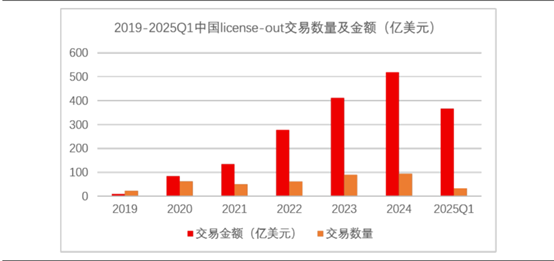
Group 1 - The core viewpoint is that the Chinese biopharmaceutical industry is entering a peak period for out-licensing innovative drugs, with at least one significant out-license deal expected this year from China National Pharmaceutical Group [1][2] - The number of license-out transactions for Chinese innovative drugs reached 41 in the first quarter of 2025, totaling $36.929 billion, nearing the total for the entire year of 2023 and surpassing the total for the first half of 2024 [2] - The domestic pharmaceutical industry is experiencing a period of innovation realization after over a decade of substantial capital investment, leading to record sales and potential growth for domestic innovative drug and device companies [2] Group 2 - The "AI + healthcare" sector is benefiting from valuation premiums due to its significant advantages over traditional pharmaceutical R&D, with favorable macro policies accelerating the approval of medical AI products [4] - The pharmaceutical sector is expected to see profit recovery among mainstream biopharmaceutical companies as drug procurement policies improve, potentially leading to a "Davis double play" scenario [5] - Long-term growth in the pharmaceutical sector is supported by demographic trends such as aging populations and consumption upgrades, making it a resilient industry amid complex macroeconomic conditions [5] Group 3 - Investors are encouraged to consider the innovative drug ETF Guotai (517110), which covers high-quality listed innovative pharmaceutical companies across three regions, as well as other ETFs like the medical ETF (159828) and biopharmaceutical ETF (512290) for investment opportunities [6]
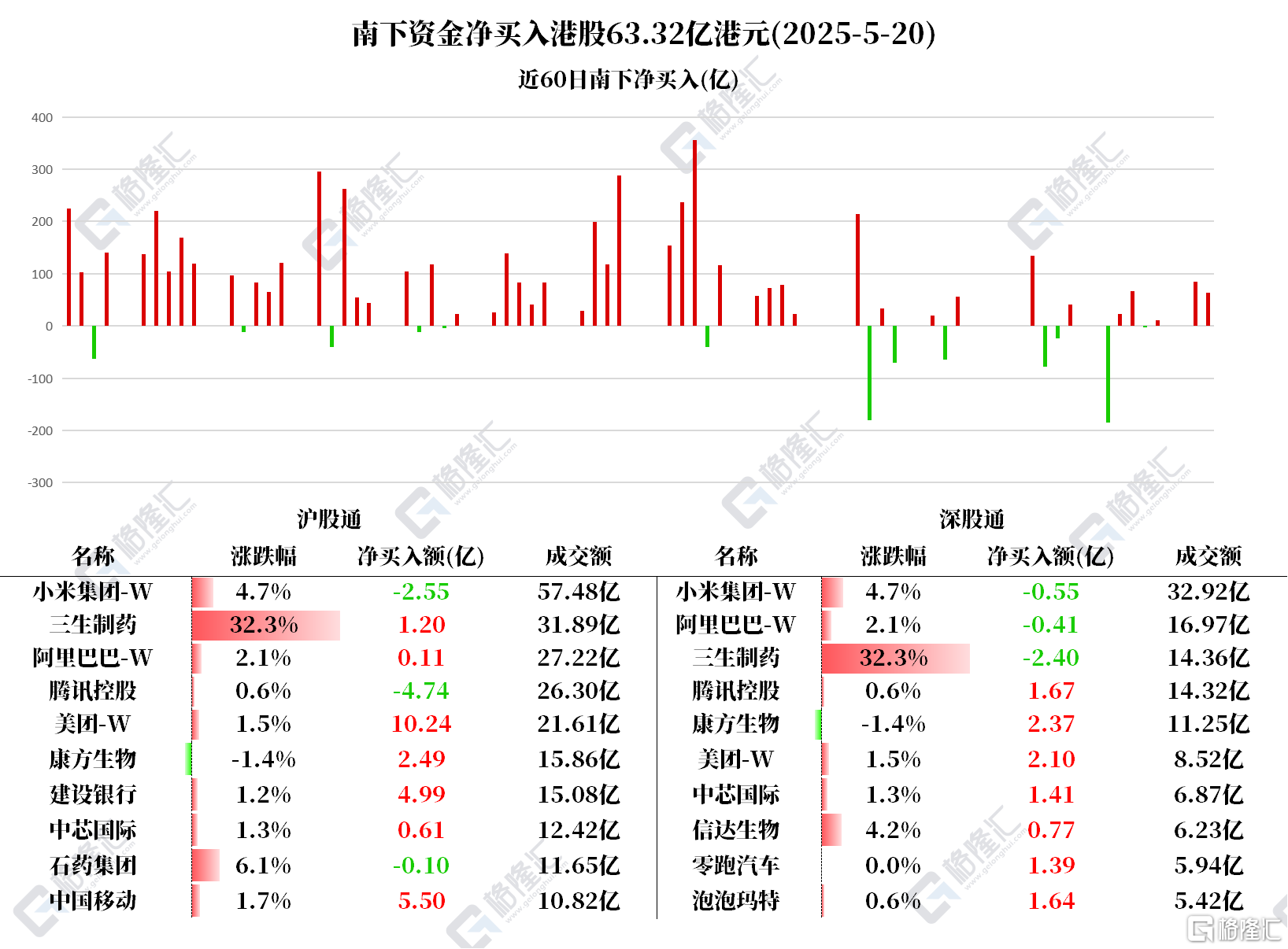
资金动向 | 北水买入港股超63亿港元,加仓美团、中国移动
Ge Long Hui A P P· 2025-05-20 12:40
Group 1: Market Activity - Net purchases included Meituan at 1.234 billion, China Mobile at 550 million, China Construction Bank at 499 million, and others, while net sales included Xiaomi Group at -310 million and Tencent Holdings at -306 million [1] - Southbound funds have recorded 11 consecutive days of net sales for Tencent, totaling 13.90601 billion HKD, and 3 consecutive days of net sales for Xiaomi, totaling 1.28491 billion HKD [1] Group 2: Company Developments - Sangfor Biopharma has reached a milestone agreement with Pfizer for the PD-1/VEGF bispecific antibody SSGJ-707, involving an upfront payment of 1.25 billion and a total of 6.05 billion for global development and commercialization, setting a record for recent Chinese innovative drug licensing [4] - China Construction Bank and other major state-owned banks have announced a reduction in multiple terms of RMB deposit rates, with the three-year and five-year rates lowered by 25 basis points to 1.25% and 1.3% respectively [4] - Leap Motor reported a 187.1% year-on-year revenue growth in Q1, reaching 10.02 billion RMB, driven by strong sales growth and optimized product structure, with a 4.9% increase in revenue per vehicle [4] Group 3: Product Launches - Xiaomi's Lei Jun announced that the Xiaomi玄戒O1, a self-developed 3nm flagship chip, has begun mass production, with two flagship products set to launch: the high-end Xiaomi 15s Pro smartphone and the ultra-high-end OLED Xiaomi Pad 7 Ultra [5]