居民人均可支配收入

Search documents
2025年全国居民人均可支配收入43377元 比上年实际增长5.0%
Guo Jia Tong Ji Ju· 2026-01-19 07:24
Group 1: Resident Income Situation - In 2025, the national per capita disposable income reached 43,377 yuan, representing a nominal growth of 5.0%, with a real growth of 5.0% after adjusting for price factors [1] - Urban residents had a per capita disposable income of 56,502 yuan, growing by 4.3% nominally and 4.2% in real terms; rural residents saw a per capita disposable income of 24,456 yuan, with a nominal growth of 5.8% and a real growth of 6.0% [1] - The per capita wage income was 24,555 yuan, increasing by 5.3%, accounting for 56.6% of the per capita disposable income; net operating income was 7,252 yuan, growing by 5.0%, making up 16.7% of the total [1] - The median per capita disposable income was 36,231 yuan, with a growth of 4.4%, and the median is 83.5% of the average; urban median was 51,115 yuan (3.7% growth) and rural median was 20,711 yuan (5.6% growth) [1] Group 2: Resident Consumption Expenditure Situation - In 2025, the national per capita consumption expenditure was 29,476 yuan, with a nominal growth of 4.4% and a real growth of 4.4% [2] - Urban residents had a per capita consumption expenditure of 35,869 yuan, growing by 3.8% nominally and 3.7% in real terms; rural residents had a per capita consumption expenditure of 20,259 yuan, with a nominal growth of 5.1% and a real growth of 5.3% [2] - Per capita expenditure on food, tobacco, and alcohol was 8,631 yuan, growing by 2.6%, accounting for 29.3% of total consumption expenditure; clothing expenditure was 1,554 yuan (2.2% growth), making up 5.3% [2] - Expenditure on education, culture, and entertainment grew by 9.4% to 3,489 yuan, representing 11.8% of total consumption expenditure [2]
国家统计局:2025年全国居民人均可支配收入43377元
2 1 Shi Ji Jing Ji Bao Dao· 2026-01-19 06:50
1月19日,国家统计局19日发布数据显示,2025年,全国居民人均可支配收入43377元,比上年名义增长 5.0%,扣除价格因素,实际增长5.0%。分城乡看,城镇居民人均可支配收入56502元,增长4.3%,扣除 价格因素,实际增长4.2%;农村居民人均可支配收入24456元,增长5.8%,扣除价格因素,实际增长 6.0%。 (文章来源:21世纪经济报道) ...
2025年中国居民人均可支配收入增长5%
Zhong Guo Xin Wen Wang· 2026-01-19 06:30
Core Insights - In 2025, China's per capita disposable income is projected to reach 43,377 yuan, reflecting a nominal growth of 5.0% and a real growth of 5.0% after adjusting for price factors [1] - Rural residents are expected to experience a faster income growth rate compared to urban residents, with urban per capita disposable income at 56,502 yuan (nominal growth of 4.3%, real growth of 4.2%) and rural per capita disposable income at 24,456 yuan (nominal growth of 5.8%, real growth of 6.0%) [1] - The income growth rate for rural residents exceeds that of urban residents by 1.5 percentage points nominally and 1.8 percentage points in real terms, leading to a reduction in the income disparity between urban and rural areas [1] Economic Context - The growth in residents' income is expected to align with the GDP growth rate, with rural income growth outpacing GDP growth [1] - Achieving these income growth figures amidst domestic and international pressures is considered a significant accomplishment [1]
速览2025年主要经济数据
Zhong Guo Jing Ji Wang· 2026-01-19 03:46
Economic Overview - The national economy in 2025 faced pressures but achieved high-quality development, successfully meeting major goals for economic and social development, marking a successful conclusion to the "14th Five-Year Plan" [1] Industrial Performance - The industrial added value of enterprises above designated size increased by 5.9% compared to the previous year [5] Service Sector - The added value of the service industry grew by 5.4% year-on-year [11] Consumer Spending - The total retail sales of consumer goods reached 501.202 billion yuan, reflecting a growth of 3.7% from the previous year [16] Investment Trends - Total fixed asset investment (excluding rural households) was 485.186 billion yuan, a decrease of 3.8% year-on-year; excluding real estate development investment, fixed asset investment fell by 0.5% [21] Trade Performance - The total value of goods imports and exports amounted to 454.687 billion yuan, representing a growth of 3.8% compared to the previous year [25] Price Levels - The Consumer Price Index (CPI) remained stable compared to the previous year, while the Producer Price Index (PPI) for industrial producers decreased by 2.6% [29][30] Employment Statistics - The average urban survey unemployment rate was 5.2% for the year [32] Income Growth - The per capita disposable income of residents was 43,377 yuan, showing a nominal increase of 5.0%, with a real growth of 5.0% after adjusting for price factors [34]

2025年经济成绩单出炉 全年GDP突破140万亿元
Xin Jing Bao· 2026-01-19 03:41
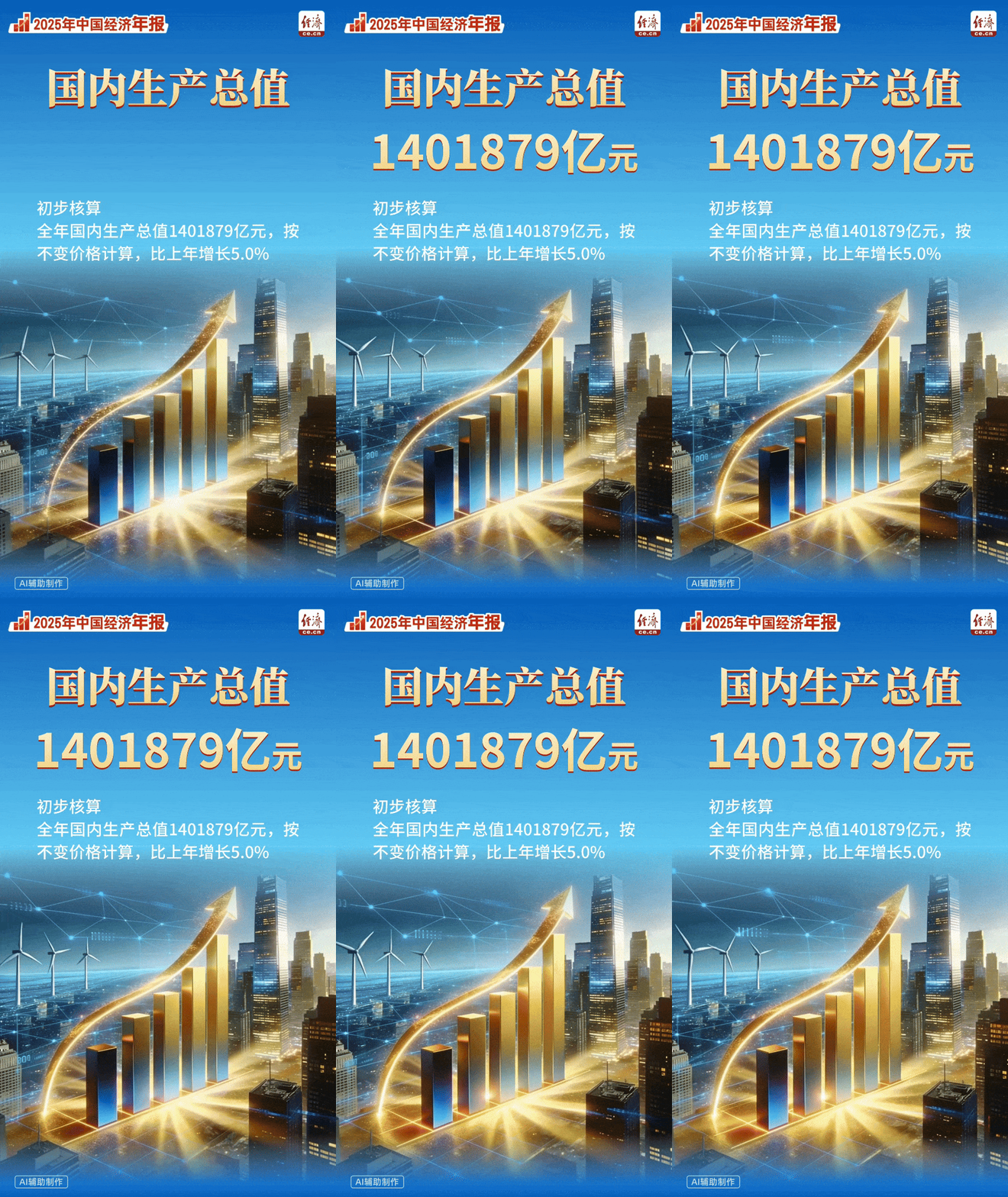
1月19日,国家统计局发布2025年经济运行情况。经初步核算,全年国内生产总值140.2万亿元,按不变价格计 算,比上年增长5.0%。全年全国规模以上工业增加值比上年增长5.9%。装备制造业增加值增长9.2%,高技术制造 业增加值增长9.4%,增速分别快于规模以上工业3.3、3.5个百分点。全年货物进出口总额45.47万亿元,比上年增 长3.8%,其中出口增长6.1%。 2025年居民收入持续增长,全年全国居民人均可支配收入43377元,实际增长5.0%。新京报贝壳财经记者带你一 览2025年全国经济成绩单。 2025年固定资产投资比上年 下降3.8% 高技术产业中 航空、航天器及设备制造业投资 2025年社会消费品 增长16.9% 零售总额50.1万亿元 2025年全国规模以上 信息服务业投资 工业增加值比上年增长 同比增长3.7 增长28.4% 城镇居民人均可支配收入 实际增长 农村居民人均可支配收入 2025年全国居民人均可支配收入实际增长5.09 实际增长 096 居民消费价格 十官 下 J L 全国城镇调查失业率 2025年货物进出口总额45.5万亿元 平均值5.2% 比上年增长3.8% 出口26. ...
国家统计局:2025年全国居民人均可支配收入43377元,比上年增长5.0%
Jing Ji Guan Cha Bao· 2026-01-19 03:20
Core Viewpoint - The National Bureau of Statistics reported that the per capita disposable income of residents in China is projected to reach 43,377 yuan in 2025, reflecting a nominal growth of 5.0% compared to the previous year, with real growth also at 5.0% after adjusting for price factors [1] Group 1: Resident Income Situation - In 2025, the urban per capita disposable income is expected to be 56,502 yuan, with a nominal growth of 4.3% and a real growth of 4.2% after price adjustments [2] - The rural per capita disposable income is projected to be 24,456 yuan, showing a nominal growth of 5.8% and a real growth of 6.0% [2] - The per capita wage income is anticipated to be 24,555 yuan, growing by 5.3%, accounting for 56.6% of the per capita disposable income [2] - The median per capita disposable income is expected to be 36,231 yuan, with a growth of 4.4%, which is 83.5% of the average [2] Group 2: Resident Consumption Expenditure Situation - The per capita consumption expenditure is projected to be 29,476 yuan, with a nominal growth of 4.4% and a real growth of 4.4% [3] - Urban residents are expected to have a per capita consumption expenditure of 35,869 yuan, growing by 3.8% nominally and 3.7% in real terms [3] - Rural residents' per capita consumption expenditure is projected to be 20,259 yuan, with a nominal growth of 5.1% and a real growth of 5.3% [3] - The per capita expenditure on education, culture, and entertainment is expected to grow by 9.4%, accounting for 11.8% of total consumption expenditure [3]
晓数点|速览!2025年国民经济成绩单出炉
Di Yi Cai Jing Zi Xun· 2026-01-19 03:09
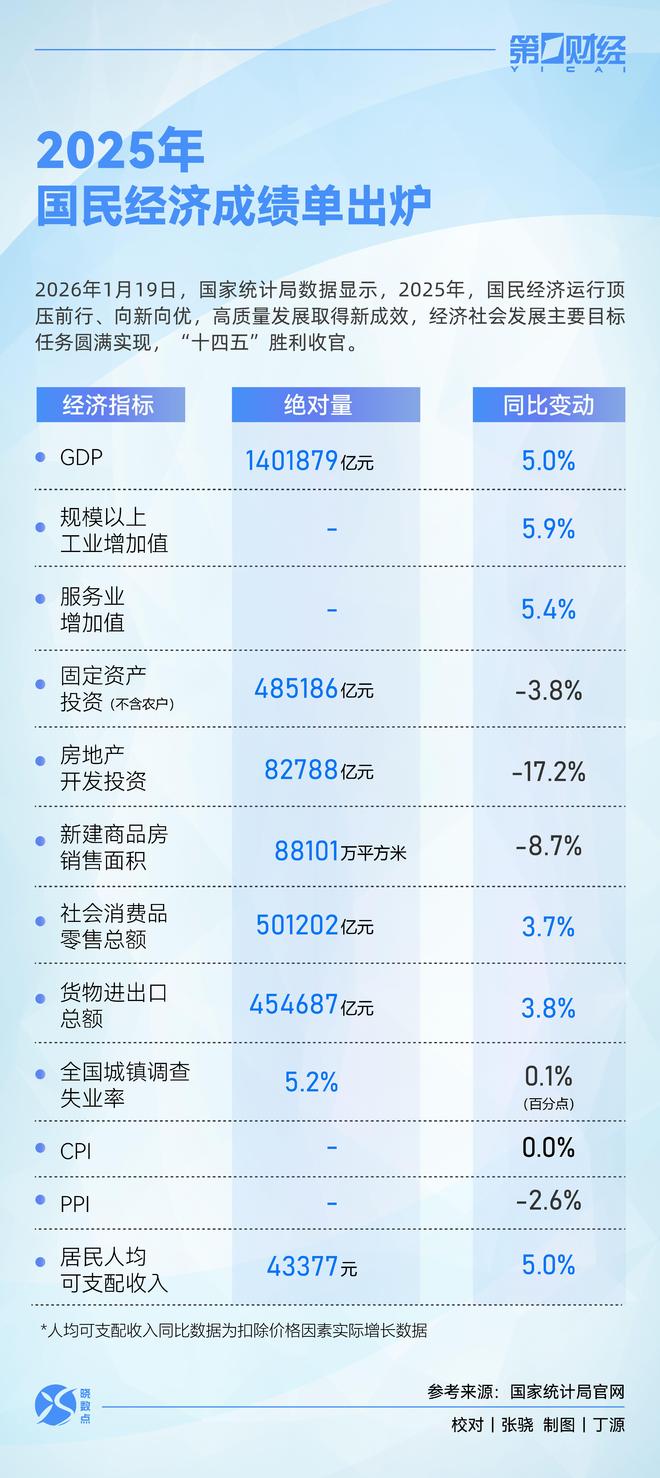
Core Viewpoint - The national economic performance report for 2025 indicates that high-quality development has achieved new results, with major economic and social development goals successfully met, marking a successful conclusion to the "14th Five-Year Plan" [1] Economic Indicators - GDP reached 14,018.79 billion yuan, growing by 5.0% year-on-year [2] - Investment (excluding rural households) totaled 485.186 billion yuan, declining by 3.8% [2] - Real estate development investment was 82.788 billion yuan, down by 17.2% [2] - New commercial housing construction area was 8,810.1 million square meters, decreasing by 8.7% [2] - Total retail sales of consumer goods amounted to 501.202 billion yuan, increasing by 3.7% [2] - Total import and export value reached 454.687 billion yuan, growing by 3.8% [2] Employment and Income - The national urban surveyed unemployment rate was 5.2%, an increase of 0.1 percentage points [3] - Per capita disposable income was 43,377 yuan, reflecting a real growth of 5.0% after adjusting for price factors [3]
2025年全国居民人均可支配收入43377元,比上年名义增长5.0%
Guo Jia Tong Ji Ju· 2026-01-19 02:39
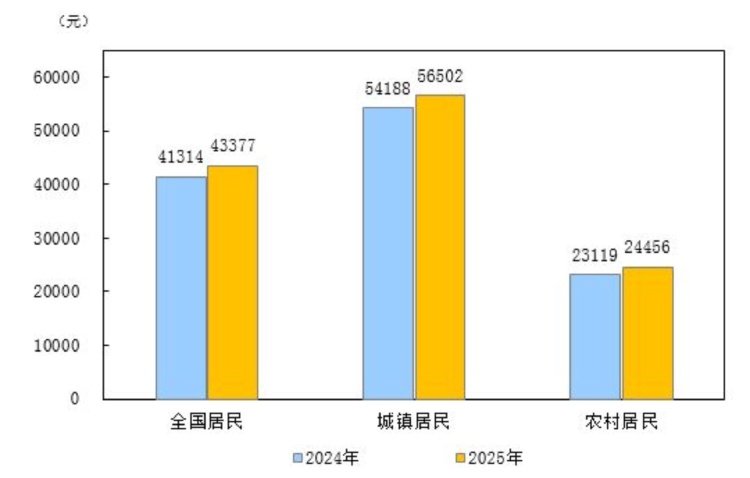
Income Situation - In 2025, the national per capita disposable income reached 43,377 yuan, representing a nominal growth of 5.0% compared to the previous year, with an actual growth of 5.0% after adjusting for price factors [2][9] - Urban residents had a per capita disposable income of 56,502 yuan, growing by 4.3% nominally and 4.2% in real terms; rural residents saw a per capita disposable income of 24,456 yuan, with a nominal growth of 5.8% and a real growth of 6.0% [2][9] - The per capita wage income was 24,555 yuan, increasing by 5.3%, accounting for 56.6% of the per capita disposable income; net operating income was 7,252 yuan, up by 5.0%, making up 16.7%; net property income was 3,490 yuan, growing by 1.6%, contributing 8.0%; and net transfer income was 8,080 yuan, increasing by 5.7%, representing 18.6% [2][9] Median Income - The median per capita disposable income for the national population was 36,231 yuan, reflecting a growth of 4.4%, with the median being 83.5% of the average [2][9] - Urban residents had a median per capita disposable income of 51,115 yuan, growing by 3.7%, which is 90.5% of the average; rural residents had a median of 20,711 yuan, increasing by 5.6%, accounting for 84.7% of the average [2][9] Consumption Expenditure - In 2025, the national per capita consumption expenditure was 29,476 yuan, with a nominal growth of 4.4% and a real growth of 4.4% [4][9] - Urban residents had a per capita consumption expenditure of 35,869 yuan, growing by 3.8% nominally and 3.7% in real terms; rural residents had a per capita consumption expenditure of 20,259 yuan, with a nominal growth of 5.1% and a real growth of 5.3% [4][9] - Per capita expenditure on food, tobacco, and alcohol was 8,631 yuan, increasing by 2.6%, accounting for 29.3% of total consumption expenditure; clothing expenditure was 1,554 yuan, up by 2.2%, making up 5.3%; housing expenditure was 6,397 yuan, growing by 2.1%, representing 21.7%; and transportation and communication expenditure was 4,306 yuan, increasing by 8.3%, accounting for 14.6% [4][5][9]
国家统计局:2025年全国居民人均可支配收入43377元 比上年名义增长5%
智通财经网· 2026-01-19 02:32
Group 1: Resident Income Situation - In 2025, the national per capita disposable income reached 43,377 yuan, representing a nominal increase of 5.0%, with a real growth of 5.0% after adjusting for price factors [2][8] - Urban residents had a per capita disposable income of 56,502 yuan, growing by 4.3% nominally and 4.2% in real terms; rural residents saw a per capita disposable income of 24,456 yuan, with a nominal growth of 5.8% and a real growth of 6.0% [2][8] - The per capita wage income was 24,555 yuan, increasing by 5.3%, accounting for 56.6% of the total disposable income; net operating income was 7,252 yuan, up by 5.0%, making up 16.7% of the total; net property income was 3,490 yuan, growing by 1.6%, contributing 8.0%; and net transfer income was 8,080 yuan, increasing by 5.7%, representing 18.6% of the total [2][8] Group 2: Resident Consumption Expenditure Situation - In 2025, the national per capita consumption expenditure was 29,476 yuan, with a nominal increase of 4.4% and a real growth of 4.4% [5][8] - Urban residents had a per capita consumption expenditure of 35,869 yuan, growing by 3.8% nominally and 3.7% in real terms; rural residents had a per capita consumption expenditure of 20,259 yuan, with a nominal growth of 5.1% and a real growth of 5.3% [5][8] - Per capita expenditure on food, tobacco, and alcohol was 8,631 yuan, increasing by 2.6%, accounting for 29.3% of total consumption expenditure; clothing expenditure was 1,554 yuan, up by 2.2%; housing expenditure was 6,397 yuan, growing by 2.1%; and expenditures on education, culture, and entertainment rose by 9.4% to 3,489 yuan, representing 11.8% of total consumption [5][8]
中国2025年GDP跨越140万亿元关口,增长5.0%!全国居民人均可支配收入比上年增长5%
Mei Ri Jing Ji Xin Wen· 2026-01-19 02:28
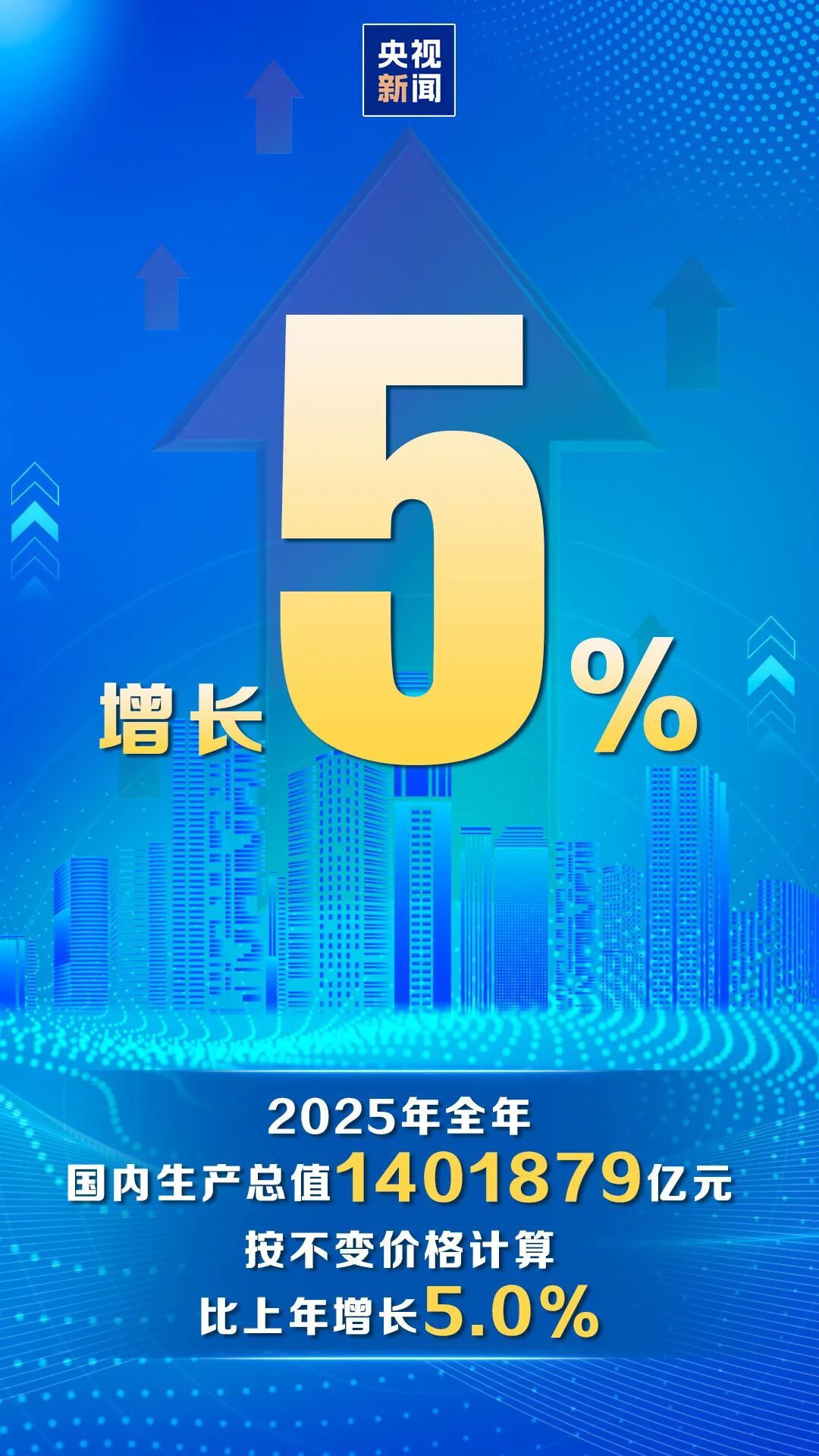
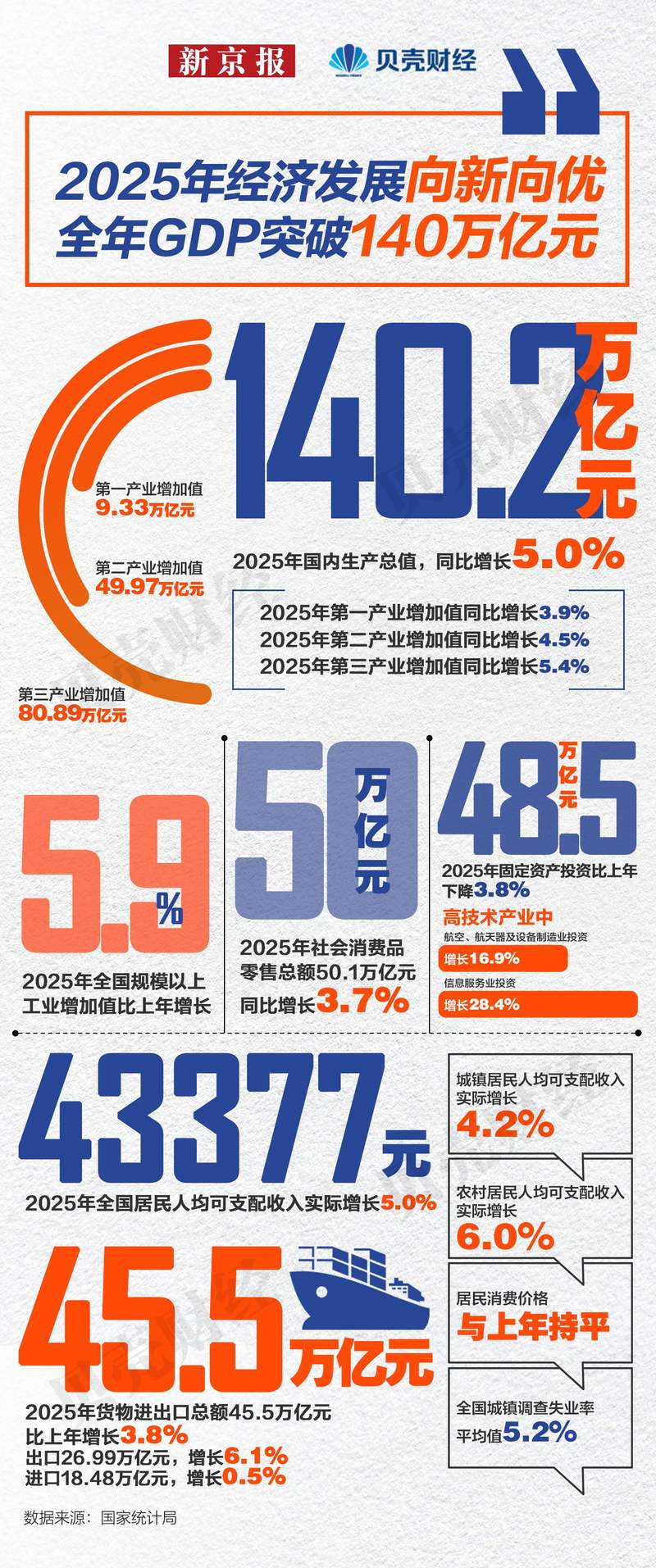
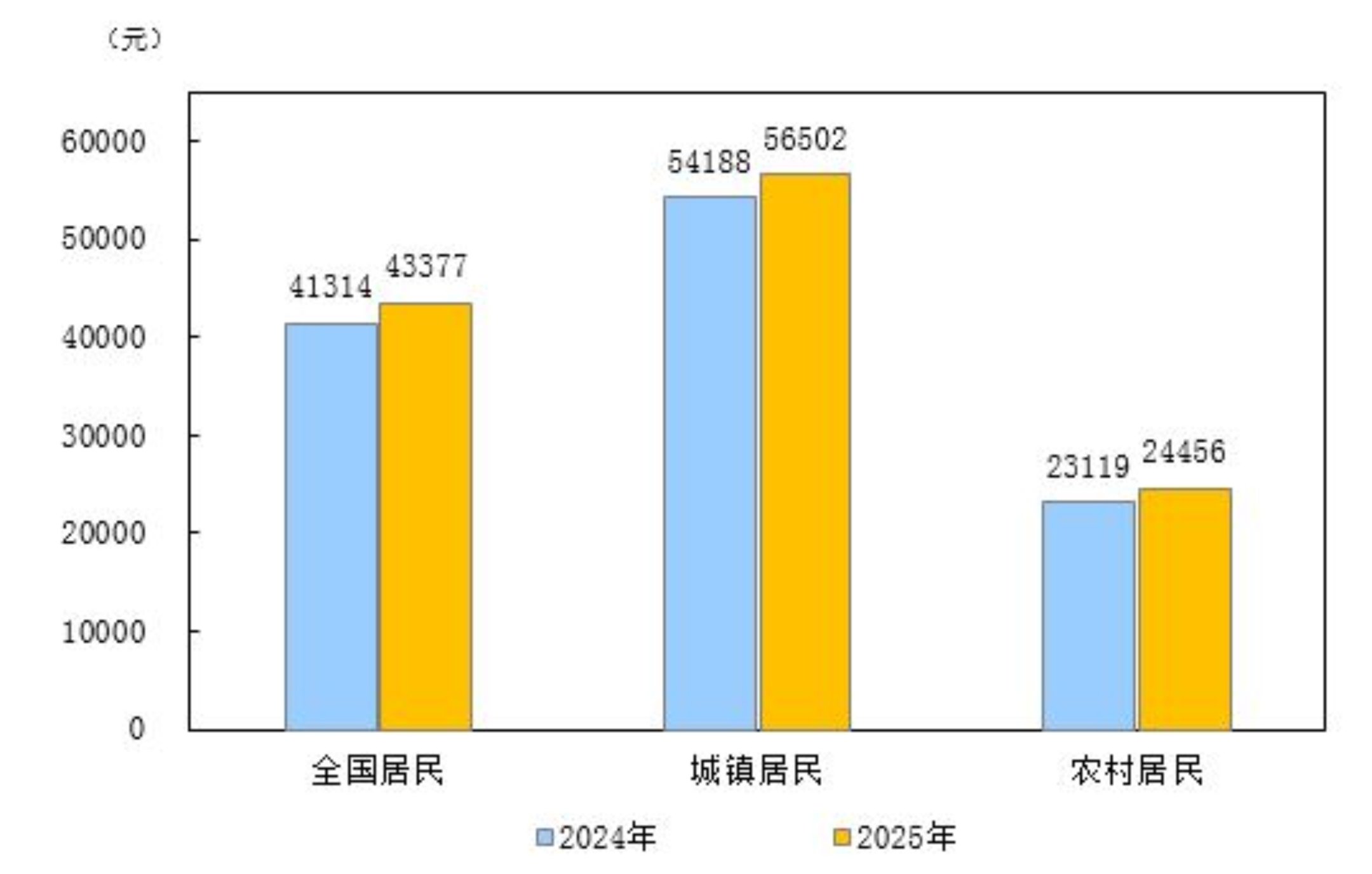
今天上午,国务院新闻办举行新闻发布会,国家统计局局长康义介绍,2025年,国民经济运行顶压前行、向新向优,高质量发展取得新成效,经济社会发 展主要目标任务圆满实现,"十四五"胜利收官。初步核算,全年国内生产总值1401879亿元,按不变价格计算,比上年增长5.0%。 面对国内外经济环境的复杂变化,国民经济运行顶压前行、向新向优,高质量发展取得新成效,经济社会发展主要目标任务圆满实现,"十四五"胜利收 官。"十四五"期间,中国经济总量连续跨越,110万亿元、120万亿元、130万亿元、140万亿元关口。 2025年全国居民人均可支配收入比上年增长5% 国家统计局1月19日发布数据显示,2025年,居民收入持续增长,农村居民收入增速快于城镇。 全年全国居民人均可支配收入43377元,比上年名义增长5.0%,扣除价格因素实际增长5.0%。按常住地分,城镇居民人均可支配收入56502元,比上年名 义增长4.3%,实际增长4.2%;农村居民人均可支配收入24456元,比上年名义增长5.8%,实际增长6.0%。全国居民人均可支配收入中位数36231元,比上 年名义增长4.4%。按全国居民五等份收入分组,低收入组人均可支配 ...