
新工科

Search documents
市教育考试院公布2025本科各批次录取控分线 录取形势如何 志愿如何填
Jie Fang Ri Bao· 2025-06-24 01:57
Group 1 - The core point of the article is the announcement of the 2025 undergraduate admission control scores in Shanghai, with specific scores for different categories [1] - The overall admission rate is expected to be similar to previous years, with an increase in the number of candidates and total enrollment plans [2] - A total of 784 universities will enroll students in Shanghai this year, an increase from 768 last year, with 697 being undergraduate institutions, up from 675 [2] Group 2 - Candidates are advised to consider their strengths and interests when filling out their application forms, and to pay attention to the admission regulations of their chosen universities [3] - The proportion of enrollment plans requiring a combination of physics and chemistry has increased, suggesting a focus on these subjects for better admission quality [4] - The admission process will ensure fairness and transparency, with strict adherence to regulations and oversight by educational authorities [5]
一财社论:第四代大学崛起,问题导向激活鲇鱼效应
Di Yi Cai Jing· 2025-06-11 13:38
Core Viewpoint - The article discusses the ongoing reforms in China's higher education system, emphasizing the need for better integration between academia and industry to address the long-standing issue of disconnection between university education and societal needs [2][3][4]. Group 1: Higher Education Reform - China's higher education is entering a new exploratory phase of reform, with the Ministry of Education announcing the establishment of ten new universities, including Greater Bay Area University and Ningbo Oriental Institute of Technology, focusing on research-oriented education [2]. - The reform efforts are characterized by the emergence of new research-oriented universities and the restructuring of established institutions, such as Fudan University and Shanghai Jiao Tong University, to enhance their educational offerings [2][3]. - The primary focus of these reforms includes the establishment of new research-oriented universities, enterprise-run universities, new engineering disciplines, and vocational technical colleges, aiming to address the historical emphasis on theoretical knowledge over practical application [2][3]. Group 2: Market Demand and Educational Needs - The rapid advancement of technologies like AI is reshaping traditional economic and social structures, necessitating a shift in higher education to meet evolving market demands [3][4]. - The Chinese government has outlined a comprehensive education plan for 2024-2035, emphasizing the integration of education, technology, and talent development to support modernization efforts [3]. - Despite producing over one-third of the world's engineering graduates, China faces a structural shortage of innovative and interdisciplinary talent, highlighting the importance of new engineering disciplines and research-oriented universities [4]. Group 3: Challenges and Opportunities - The article points out the critical challenge of integrating education with industry needs, stressing that simply placing students in internships is insufficient for fostering interdisciplinary problem-solving skills [4][5]. - There is a concern that the trend of vocational education transitioning to degree programs may dilute the practical focus of vocational training, raising questions about the effectiveness of such reforms [4][5]. - The emphasis on foundational research is crucial, as it distinguishes human capabilities from artificial intelligence, suggesting that universities should leverage their strengths to enhance educational outcomes [5][6].
财大气粗、专业“实用”,这些“第四代”大学正崛起
Di Yi Cai Jing· 2025-06-10 14:05
曹德旺表示,福耀科技大学从体制上、机制上对标斯坦福大学;首年招50个学生,预算是8亿。 高考落幕后,对考生来说,接下来最关心的就是高考志愿的填报。随着近年我国新型研究型大学越来越 多,不少考生也有了新选择。 新型研究型大学以创新治理模式、人才培养模式和科研组织形式为突破口,以科学技术研究为主要任 务,具有高起点、投入大、高水平、国际化等特点。南方科技大学、上海科技大学、西湖大学、深圳理 工大学,福耀科技大学等都是新型研究型大学的代表高校。 福建福耀科技大学常务副校长徐飞撰文指出,当下,以新型研究型大学为代表的第四代大学正陆续出 现,这些大学的本质是打破传统边界,以颠覆性理念重构知识生产模式,以科技赋能重塑教育生态,以 全球协作应对人类共同挑战。 厦门大学经济学系副教授丁长发分析,以我国的人口规模和需求来说,当前此类新型研究型大学还是比 较少的,未来可以鼓励各地和更多民营企业家创办新型研究型大学,通过新的增量,促进高校之间的良 性竞争。 "新"在哪里 近年来,新型研究型大学成为很多高分考生的选择。以深圳理工大学为例,其2024年首次面向广东高考 招生,录取物理类考生120人,录取最低分为624分/9667名,最 ...
复旦六大新工科学院招生占比近30%,高校人才培养瞄准哪些重点
Di Yi Cai Jing· 2025-05-28 06:58
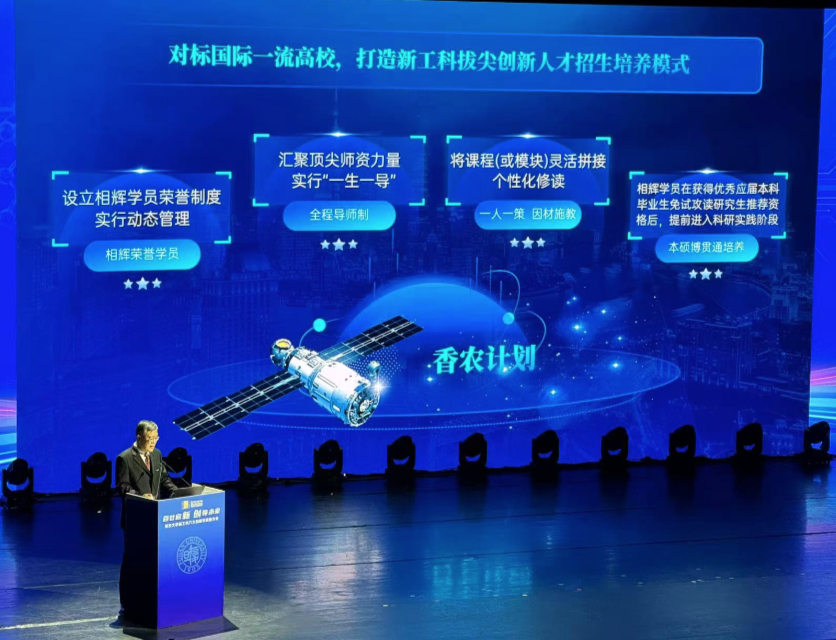
近年来,实用性较强的工科专业成为高考报考热门,就业热度也居高不下。 伴随新一代信息技术的加速创新,加大新工科布局也成为各大高校的重点目标之一。 "新工科"不是一般意义的工程技术,而是融通基础与应用,既要"顶天"又要"立地"。 复旦大学副校长、智能机器人与先进制造创新学院院长姜育刚介绍称,创新学院正在致力于研发可用、可靠、可信的 智能体。未来智能机器人能够助力各种物品的自动化生产,并会服务人类生活的方方面面。为了实现这样的目标,创 新学院以复旦综合性学科优势为支撑,布局机器人与具身智能、智能空天、智能光电三大方向。 27日下午,复旦大学新工科六大创新学院公布全新的培养方案:今年,六大创新学院将投放超1000个本科招生计划 数,较去年工科规模同比增长超过20%,占全校招生计划规模28.5%。当天,新工科发展基金发布,首期已筹集规模1.2 亿元。 复旦大学校长、中国科学院院士金力在致辞中称,为满足更多学子的新工科志趣,今年学校在六大创新学院投放过千 的本科招生计划数,同比增长超过20%;各创新学院内部专业实现完全自由分流。推出18个本博、本研融通培养项 目,覆盖创新学院近一半(43%)的本科生源。试点推出超常规人才 ...

“双高”联手,发掘更多新工科人才
Xin Hua Ri Bao· 2025-05-19 21:08
Core Insights - The article discusses the rapid development of new engineering disciplines in higher education, emphasizing the need for innovative talent cultivation in response to technological advancements and industry changes [1][2]. Group 1: New Engineering Disciplines - Since the "Fudan Consensus" in 2017, the path for new engineering disciplines in Chinese universities has become clearer, with a significant increase in engineering-related programs, particularly in artificial intelligence and other technological fields [2]. - Nanjing University and Southeast University have introduced new programs focusing on intelligent science and electronic science, aiming to cultivate interdisciplinary talents [2]. - Nanjing University has launched various dual-degree programs, such as "Software Engineering + Business Management," to foster cross-disciplinary skills [2]. Group 2: Talent Cultivation Models - Nanjing University of Aeronautics and Astronautics has introduced new undergraduate programs related to the low-altitude economy, with a focus on intelligent flying technology [3]. - Nanjing University of Science and Technology has established an innovation talent class to train exceptional engineering talents through a project-driven approach [3]. - More universities are aligning their programs with emerging disciplines and regional development needs, enhancing the integration of different fields to produce top-tier engineering talents [3]. Group 3: High School Education's Role - High schools are encouraged to break down subject barriers and adopt project-based learning to better prepare students for new engineering fields [7]. - The emphasis is on nurturing students' problem-solving abilities and practical skills, rather than merely focusing on theoretical knowledge [7]. - Schools are urged to create a nurturing environment that fosters innovation and a sense of national responsibility among students [8]. Group 4: Challenges in Curriculum and Faculty Development - There are significant challenges in aligning high school and university curricula, particularly in developing new engineering preparatory courses and addressing faculty shortages [9]. - Establishing a collaborative community among high schools, universities, and industries is seen as essential for effective talent cultivation [9]. - The need for a dual-track curriculum that integrates core subjects with new engineering disciplines is highlighted as a potential solution [10].
“数”说高校专业调整,“未来风口”专业是哪些?
Yang Shi Xin Wen· 2025-05-11 04:01
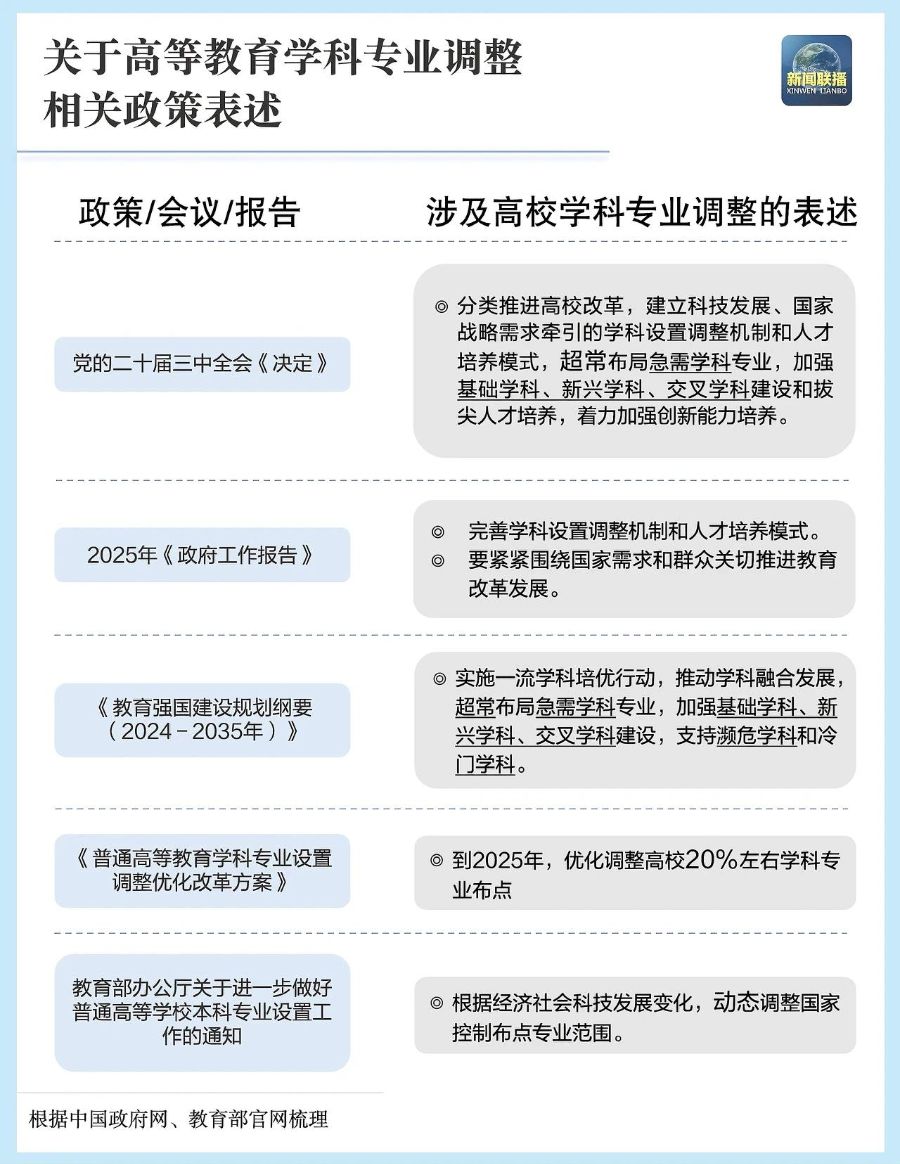
Core Insights - The article discusses the recent adjustments in undergraduate programs in China, highlighting the addition, removal, and restructuring of 3,424 programs across the country, with a focus on "strategic urgent" and "emerging interdisciplinary" fields [1][3]. Group 1: Professional Adjustments - The Ministry of Education's recent report indicates a significant shift in professional adjustments, moving from traditional "addition and subtraction" to a more in-depth "structural adjustment and integration" approach [3]. - In the past five years, "Double First Class" universities have added a total of 1,068 new programs, with engineering disciplines leading the way at 501 programs, accounting for nearly half of the total [4][5]. Group 2: Key Trends in New Programs - The majority of new engineering programs focus on technological innovation and engineering applications, aligning with the national strategy for "new engineering" development [7]. - Artificial intelligence has emerged as the most popular new program, with 41 "Double First Class" universities establishing this major, reflecting a strong emphasis on talent cultivation in this field [7][8]. - The new program "Energy Storage Science and Engineering" has gained traction, focusing on renewable energy and materials, and is seen as crucial for achieving carbon neutrality goals [8]. Group 3: Interdisciplinary and Emerging Fields - A notable trend is the rise of interdisciplinary programs, with 203 new programs incorporating "intelligent" and "smart" themes, primarily within engineering [11]. - New programs such as "Smart Agriculture" and "Smart Transportation" emphasize the digital transformation of traditional industries, indicating a broadening of the "intelligent+" concept beyond engineering [12]. Group 4: Health and Sports Programs - The "Exercise Training" program has seen a surge, with 25 new additions, driven by the "Healthy China" initiative and the integration of sports and education [16][17]. - New health-related programs like "Infant Development and Health Management" and "Geriatric Medicine and Health" are emerging, reflecting societal needs [22]. Group 5: Program Cancellations - Despite the increase in new programs, there is a noticeable trend of program cancellations, with "Double First Class" universities like Shandong University and Sichuan University removing numerous programs due to factors such as low enrollment and outdated relevance [30][33]. - The adjustments are driven by the need for high-quality employment outcomes, faculty resource considerations, and alignment with current industry demands [36][39]. Group 6: Future Directions - The establishment of new programs is increasingly aligned with national strategic needs, such as the recent addition of "Low-altitude Technology and Engineering" to support the burgeoning low-altitude economy [24]. - The ongoing adjustments in higher education programs reflect a broader commitment to enhancing the quality and relevance of education in response to evolving societal and economic demands [41].
山东58所高校新增152个专业点
Qi Lu Wan Bao· 2025-05-07 21:07
Group 1 - The Ministry of Education announced the results for the 2024 undergraduate program approvals, with a total of 1,839 new program points added, 157 programs adjusted, 2,220 programs discontinued, and 1,428 programs revoked, indicating a significant optimization of academic programs [2][3] - Among the new programs, engineering saw the highest addition with 940 new points, followed by science with 193, agriculture with 46, and medicine with 16, making up 65% of the total new programs [2] - The artificial intelligence program was the most added, with 91 new points, accounting for approximately 5% of all new programs, involving both "Double First-Class" and non-"Double First-Class" universities [2][3] Group 2 - Other notable new programs included smart construction, big data management, smart manufacturing engineering, robotics engineering, and integrated circuit design, each with over 30 new points [3] - The updated directory also included 29 new programs, with low-altitude technology and engineering being the most popular, offered by six universities [3] Group 3 - In Shandong province, 58 universities added a total of 182 new program points, with 152 being actual new programs, and the most added program was integrated circuit design [4][5] - Shandong's universities have a unique focus, with only 5 new artificial intelligence programs added, as the province has already established a strong foundation in this area since 2018 [5] Group 4 - Nationwide, 49 universities adjusted the duration of some five-year programs to four years, primarily in landscape architecture and urban planning [6] - This adjustment aligns with the Ministry of Education's initiative to optimize program structures and talent cultivation in response to new development patterns [6][7]

上海交大“万人大院”重组,今年我国本科专业有这些调整
Di Yi Cai Jing· 2025-04-29 12:24
Core Points - The newly published "Directory of Undergraduate Programs in General Higher Education" includes 93 categories and 845 programs, with 29 new programs added [2][6] - Major universities like Peking University, Shanghai Jiao Tong University, and Fudan University have made significant reforms in their departments, focusing on interdisciplinary education and emerging fields [2][4][5] Group 1: New Programs and Department Reforms - The new programs include Intelligent Molecular Engineering, Medical Devices and Equipment Engineering, and Spatiotemporal Information Engineering, among others [2][7] - Shanghai Jiao Tong University has split its renowned Electrical and Electronic Engineering College into four independent colleges to better support talent development in artificial intelligence and related fields [3][4] - Fudan University has established six new innovative engineering colleges, each led by top scientists, adopting an interdisciplinary talent training model [4][7] Group 2: Implications for Talent Development - The restructuring aims to enhance the quality of talent produced, focusing on strategic scientists who can lead industry advancements [4][5] - The changes are expected to create a more competitive environment for students, potentially leading to a greater emergence of talent [4][6] - The emphasis on interdisciplinary programs aligns with current industry needs, moving away from traditional single-discipline education [5][6] Group 3: Impact on Student Enrollment - The adjustments in departments and new program offerings will significantly influence the 2025 college entrance examination candidates, with potential shifts in enrollment patterns [6][7] - The demand for graduates in IT, internet, and gaming sectors remains high, with a projected 20% to 25% increase in job openings for these fields [6][7] - The newly added programs are designed to meet national strategic needs and adapt to market demands, including areas like carbon neutrality and health care [7][8]
教育部发布29种本科新专业,含游戏艺术设计、舞蹈治疗等
Xin Jing Bao· 2025-04-22 10:36
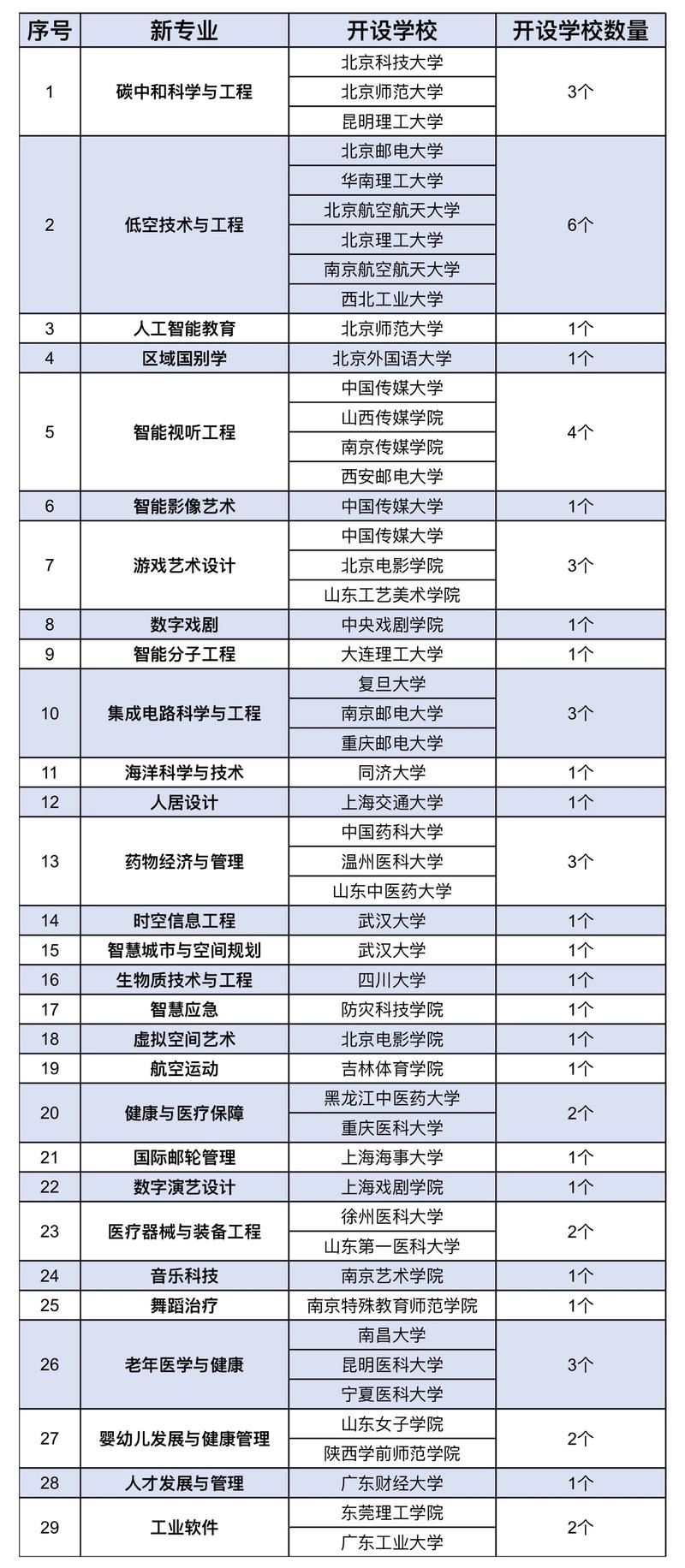
Core Viewpoint - The Ministry of Education has updated the undergraduate program directory for 2025, adding 29 new majors to better align with national strategic needs and high-quality development [1][4]. Group 1: New Majors Overview - The new directory includes 93 categories and 845 majors, with a focus on responding quickly to national strategies and market demands [1][4]. - The most frequently added major is "Low Altitude Technology and Engineering," with six universities offering it [1][4]. Group 2: Distribution of New Majors - The new majors include "Carbon Neutrality Science and Engineering," offered by five universities, and "Artificial Intelligence Education," offered by one university [2][4]. - "Regional Studies" has the highest number of universities offering it, with 11 institutions [2][4]. - Other notable new majors include "Smart Audio-Visual Engineering," "Game Art Design," and "Health and Medical Security," with varying numbers of universities offering them [2][3][4]. Group 3: Strategic Alignment - The new majors reflect the government's focus on strategic areas such as carbon neutrality, marine science, and health management, aligning educational offerings with technological advancements and market needs [4][5]. - The Ministry of Education has established a mechanism for rapid response to strategic needs, allowing for immediate establishment of relevant programs in high-priority areas [4].
多家高校开启新文科探索,AI浪潮下的坚守与融合
Xin Jing Bao· 2025-04-12 14:10
高校学科专业正在加快优化调整 复旦大学即将开启的改革措施社会反响强烈。日前,迎来建校120周年的复旦大学将2025年度的关键词 确定为"改革·破局",提出要打造"新工科"和"新文科",其中学校新的招生比例,文理医工和交叉门类各 占20%。 日前,复旦大学宣布进行"大手术"式改革,以及国内各高校的专业设置调整优化引发社会关注。文科发 展相关话题的关注度不断升温,社交媒体上关于文科生就业前景及学科价值的讨论持续发酵,引发了一 场对学科调整的重新审视。 高校纷纷进行专业调整背后的逻辑是什么?未来文科专业的转型路径和文科生的核心竞争力是什 么?……事实上,我国早已提出"新文科"且已有高校开启新文科探索,相关专家表示,未来文科专业的 孩子仍然具备多元化的出路,但是高校的传统文科需要变革、改进。 复旦大学这一重大调整也被视为高校发展的风向标。一时间,这一消息被坊间解读为"复旦将降低文科 招生比例"。复旦大学校长、中国科学院院士金力在接受媒体采访时对该问题回应称,今年复旦本科生 招生计划,文科确实有所减少。他进一步指出,人文社科背景的培养项目容量约占复旦本科2025级的 30%,但内涵和模式有很大的转型升级。传统文科的招生 ...