
资本市场投融资综合改革

Search documents
资本市场投融资改革“动刀”
Guo Ji Jin Rong Bao· 2025-12-31 07:37
Core Insights - The continuous deepening of capital market investment and financing reforms has been a key focus of the Central Economic Work Conference for two consecutive years, indicating a significant commitment to advancing these reforms in the "14th Five-Year Plan" period [1][2][3] Group 1: Reform Objectives - The reform aims to transition from a "single financing channel" to a "coordinated investment and financing ecosystem," with A-share total market value exceeding 100 trillion yuan and long-term funds holding over 21 trillion yuan in circulating market value [1] - The emphasis on "sustained deepening" signifies a shift towards long-term, stable policy execution and a holistic approach to reform, moving from institutional building to ecosystem cultivation [2][3] Group 2: Key Areas of Focus - The reform will focus on enhancing the inclusivity and adaptability of capital market systems, addressing structural contradictions through coordinated investment and financing [2][4] - Key areas for reform include improving the registration system, enhancing the quality of listed companies, and developing a long-term investment ecosystem to shift the focus from "financing" to "investment" [6][7] Group 3: Investment and Financing Balance - The core of the reform is to address the imbalance in investment and financing structures, moving from indirect financing dominated by banks to a more balanced approach that emphasizes direct financing [4][5] - The goal is to create a virtuous cycle of technological innovation, industrial upgrading, and wealth growth for residents by increasing the proportion of direct financing and reducing reliance on the banking system [5] Group 4: Implementation Strategies - Strategies for implementation include optimizing the entire lifecycle of financing services, enhancing the mechanisms for delisting, information disclosure, and dividend repurchase, and developing regional equity markets [6][7] - Establishing a special mechanism to support key technological breakthroughs and developing private equity secondary markets to broaden exit channels are also critical components of the reform [7]
2026:26个关键词里的未来(一)
Di Yi Cai Jing· 2025-12-30 13:14
Group 1: China's Trade Balance - China's total goods trade has maintained the world's largest position for eight consecutive years, with exports accounting for over 14% of global trade and imports increasing from 9.7% in 2012 to 10.5% in 2024 [1] - The internal motivation for achieving trade balance comes from the continuous upgrading of trade structure, with high-tech products making up 18.2% of exports [1] - China is transitioning from a "world factory" to a "global market," reducing the overall tariff level to 7.3% and offering zero-tariff treatment to the least developed countries [1] Group 2: Employment and Consumption Impact - Foreign trade and foreign investment have directly or indirectly supported over 200 million jobs in China, with more than 80 million being migrant workers [2] - The import of over $250 billion in consumer goods each year has significantly enriched domestic market supply and consumer choices [2] - The upcoming China International Import Expo aims for a transaction value of $83.49 billion, signaling China's commitment to opening its market to global quality products [2] Group 3: 2026 FIFA World Cup - The 2026 FIFA World Cup will be jointly hosted by the USA, Canada, and Mexico, marking the first time three countries will co-host the event, with the number of participating teams increasing from 32 to 48 [3][4] - A total of $727 million will be allocated for bonuses and subsidies, with a 50% increase compared to the previous tournament [4] - The economic output from the event is expected to reach up to $47 billion, although hosting cities may face increased financial burdens due to high operational costs [4] Group 4: RMB Exchange Rate Outlook - The offshore RMB exchange rate against the USD reached a critical point, touching 6.99, indicating a strong appreciation trend since late November 2025 [5] - Factors supporting the RMB's appreciation include a weaker USD index, resilient domestic exports, and improved asset allocation value [5] - The RMB exchange rate is expected to exhibit two-way fluctuations in 2026, influenced by various internal and external variables [6] Group 5: Monetary Policy Direction - The central economic work conference emphasized the need for a moderately loose monetary policy, focusing on maintaining liquidity and promoting stable economic growth [7] - The use of various policy tools, including interest rate cuts and reserve requirement ratio adjustments, will be flexible and efficient to match economic growth and price expectations [8] - Structural monetary policy tools will be highlighted to support domestic demand, technological innovation, and small and medium enterprises [8] Group 6: Financial Risk Management - The National Financial Supervision Administration has prioritized the prevention and resolution of financial risks, particularly illegal financial activities [10] - Common illegal financial activities include fraudulent fundraising and misleading investment schemes that threaten market stability and public safety [11] - A comprehensive regulatory framework is being established to combat illegal financial activities and protect consumer interests [11] Group 7: Capital Market Reforms - The central economic work conference has called for continued deepening of capital market reforms, focusing on the coordination of investment and financing [12] - Reforms will include enhancing listing standards for new industries, improving merger and acquisition support channels, and promoting long-term investment products [13] - A new regulatory framework for listed companies is being developed to ensure better governance, information disclosure, and investor protection [14][15] Group 8: Insurance Capital Market Participation - Insurance capital investment in the stock market has significantly increased, with core equity assets reaching 5.59 trillion yuan by the end of Q3 2025 [16] - Policies encouraging insurance companies to invest in A-shares have been implemented, with expectations for substantial new equity investments in 2026 [17] - The focus for insurance capital will likely be on high-dividend stocks and growth stocks that align with national development goals [17][18] Group 9: AI Investment Landscape - The AI investment landscape is characterized by high capital expenditures from major cloud service providers, raising concerns about the sustainability of returns [19] - The global AI infrastructure investment is projected to reach $5 trillion to $8 trillion by 2030, with the potential for significant economic impact if growth can exceed historical trends [19][20] - Different investment strategies are emerging in the US and China, with the former focusing on cutting-edge technology and the latter on cost-effective applications [20]
田轩:以深化改革巩固资本市场向好发展势头(财经观)
Xin Lang Cai Jing· 2025-12-29 01:36
Core Viewpoint - The article emphasizes the need to enhance the attractiveness and inclusiveness of the capital market to better serve as a hub for capital allocation, aligning with technological and industrial demands, and empowering technological innovation with patient capital [2][3][4]. Group 1: Capital Market Reforms - The "14th Five-Year Plan" suggests improving the inclusiveness and adaptability of capital market systems, and establishing a coordinated investment and financing function [2][3]. - Recent central economic work meetings have highlighted the continuous deepening of comprehensive reforms in capital market investment and financing [2][3]. - The focus is on long-term market mechanism construction and ecological optimization, as indicated by the consistent policy direction from recent political meetings [2][3]. Group 2: Investment Side Enhancements - Key strategies to enhance the investment side include optimizing return mechanisms, fostering long-term investments, and implementing institutional openness [4][11]. - Strengthening the investment return mechanism is crucial for activating domestic capital and ensuring that listed companies prioritize investor returns [4][11]. - Creating a more favorable investment environment for long-term funds, such as social security funds and insurance capital, is essential for increasing market participation [4][11]. Group 3: Financing Side Enhancements - The core of enhancing the financing side lies in constructing a "multi-layered, widely covered, and differentiated" market system to meet the financing needs of various types and stages of enterprises [5][12]. - Reforms in the "Two Innovation Boards" are aimed at broadening financing channels for innovative enterprises [5][12]. - Establishing a comprehensive financing service system that covers the entire lifecycle of enterprises is necessary, along with promoting market-oriented reforms in mergers and acquisitions [5][12]. Group 4: Risk Management - Continuous prevention and resolution of key area risks are emphasized as a fundamental requirement for the stability and long-term sustainability of the capital market [6][13]. - The need for improved risk warning and emergency response mechanisms is highlighted to enhance the identification and response capabilities for systemic risks [6][13]. - Encouraging companies to improve operational efficiency and profitability, while ensuring a competitive market ecology through effective delisting mechanisms, is essential [6][13]. Group 5: Collaborative Efforts - The success of capital market reforms relies on collaborative efforts from various stakeholders, including policy makers, listed companies, intermediaries, and investors [6][13]. - Creating a favorable social environment for capital market reforms is crucial for ensuring stable development [6][13]. - The ongoing reforms aim to enhance the capital market's role in effectively allocating resources and supporting technological innovation, contributing to the broader goals of national modernization [6][13].

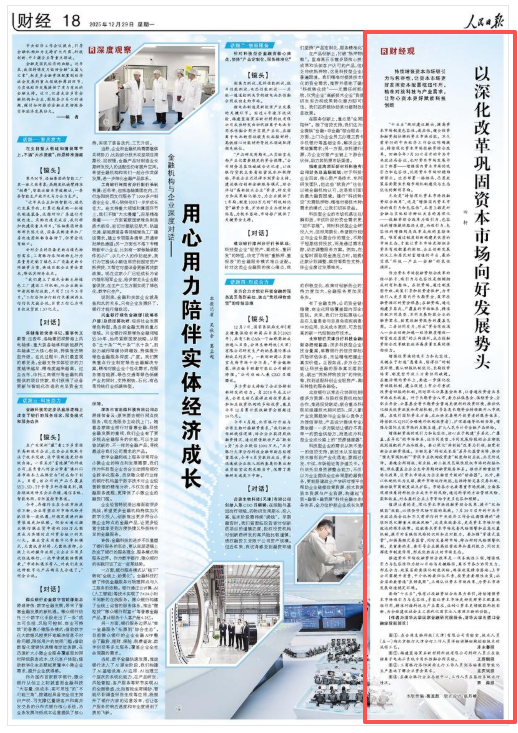
以深化改革巩固资本市场向好发展势头(财经观)
Ren Min Ri Bao· 2025-12-28 22:04
Group 1 - The core viewpoint emphasizes the need to enhance the attractiveness and inclusiveness of the capital market to better serve as a hub for capital allocation and to align with technological and industrial demands, ultimately empowering technological innovation with patient capital [1][5] - The "14th Five-Year Plan" suggests improving the inclusiveness and adaptability of the capital market system, and the recent Central Economic Work Conference highlighted the importance of deepening comprehensive reforms in capital market investment and financing [1][5] - The relationship between financial and real economies is reiterated, where comprehensive investment and financing reforms provide support for enhancing attractiveness and inclusiveness, which in turn reflects the effectiveness of these reforms [1][5] Group 2 - The attractiveness and inclusiveness of the investment side are crucial for creating an environment that encourages long-term investment, which involves optimizing return mechanisms, nurturing long-term investments, and implementing institutional openness [2][3] - On the financing side, a multi-tiered and widely covered market system is essential to meet the financing needs of various types of enterprises at different development stages, thereby broadening the coverage of investment and financing services [2][4] - The positive cycle of "effective capital inflow—accelerated enterprise innovation—enhanced economic quality and efficiency—wealth effect realization" is driven by the synergy between investment and financing reforms [2][4] Group 3 - To enhance the investment side's attractiveness, it is necessary to strengthen the investment return mechanism and deepen public fund reforms to allow ordinary investors to share in market growth [3] - For long-term capital, creating a more convenient investment environment for social security funds, insurance funds, and public funds is essential, along with optimizing related investment policies and assessment mechanisms [3] - Attracting international capital requires improving the service system for foreign investors and enhancing mechanisms like QFII and the Shanghai-Shenzhen-Hong Kong Stock Connect to increase connectivity with international markets [3] Group 4 - Enhancing the financing side's attractiveness involves constructing a differentiated market system that allows various enterprises to find suitable products and services, with a focus on deepening reforms in the "Two Innovation Boards" [4] - The establishment of a financing service system that covers the entire lifecycle of enterprises is crucial, along with promoting market-oriented reforms in mergers and acquisitions to support enterprise transformation [4] - Market efficiency can be improved through mechanism optimization, including refining trading mechanisms and expanding pilot programs for market makers, while respecting market rules and managing risks scientifically [4]
A股多项纪录收入囊中,滞涨券商放量躁动,顶流券商ETF(512000)上探近2%,2026或迎四大催化
Xin Lang Cai Jing· 2025-12-28 11:30
Core Viewpoint - The brokerage sector is experiencing a resurgence, with the top-performing brokerage ETF (512000) showing a price increase and significant trading volume, indicating renewed investor interest despite a lackluster performance throughout the year [1][9]. Group 1: Market Performance - The brokerage ETF (512000) has seen a year-to-date increase of only 3.96%, significantly lagging behind the broader market indices, which have shown much higher gains [3][11]. - The sector's price-to-book ratio (PB) stands at 1.5 times, which is at a low level compared to the historical average over the past decade [3][11]. - Individual stocks within the sector have shown positive movements, with notable gains from companies like China Merchants Securities and Industrial Securities [1][9]. Group 2: Future Growth Drivers - The brokerage industry is entering a new growth cycle driven by three core factors: the service of new productive forces, the influx of long-term capital, and opportunities for internationalization [5][13]. - By 2026, the sector is expected to benefit from four catalysts: increased market activity due to the relocation of household savings, enhanced market resilience leading to improved profitability, opportunities in direct financing for tech enterprises, and ongoing mergers and acquisitions among brokerages [14][15]. - Regulatory support for the development of first-class investment banks is anticipated to further enhance the sector's valuation and growth potential [15]. Group 3: Investment Tools - The brokerage ETF (512000) is a highly efficient investment tool that passively tracks the CSI All Share Securities Companies Index, encompassing 49 listed brokerage stocks [7][15]. - The ETF has a fund size exceeding 400 billion yuan and has maintained a daily trading volume of over 10 billion yuan, making it one of the most liquid ETFs in the A-share market [7][15].
滞涨券商行情虽迟但到?顶流券商ETF(512000)放量上探近2%,机构:看好券商板块估值向上空间
Xin Lang Cai Jing· 2025-12-26 11:41
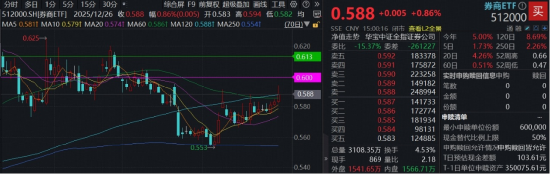
Core Viewpoint - The brokerage sector is experiencing a resurgence, driven by favorable market conditions and regulatory support, with expectations for significant growth in the coming years [3][4][11]. Group 1: Market Performance - On December 26, the brokerage sector showed active performance, with the top brokerage ETF (512000) reaching a peak increase of 1.89% and closing up 0.86%, marking three consecutive days of gains [1][9]. - The total trading volume for the day was 1.83 billion yuan, with a significant increase of over 800 million yuan compared to the previous day [1][9]. - Individual stocks mostly rose, with China Merchants Securities leading with a 5.59% increase, followed by Industrial Securities with over a 3% rise [1][9]. Group 2: Sector Growth Drivers - The brokerage industry is entering a new growth cycle, supported by three core favorable factors: serving new productive forces, long-term capital entering the market, and opportunities for internationalization [3][11]. - The total trading volume of A-shares exceeded 400 trillion yuan for the first time this year, indicating increased market activity driven by low interest rates and positive returns in the equity market [4][12]. - The resilience of the capital market and reduced volatility are expected to enhance profitability for brokerages, allowing them to capitalize on opportunities in the equity market [4][12]. Group 3: Future Catalysts - The brokerage sector is anticipated to benefit from four key catalysts by 2026: 1. Increased market activity due to the migration of household deposits and long-term investments [4][12]. 2. Enhanced profitability from a more resilient capital market [4][12]. 3. Opportunities in investment banking driven by direct financing and support for innovative enterprises [4][12]. 4. Mergers and acquisitions within the industry, leading to improved market structure and international expansion [4][12][6]. Group 4: Valuation and Market Sentiment - The brokerage sector has underperformed this year, with the ETF tracking the CSI All-Share Securities Company Index showing a modest increase of 3.96%, lagging behind the broader market [5][13]. - The current price-to-book ratio (PB) for the sector is 1.5 times, indicating a low valuation relative to historical levels [5][13]. - Analysts believe that the lack of independent catalysts and lingering pessimism from previous years have contributed to this underperformance [5][13].
中国证监会债券司副司长黄建山:支持符合条件的西部陆海新通道沿线省区市企业IPO
Zheng Quan Ri Bao· 2025-12-25 16:48
Core Viewpoint - The People's Bank of China emphasizes the importance of financial support for accelerating the construction of the Western Land-Sea New Corridor, highlighting the role of multi-level capital markets in facilitating diverse financing channels for this initiative [1] Group 1: Stock Market Support - The China Securities Regulatory Commission (CSRC) is actively supporting eligible enterprises along the Western Land-Sea New Corridor in issuing IPOs, refinancing, and mergers and acquisitions, with over 650 A-share listed companies in the region [1] - In the first 11 months of this year, the Shanghai and Shenzhen stock exchanges supported 4 IPOs from corridor enterprises, raising nearly 7 billion yuan, and facilitated 17 refinancing cases, raising about 25 billion yuan [1] - More than 300 mergers and acquisitions involving listed companies along the corridor have been supported, significantly contributing to the economic development of the region [1] Group 2: Bond Market Support - In the first 11 months of this year, the exchange market supported the issuance of nearly 700 billion yuan in corporate bonds by enterprises in the corridor, enhancing financing channels and reducing costs [2] - The exchange market has also promoted the issuance of technology innovation bonds, with over 2 trillion yuan issued since 2021, and corridor enterprises accounting for more than 260 billion yuan of this total [2] - Various specialized bonds, including green bonds and rural revitalization bonds, have been developed to support diverse financing needs of corridor enterprises [2] Group 3: Asset Securitization and REITs - The exchange market has facilitated the issuance of over 160 billion yuan in asset-backed securities (ABS) by corridor enterprises in the first 11 months, covering asset types such as infrastructure fees and small loans [2] - A total of 24 REITs for transportation and logistics projects have been promoted, raising nearly 100 billion yuan, which has led to over 500 billion yuan in new project investments [3] - 13 REIT products from corridor-related enterprises have been issued, raising over 30 billion yuan, supporting various asset types including industrial parks and energy facilities [3] Group 4: Future Directions - The CSRC plans to deepen comprehensive reforms in capital market financing, enhance the inclusiveness and adaptability of capital market systems, and better support the high-quality development of the real economy [3]
加快西部陆海新通道建设,金融如何发力支持?
Xin Hua Wang· 2025-12-25 14:57
Core Viewpoint - The recent release of the "Opinions on Financial Support for Accelerating the Construction of the Western Land-Sea New Corridor" emphasizes the role of financial services in enhancing the development of this corridor, which connects various economic regions and promotes a dual circulation economy [1][2]. Financial Support Measures - The People's Bank of China and eight other departments have proposed 21 key financial support measures aimed at enhancing the financing and settlement functions to support the high-quality development of the Western Land-Sea New Corridor [1][2]. - The measures focus on regional collaborative development, addressing common financing needs while allowing for tailored financial services based on local conditions [2]. Digital Empowerment and Logistics - The opinions highlight the integration of logistics and financial services, particularly through the enhancement of digital capabilities, which will convert data into effective financial services [2]. - There is encouragement for local governments to deepen pilot programs for railway transport document financial services, which align with the corridor's development goals [2]. Capital Market Contributions - In the first 11 months of this year, the Shanghai and Shenzhen stock exchanges supported four initial public offerings (IPOs) for corridor-related companies, raising nearly 7 billion yuan, and facilitated refinancing for 17 companies, raising about 25 billion yuan [3]. - The China Securities Regulatory Commission plans to continue reforms in the capital market to support various financing tools, enhancing the service capabilities for the corridor's construction [3]. Foreign Exchange Policy Enhancements - The opinions aim to create a more convenient, open, secure, and intelligent foreign exchange policy environment to improve cross-border settlement efficiency and reduce trade settlement costs [3]. - The State Administration of Foreign Exchange has optimized processes for foreign investment and relaxed restrictions on overseas direct investment to facilitate participation in corridor construction [3]. Implementation and Coordination - Local governments, such as Chongqing, are developing financial service center plans to enhance cooperation among financial institutions along the corridor, ensuring effective implementation of the proposed policies [5].
聚焦中央经济工作会议 | 持续深化资本市场投融资综合改革
Xin Hua She· 2025-12-23 11:24
Group 1 - The core viewpoint emphasizes the importance of "continuously deepening the comprehensive reform of capital market investment and financing" for the healthy circulation of the capital market and overall economic development in China [1] - The 2024 Central Economic Work Conference highlights the need to enhance the inclusiveness and adaptability of capital market systems, aiming to address bottlenecks in long-term capital entering the market [1] - The focus on comprehensive reform indicates a commitment to improving the overall stability and coordination of the capital market, enhancing its attractiveness and competitiveness [1] Group 2 - Recent years have seen comprehensive investment and financing reform become a key focus of capital market reform, with significant measures taken to optimize public fund reforms and encourage long-term capital market entry [2] - As of the end of August this year, various types of long-term funds held approximately 21.4 trillion yuan in A-share market value [2] - In the financing aspect, initiatives such as the "16 Articles for Science and Technology Innovation" and the establishment of the Science and Technology Innovation Board have been introduced, leading to a significant increase in A-share refinancing, which surpassed 800 billion yuan in the first three quarters of this year, a year-on-year increase of 258% [2]
聚焦中央经济工作会议|持续深化资本市场投融资综合改革
Xin Hua She· 2025-12-23 09:12
Group 1 - The core viewpoint emphasizes the importance of deepening the comprehensive reform of investment and financing in the capital market for the healthy circulation of the economy [1] - The 2024 Central Economic Work Conference aims to enhance the inclusiveness and adaptability of the capital market system, addressing the bottlenecks for long-term funds entering the market [1] - The focus on comprehensive reform highlights its significance for the development of the capital market and the broader Chinese economy, signaling a commitment to improving the overall stability and coordination of the market [1] Group 2 - Recent reforms in investment have included optimizing public fund reforms and enhancing the mechanisms for venture capital, with a total of approximately 21.4 trillion yuan held by various long-term funds in A-shares as of the end of August [2] - On the financing side, measures such as the "16 Articles for Science and Technology Innovation" and the establishment of the Science and Technology Innovation Board have been introduced, with A-share refinancing exceeding 800 billion yuan in the first three quarters of this year, a 258% increase year-on-year [2] - The ongoing comprehensive reform of investment and financing is expected to enhance the inclusiveness and adaptability of the capital market, allowing quality enterprises and various funds to better realize their value and support broader economic development [2]