量化私募

Search documents
逐渐边缘的主观多头
远川投资评论· 2025-12-10 07:23
Core Viewpoint - The recent draft of the "Guidelines for Performance Assessment Management of Fund Management Companies" has sparked significant discussion in the public fund industry, particularly due to its stipulation that fund managers with performance below the benchmark by over 10% for three years and negative profit margins must see a salary reduction of at least 30% [2][3]. Group 1: Impact on Fund Managers - Nearly a thousand active equity fund managers have underperformed the benchmark by over 10% in the past three years, including notable figures like Zhang Kun and Ge Lan [2]. - Concerns about talent loss in public funds are rising, as private equity firms offer more attractive compensation structures [2][4]. - The shift towards quantitative private equity is reshaping the landscape, with a focus on performance stability becoming paramount for high-net-worth individuals [9]. Group 2: Performance Comparison - In 2023, the CSI 300 index rose by 16% and the Hang Seng index by 26%, yet subjective long-only funds have not seen a corresponding increase in net subscriptions [6]. - Subjective long-only funds achieved a 33.88% increase, but this was outperformed by quantitative strategies, which saw increases of 54.74% and 46.86% for specific indices [6][12]. - The evolving preferences of wealth management clients indicate a shift towards quantitative strategies, which are perceived as more stable and reliable [9][15]. Group 3: Strategic Evolution - The fundamental difference between subjective and quantitative strategies lies in their narratives; subjective strategies focus on mean reversion, while quantitative strategies emphasize iteration and adaptability [9][10]. - Quantitative private equity has evolved from linear models to more complex non-linear models, enhancing their ability to adapt and recover from market downturns [10][12]. - The ability of quantitative firms to offer a diverse range of products tailored to various risk appetites is a significant advantage over traditional subjective strategies [12][13]. Group 4: Future of Subjective Strategies - The future of subjective long-only strategies may require deeper asset research and more selective client engagement to remain competitive [20][21]. - The pressure on subjective fund managers to justify their investment choices is increasing, particularly in light of the performance of quantitative strategies [15][20]. - The need for a longer investment horizon and a more stable funding structure is critical for subjective managers to achieve long-term success [14][21].





谁拿走了沐曦股份最多的筹码?
财联社· 2025-12-09 09:15
Core Viewpoint - The article highlights the competitive nature of the offline subscription for Muxi Co., with significant interest from institutional investors, indicating a strong demand for shares in the technology sector [1][2]. Group 1: Subscription and Allocation Details - Muxi Co. had a total of 401 million shares issued at a price of 104.66 yuan per share, raising approximately 4.197 billion yuan, with a total offline subscription amounting to 571.69 million shares [1]. - The offline allocation structure shows that 269 institutional investors participated, with public funds, insurance asset management, and securities asset management dominating the allocation [3][4]. - A total of 85.83% of the offline subscription volume came from A-class investors, who received 98.04% of the total offline allocation, indicating a strong preference for long-term holding [3][4]. Group 2: Institutional Participation - Major public funds accounted for over half of the total allocation, with 94 public funds participating and receiving 1.339 million shares, amounting to approximately 1.402 billion yuan [4][5]. - Notable public funds such as E Fund, Southern Fund, and ICBC Credit Suisse were among the top participants, with significant allocations [4][5][6]. - Insurance funds also played a crucial role, collectively acquiring about 404.70 million shares, with an average of 5,000 shares per product, indicating a strategic long-term investment approach [7][8]. Group 3: Private Fund Participation - Private funds, particularly quantitative funds, adopted a strategy of broad participation with smaller allocations, resulting in limited but widespread involvement [10][12]. - A total of 110 private funds participated, acquiring approximately 367,500 shares, which accounted for a small portion of the total allocation [12][13]. - The article notes a trend where larger private funds dominate the allocation, while smaller funds tend to participate in a more fragmented manner [12][13]. Group 4: Market Implications - The allocation structure reflects a growing trend in the technology IPO market, where long-term institutional investors are complemented by more agile private funds, creating a balanced investment ecosystem [13]. - The combination of long-term capital from public and insurance funds with the liquidity provided by private funds is seen as a stabilizing factor for stock prices post-IPO [9][13].

私募发行年末冲刺,量化巨头引领备案潮
Huan Qiu Wang· 2025-12-07 03:11
Core Insights - The A-share market is experiencing a surge in private fund registrations, with November seeing a nearly 30% month-on-month increase, marking the second-highest record of the year [1] - Quantitative private funds are leading this registration wave, with major players dominating the top of the registration list, indicating their significant role in this trend [1] Group 1: Private Fund Registration Data - A total of 1,285 private securities products were registered in November, a substantial increase from 994 in October, reflecting a 29.28% growth [1] - This increase demonstrates private institutions' strong willingness to raise funds before year-end, laying a foundation for future market conditions [1] Group 2: Market Sentiment and Strategy - Private institutions are optimistic about future market prospects, believing that current equity asset valuations are reasonable, prompting them to register products to seize upcoming market opportunities [1] - The continuous decline in risk-free returns is driving investors to shift funds towards higher-yielding private securities products [1] - The overall performance of private products this year, particularly in quantitative strategies, has bolstered confidence among channels and high-net-worth clients [1] Group 3: Strategy Breakdown - Stock strategies remain the dominant focus for private institutions, with 849 registrations in November, accounting for 66.07% of total registrations [3] - There is a growing demand for diversified asset allocation, with multi-asset strategies and futures/derivatives strategies also maintaining high interest, collectively representing nearly one-quarter of registrations [3] Group 4: Quantitative Private Fund Performance - Quantitative private funds registered 565 products in November, making up 43.97% of all registered products, indicating that one in every two private products is quantitative [3] - The core strategy for quantitative private funds is stock strategies, with 402 registrations, nearly half of the total stock strategy registrations [3] - Quantitative long strategies, particularly index enhancement and quantitative stock selection, are prominent, with 310 registrations, signaling a clear intent to capture beta returns in the A-share market [3] Group 5: Industry Dynamics - The registration data highlights the "Matthew Effect" in the private fund industry, with 30 out of the 49 active institutions managing over 10 billion, representing more than 60% [4] - The leading position of large quantitative private funds is attributed to regulatory guidance, the competitive edge of top institutions in research and branding, and their outstanding performance this year [4] - Despite the dominance of larger firms, some smaller institutions are showing vitality, indicating that differentiated competitive advantages can still provide growth opportunities in a consolidating market [5]

一场金融圈盛会!超200家私募齐聚,看好2026年权益市场
Zheng Quan Shi Bao Wang· 2025-12-04 12:53
Core Insights - The conference organized by Founder Securities aims to create a professional exchange platform for over 200 private equity firms, promoting healthy interactions within the private equity industry and efficient connections with the capital market [1][2] Group 1: Company Developments - Founder Securities reported a revenue of 9.082 billion yuan for the first three quarters of the year, a year-on-year increase of 67.17%, and a net profit attributable to shareholders of 3.799 billion yuan, up 93.31% [2] - The company is transitioning into a wealth management-focused comprehensive brokerage, concentrating on four major business segments: "large wealth, large investment transactions, large asset management, and large institutions" [2][3] - Founder Securities has established a comprehensive private equity service system covering the entire lifecycle of private equity funds, successfully incubating 44 quality managers through its seed fund initiative [2][6] Group 2: Industry Trends - The private equity industry in China has seen two significant changes this year: a strong return of quantitative private equity, with the number of billion-yuan quantitative firms surpassing subjective strategies for the first time, and a recovery in performance for established subjective private equity firms due to a stable market style [5][4] - As of October 2025, there are 19,367 active private equity fund managers in China, managing a total of 22.05 trillion yuan, with the number of billion-yuan private equity firms exceeding 100 [5] Group 3: Future Outlook - Founder Securities' Chief Economist, Yan Xiang, forecasts a resilient Chinese economy with a GDP growth of 5.2% in the first three quarters of 2025, and anticipates a shift in the capital market towards a profit-driven phase by mid-2026 [7][8] - Investment opportunities are expected to arise in technology growth sectors and consumer markets as the profit cycle rebounds and price corrections occur [8] Group 4: AI and Investment Opportunities - The conference featured discussions on the transformative impact of AI on investment strategies, with insights from industry leaders highlighting the shift towards efficiency and innovation in corporate behavior [9][10] - AI is reshaping the quantitative investment landscape by enhancing research efficiency and enabling adaptive trading strategies, marking a new phase in the industry [11]

证券时报社党委委员、副总编辑汤泳:今年以来私募行业呈现两大新变化
Zheng Quan Shi Bao Wang· 2025-12-03 08:49
Core Insights - The private equity fund industry in China is experiencing significant growth, with the number of active private fund managers reaching 19,367 and total fund management scale at 22.05 trillion yuan by October 2025 [1] - The number of private securities investment fund managers is 7,592, managing a total of 7.01 trillion yuan, indicating a rising industry concentration with over 100 private equity firms managing over 10 billion yuan [1] Industry Trends - The private equity sector has become a crucial force in supporting the real economy and enhancing market vitality since its inception, reflecting a strong correlation with the development of capital markets [1] - Two notable trends have emerged in the private equity fund industry this year: - The resurgence of quantitative private equity, driven by structural market conditions and ample liquidity, with index-enhancing strategies becoming a core engine, and AI technology improving industry efficiency [1] - A recovery in performance among established subjective private equity firms, as market styles stabilize and industry logic becomes clearer, allowing these firms to regain recognition through solid research and investment practices [1] Future Outlook - The Securities Times plans to continue deepening industry research and enhancing professional services, aiming to create more high-quality platforms for communication and collaboration within the private equity fund sector [1]
万亿“天降”私募圈,一场低调的“财富迁徙潮”
3 6 Ke· 2025-12-01 00:31
中国私募证券行业,出现了一组突然 "跳高"的数据。 不是某家机构突然高速增长,也不是市场情绪彻底反转,而是整个行业的规模在一个月里被急速"抬"上 了新的台阶。 更耐人寻味的是,这种跃升并不完全能从新品数量、市场热点,或者某类风格的大幅走强中就能解释得 清楚。 从公开数据到机构端反馈,都指向了一个更深层的变化: 资金的流向变了,节奏变了。 为什么偏偏是十月?增长究竟来自哪里?又是谁在接住这些突然变重的资金? 这一切,都指向了一个更值得被重新理解的中国私募行业。 01 单月万亿增量 根据中国基金业协会的披露信息,10月的私募证券行业数据一公布,最刺眼的数字不是总规模突破7万 亿元,而是: 单月存量规模"突然"增加了一万多亿元。 比较一下两个指标就能看出这次变化的特别之处:10月新备案产品的规模只有400多亿元,属于正常水 平;但存量规模却在同一时间里放大了1.14万亿元,增幅超过17个百分点。 这种反差在私募行业里极少见,因为它意味着增长不是来自"新产品",而是"老产品"的资金和净值在同 一个月里罕见地同步抬升。 这更像是一根内部曲线的突然跳高:不是行业之外的资金在冲,而是原本已经在池子里的资金,在10月 这个节 ...
私募业,最新规模揭晓!
中国基金报· 2025-11-28 11:27
Core Insights - The total scale of private equity products has reached a historical high of 22.05 trillion yuan as of October 2025, with 19,367 registered private fund managers and 137,905 funds [2][4] - The scale of securities private equity has surpassed 7 trillion yuan for the first time, marking a significant milestone [3][4] - The private equity industry is experiencing increased regulatory scrutiny, leading to a faster industry cleanup, with 1,053 private fund managers deregistered in 2025 [2][4][8] Group 1 - As of October 2025, the number of registered private fund managers is 19,367, including 7,592 securities private fund managers, 11,594 private equity and venture capital fund managers, 6 asset allocation fund managers, and 175 other private investment fund managers [4] - In October alone, 1,389 new private funds were registered, with a total new scale of 67.01 billion yuan, predominantly in securities private funds [4][5] - The recent market upturn has positively impacted private fund performance, particularly among large private funds, attracting more capital and leading to active new product registrations [4][5] Group 2 - The private equity industry is transitioning from a focus on quantity to a focus on quality, with a notable decrease in the number of securities private fund managers from 8,059 in October 2024 to 7,592 in October 2025 [8] - The concentration of private fund managers is increasingly evident, with 72.34% of registered managers located in major cities such as Shanghai, Beijing, and Shenzhen [9] - The number of large private equity firms is on the rise, with quantitative private equity becoming a significant force, comprising 48.67% of the 113 large private equity firms [10][12]

私募最新10强基金经理出炉!九坤、幻方、复胜创始人排名居前!
Sou Hu Cai Jing· 2025-11-20 06:46
Core Insights - The article highlights the performance of private fund managers in the A-share, Hong Kong, and US stock markets, as well as in commodities like gold and silver, showcasing the top-performing managers for the year 2025 [1][2] Group 1: Performance Overview - As of October 2025, there are 565 fund managers with at least three products showing performance data for the year, with a median return of approximately 24.32%, outperforming the Shanghai Composite Index's 18% [1][2] - Among these, 16 fund managers achieved returns above ***%, while 81 managers exceeded ***% [1] Group 2: Fund Manager Rankings by Scale - In the over 100 billion category, 77 fund managers were identified, with the top 10 achieving returns above ***%. The top managers include Jiang Yunfei, Ma Zhiyu, and Lu Hang, with strategies primarily focused on stocks [3][4] - For the 50-100 billion category, 51 fund managers were noted, with the top five including Tong Xun, Wang Shichao, and Cai Zhijun, all from subjective private equity firms [8][9] - In the 20-50 billion category, 87 fund managers were listed, with the top five being Yuan Hao, Huang Litong, and Zhai Jingyong, all from subjective private equity firms [11][12] - The 10-20 billion category saw 77 fund managers, with He Zhenquan from Liangli Private Equity taking the top spot [14][15] - In the 5-10 billion category, 95 fund managers were identified, with Liu Xianglong, Luo Huasen, and Wu Tianzeng leading the rankings [17][18] - For the under 5 billion category, 178 fund managers were noted, with Yang Zhongguang, Xie Libo, and Chu Fan as the top performers [20][21] Group 3: Notable Fund Managers - Lu Hang, with 20 years of experience, focuses on growth stock investments and has received multiple awards [5] - Xu Jin from Ningbo Huansheng Quantitative is a partner and has a strong background in strategy research and technical development [6] - Wang Chen from Jiukun Investment has a notable academic background and experience in quantitative hedge funds [7] - Cai Zhijun from Shengqi Asset has a solid foundation in macroeconomics and practical experience in investment management [10] - He Zhenquan from Liangli Private Equity has over 20 years of experience in securities and industry investment [16] - Wu Tianzeng from Zhongying Investment has extensive research experience in TMT and high-end manufacturing sectors [19]
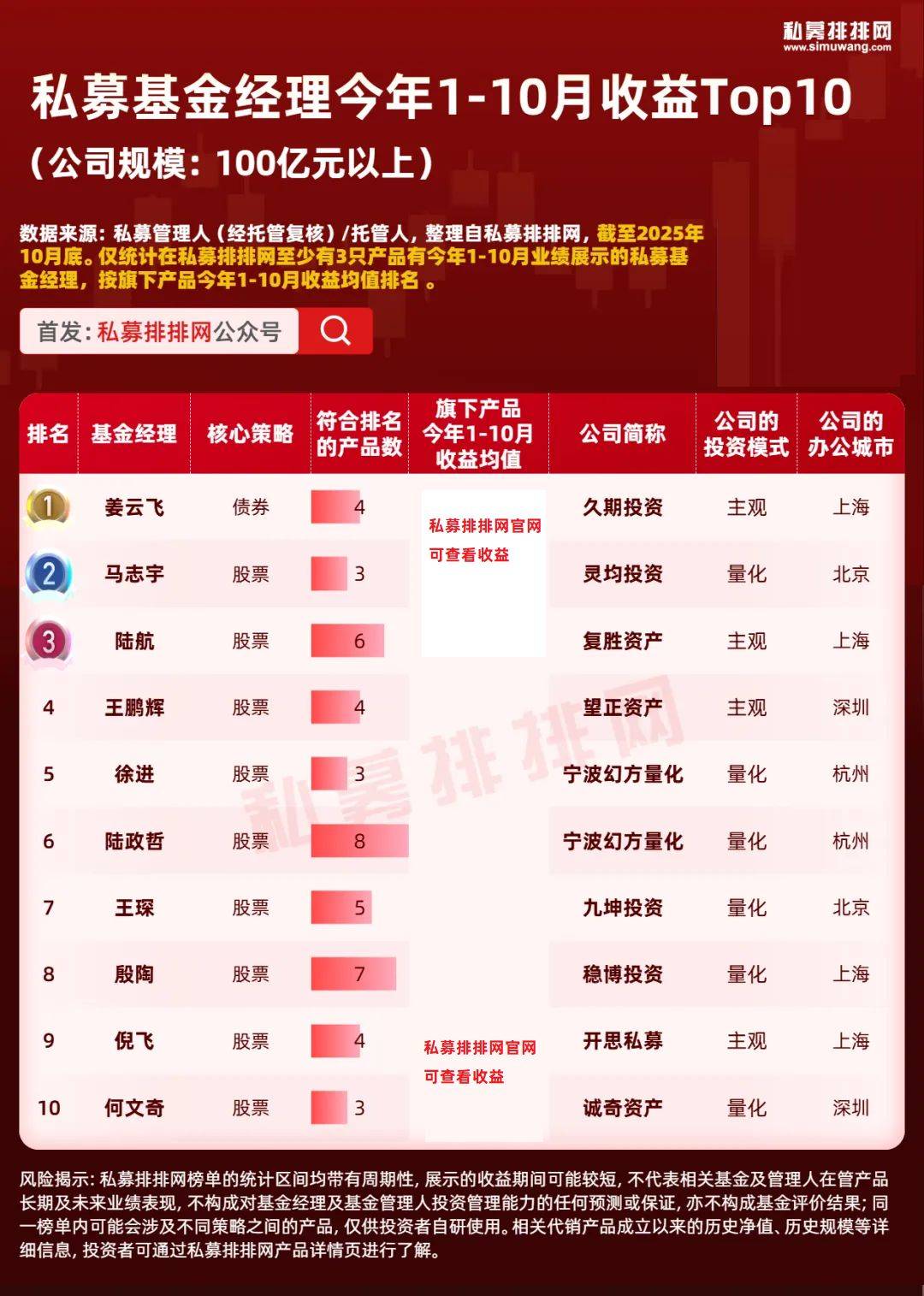
2025量化私募人才大扩招!未来3-5年如何演进?蒙玺、鸣石、因诺、世纪前沿等十余家私募研判!
私募排排网· 2025-11-19 03:31
Core Insights - The private equity industry is undergoing a new round of capability restructuring, driven by intensified market differentiation and accelerated technological empowerment [2] - Talent acquisition and technological layout have become core competitive advantages for private equity firms, essential for navigating market cycles [2] Talent Recruitment Strategies - The number of recruits in 2025 is significantly higher than in previous years, focusing on strategy, model, and IT positions, indicating a systematic enhancement of capabilities rather than mere personnel expansion [5][6] - Companies are increasingly prioritizing the recruitment of top-tier talent globally, with initiatives like campus recruitment and AI-related positions to strengthen existing quantitative strategies and foster innovation [6][7] - The emphasis is on quality over quantity in recruitment, with a focus on candidates with strong backgrounds in AI, big data, and foundational system architecture [10][11] IT and Data Investment - Investment in IT and data infrastructure is seen as a strategic necessity for risk management and operational efficiency, with a focus on enhancing computational efficiency, data effectiveness, and system stability [16][20] - Companies have made substantial investments in computing power, with some reporting over 200 million yuan in cumulative investments to support research and strategy development [17][20] - The approach to IT investment is not merely defensive but is viewed as a proactive competitive strategy to enhance research capabilities and ensure long-term sustainability [23] Future Trends in the Industry - The private equity sector is expected to enter a phase of "refined integration" over the next 3-5 years, with a focus on engineering and precision [24] - Team structures will evolve towards a more industrialized research system, emphasizing platform building and specialized roles, with a growing demand for interdisciplinary talent [27][31] - AI technology will become a foundational element of quantitative strategies, transforming various industry segments and enhancing the overall research process [30][34]

宏观策略基金的起伏:市场风格与政策变化的影响
私募排排网· 2025-11-18 03:31
Core Viewpoint - The article discusses the performance divergence of macro strategy private equity funds in China between the first half and the second half of 2025, attributing this to changes in market sentiment and macro policy adjustments [2]. Group 1: Asset Class Performance and Driving Mechanisms - A-shares showed a modest increase of 2.76% in the first half of the year, influenced by economic slowdown and external risks, with defensive sectors being favored [3]. - In the second half, A-shares experienced a structural recovery as policies were implemented and the economy improved, leading to a shift towards aggressive allocations in technology and growth sectors [3]. - Hong Kong stocks performed strongly in the first half, with the Hang Seng Index rising approximately 20% due to foreign capital inflows and low valuation recovery, but faced a slowdown in the second half due to tightening global liquidity and economic concerns [3]. - U.S. stocks, represented by the S&P 500, saw a 5% increase in the first half, driven by large tech stocks, but faced volatility due to economic uncertainties and Fed policy expectations [7]. - The bond market experienced a yield increase early in the year due to revised expectations of monetary policy, but later saw support from improved economic fundamentals and a stable central bank stance [9]. - Gold maintained strong performance as a safe-haven asset in the first half, with prices nearing historical highs, and continued to rise in the second half amid concerns over U.S. policy uncertainty [11][12]. Group 2: Reasons for Performance Divergence in Macro Strategies - The initial slow performance of macro strategies in the first half was due to unclear policy signals and cautious investor sentiment, leading to stable or slightly declining net values [14]. - In the second half, as market signals confirmed potential rate peaks and liquidity improvements, macro strategies shifted to active positions, resulting in accelerated net value increases [14]. - Institutional funds typically enter the market after clear policy signals, contributing to the liquidity boost and asset price increases in the second half [14]. - A significant emotional shift occurred from "fear" to "expectation," allowing macro strategies to capture excess returns if they managed the timing effectively [15]. Group 3: Implications for Domestic Investors - Macro strategy funds are high-risk investments influenced by market style shifts and policy fluctuations, often facing drawdown risks during uncertain market conditions [16]. - Effective management of drawdowns and net value fluctuations in the first half indicates strong asset allocation strategies and risk management capabilities [16]. - Investors should focus on the risk management abilities of macro strategy funds, especially in uncertain market environments, rather than solely pursuing short-term high returns [16].