
私募证券投资基金

Search documents
来了就是合伙人!排排网旗下融智投资,诚邀优秀私募基金经理加入!
私募排排网· 2026-03-29 12:00
Core Viewpoint - The article emphasizes the importance of collaboration and platform support in the private equity investment sector, highlighting how融智投资 provides various resources and strategies to enhance investment opportunities and operational efficiency [8][12]. Group 1: Investment Strategies -融智投资 focuses on multi-strategy mechanisms and multi-asset allocation, allowing investment managers to develop diverse strategies collaboratively [8]. - The company supports a partnership model that shares platform resources, including brand, data, and channels, to enhance collective growth [9]. Group 2: Operational Efficiency -融智投资 leverages advanced analytical tools from its parent company to support daily investment research, ensuring that decisions are data-driven and well-supported [11]. - The company promotes a multi-channel fundraising model that includes institutional sales, direct connections with high-net-worth individuals, and online exposure, making fundraising more efficient [11]. Group 3: Platform Benefits - Joining融智投资 provides immediate access to platform empowerment, operational convenience, and brand endorsement, facilitating a more effective business development process [12][14]. - The company has over 20 years of experience in the private equity sector, which enhances its credibility and operational capabilities [13].


国泰海通 · 宏观聚焦|广义视角:存款搬家是个“伪命题”—— “居民财富何处流”研究三
国泰海通证券研究· 2026-03-26 14:00
Core Insights - The article discusses the historical migration of Chinese household wealth, indicating that a third significant migration began around 2023 under low interest and inflation conditions, with a focus on "deposits +" as the main direction [2] - It highlights that the period from 2024 to 2025 will see an average net inflow of nearly 7 trillion yuan into wealth management, insurance, and money market funds, which will serve as the main support for the outflow of deposits [2][8] - The article emphasizes that the stock market's performance in 2025 is driven more by leveraged funds rather than direct household investments, with a significant contribution from insurance funds [3][27] Group 1: Wealth Migration Characteristics - The third historical migration of wealth is characterized by a shift towards low-risk products like wealth management and insurance, while the underlying asset allocation structure has changed, allowing for indirect penetration into equity markets [2][14] - By the end of 2025, the proportion of insurance funds allocated to stocks increased from 7.5% to 10.1%, driven by policy support and market performance [14][16] - The article notes that the net inflow of funds into various asset management products, excluding valuation effects, is expected to be approximately 2.6 trillion yuan for bank wealth management, 2.7 trillion yuan for insurance, and 1.9 trillion yuan for money market funds during 2024-2025 [8][19] Group 2: Market Dynamics and Fund Flows - The stock market's rally in 2025 was primarily led by leveraged funds, with margin trading reaching a historical high of 2.5 trillion yuan, indicating a strong correlation with high-risk preference sectors like AI and semiconductors [24][26] - The article predicts that the reallocation of 8-10 trillion yuan in maturing deposits in 2026 will depend on inflation expectations, with potential for a smooth transition of "sleeping" funds into the stock market if inflation expectations rise [3][26] - The observed outflow of deposits is more about internal rebalancing within the financial system rather than a large-scale exit, with non-bank asset management products absorbing the outflow [26][27]
居民财富何处流研究三:广义视角:存款搬家是个伪命题
GUOTAI HAITONG SECURITIES· 2026-03-25 14:24
Group 1: Deposit Migration Insights - The current deposit migration phenomenon is more about internal rebalancing within the financial system rather than a large-scale outflow of funds from low-risk systems[8] - The concept of "Deposit+" is emerging as a primary direction for wealth allocation, indicating a shift towards more flexible, low-risk assets[5] - From 2024 to 2025, the average net inflow into wealth management, insurance, and money market funds is estimated to be nearly 7 trillion yuan, serving as the main support for deposit outflows[14] Group 2: Market Dynamics and Investment Behavior - In 2025, the stock and mixed fund shares increased by 331.3 billion units, indicating a cautious recovery in risk appetite among residents[20] - The insurance sector has seen a significant increase in stock allocation, rising from 7.5% at the end of 2024 to 10.1% by the end of 2025, driven by policy support and market conditions[22] - The total net inflow of resident funds into the market in 2025 is estimated at approximately 1.6 trillion yuan, primarily contributed by insurance funds, reflecting a passive rather than active risk-taking behavior[36] Group 3: Economic Outlook and Risks - The reallocation direction of 8-10 trillion yuan in maturing deposits in 2026 will depend on the evolution of inflation expectations; a significant rebound in inflation could lead to a smoother transition of "sleeping" funds into the stock market[39] - The report highlights that the current "deposit migration" is fundamentally an internal shift in financial savings rather than a systemic outflow from the financial system[39] - Risks include potential deviations in data assumptions, slower-than-expected macroeconomic recovery, and market volatility due to leveraged funds[40]
上海,落地了全国首只 AIC 产业并购基金
母基金研究中心· 2026-03-24 09:18
Group 1 - The first AIC industrial merger fund in China was launched in Shanghai with an initial fundraising scale of 5.702 billion yuan, focusing on key areas of integrated circuit equipment to support industrial mergers and resource integration [2] - The establishment of the AIC industrial merger fund signifies a shift from financial investor to industrial organizer, indicating a more diversified approach to participating in the primary market [2] - The investment logic has evolved from single project focus to cluster-based layouts around industrial chain maps, enhancing the full-cycle service capability of fundraising, investment, management, exit, and nurturing [2] Group 2 - Shanghai is actively developing its merger ecosystem, with government initiatives including a 100 billion yuan integrated circuit design merger fund and a 100 billion yuan biopharmaceutical merger fund to attract market-oriented merger fund managers [3] - The Shanghai municipal government has initiated a 500 billion yuan industrial transformation upgrade fund, targeting new-generation electronic information, high-end equipment, and other key industries [4] - The establishment of a national-level merger fund is expected to mobilize over 1 trillion yuan in various funds, marking a strategic shift towards market-driven mergers and industry integration [5][6] Group 3 - The current landscape of China's merger funds presents a historic structural development opportunity, driven by the need for industry consolidation and the emergence of new integration models [6][7] - The development of merger funds is seen as a solution to the "exit difficulty" faced by private equity investments, with only 7% of exits in 2024 occurring through mergers compared to more mature markets [7] - The active participation of private equity funds in mergers is increasing, with a 22.88% year-on-year growth in transaction value involving private equity funds [8] Group 4 - The establishment of a national-level merger fund is viewed as a milestone, signaling a new development paradigm that integrates national strategic capital with market-driven operations to enhance industrial competitiveness [9] - The focus on deep integration and upgrading of industries aims to foster globally competitive industry leaders in key sectors such as integrated circuits, biomedicine, and artificial intelligence [9]

金融市场流动性与监管动态周报:私募基金规模继续回升,外资成交持续活跃-20260310
CMS· 2026-03-10 12:32
Group 1 - The report indicates that private equity funds are expected to become a significant source of incremental capital in the market, benefiting small and mid-cap stocks [1][3][16] - The overall market growth value style is anticipated to become more balanced, with small and mid-cap stocks likely to outperform as risk appetite improves and financing capital returns [1][3][16] Group 2 - Public funds saw a slight increase in overall shares, with stock and mixed funds collectively rising by 147 million shares, while their net value decreased by 136 billion yuan [3][11] - The private equity securities investment fund's management scale reached 7.26 trillion yuan, reflecting a year-on-year growth rate of 38.76%, contributing significantly to market liquidity [3][13] Group 3 - The report highlights that the market sentiment has weakened, with a rise in equity risk premiums and a decrease in financing trading activity [41][43] - The sectors that attracted significant net inflows included oil and petrochemicals, non-ferrous metals, and transportation, while sectors like electronics and computing experienced substantial net outflows [51][52]
让每一分投资都心中有数!——合规视角解读私募信披新规的三重投资者守护
私募排排网· 2026-03-06 04:01
Core Viewpoint - The article discusses the implementation of the new regulatory framework for private investment funds in China, which aims to enhance transparency and protect investors' rights in a market valued at 22 trillion yuan [2]. Group 1: First Layer of Protection - The new regulations introduce "penetrating disclosure," allowing investors to see the underlying assets of their investments, breaking the previous information black box created by complex fund structures [4]. - Fund managers are now legally required to disclose the final investment targets, ensuring that investors know exactly where their money is going, regardless of the complexity of the product structure [4]. Group 2: Second Layer of Protection - A comprehensive information disclosure framework covering the entire lifecycle of funds has been established, enabling investors to continuously monitor their investments [5]. - The framework includes periodic reports (quarterly and annual) and temporary reports for significant events, ensuring timely and relevant information is provided to investors [5][6]. Group 3: Third Layer of Protection - The new regulations set strict standards and responsibilities to ensure that the information provided to investors is truthful, accurate, and understandable [7]. - Prohibited practices include misleading disclosures about investment performance and the obligation to provide clear risk warnings for complex and high-risk products [7]. - The responsibility for compliance has been extended to fund managers' shareholders and actual controllers, creating a multi-layered accountability system to enhance information credibility [7].

2026年3月私募月度市场研报
私募排排网· 2026-03-06 01:35
Investment Rating - The report indicates a positive investment outlook for the A-share market, highlighting a structural recovery and opportunities for multi-strategy investments [34]. Core Insights - The A-share market experienced a strong structural performance in February 2026, with the CSI 500 index leading with over 15% returns year-to-date. The overall market showed a good profit effect, with 3,342 stocks achieving positive monthly returns [1][2]. - The report emphasizes the importance of focusing on structural opportunities, particularly in sectors like food and beverage, tourism, and technology, which are supported by policy directions in innovation and digital economy [2][34]. - The report suggests that the market will continue to exhibit structural characteristics, with a gradual alleviation of short-term volatility, indicating a "structural differentiation and steady recovery" trend [34]. Market Review - In February 2026, the A-share market showed a clear small-cap trend, with the CSI 500 index rising by 3.44% and the CSI 1000 index by 3.71%. The Shanghai Composite Index and Shenzhen Composite Index had modest gains of 0.09% and 2.04%, respectively [1][19]. - The average daily trading volume in the two markets was approximately 22,919.05 billion yuan, reflecting a decrease of about 7,228 billion yuan compared to January [1]. - The report notes a significant increase in the number of private equity funds registered, with 1,296 funds approved in February, up from 648 in January, indicating a growing interest in equity strategies [21][22]. Private Fund Strategy Review - The average return for private equity products in February was 0.91%, with quantitative long strategies performing well. However, subjective long strategies lagged behind due to market sentiment influenced by AI narratives [28][29]. - The report highlights that smaller fund managers (0-5 billion yuan) showed higher return elasticity, achieving an average return of 7.25%, while larger managers (over 100 billion yuan) had a lower average return of 5.89% but a higher positive return ratio [31][32]. Market Outlook - The report anticipates that the A-share market will maintain an upward trend, supported by favorable policies and liquidity conditions, with a focus on risk management and identifying strong subjective long managers [34][35]. - It suggests that quantitative strategies will continue to leverage structural advantages, particularly in small-cap stocks, while CTA strategies may benefit from increased volatility in the commodity market [36].
3万字【重磅新规逐条解读】:GP合规指南来了
FOFWEEKLY· 2026-02-28 09:29
Core Viewpoint - The article discusses the new regulations on information disclosure for private equity investment funds in China, emphasizing the need for a more robust and systematic framework to protect investors' rights and promote healthy industry development [9][11]. Summary by Sections Introduction - The information disclosure system aims to address information asymmetry between securities issuers and investors, and has been adapted for private equity investment funds, which face unique challenges due to their non-standardized and private nature [3][4]. Current State of Private Equity Information Disclosure - The private equity investment fund sector in China has seen rapid growth over the past three decades, but issues such as the misuse of information advantages by managers and the inadequacy of existing disclosure regulations have become increasingly prominent [4][8]. Legal Framework - The legal framework for information disclosure in private equity includes a broad range of laws and regulations, categorized into four levels: laws, administrative regulations, departmental rules, and industry self-regulatory rules [5][6]. New Regulations Overview - The new "Information Disclosure and Reporting Management Regulations" issued by the China Securities Regulatory Commission (CSRC) aims to establish a comprehensive disclosure system, focusing on protecting investors' rights and ensuring the healthy development of the private equity industry [9][11]. Key Content of the Regulations - The regulations outline six main areas: 1. Clear principles and scope of disclosure, emphasizing the responsibility of fund managers, custodians, and sales institutions [12]. 2. Specific responsibilities for each market participant, ensuring that fund managers are primarily accountable for disclosure [12]. 3. Detailed disclosure requirements throughout the fund's lifecycle, including differentiated arrangements for different types of funds [13]. 4. Enhanced risk disclosure and transparency, particularly regarding complex and high-risk investments [14]. 5. Improved management of disclosure processes, including the establishment of internal controls and accountability mechanisms [15]. 6. Strengthened external oversight by custodians and auditors to ensure compliance and protect investor interests [15]. Core Changes in the Regulations - The new regulations focus on investor protection, streamline obligations, and enhance transparency, with significant adjustments in areas such as disclosure frequency, responsibility delineation, and penalties for non-compliance [17][18]. Functions of the Regulations - The regulations aim to protect investors' rights by ensuring transparency and accountability in fund operations, while also promoting a healthy industry environment through rigorous compliance and oversight [19][21]. Conclusion - The implementation of these regulations marks a significant step towards a more transparent and accountable private equity market in China, ultimately benefiting both investors and the industry as a whole [22].

协会公布,私募最新数据:1月新备案1235只、640.62亿元,管理基金总规模达22.44万亿元
Sou Hu Cai Jing· 2026-02-28 04:29
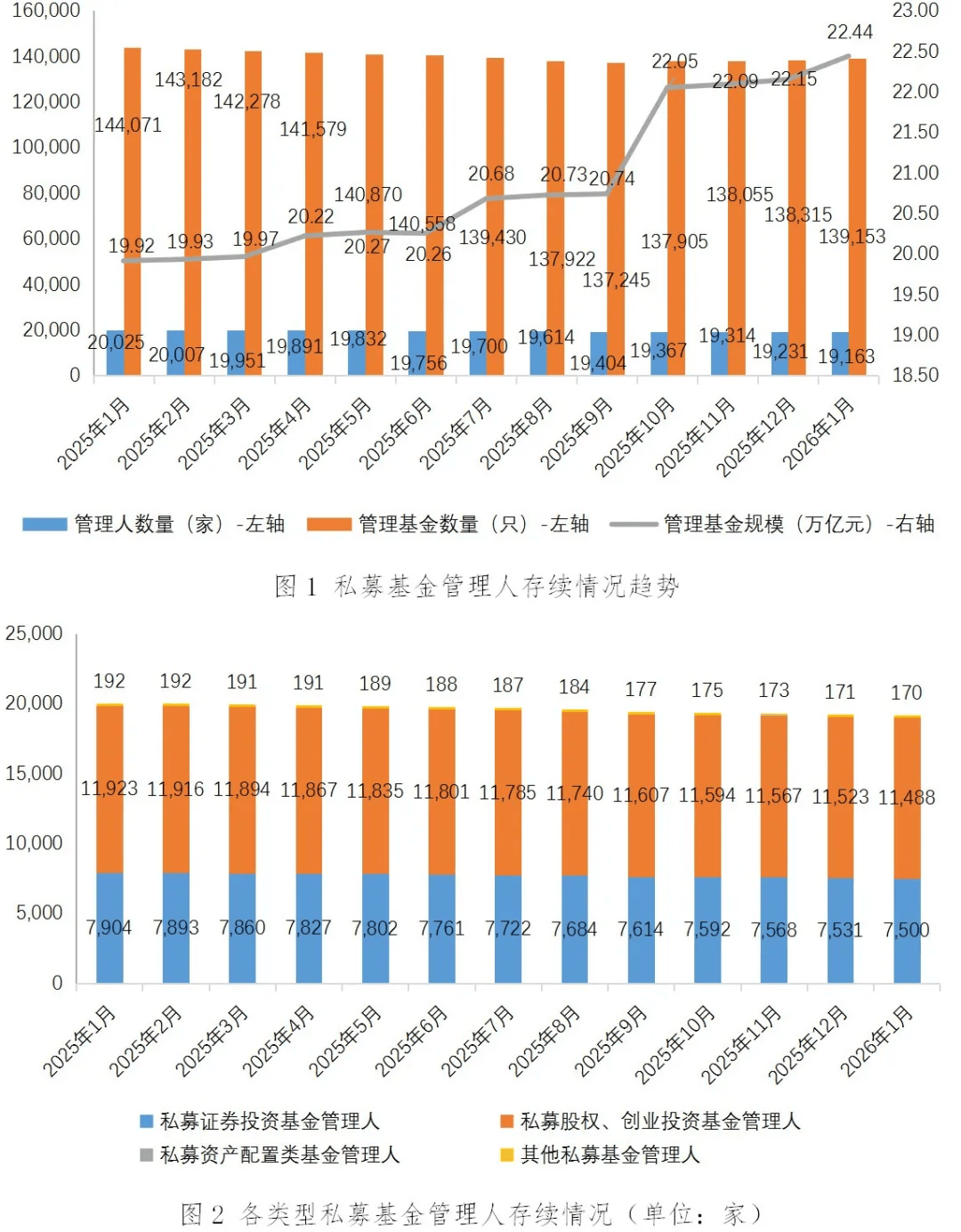
Group 1: Private Fund Manager Registration Overview - In January 2026, 6 private fund managers were registered, including 3 private securities investment fund managers and 3 private equity and venture capital fund managers, while 74 private fund managers were deregistered [1] - As of the end of January 2026, there were 19,163 active private fund managers managing a total of 139,153 funds with a combined scale of 22.44 trillion yuan [2][10] - The distribution of registered private fund managers is concentrated in Shanghai, Beijing, Shenzhen, Zhejiang (excluding Ningbo), Guangdong (excluding Shenzhen), and Jiangsu, accounting for 72.39% of the total [4] Group 2: Private Fund Manager Geographic Distribution - The top six regions by the number of registered private fund managers are Shanghai (3,622), Beijing (3,173), Shenzhen (2,839), Zhejiang (excluding Ningbo) (1,533), Guangdong (excluding Shenzhen) (1,520), and Jiangsu (1,185) [4][6] - In terms of fund management scale, the leading regions are Shanghai (60.73 billion yuan), Beijing (50.78 billion yuan), Shenzhen (20.55 billion yuan), Guangdong (excluding Shenzhen) (13.55 billion yuan), Jiangsu (12.97 billion yuan), and Zhejiang (excluding Ningbo) (10.59 billion yuan), together accounting for 75.38% of the total [6] Group 3: Private Fund Product Registration Overview - In January 2026, 1,235 new private fund products were registered, with a total new scale of 640.62 billion yuan [9] - The breakdown of new registrations includes 687 private securities investment funds (276.86 billion yuan), 140 private equity investment funds (149.37 billion yuan), and 408 venture capital funds (214.39 billion yuan) [9] Group 4: Private Fund Product Status - As of the end of January 2026, there were 139,153 active private funds with a total scale of 22.44 trillion yuan [10] - The active private securities investment funds numbered 80,801 with a scale of 7.26 trillion yuan, private equity investment funds totaled 29,862 with a scale of 11.15 trillion yuan, and venture capital funds reached 27,729 with a scale of 3.74 trillion yuan [10]
《私募投资基金信息披露监督管理办法》颁布,规定七大禁止行为
Xin Lang Cai Jing· 2026-02-28 02:34
Core Viewpoint - The China Securities Regulatory Commission (CSRC) has issued the "Regulations on Information Disclosure Supervision and Management of Private Investment Funds," which will take effect on September 1, 2026, aiming to standardize information disclosure practices and protect investors' rights [1][36]. Group 1: Background and Purpose - The regulation aims to enhance transparency in private fund operations and protect investors' legal rights, as mandated by the Securities Investment Fund Law and the Private Fund Supervision Regulations [2][37]. - Information disclosure is fundamental for investors to understand private fund operations and ensure their rights are safeguarded [2][37]. Group 2: Main Contents - The regulation consists of seven chapters and forty-four articles, outlining the responsibilities of private fund managers and custodians to disclose information truthfully, accurately, completely, and timely [3][38]. - It specifies the basic requirements for information disclosure, including the need for private fund managers to disclose information according to the fund contract and to enhance industry transparency [3][39]. - The regulation prohibits certain behaviors in information disclosure, such as making false statements, predicting investment performance, and promising capital protection or minimum returns [1][36][39]. Group 3: Reporting Requirements - Private fund managers are required to provide regular reports, including quarterly and annual reports, detailing fund performance, net asset values, and investment strategies [4][20]. - In the event of significant occurrences, private fund managers must prepare and disclose temporary reports within five working days [4][23]. Group 4: Management of Disclosure Affairs - The regulation mandates the establishment of robust information disclosure management systems by private fund managers and custodians [5][26]. - It emphasizes the need for cooperation from stakeholders, including shareholders and partners, in fulfilling disclosure obligations [5][27]. Group 5: Supervision and Legal Responsibilities - The CSRC and its local branches will supervise the information disclosure activities of private fund managers, custodians, and sales institutions, with the authority to impose administrative penalties for violations [5][39]. - The regulation outlines specific penalties for non-compliance with disclosure requirements, ensuring accountability among private fund managers and related entities [5][30]. Group 6: Public Consultation - The regulation underwent public consultation from July 5 to August 5, 2024, receiving feedback from 96 institutions and individuals, which contributed to refining the disclosure requirements [6][40]. - Key suggestions included extending the reporting timeline for private securities investment funds and clarifying the standards for disclosing underlying asset information [6][41]. Group 7: Implementation Schedule - The regulation will be implemented starting September 1, 2026, requiring new private funds to comply with the updated disclosure standards from that date [8][42].
