ETF市场发展

Search documents
“国家队”操作路线曝光
Sou Hu Cai Jing· 2025-09-01 02:10
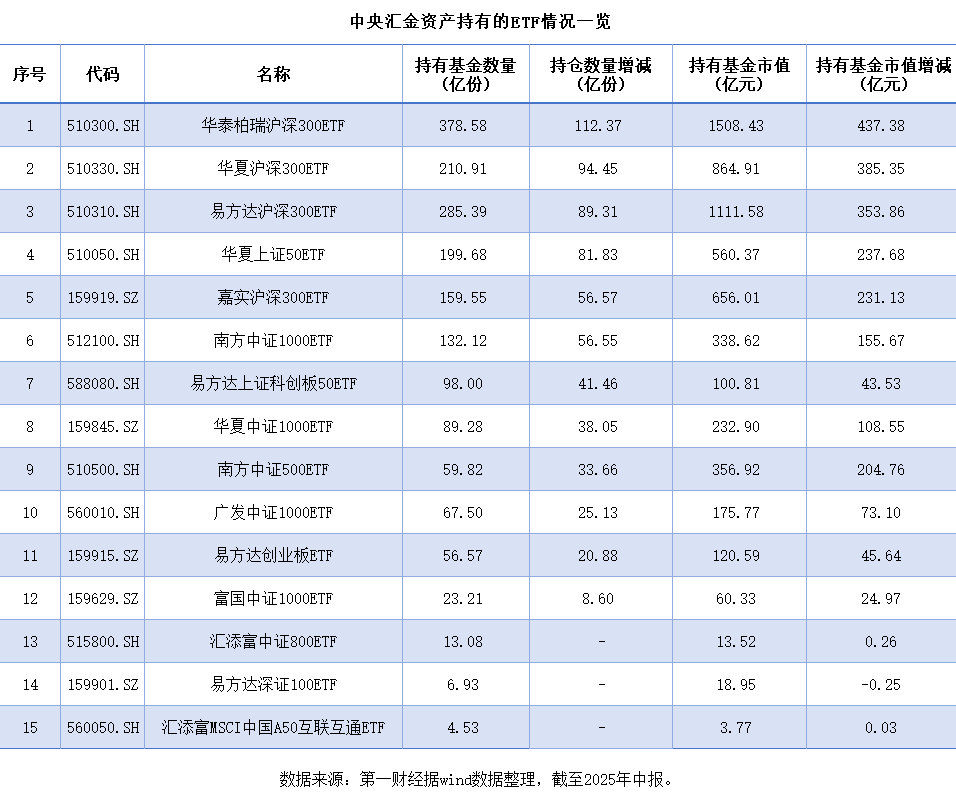
Core Viewpoint - The "national team" has significantly increased its holdings in ETFs and other Chinese stock assets during the first half of the year, demonstrating its influence and stabilizing effect on the A-share market amidst volatility [1][3][11]. Group 1: National Team's Investment Strategy - As of June 30, the "national team" institutions, including Central Huijin and China Reform Holdings, held a total of 3.769 billion ETF shares, an increase of 659.41 million shares year-to-date, with a total market value of 1.28 trillion yuan, reflecting a growth of over 20% [8][9]. - Central Huijin maintained a stable overall holding, with 21 ETFs and a total of 1.971 billion shares, while Central Huijin Asset Management significantly increased its holdings by 658.86 million shares to 1.785 billion shares, a 58.5% increase from the end of last year [4][9]. - The top five ETFs held by the "national team" include Huatai-PB CSI 300 ETF (market value of 292.9 billion yuan), E Fund CSI 300 ETF (217.7 billion yuan), and others, which together account for over 75% of the total market value of their ETF holdings [9]. Group 2: Market Trends and ETF Growth - The total market size of ETFs surpassed 5 trillion yuan by August 31, 2023, marking a 37.25% increase from the end of the previous year, with a record increase of 1.39 trillion yuan in the first eight months [11][12]. - The rapid growth of the ETF market is attributed to multiple factors, including policy support, improved market sentiment, product innovation, and increased investment demand [13][14]. - The "national team" played a crucial role in stabilizing the market during downturns, with significant inflows from long-term funds such as insurance capital, which is expected to reach a net inflow of 1 trillion yuan into equity assets this year [11][12].

6406亿美元,超越日本,中国ETF规模首登亚洲第一
3 6 Ke· 2025-08-26 00:48
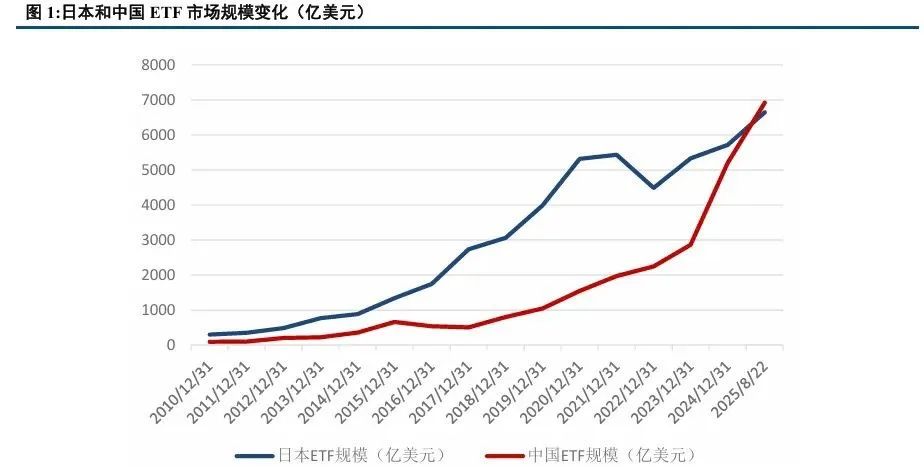
Core Insights - As of the end of July, China's ETF market has surpassed Japan, becoming the largest ETF market in Asia with an asset management scale of $640.6 billion compared to Japan's $622.3 billion [1][2][5] Group 1: Market Growth and Dynamics - China's overall ETF scale reached 4.97 trillion yuan ($747.5 billion) by August 22, showing a remarkable increase of over 1.2 trillion yuan ($184.5 billion) year-to-date [5] - The growth in China's ETF market is driven by strong net inflows, particularly in industry and bond ETFs, with net inflows of 534.1 billion yuan ($82.5 billion) and 451.9 billion yuan ($70.1 billion) respectively [5] - Equity ETFs have seen a significant increase, with a growth of nearly 800 billion yuan ($123.5 billion) this year, surpassing the 4 trillion yuan ($615.5 billion) mark for the first time [5][6] Group 2: Structural Comparison with Japan - Japan's ETF market growth has slowed, with its first ETF launched in 1995 taking 20 years to reach $100 billion and 30 years to reach $600 billion, while China achieved similar milestones in 15 and 21 years respectively [8] - The structure of Japan's ETF market is heavily weighted towards large-cap stocks, with 96.86% of its ETFs being stock-based, while China's ETF market is more diversified, with significant growth in bond and cross-border ETFs [9][10] Group 3: Future Outlook - The internal drivers for China's ETF growth include state-owned investment and strong regulatory support, which are expected to maintain China's lead over Japan in asset management scale [7][11] - The rapid approval of new ETF products and the potential for more diverse offerings, including actively managed and derivative-based ETFs, are anticipated to further enhance the market's growth potential [11]

6406亿美元,超越日本!中国ETF规模首登亚洲第一
Mei Ri Jing Ji Xin Wen· 2025-08-25 12:49
Core Insights - As of the end of July, China's ETF market has surpassed Japan, becoming the largest ETF market in Asia with an asset management scale of $640.6 billion compared to Japan's $622.3 billion [1][3][8] - The growth of China's ETF market is driven by state-backed investments and strong regulatory support, with expectations for record-breaking asset management scale, capital flow, liquidity, and product supply in the coming years [8][12] ETF Market Size and Growth - By August 22, the total size of domestic ETFs reached 4.97 trillion yuan, up from 3.73 trillion yuan at the end of the previous year, indicating a growth of over 1.2 trillion yuan within the year [6] - The increase in ETF size is significantly attributed to market appreciation, with a net inflow of 534.1 billion yuan into industry ETFs and 451.9 billion yuan into bond ETFs recently [6] Types of ETFs and Their Performance - Equity ETFs have seen a robust growth of nearly 800 billion yuan this year, surpassing the 4 trillion yuan mark, setting a historical record [6] - Bond ETFs have also experienced substantial growth, with their total size increasing from 173.97 billion yuan at the end of last year to 553.69 billion yuan as of August 22, marking a 218.26% increase [7] Comparison with Japan's ETF Market - Japan's ETF market growth has slowed, with its first ETF launched in 1995 taking 20 years to reach $100 billion and 30 years to reach $600 billion, while China achieved $600 billion in just 21 years since its first ETF launch in 2004 [9] - The structure of Japan's ETF market is heavily weighted towards domestic large-cap stocks, while China's ETF market is more diversified, with significant growth in bond and cross-border ETFs [9][10] Future Outlook - The Chinese ETF market is expected to continue its rapid growth due to factors such as a large population, accelerated product approvals, and the current underdevelopment of various ETF products [12] - The increasing popularity of passive management funds and the role of ETFs in enhancing market liquidity and stability are anticipated to further diversify the types and forms of ETF products available in the future [12]

领跑亚太,中国ETF市场规模超越日本
Huan Qiu Wang· 2025-08-22 02:27
Core Insights - The Chinese ETF market has surpassed Japan, reaching an asset management scale of $681 billion, making it the largest ETF market in the Asia-Pacific region [1] - Since 2015, both China and Japan's ETF markets have shown steady growth, but the growth rate has diverged significantly, with China's market accelerating post-2022 [3] - In 2024, Japan's ETF market saw a net inflow of $13 billion, while China's inflow reached $133 billion, indicating a substantial difference in market dynamics [3] Market Growth Comparison - Japan's ETF market has experienced slower growth, taking approximately 20 years to reach $100 billion and 30 years to exceed $600 billion [4] - In contrast, China's first ETF was launched in December 2004, and it took over seven years to surpass $1 trillion in scale, with the latest market size exceeding $480 billion in August 2023 [3][4] - The Asia-Pacific ETF market is projected to grow at a compound annual growth rate (CAGR) of 18%, potentially reaching $8 trillion by 2035 [4] Regulatory Support - Chinese regulatory bodies have actively supported the ETF market by expediting product approvals and removing financing limits, which has contributed to its rapid growth and increased product offerings [4] - The rise in acceptance of low-cost, high-liquidity investment products among retail investors has also been a significant factor in the growth of the Chinese ETF market [4]

超越日本,中国成为亚洲最大ETF市场
Zhong Guo Ji Jin Bao· 2025-08-21 11:09
Core Viewpoint - China has overtaken Japan to become the largest ETF market in Asia, with a management scale of $681 billion, surpassing Japan's $668 billion, and is leading the race against Europe in the region [1][3]. Market Growth - Bloomberg's ETF team predicts that China will be a significant growth engine for the Asian ETF market over the next decade, with the market expected to reach $8 trillion by 2035, surpassing Europe [1][14]. - The Chinese ETF market recently broke the $480 billion mark on August 18, just four months after surpassing $400 billion for the first time [1][9]. Historical Context - China's ETF market reached $600 billion in 21 years, nine years faster than Japan, which took 30 years to reach the same milestone [8][9]. - The first ETF in China was launched in December 2004, and it took over seven years to exceed $100 billion in scale, while Japan's first ETF was launched in 1995 and took 20 years to reach the same level [9]. Recent Trends - Since 2020, net inflows into Japanese ETFs have significantly slowed, while Chinese ETFs have seen rapid growth, with inflows in 2024 projected to be $133 billion, ten times that of Japan's $13 billion [6][10]. - The Chinese ETF market has shown consistent growth, even during periods when the Japanese market was declining [4][10]. Regulatory Support - Chinese regulatory authorities have provided strong support for the ETF market, including speeding up product approvals and not setting limits on financing scales, which helps maintain China's leading position over Japan [10]. Future Potential - The adoption rate of ETFs among individual investors in China is currently low, with only 10 million ETF investors as of June 2024, indicating significant growth potential as financial education improves [14]. - The diversification of products in China's ETF market is still in its early stages, with potential for more products like active ETFs, derivative-based ETFs, leveraged and inverse ETFs, and cryptocurrency ETFs to be approved in the future [16].
超越日本!中国成为亚洲最大ETF市场
Zhong Guo Ji Jin Bao· 2025-08-21 10:36
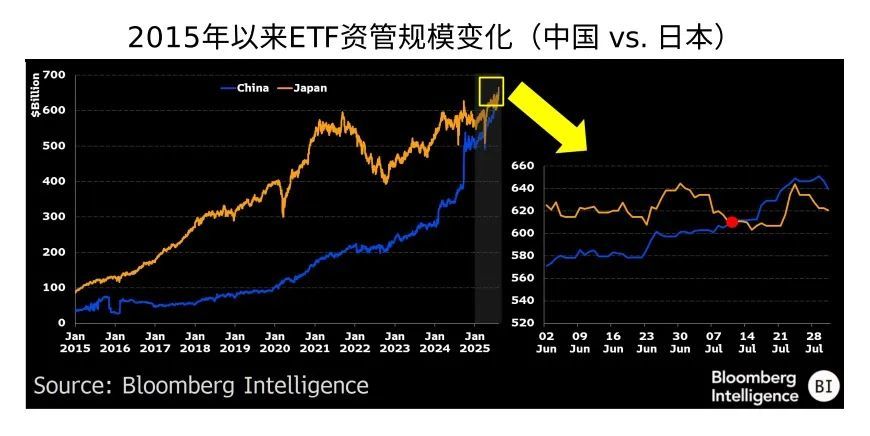
Core Insights - China has overtaken Japan to become the largest ETF market in Asia, with a management scale of $681 billion compared to Japan's $668 billion [2][3] - Bloomberg's ETF team predicts that China will be a significant growth engine for the Asian ETF market over the next decade, with the market expected to reach $8 trillion by 2035 [1][12] - The rapid growth of China's ETF market is attributed to increased retail participation and supportive regulatory measures [1][9] Market Growth - Since 2015, both China and Japan have seen steady growth in their ETF markets, but China's growth has accelerated significantly post-2022, while Japan's growth has slowed [4][6] - In 2024, Japan's ETF market is projected to see a net inflow of only $13 billion, while China's inflow is expected to be ten times higher at $133 billion [6] Historical Context - China's ETF market reached $600 billion in 21 years, nine years faster than Japan [8][9] - The first ETF in China was launched in December 2004, and it took just over seven years to surpass $1 trillion in assets, with subsequent milestones achieved in increasingly shorter timeframes [8][9] Future Projections - The Asia-Pacific ETF market is expected to grow over 30% in 2024, with a compound annual growth rate of 18% projected until 2035 [12] - As of June 2024, only 10 million individual investors in China are engaged in ETF investments, indicating significant room for growth as financial education improves [12] Product Diversification - China's ETF market is still in the early stages of product diversification, lacking actively managed ETFs, derivative-based ETFs, leveraged and inverse ETFs, or cryptocurrency ETFs [14]
超越日本!中国成为亚洲最大ETF市场
中国基金报· 2025-08-21 10:27
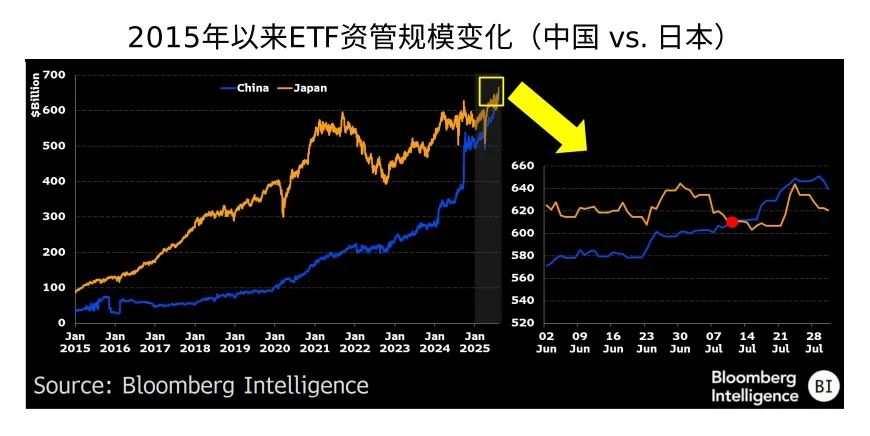
Core Viewpoint - China has overtaken Japan to become the largest ETF market in Asia, with a management scale of $681 billion, surpassing Japan's $668 billion [3][5]. Group 1: Market Growth and Comparison - The Chinese ETF market has shown remarkable growth, reaching a management scale of $681 billion, while Japan's market is at $668 billion, solidifying China's position as the leader in the Asia-Pacific region [3][5]. - Bloomberg's research team predicts that China will be a significant growth engine for the Asian ETF market over the next decade, with the market expected to reach $8 trillion by 2035, surpassing Europe [3][19]. - The Chinese ETF market recently broke the $4.8 trillion mark on August 18, 2023, just four months after surpassing $4 trillion for the first time [3][13]. Group 2: Historical Context and Development - China's ETF market has grown rapidly since the launch of its first ETF in December 2004, reaching $1 trillion in 15 years and $6 trillion in 21 years, which is 9 years faster than Japan [12][14]. - In contrast, Japan's first ETF was launched in 1995, taking 20 years to reach $1 trillion and 30 years to hit $6 trillion [12][14]. - The growth trajectory of the Chinese ETF market has accelerated, with significant milestones achieved in shorter time frames compared to Japan [13]. Group 3: Future Potential and Investor Adoption - The adoption rate of ETFs among individual investors in China is currently low, with only 10 million ETF investors as of June 2024, indicating significant potential for growth as financial education improves [20]. - The Asia-Pacific ETF market is projected to grow over 30% in 2024, with a compound annual growth rate of 18% expected to elevate the market from approximately $2 trillion to $8 trillion by 2035 [19][20]. - China's ETF market is still in the early stages of product diversification, lacking active ETFs, derivative-based ETFs, leveraged and inverse ETFs, or cryptocurrency ETFs, which could further enhance growth if introduced [22].

ETF增长提速,科创债批量新发
HTSC· 2025-08-08 10:16
Investment Rating - The report maintains an "Overweight" rating for the diversified financial industry [1] Core Insights - In July, the total asset scale of ETFs increased by 8.1% month-on-month, up from a 4.3% increase in June, with stock ETFs growing by 4.6% and bond ETFs expanding by over 100 billion [4][11] - The competitive landscape shows a mixed trend in concentration, with CR5 declining while CR10 increased, indicating intensified competition among leading firms [4][6] - New product issuance saw a decline in stock ETF issuance while bond ETF issuance reached a new peak, surpassing 25 billion [4][22] - The rapid rollout of Sci-tech bond ETFs has led to a total scale exceeding 100 billion, enhancing the ETF product system and market ecology [4][8] Summary by Sections Total Structure - As of the end of July 2025, the total net asset value of all ETFs reached 46,547 billion, reflecting an 8.1% month-on-month growth, with stock ETFs accounting for 31,722 billion, a 4.6% increase [5][12] - The proportion of stock ETFs in the total ETF market was 68.2%, showing a slight decline of 2.3 percentage points [15] Competitive Landscape - The asset concentration ratios for ETFs as of the end of July 2025 were CR3 at 44.0%, CR5 at 57.0%, and CR10 at 78.2%, with CR5 decreasing slightly while CR10 increased [6][18] - Leading firms like Huaxia, E Fund, and Huatai-PB maintained their positions, although their market shares saw minor declines [6][21] New Product Issuance - Stock ETF issuance in July 2025 recorded a slight decline to 10.7 billion, while bond ETFs saw a total new issuance of 37.9 billion, surpassing previous peaks [7][22] Policy Dynamics - The first batch of Sci-tech bond ETFs was launched in July 2025, with a total scale exceeding 100 billion, featuring a T+0 trading mechanism and physical redemption model [8][28]
上半年ETF市场图谱:三大券商“合砍”25%交易份额,做市商覆盖98%产品
Sou Hu Cai Jing· 2025-07-26 02:20
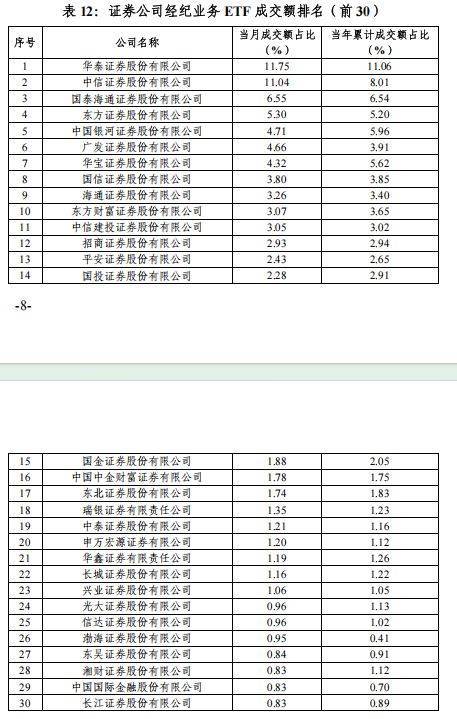
Core Viewpoint - The ETF market in China has reached a significant milestone, surpassing 4 trillion yuan in total market size for the first time, with over a thousand products available [1]. Group 1: Market Overview - As of June 2025, the Shanghai Stock Exchange has 870 fund products with a total asset management scale of 32,259.87 billion yuan, including 701 ETFs valued at 31,473.20 billion yuan, reflecting a 4.84% increase [1]. - The total trading volume of ETFs reached 39,035.13 billion yuan in the same period, with an average daily trading amount of 1,951.76 billion yuan, marking a 23.21% increase [1]. Group 2: Brokerage Performance - The top three brokerages in ETF trading volume are Huatai Securities, CITIC Securities, and Guotai Junan Securities, with market shares of 11.75%, 11.04%, and 6.55% respectively, collectively accounting for over 25% of the market [1][4]. - In the first half of 2025, Huatai Securities led the ETF brokerage business with an 11.06% market share, followed by CITIC Securities at 8.01% and Guotai Junan Securities at 6.54% [3][4]. Group 3: Market Concentration - The top ten brokerages account for 57.2% of the total ETF trading volume, indicating a high level of market concentration [5]. - The leading brokerage in ETF holdings is China Galaxy Securities, holding 24.03% of the market, although this is a slight decrease from 24.63% [6][7]. Group 4: Trading Accounts - Huatai Securities leads in the number of ETF trading accounts with a market share of 10.60%, showcasing its strong customer engagement and market influence [10]. - The top ten brokerages collectively hold over 55.06% of the ETF trading accounts, reflecting a significant concentration in the industry [12]. Group 5: Market Ecosystem - The market ecosystem is maturing, with over 1,200 ETFs receiving liquidity support from market makers, indicating a well-developed market structure [1][13]. - As of mid-2025, there are 20 primary market makers and 12 general market makers on the Shanghai Stock Exchange, providing liquidity services to 746 fund products [13].





这类产品,大爆发!
中国基金报· 2025-07-13 06:04
Core Viewpoint - The number and scale of newly established ETFs in 2023 have surpassed the total levels of 2022, indicating a robust growth trend in the ETF market driven by regulatory support and increasing investor demand [2][3][5]. Group 1: ETF Market Overview - As of July 11, 2023, a total of 184 new ETFs have been established, raising approximately 146.47 billion yuan, exceeding the total for the entire previous year [3]. - Among the new ETFs, stock ETFs dominate with 164 products, accounting for about 65% of the total, while bond ETFs have also seen significant growth with 18 products, making up 34.61% [3]. - Notably, 10 new science and technology innovation bond ETFs have been issued, representing nearly 57% of the bond ETF issuance [3]. Group 2: Diversification and Specialization - The ETF issuance in 2023 reflects a trend towards diversification and specialization, with active issuance in sectors like TMT (Technology, Media, Telecommunications) and healthcare, particularly in innovative drugs [4]. - Smart Beta ETFs, such as those focusing on free cash flow, have seen a surge in issuance, indicating a shift in market investment logic towards high-quality factors [4]. Group 3: Factors Driving ETF Growth - Multiple factors are contributing to the booming ETF market, including policy support from regulatory bodies and a strong demand for fixed-income instruments, particularly bond ETFs [6][7]. - The recent push for scenario-based investment strategies by exchanges has also catalyzed the acceleration of fund allocation towards ETFs [7][8]. Group 4: Future Trends in ETF Development - The future of the ETF market is expected to see increased diversification in asset classes and strategies, with a focus on low-volatility and multi-asset products [10][11]. - Continuous innovation in ETF products, including the development of niche themes and strategies, will provide investors with a broader range of investment options [10][11].