Stagflation

Search documents
Gold and Silver Have Gone Parabolic -- and the Primary Catalyst Behind This Move Isn't What You Think It Is
Yahoo Finance· 2025-12-29 08:26
President Donald Trump's tariff and trade policy, introduced in early April, set a 10% global tariff rate and instituted higher "reciprocal tariffs" on dozens of countries deemed to have adverse trade imbalances with America. This has cast a cloud over global trade and U.S. economic growth, which Wall Street typically dislikes. Precious metals often flourish as a safe-haven investment during periods of economic turbulence and uncertainty.Historically, investors have turned to gold and, to a lesser extent, s ...
Here’s Why Johnson & Johnson (JNJ) Surged in Q3
Yahoo Finance· 2025-12-24 13:02
Core Insights - The Meridian Hedged Equity Fund reported a return of 1.67% in Q3 2025, underperforming the S&P 500 Index which returned 8.13% and the CBOE S&P 500 BuyWrite Index which returned 3.53% [1] Company Overview - Johnson & Johnson (NYSE: JNJ) is a major player in the healthcare sector, focusing on innovative pharmaceuticals and medical devices [3] - The company has a market capitalization of $495.785 billion, with its stock closing at $205.78 per share on December 23, 2025 [2] Performance Metrics - Johnson & Johnson's stock experienced a one-month return of -0.43% but gained 41.09% over the last 52 weeks [2] Strategic Developments - Johnson & Johnson is facing a critical transition as sales from its blockbuster drug Stelara decline due to patent expiration, but it is countering this with a strong pipeline of new drugs, particularly in oncology and immunology [3] - The company secured FDA approval for Inlexzo, a new bladder cancer treatment, and its lung cancer drug Rybrevant is moving closer to broader adoption following positive trial data [3] - Strong sales momentum from other key drugs has compensated for the decline in Stelara, and favorable legal developments have eased concerns regarding ongoing talc litigation [3] Investment Sentiment - Johnson & Johnson was held by 103 hedge fund portfolios at the end of Q3 2025, an increase from 95 in the previous quarter [4] - Despite its potential, some analysts believe that certain AI stocks may offer greater upside potential and less downside risk compared to Johnson & Johnson [4]

Successful Scaling of Figure Connect Marketplace Lifted Figure Technology Solutions (FIGR)
Yahoo Finance· 2025-12-24 12:59
Meridian Funds, managed by ArrowMark Partners, released its “Meridian Hedged Equity Fund” third-quarter 2025 investor letter. A copy of the letter can be downloaded here. In the quarter, the market is more focused on the tailwind of policy easing than the headwind of weakening fundamentals, resulting in substantial gains despite stagflation emerging as a key concern. In this environment, the fund returned 1.67% (net) during the quarter, compared to 8.13% returns of the S&P 500 Index and 3.53% returns of th ...
Do You Believe in Intercontinental Exchange’s (ICE) Long-Term Growth Potential?
Yahoo Finance· 2025-12-24 12:57
Core Insights - The Meridian Hedged Equity Fund reported a return of 1.67% in Q3 2025, underperforming the S&P 500 Index which returned 8.13% and the CBOE S&P 500 BuyWrite Index which returned 3.53% [1] - The fund's performance was influenced by a market focus on policy easing rather than weakening fundamentals, despite concerns about stagflation [1] Company Highlights - Intercontinental Exchange, Inc. (NYSE:ICE) is highlighted as a key stock in the fund's portfolio, with a one-month return of 3.84% and a 52-week gain of 7.64% [2] - As of December 23, 2025, Intercontinental Exchange, Inc. had a stock price of $161.95 and a market capitalization of $92.704 billion [2] - The company operates a global network of exchanges and data services across various asset classes, benefiting from a resilient business model that combines transaction-based revenues with recurring data and technology revenues [3] Investment Sentiment - Despite the underperformance of Intercontinental Exchange, Inc. in the recent quarter, the fund maintains confidence in its long-term potential due to strong cash flow generation for debt reduction and shareholder returns [3] - The company is not among the top 30 most popular stocks among hedge funds, with 82 hedge fund portfolios holding its stock at the end of Q3 2025, a slight decrease from 84 in the previous quarter [4] - The fund suggests that certain AI stocks may offer greater upside potential compared to Intercontinental Exchange, Inc., indicating a competitive investment landscape [4]

Here’s What Impacted Kenvue’s (KVUE) in Q3
Yahoo Finance· 2025-12-24 12:55
Core Viewpoint - The Meridian Hedged Equity Fund's third-quarter 2025 performance reflects a market more influenced by policy easing than weakening fundamentals, achieving a net return of 1.67% despite concerns over stagflation [1] Fund Performance - The fund's return of 1.67% in Q3 2025 is compared to the S&P 500 Index's return of 8.13% and the CBOE S&P 500 BuyWrite Index's return of 3.53% [1] Company Focus: Kenvue Inc. - Kenvue Inc. (NYSE:KVUE), a consumer health company with brands like Tylenol and Neutrogena, is highlighted as a key investment despite a one-month return of -0.06% and a 52-week loss of 21.06% [2][3] - Kenvue's stock closed at $17.02 on December 23, 2025, with a market capitalization of $32.609 billion [2] Investment Rationale for Kenvue Inc. - The fund sees potential for Kenvue to unlock value through reinvestment in underfunded brands, cost optimization, and margin improvement [3] - Recent market reactions to studies linking acetaminophen to autism risk during pregnancy are viewed as overblown, with minimal revenue impact expected from pregnant women, who represent less than 1% of Tylenol's global sales [3] Hedge Fund Interest - Kenvue Inc. was held by 73 hedge fund portfolios at the end of Q3 2025, an increase from 72 in the previous quarter, indicating growing interest [4] - Despite this interest, the fund suggests that certain AI stocks may offer greater upside potential and lower downside risk compared to Kenvue [4]

Here’s Meridian Hedged Equity Fund’s Updates on Liberty Broadband Corporation (LBRDK)
Yahoo Finance· 2025-12-24 12:53
Core Insights - The Meridian Hedged Equity Fund reported a return of 1.67% in Q3 2025, underperforming the S&P 500 Index which returned 8.13% and the CBOE S&P 500 BuyWrite Index which returned 3.53% [1] Company Overview - Liberty Broadband Corporation (NASDAQ:LBRDK) is a communication services provider based in Englewood, Colorado, with a market capitalization of $6.854 billion [2] - The company has a 26% ownership stake in Charter Communications and full ownership of GCI, a broadband and wireless provider in Alaska [3] Investment Case - Liberty Broadband's shares are trading at a significant discount to the value of its underlying assets, primarily its stake in Charter Communications, with a prospective merger between the two companies seen as a key catalyst for value realization [3] - The stock has underperformed due to negative sentiment in the cable sector following Charter's weaker second-quarter earnings [3] - Liberty completed the spin-off of its GCI subsidiary into a standalone entity in July, which saw GCI's shares rise approximately 20% post-listing, partially offsetting Liberty's earlier stock weakness [3] - Following the announcement of a definitive merger agreement with Charter, Liberty's shares have shown some recovery, allowing management to focus on maximizing value from its Charter investment [3]
Next Fed Meeting: When It Is In January And What To Expect on Interest Rates
Investopedia· 2025-12-23 01:00
Core Insights - The Federal Reserve is expected to hold its key interest rate steady during the upcoming meeting on January 27 and 28 after a series of recent cuts aimed at addressing job market concerns [1][9]. Interest Rate Decisions - The Federal Open Market Committee will consider whether to cut the federal funds rate from its current range of 3.5% to 3.75% [2]. - Recent cuts of a quarter percentage point at the last three meetings were intended to prevent a slowdown in the job market from escalating into higher unemployment [2][9]. - Fed officials are divided on whether to cut rates to support the job market or maintain higher rates to combat inflation, which has been above the target of 2% since 2021 [3][9]. Economic Implications - The current economic landscape poses a risk of "stagflation," characterized by stagnant growth, high inflation, and a weak job market, which the Fed aims to avoid by appropriately setting the fed funds rate [6]. - The influence of the fed funds rate extends to borrowing costs for short-term loans, impacting consumer spending and overall economic activity [5]. Perspectives from Fed Officials - Some officials, like Beth Hammack, advocate for holding rates steady for several months to gather clearer evidence on inflation and employment trends [7][8]. - Hammack noted that inflation has been above the target for nearly five years and emphasized the importance of bringing it down [8]. - Conversely, other officials, such as Stephen Miran, argue for steeper rate cuts to mitigate recession risks, highlighting concerns over the faltering job market and hiring uncertainties [11][12].

S&P 500 set to rise for eight straight month
Youtube· 2025-12-22 20:20
I think for the near-term and near-term in this context, May being 2026, I think we should expect more M&A. And one of the reasons why I say that is because on one hand, you're seeing reasonably strong equity markets and some stability in rates. And, you know, you look at Treasury volatility, that's much lower.Rates may not be as low as some would like, but the rate volatility is lower. It sets a better platform. But I think the other sort of overarching theme here is that, you know, we have this k-shaped e ...

Bitcoin Could Hit $170K in 2026 Fed Crisis Scenario
Etftrends· 2025-12-22 17:46
Core Viewpoint - The price of bitcoin could exceed $170,000 by 2026 if the Federal Reserve loses control of the economy and resorts to aggressive stimulus measures, according to CoinShares' latest outlook report [1] Scenario Summaries - The base case scenario predicts bitcoin trading between $110,000 and $140,000 during a slower economic expansion, characterized by subdued growth, persistent inflation, and cautious Fed rate cuts [2] - In the bull case, bitcoin could rise above $150,000 if inflation decreases steadily and AI-related productivity gains enable the Fed to implement more decisive rate cuts [3] - The bear case presents two outcomes: in a recession where the Fed cannot respond quickly, bitcoin may initially fall but could rebound past $170,000 as aggressive easing is interpreted as the Fed losing control [4] - A stagflation scenario, combining weak growth with rising inflation, could see bitcoin drop to the $70,000–$100,000 range due to ETF outflows [5] Investment Opportunities - Investors can gain exposure to bitcoin and ether futures through the CoinShares Bitcoin & Ether ETF (BTF), which currently holds $14.5 million in assets and has seen net inflows of $913,570 over the past month [6] - BTF invests in CME bitcoin and ether futures contracts, as well as treasuries, corporate bonds, and cash, rather than holding digital assets directly, with a 1.25% expense ratio [7] - Beyond the cyclical dynamics of 2026, the gradual decline in dollar reserve dominance is expected to provide a long-term structural tailwind for cryptocurrencies as central banks diversify away from single-currency dependence [7]

California Faces Fuel Disaster As Refineries And Gas Stations Shut Down
ZeroHedge· 2025-12-21 23:05
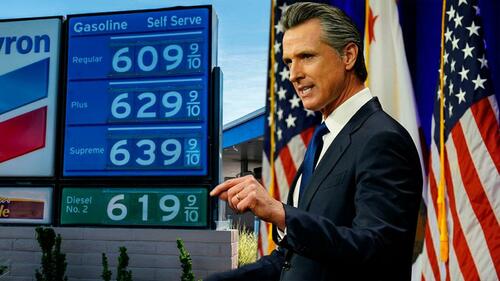
Economic Narrative and Policies - The narrative from Democrats attributes inflation to "corporate greed" and "price gouging," while the actual causes are linked to pandemic-related monetary policies and consumer demand surges [1] - Profit margins in various industries are reportedly thin due to rising manufacturing and labor costs, contradicting claims of corporate wrongdoing [2] California's Legislative Actions - California's Governor Gavin Newsom has enacted laws that increase state control over oil refineries and gas stations, which may lead to economic decline [3][5] - The major refinery law ABX2-1 empowers the California Energy Commission to mandate fuel storage levels and oversee refinery maintenance to stabilize supply [5] Refinery Closures and Economic Impact - Planned shutdowns of two major refineries, Valero's Benicia facility and Phillips 66's Los Angeles plant, could eliminate nearly 20% of California's refining capacity, potentially driving prices up [6] - Experts predict gas prices could rise to $10-$12 per gallon due to supply constraints, affecting not only California but also neighboring states [7] Military and Fuel Supply Concerns - The refineries are crucial for supplying jet fuel and diesel to military bases in California, raising concerns about national security due to potential fuel shortages [8] - Governor Newsom has dismissed these concerns, asserting that foreign fuel shipments will compensate for any supply gaps [8] Environmental Regulations and Small Business Impact - California law mandates the closure or replacement of single-walled underground storage tanks by December 31, 2025, to prevent leaks, with significant penalties for non-compliance [9] - The RUST program intended to assist small businesses in meeting these regulations has reportedly failed to provide aid to many applicants, leading to potential closures of rural gas stations [10] Price Analysis and Regulatory Findings - The newly established Division of Petroleum Market Oversight confirmed that California's gas prices are higher due to taxes and regulatory costs, with no evidence of price gouging found [11] - Blue states like California are implementing policies that create artificial energy scarcity, pushing consumers towards electric vehicles while raising taxes [12]