AI制药

Search documents
斩获430亿大单,“AI制药第一股”晶泰控股成色几何?
Huan Qiu Lao Hu Cai Jing· 2025-08-06 13:03
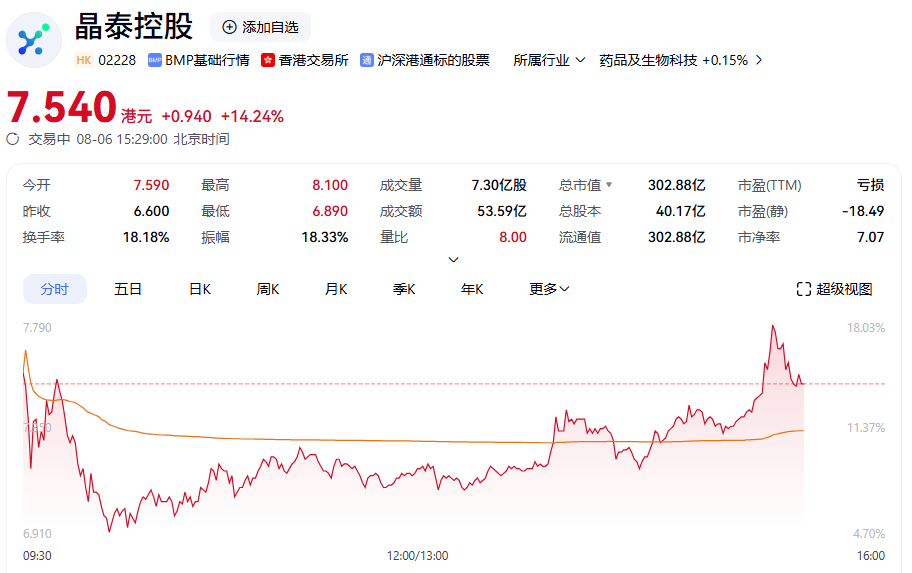
Core Viewpoint - JingTai Holdings has secured a significant AI pharmaceutical collaboration with DoveTree, amounting to a total of $5.99 billion, marking a record in the "AI + Robotics" drug development sector [1][2]. Group 1: Financial Details - The deal includes an initial payment of $51 million, potential further payments of $49 million, and milestone payments of $5.89 billion, with additional royalties based on annual net sales [2]. - JingTai Holdings' market capitalization reached HKD 298.1 billion following the announcement, with a stock price increase of 12.42% [2]. - The company reported a revenue of RMB 266 million in 2024, surpassing the HKD 250 million threshold required to remove its "P" label under the Hong Kong Stock Exchange's special technology rules [5]. Group 2: Company Background - Founded in 2015 by three MIT postdoctoral researchers, JingTai Holdings is recognized as the first AI pharmaceutical company listed on the Hong Kong Stock Exchange [5]. - The company has attracted significant investment from major firms, including Tencent, Sequoia, and China Life, and has completed multiple funding rounds totaling over RMB 5 billion [7]. Group 3: Business Operations - JingTai Holdings operates primarily in drug discovery solutions and intelligent automation solutions, with the latter generating RMB 163 million in revenue in 2024, a growth of 87.8% [6]. - The company has expanded its business beyond AI pharmaceuticals into materials science, agriculture, and consumer goods, signing a five-year contract worth RMB 1 billion with GCL Group for AI model development in new energy materials [6]. Group 4: Strategic Investments - In 2024, JingTai Holdings acquired a 90% stake in Siwei Medical, aiming to integrate its ECG diagnostic data with AI technology for cardiovascular drug development [9]. - The company also completed the acquisition of Liverpool ChiroChem, enhancing its capabilities in automated chiral chemistry [9]. - JingTai Holdings has invested in several biotech firms, including Merda Bio, which has received orphan drug designation from the FDA for a candidate drug [10].
签近60亿美元大单,这家公司股价暴涨
Zheng Quan Shi Bao· 2025-08-06 09:42
Core Insights - The collaboration between JingTai Technology and DoveTree marks a significant milestone in the AI pharmaceutical sector, with a total order value of approximately HKD 470 billion (around USD 59.9 billion) [1][6][10] - The partnership aims to leverage AI and robotics for drug discovery, focusing on oncology, immunology, inflammation, neurological diseases, and metabolic disorders [6][8][11] Company Developments - JingTai Technology has received an initial payment of approximately HKD 4 billion (around USD 510 million) as part of the agreement, with potential further payments totaling USD 58.9 billion (approximately HKD 462 billion) based on regulatory and commercial milestones [6][10] - The collaboration is expected to enhance drug development capabilities by integrating advanced technologies such as AI, robotics, and quantum physics [7][8] Market Trends - The AI pharmaceutical market in China is experiencing rapid growth, with a projected increase from CNY 0.7 billion in 2019 to CNY 7.3 billion in 2024, reflecting a compound annual growth rate (CAGR) of 47.8% [14] - The market is anticipated to expand further from CNY 12.1 billion in 2025 to CNY 58.6 billion by 2028, with a CAGR of 68.3% [14][15] Industry Context - The AI pharmaceutical sector is witnessing a surge in large-scale orders, with notable collaborations occurring in recent months, indicating a growing interest and investment in AI-driven drug discovery [10][11] - The integration of AI in early drug discovery processes allows for large-scale virtual screening and accelerated identification of lead compounds, enhancing the efficiency of drug development [11][15]

签近60亿美元大单,这家公司股价暴涨!
Zheng Quan Shi Bao· 2025-08-06 09:23
Core Insights - The collaboration between JingTai Technology and DoveTree marks a significant milestone in the AI pharmaceutical sector, with a total order value of approximately HKD 470 billion (around USD 59.9 billion) [1][5][8] - The partnership aims to leverage AI and robotics for drug discovery targeting oncology, immunology, inflammation, neurological disorders, and metabolic disorders [5][7][8] Company Developments - JingTai Technology has received an initial payment of approximately HKD 4 billion (around USD 510 million) as part of the agreement, with potential further payments totaling USD 58.9 billion (approximately HKD 462 billion) based on regulatory and commercial milestones [5][6] - The collaboration is expected to enhance drug development capabilities by integrating advanced technologies such as AI, robotics, and quantum physics [6][12] Market Trends - The AI pharmaceutical market in China is experiencing rapid growth, with a projected increase from CNY 0.7 billion in 2019 to CNY 7.3 billion in 2024, reflecting a compound annual growth rate (CAGR) of 47.8% [11][12] - The market is anticipated to expand further from CNY 12.1 billion in 2025 to CNY 58.6 billion by 2028, with a CAGR of 68.3% [11][12] Industry Context - The AI pharmaceutical sector is witnessing a surge in large-scale orders, with notable collaborations occurring in recent months, indicating a growing interest and investment in AI-driven drug discovery [8][9] - The integration of AI in early drug discovery processes allows for large-scale virtual screening and accelerated identification of lead compounds, enhancing the efficiency of drug development [9][10]

签近60亿美元大单,这家公司股价暴涨!
证券时报· 2025-08-06 09:15
Core Viewpoint - The AI pharmaceutical industry in China has made significant progress in commercial cooperation, market scale, and policy support, marking a new milestone in 2025 [1] Group 1: Major Collaborations - On August 5, Crystal Technology announced a pipeline cooperation agreement with DoveTree, with a total order size of approximately HKD 470 billion (about USD 59.9 billion), setting a new record in the AI + robotics new drug development field [2][11] - The agreement includes an initial payment of approximately HKD 4 billion (about USD 51 million) [2][7] - The collaboration will focus on drug discovery and development for oncology, immunology, inflammation diseases, neurological disorders, and metabolic disorders [7][9] Group 2: Market Trends - The AI pharmaceutical sector has seen a surge in large orders, with over USD 10 billion in orders in the past two months, primarily from domestic companies like Crystal Technology and Stone Pharmaceutical Group [12] - The market for AI pharmaceuticals in China is expected to grow significantly, with projections indicating a compound annual growth rate (CAGR) of 68.3% from 2025 to 2028, increasing from CNY 1.21 billion to CNY 5.86 billion [14] Group 3: Technological Advancements - The integration of advanced technologies such as generative AI and robotic automation with quantum physics is enhancing the pharmaceutical industry's research capabilities [9] - AI is becoming a key technology for tackling challenging innovative targets in drug development, with Crystal Technology's algorithms and robotic technology leading the industry [9][15] - AI's application in early drug discovery allows for large-scale virtual screening and accelerates the transition of lead compounds to candidate therapies [12]

晶泰控股拿下60亿美元大单,刷新AI制药出海纪录
Jing Ji Guan Cha Wang· 2025-08-06 08:45
Group 1 - Crystal Tech Holdings (02228.HK) has signed a significant pipeline collaboration agreement with US pharmaceutical company DoveTree, with a total order value of approximately $6 billion, setting a record for AI pharmaceutical overseas orders [2][3] - The company has received an initial payment of $51 million, which exceeds its projected revenue of $26.6 million for the entire year of 2024 [2] - The collaboration will focus on high-potential pipeline projects in oncology, immunology, inflammation diseases, neurological disorders, and metabolic disorders [2] Group 2 - The agreement includes cooperation on multiple preclinical large and small molecule innovative drug assets, with DoveTree holding exclusive global development and commercialization rights [3] - The integration of AI technology in drug development is expected to significantly reduce the time and cost associated with bringing new drugs to market, which traditionally takes over 10 years and costs around $1 billion [3] - The CEO of Crystal Tech Holdings emphasized the growing importance of AI as a foundational enabling technology in the pharmaceutical industry [3] Group 3 - As of August 6, Crystal Tech Holdings' stock price increased by over 12%, bringing its total market capitalization to nearly HKD 30 billion [4]

高成长AI医疗概念股涨幅榜出炉
Di Yi Cai Jing· 2025-08-06 06:30
泰格医药子公司泰雅科技以开源模型Qwen2.5为基座,打造了面向医学领域一站式的AI产品泰雅大模型 医疗场景解决方案。 据数据宝,A股市场上和AI制药相关的概念题材是AI医疗,合计有82股。从未来成长性来看,根据两家 以上机构一致预测,有20股今年、明年及2027年净利增速均超20%。这些高成长概念股主要集中在医药 生物行业,和AI制药相关性较高的个股并不多,其中部分个股研报中有提及AI相关信息。 从股价表现来看,市场对上榜概念股的认可度较高,年内平均涨幅接近58%,远强于市场整体水平,一 品红和美迪西涨幅均超100%。目前来看,上榜概念股表现多与创新药相关。随着AI制药题材的发酵, 相关个股也许会有新动向。 成都先导在2024年成功完成了DEL+AI+自动化的DMTA分子优化能力基础设施建设,并在客户某靶点项 目中实现了AIDD推动的两轮DMTA循环。 截至2024年末,泓博医药核心技术平台CADD/AIDD已累计为80个新药项目提供了技术支持。 ...
中国AI制药创下新纪录,A股高成长概念股稀缺(附名单)
Zheng Quan Shi Bao Wang· 2025-08-06 06:00
Core Insights - The article highlights a significant collaboration in the AI pharmaceutical sector, with JingTai Holdings announcing a pipeline cooperation worth approximately HKD 47 billion (USD 5.99 billion) with DoveTree, marking it as the largest publicly disclosed deal in AI drug discovery globally [1] - This partnership is expected to transform JingTai Holdings from a technology service provider to a revenue-sharing innovator in pharmaceuticals, indicating a shift in the business model towards commercialization of AI drug discovery [1] - The global AI pharmaceutical market is experiencing rapid growth, with projections indicating a compound annual growth rate (CAGR) exceeding 30% from USD 792 million in 2021 to USD 1.758 billion by 2024 [4] Company Overview - JingTai Holdings is positioned as a global leader in AI for Science, utilizing quantum physics and AI-driven solutions to provide drug and materials science research services [2] - The company has developed over 200 AI models, including crystal structure prediction and free energy perturbation algorithms, which are critical to its competitive advantage [2] Market Response - The capital market reacted positively to JingTai Holdings' large order, with the stock price surging nearly 23% during trading [3] - The article notes that the recent large orders in the AI pharmaceutical sector reflect a high level of industry vitality, with several major collaborations reported, including partnerships involving Novo Nordisk and AstraZeneca [4] Growth Potential - The AI pharmaceutical market is entering a transformative phase, with significant growth expected in both global and domestic markets. The Chinese AI pharmaceutical market is projected to grow from CNY 0.7 billion in 2019 to CNY 4.1 billion in 2023, with a CAGR of 57.4% [4] - A list of high-growth stocks related to AI pharmaceuticals indicates that there are limited options in the A-share market, with only 20 stocks expected to achieve net profit growth exceeding 20% in the coming years [5] Stock Performance - The article provides a table of high-growth AI medical concept stocks, highlighting significant year-to-date price increases for companies such as Yipin Hong (320.22%) and Meidi Xi (105.83%), indicating strong market interest in AI-related pharmaceutical stocks [9]

AI制药领域大额订单频现 高成长概念股稀缺
Xin Lang Cai Jing· 2025-08-06 05:43
Core Viewpoint - The AI pharmaceutical sector is experiencing significant orders, indicating a high level of industry prosperity [1] Group 1: Market Performance - In the A-share market, there are 82 stocks related to AI pharmaceuticals, primarily categorized under AI healthcare [1] - The average increase in stock prices for these concept stocks is nearly 58% this year, significantly outperforming the overall market [1] - Notable stocks such as Yipinhong and Meidixi have seen price increases exceeding 100% [1] Group 2: Growth Potential - According to consensus forecasts from multiple institutions, 20 stocks are expected to have net profit growth rates exceeding 20% this year, next year, and in 2027 [1] - High-growth concept stocks are mainly concentrated in the biopharmaceutical industry, with limited stocks having a strong correlation to AI pharmaceuticals [1] Group 3: Innovation and Future Trends - The performance of the listed concept stocks is closely related to innovative drugs [1] - As the AI pharmaceutical theme continues to develop, related stocks may exhibit new trends [1]
晶泰控股达成59.9亿美元授权合作,创AI药物发现合作订单新纪录
Di Yi Cai Jing· 2025-08-06 05:22
Group 1 - The core point of the news is that Crystal Tech has signed a pipeline cooperation agreement with DoveTree, with a total order value of approximately HKD 47 billion (USD 5.99 billion) and has received an initial payment of about HKD 400 million (USD 51 million) [1][3] - The collaboration involves multiple preclinical stage large and small molecule innovative drug assets, focusing on various targets specified by DoveTree for new drug development, with DoveTree holding exclusive global development and commercialization rights [1][3] - Crystal Tech is entitled to receive further payments of approximately HKD 385 million (USD 49 million) and potential milestone payments and sales shares amounting to about HKD 462 billion (USD 58.9 billion) [1][3] Group 2 - DoveTree was founded by Dr. Gregory Verdine, a legendary figure in the biopharmaceutical industry, and the partnership aims to advance high-potential pipeline projects in oncology, immunology, inflammation diseases, neurological disorders, and metabolic disorders [3] - The emergence of AI technology in drug development is expected to accelerate the process and improve success rates, as traditional drug development typically requires 10 to 15 years and an investment of USD 1 to 1.5 billion, with a success rate of only 10% [3] - The AI pharmaceutical sector is experiencing rapid iteration and transformation, with increased attention from capital and pharmaceutical industries in 2023, as seen in the strategic research collaboration between CSPC and AstraZeneca [3] Group 3 - In 2024, Crystal Holdings reported revenue of HKD 266 million, although the adjusted net loss (non-IFRS measure) was still significant at HKD 455 million, representing a 12.5% reduction compared to the losses in 2023 [4]

异动盘点0806|松景科技复牌逾40%,玖龙纸业再涨超10%;美国福泰制药大幅下跌近20%
贝塔投资智库· 2025-08-06 04:01
Group 1 - Angelalign (06699) opened nearly 19% higher after a positive earnings forecast, driven by strategic price adjustments in its core Chinese business and continued growth in revenue outside China [1] - Songjing Technology (01079) resumed trading with an opening increase of over 40% [1] - Jingtai Holdings (02228) opened more than 9% higher after announcing a significant partnership with DoveTree, valued at approximately HKD 47 billion (USD 5.99 billion) for AI pharmaceutical development [1] Group 2 - Shunmei Co., Ltd. (02145) saw an early morning increase of over 5%, projecting a revenue of RMB 4.09 billion to RMB 4.11 billion for the first half of 2025, a year-on-year growth of 16.8%-17.3% [2] - Nine Dragons Paper (02689) rose over 10% following the successful commissioning of its PM56 production line, which can produce 250,000 tons of high-grade cultural paper annually [2] Group 3 - Giant Star Legend (06683) increased over 1% after announcing a collaboration with Jiushi Wen Chuan for a large-scale IP and cultural tourism project in Shanghai [3] - South Manganese Industry (01091) surged over 15%, expecting to turn a profit of at least HKD 150 million in the first half of 2025, compared to a loss of HKD 162.8 million in the same period of 2024 [3] Group 4 - China Shenhua (01088) rose over 3% after announcing plans to acquire significant assets from its controlling shareholder, which would enhance its coal production capacity by 74.5% [4] - Boya Interactive (00434) fell over 6% due to a profit warning, expecting a decrease of approximately 25%-35% in profit for the first half of 2025 compared to the same period in 2024 [4] Group 5 - Wuling Motors (00305) increased over 9% after announcing a projected net profit of approximately RMB 84 million for the first half of 2025, a significant increase from RMB 21.125 million in the same period of 2024 [5] Group 6 - Hims & Hers Health (HIMS.US) dropped 12.36% after reporting second-quarter sales of USD 545 million, below market expectations [6] - Palantir (PLTR.US) rose 7.85% after reporting second-quarter revenue of over USD 1 billion, a 48% year-on-year increase [6] Group 7 - Futu Holdings (FUTU.US) increased by 2.82% after UBS raised its target price, citing strong expected performance in the second quarter [7] - Daqo New Energy (DQ.US) rose 3.68% as market signals indicated positive changes in the photovoltaic polysilicon sector [7] Group 8 - Li Auto (LI.US) saw a slight increase in stock price after announcing adjustments to its electric vehicle model pricing [8] - Vertex Pharmaceuticals (VRTX.US) fell 20.60% after failing to meet key endpoints in a clinical trial [8] Group 9 - Chinese gaming stocks collectively rose, with Bilibili (BILI.US) up 2.07% following a report indicating a 14.08% year-on-year increase in the domestic gaming market [9] Group 10 - Taiwan Semiconductor Manufacturing Company (TSM.US) fell 2.70% amid reports of a potential technology leak involving its 2nm chip process [9] - Advanced Micro Devices (AMD.US) decreased by 1.40% despite reporting a 32% year-on-year revenue increase for the second quarter [10]