长期投资

Search documents
A股企稳回升,证监会:持续巩固资本市场回稳向好势头
Bei Jing Ri Bao Ke Hu Duan· 2025-08-29 12:42
Core Viewpoint - The China Securities Regulatory Commission (CSRC) emphasizes the importance of consolidating the positive momentum of the capital market and planning key tasks for the "15th Five-Year Plan" period [1][2]. Group 1: Capital Market Development - The implementation of policies such as the "New National Nine Articles," "Science and Technology Innovation Board Eight Articles," and "Mergers and Acquisitions Six Articles" has led to significant improvements in the capital market, enhancing market expectations and confidence [2]. - The A-share market has shown signs of stabilization and recovery, with increased trading activity this year [2][4]. Group 2: Future Planning and Recommendations - Experts suggest enhancing the multi-tiered capital market system, deepening institutional reforms, and improving market functions [2]. - Recommendations include improving the quality and investment value of listed companies, fostering long-term capital, and establishing a robust legal framework for key areas of the capital market [2]. - The CSRC aims to promote high-level institutional opening of the capital market and support the return of high-quality overseas enterprises to the A-share market [2]. Group 3: Strategic Focus - The "15th Five-Year Plan" period is seen as crucial for achieving socialist modernization and high-quality development in the capital market [2][3]. - The CSRC plans to enhance market attractiveness and inclusiveness while advocating for long-term, value, and rational investment [3].

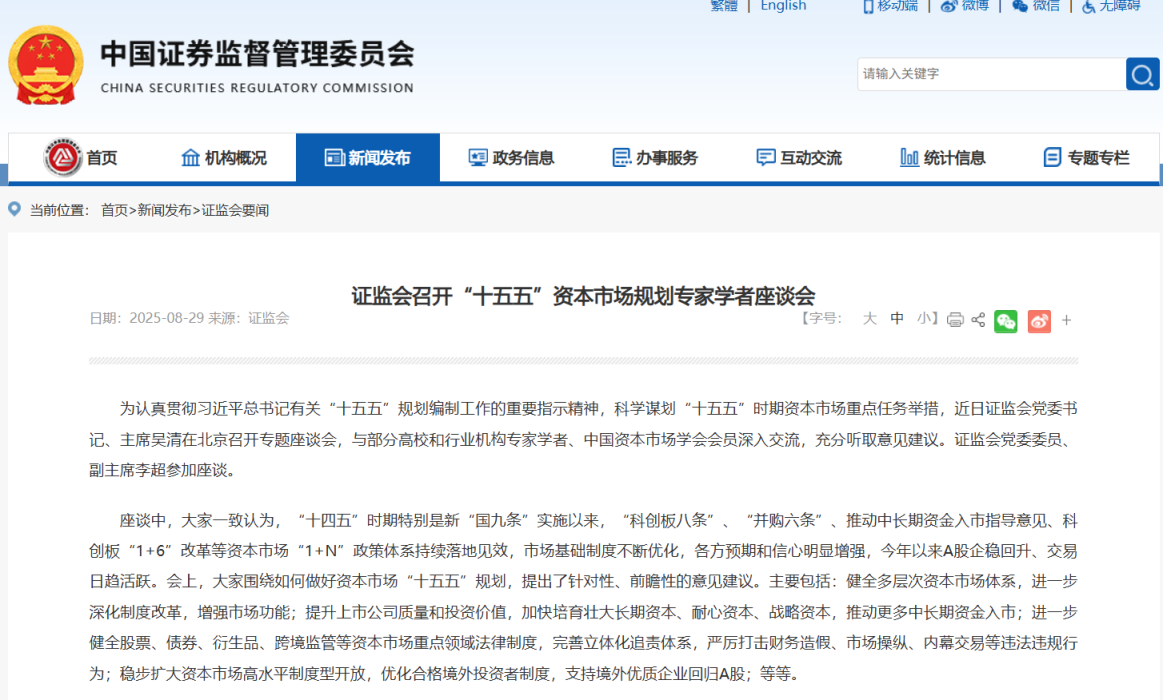
证监会:持续巩固资本市场回稳向好势头
第一财经· 2025-08-29 12:35
Core Viewpoint - The article discusses the recent meeting held by the China Securities Regulatory Commission (CSRC) to plan the key tasks for the capital market during the 14th Five-Year Plan period, emphasizing the importance of implementing the "15th Five-Year Plan" for high-quality development of the capital market [3][5]. Summary by Sections Capital Market Development - The meeting highlighted the positive effects of various policies such as the "New National Nine Articles," "Science and Technology Innovation Board Eight Articles," and "Mergers and Acquisitions Six Articles," which have led to improved market fundamentals and increased confidence among market participants [4]. - There is a consensus on the need to enhance the multi-tiered capital market system, deepen institutional reforms, and improve market functions [4]. Recommendations for Future Planning - Suggestions include enhancing the quality and investment value of listed companies, fostering long-term capital, and promoting the entry of more medium- and long-term funds into the market [4]. - The need for a robust legal framework in key areas such as stocks, bonds, derivatives, and cross-border regulation was emphasized, along with strict measures against financial fraud and market manipulation [4]. Strategic Importance - The "15th Five-Year Plan" period is seen as crucial for achieving socialist modernization and high-quality development in the capital market [5]. - The CSRC aims to consolidate the positive momentum in the capital market and promote comprehensive reforms to enhance market attractiveness and inclusivity [5].

证监会主席吴清:持续巩固资本市场回稳向好势头 加快推进新一轮资本市场改革开放
智通财经网· 2025-08-29 12:05
Core Viewpoint - The China Securities Regulatory Commission (CSRC) is focusing on high-quality planning for the capital market's "14th Five-Year Plan" and aims to enhance market stability and attractiveness through comprehensive reforms and long-term investment advocacy [1][3]. Group 1: Meeting Insights - The meeting involved discussions with experts from universities and industry institutions to gather opinions on the capital market's development during the "14th Five-Year Plan" period [2]. - Participants noted the positive impact of recent policies such as the "New Nine Articles" and "Science and Technology Innovation Board" reforms, which have improved market fundamentals and boosted investor confidence [2]. Group 2: Future Planning - The CSRC plans to establish a multi-tiered capital market system and deepen institutional reforms to enhance market functions [2]. - There is a focus on improving the quality and investment value of listed companies, fostering long-term capital, and encouraging more medium to long-term funds to enter the market [2]. - The meeting emphasized the need for a robust legal framework in key areas such as stocks, bonds, derivatives, and cross-border regulation, alongside strict measures against financial fraud and market manipulation [2]. Group 3: Strategic Importance - The "15th Five-Year Plan" period is seen as crucial for achieving socialist modernization and high-quality development in the capital market [3]. - The CSRC aims to consolidate the positive momentum in the capital market and promote a culture of long-term, value, and rational investment [3].
证监会召开“十五五”资本市场规划专家学者座谈会:进一步健全股票、债券、衍生品、跨境监管等资本市场重点领域法律制度
Qi Huo Ri Bao· 2025-08-29 12:01
Group 1 - The core viewpoint emphasizes the importance of planning for the "15th Five-Year" period in the capital market, aligning with the directives from the central government [1][3] - The meeting highlighted the positive impact of the "14th Five-Year" initiatives, including the implementation of various policies that have enhanced market confidence and activity, leading to a recovery in A-shares [2] - Suggestions for the "15th Five-Year" plan include improving the multi-tiered capital market system, enhancing the quality of listed companies, and promoting long-term capital investment [2][3] Group 2 - The "15th Five-Year" period is identified as a critical phase for achieving high-quality development in the capital market, building on the reforms and regulatory measures established during the "14th Five-Year" period [3] - The China Securities Regulatory Commission (CSRC) aims to consolidate the positive momentum in the capital market and promote comprehensive reforms to enhance market attractiveness and inclusivity [3] - Experts and scholars are encouraged to leverage their expertise to address strategic and foundational issues in the capital market, contributing to the development of the "15th Five-Year" plan [3]
证监会:持续巩固资本市场回稳向好势头
Di Yi Cai Jing· 2025-08-29 12:00
Core Viewpoint - The China Securities Regulatory Commission (CSRC) is accelerating the reform and opening up of the capital market to enhance its attractiveness and inclusiveness, in line with the directives of the "14th Five-Year Plan" and the upcoming "15th Five-Year Plan" [1][3]. Group 1: Capital Market Reform and Development - The implementation of policies such as the "New National Nine Articles," "Science and Technology Innovation Board Eight Articles," and "Mergers and Acquisitions Six Articles" has led to a noticeable improvement in market fundamentals and increased confidence among market participants [2]. - Experts emphasized the need to establish a multi-tiered capital market system, deepen institutional reforms, and enhance market functions to support long-term capital inflow [2]. - The CSRC aims to strengthen legal frameworks in key areas such as stocks, bonds, derivatives, and cross-border regulation, while also intensifying efforts to combat financial fraud and market manipulation [2]. Group 2: Strategic Planning and Future Directions - The "15th Five-Year Plan" period is seen as crucial for achieving socialist modernization and high-quality development in the capital market [3]. - The CSRC plans to consolidate the positive momentum in the capital market and promote comprehensive reforms in investment and financing to enhance market appeal [3]. - The involvement of experts and scholars is encouraged to leverage their expertise in addressing strategic and foundational issues in the capital market [3].
证监会主席吴清:持续巩固资本市场回稳向好势头
Zheng Quan Shi Bao Wang· 2025-08-29 11:58
Core Viewpoint - The China Securities Regulatory Commission (CSRC) is committed to implementing the "14th Five-Year Plan" for the capital market, focusing on high-quality development and enhancing market attractiveness and inclusivity [1] Group 1: Capital Market Strategy - The CSRC will deepen comprehensive reforms in investment and financing as a driving force for the next round of capital market reform and opening up [1] - Emphasis will be placed on advocating for long-term, value, and rational investment philosophies [1] Group 2: Research and Collaboration - Experts and scholars are encouraged to leverage their professional strengths and utilize the platform of the China Capital Market Society to enhance research on significant strategic and foundational issues in the capital market [1]
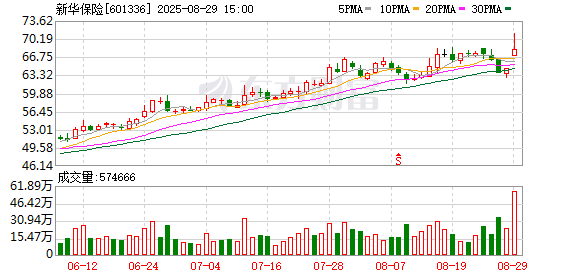
新华保险回应鸿鹄基金最新进展:二期基本完成建仓 三期7月启动进展顺利
Xin Hua Cai Jing· 2025-08-29 11:56
Group 1 - The core viewpoint of the article emphasizes that Xinhua Life Insurance Company is optimistic about the Chinese economy and aims to leverage the advantages of insurance funds as "long-term capital and patient capital" to support the real economy and the long-term healthy development of the capital market [2] Group 2 - Xinhua Asset Management's President Chen Yijiang reported that the Honghu Fund has three phases, with the third phase starting in early July and progressing smoothly. The company plans to invest a total of 46.25 billion yuan [2] - The investment scope of the three-phase fund includes large listed companies that meet the criteria of the CSI A500 index, focusing on companies with good governance, stable operations, relatively stable dividends, and good liquidity [2] - The investment team has made significant progress in stock selection capabilities after more than a year of practice [2]

证监会:持续巩固资本市场回稳向好势头,加快推进新一轮资本市场改革开放
Hua Er Jie Jian Wen· 2025-08-29 11:49
Group 1 - The core viewpoint emphasizes the need for the China Securities Regulatory Commission (CSRC) to implement high-quality planning for the capital market in line with the "14th Five-Year Plan" [1] - The CSRC aims to consolidate the positive momentum of the capital market and deepen comprehensive reforms in investment and financing [1] - There is a focus on enhancing the attractiveness and inclusiveness of the market while promoting long-term, value, and rational investment concepts [1]
史上最好中期业绩后,“券商一哥”高层有何新计划?
Hua Er Jie Jian Wen· 2025-08-29 09:36
Core Viewpoint - CITIC Securities reported strong half-year performance for 2025, achieving a revenue of 33.04 billion yuan, a year-on-year increase of 20.44%, and a net profit attributable to shareholders of 13.72 billion yuan, up 29.80%, marking the best mid-year performance in its history [1] Group 1: Financial Performance - Total assets reached 1.81 trillion yuan, an increase of 5.67% compared to the end of the previous year [1] - Net assets attributable to shareholders amounted to 305.43 billion yuan, growing by 4.20% from the end of last year [1] Group 2: A-Share Market Insights - The A-share market has shown resilience and increased activity due to government policies aimed at stabilizing and invigorating the capital market [2] - Daily trading volume and turnover have significantly increased year-on-year, with the total market capitalization of listed companies surpassing one trillion yuan [2] Group 3: Investment Strategy - The company adheres to a customer-driven asset allocation philosophy, focusing on long-term and value investments while maintaining a prudent approach to risk management [3][4] - The investment portfolio primarily consists of financing, fixed income, and stocks that hedge client demand, resulting in favorable asset allocation outcomes [3] Group 4: Stock Cost and Management - The decline in stock cost is attributed to the maturity of certain perpetual bond holdings and a decrease in the scale of stock return swap transactions [5] - The company plans to continue proactive risk management and adjust asset allocation strategies in response to market changes to ensure stable returns [5] Group 5: Profit Distribution - The board approved a mid-term profit distribution plan, proposing a cash dividend of 2.90 yuan per 10 shares, totaling 4.298 billion yuan, which represents 32.53% of the net profit attributable to shareholders [7][8] - This marks the second consecutive year of mid-term dividends, with the payout amount increasing from 2.40 yuan to 2.90 yuan per 10 shares, reflecting a year-on-year growth of over 20% [8] Group 6: International Strategy - CITIC Securities has strengthened its international strategy, achieving revenue of 1.49 billion USD in the first half of 2025, a 53% increase, and a net profit of 390 million USD, up 66% [9] - The company aims to become the preferred investment bank for Chinese clients "going out" and foreign clients "coming in," enhancing its global business footprint and cross-border financial services [9]

时报观察丨加快权益资产配置 险资“长钱长投”效应显现
证券时报· 2025-08-28 23:59
Group 1 - The core viewpoint of the article highlights the significant increase in stock investments by listed insurance companies in China, with a total stock asset amount exceeding 1.8 trillion yuan as of June 30, marking an increase of over 400 billion yuan and a growth rate of 28.7% compared to the end of the previous year [1] - The combined amount of stocks and funds held by listed insurance companies has also shown rapid growth, with specific allocation ratios for major companies such as China Life, Ping An, China Pacific Insurance, and China People’s Insurance reaching 13.6%, 12.6%, 11.8%, and 10.7% respectively, reflecting an increase of 0.9 to 2.7 percentage points [1] - The increase in equity asset allocation by insurance companies is driven by two main factors: the low interest rate environment and new accounting standards, creating a real demand for increasing equity asset allocation [1] Group 2 - The policies introduced since last September, including the Central Political Bureau's call to guide long-term funds into the market, have effectively addressed the barriers to insurance capital entering the market, leading to a significant increase in investments [2] - The active participation of insurance capital in the market is expected to enhance its role as a stabilizer and ballast, promoting a trend towards long-term and value investing, which in turn supports the stable and healthy development of the capital market [2] - In the long term, the combination of a low interest rate environment and policies encouraging insurance and other long-term funds to enter the market is likely to lead to a continued increase in equity asset allocation by insurance companies [2]