世界模型

Search documents
AI教母李飞飞:空间智能才是走向AGI的唯一路径
虎嗅APP· 2025-11-11 10:52
Core Viewpoint - The article emphasizes that current AI models, particularly large language models, lack spatial intelligence, which is essential for achieving true artificial general intelligence (AGI). The author, Fei-Fei Li, argues that the next step in AI development should focus on building "world models" that incorporate spatial understanding rather than merely expanding language models [4][17][38]. Group 1: Current Limitations of AI - AI models can generate text and images but struggle with basic physical understanding, such as predicting the outcome of simple physical actions [5][7][9]. - The inability of AI to comprehend physical laws and spatial relationships limits its application in fields requiring 3D understanding, such as drug discovery and architecture [9][10][36]. - Despite advancements, AI's spatial capabilities remain far below human levels, often resorting to guesswork in tasks involving distance and direction [36][37]. Group 2: Importance of Spatial Intelligence - Spatial intelligence is described as a foundational cognitive ability that humans develop early in life, enabling interaction with the physical world [12][15][32]. - This intelligence underpins creativity and imagination, allowing for the visualization and manipulation of complex environments [33][34]. - Historical examples illustrate how spatial intelligence has driven significant advancements in civilization, from calculating the Earth's circumference to designing innovative machinery [34]. Group 3: Future Directions for AI - The article proposes that the future of AI lies in developing "world models" that integrate spatial intelligence, allowing machines to understand and interact with the world in a more human-like manner [17][38][39]. - These world models should be generative, multimodal, and interactive, enabling AI to create and predict outcomes in complex environments [22][39][40]. - The potential applications of such advancements include revolutionizing storytelling, enhancing robotics, and transforming scientific research and education [19][24][49][56]. Group 4: Societal Impact and Vision - The ultimate goal of AI development should be to empower humans rather than replace them, enhancing creativity, productivity, and empathy [25][54]. - The integration of spatial intelligence into AI could lead to transformative changes across various sectors, including healthcare, education, and creative industries [27][56]. - The vision for the future emphasizes collaboration between AI and humans, where machines serve as partners in addressing complex challenges [47][48].


LLM只是“黑暗中的文字匠”?李飞飞:AI的下一个战场是“空间智能”
3 6 Ke· 2025-11-11 10:22
Core Insights - The next frontier for AI is "Spatial Intelligence," which is crucial for understanding and interacting with the physical world [1][4][14] - Current AI systems lack the ability to comprehend spatial relationships and physical interactions, limiting their effectiveness in real-world applications [1][12][26] - The development of a "world model" is essential for achieving true spatial intelligence in AI, enabling machines to perceive, reason, and act in a manner similar to humans [14][15][20] Group 1: Importance of Spatial Intelligence - Spatial intelligence is identified as a missing component in AI, which could lead to significant advancements in capabilities, particularly in achieving Artificial General Intelligence (AGI) [3][12] - The limitations of current AI systems are highlighted, emphasizing their inability to perform basic spatial reasoning tasks, which hinders their application in various fields [12][26] - The potential of spatial intelligence to revolutionize creative industries, robotics, and scientific exploration is underscored, indicating its broad implications for human civilization [1][4][10] Group 2: Development of World Models - The concept of world models is introduced as a new paradigm that surpasses existing AI capabilities, focusing on understanding, reasoning, and generating interactions with the physical world [14][15] - Three core capabilities for effective world models are outlined: generative ability to create realistic environments, multimodal processing of diverse inputs, and interactive capabilities to predict outcomes based on actions [15][16][17] - The challenges in developing these models include creating new training objectives, utilizing large-scale training data, and innovating model architectures to handle complex spatial tasks [18][19][20] Group 3: Applications and Future Prospects - The applications of spatial intelligence span various fields, including creative industries, robotics, and healthcare, with the potential to enhance human capabilities and improve quality of life [21][26][27] - The World Labs initiative is highlighted as a key player in advancing spatial intelligence through the development of tools like the Marble platform, which aims to empower creators and enhance storytelling [20][22] - The long-term vision includes transforming how humans interact with technology, enabling immersive experiences and fostering collaboration between humans and machines [28][29]
李飞飞终于把空间智能讲明白了:AI 的极限不是语言,世界远比文字更广阔!
AI科技大本营· 2025-11-11 09:08
Core Viewpoint - The article discusses the emerging concept of spatial intelligence in artificial intelligence (AI), emphasizing its importance for understanding and interacting with the physical world, beyond the capabilities of current language models [6][24][33]. Summary by Sections Introduction - A recent roundtable discussion featuring AI leaders like Huang Renxun and Li Feifei sparked controversy regarding the role of different players in the AI landscape [1][3]. Current AI Limitations - Many believe that the true power in AI lies with those who create large models like GPT and those who develop GPUs that enable these models to run efficiently [4][5]. - Li Feifei's focus on spatial intelligence highlights a significant limitation in current AI paradigms, which primarily rely on language as a means of understanding the world [5][10]. Spatial Intelligence Concept - Spatial intelligence is defined as the ability to perceive, understand, and interact with the physical world, which is crucial for AI to truly comprehend and engage with its environment [9][12]. - The article outlines how spatial intelligence serves as a scaffold for human cognition, influencing reasoning, planning, and interaction with the world [13][15]. Development of World Models - The creation of world models is proposed as a pathway to develop AI with spatial intelligence, enabling machines to generate and interact with complex virtual or real environments [16][17]. - Three fundamental capabilities are identified for world models: generative, multimodal, and interactive [17][19][20]. Applications of Spatial Intelligence - The potential applications of spatial intelligence span various fields, including creative industries, robotics, scientific research, healthcare, and education [24][30]. - Tools like World Labs' Marble are highlighted as early examples of how spatial intelligence can enhance creativity and storytelling [22][26]. Future Prospects - The article emphasizes the need for collective efforts across the AI ecosystem to realize the vision of spatial intelligence, which could transform human capabilities and enhance various sectors [25][31]. - The ultimate goal is to create AI that complements human creativity, judgment, and empathy, rather than replacing them [30][33].
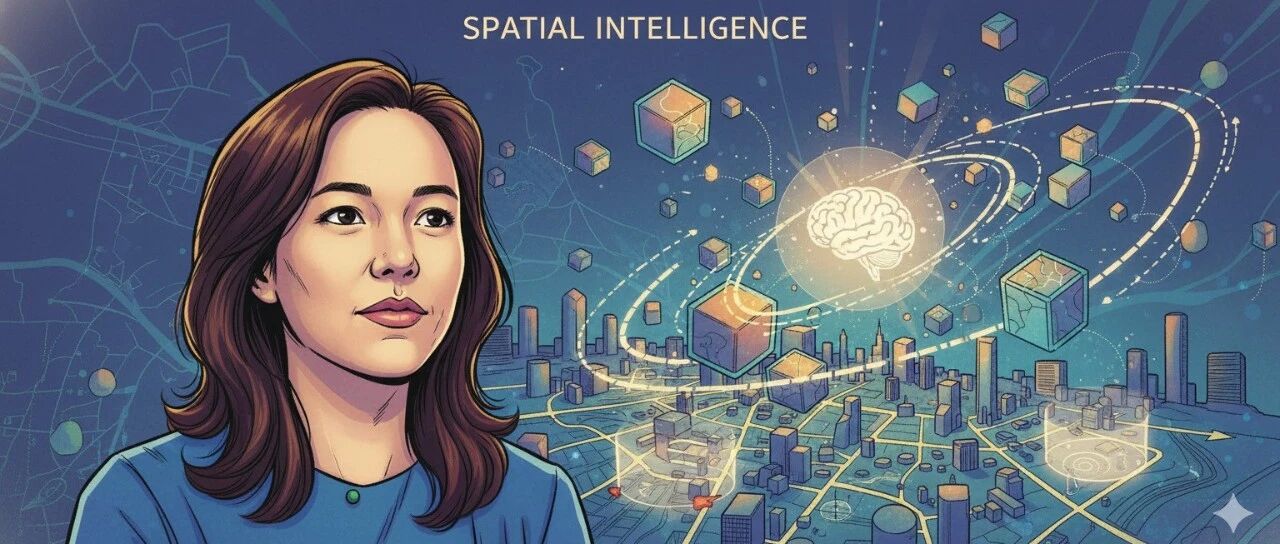
李飞飞最新发文:下一个十年,空间智能将成为人类认知的“脚手架”
Tai Mei Ti A P P· 2025-11-11 06:19
Core Insights - The article emphasizes that spatial intelligence will be the cornerstone of human cognition and the next frontier for AI development [3][4][5] - The establishment of WorldLabs aims to create a "world model" that embodies spatial intelligence, addressing the limitations of current AI systems [2][8] Group 1: Importance of Spatial Intelligence - Spatial intelligence is crucial for human interaction with the physical world and underpins imagination, creativity, and civilization progress [3][4][5] - Historical breakthroughs in civilization have been driven by spatial intelligence, as seen in the works of Eratosthenes, Hargreaves, and Watson and Crick [4][24] Group 2: Current Limitations of AI - Despite advancements in generative AI, current AI systems lack the spatial capabilities that humans possess, leading to fundamental limitations in perception, decision-making, and execution [6][25] - AI struggles with tasks such as estimating distances, navigating environments, and maintaining temporal coherence in generated content [6][25] Group 3: The Concept of World Models - The "world model" is proposed as a solution to enhance AI's spatial intelligence, enabling machines to understand, reason, generate, and interact with complex environments [8][27] - World models are defined by three core capabilities: generative ability, multimodal capability, and interactive ability [10][28][30] Group 4: Applications of Spatial Intelligence - In the creative domain, spatial intelligence will transform storytelling and design processes, allowing creators to visualize and iterate on concepts more efficiently [12][13][35] - In robotics, spatial intelligence will enable robots to become collaborative partners, enhancing their ability to assist in various environments [14][37] - In science, healthcare, and education, spatial intelligence will unlock new potentials for discovery, patient care, and immersive learning experiences [15][39][40] Group 5: Future Vision - The development of spatial intelligence is seen as a pathway to enhance human capabilities rather than replace them, fostering a more productive and harmonious relationship between humans and AI [18][34][42] - The vision for the future includes a world where AI seamlessly integrates into daily life, empowering creativity, exploration, and care [18][34][42]

李飞飞万字长文爆了!定义AI下一个十年
3 6 Ke· 2025-11-11 03:00
Core Insights - The article discusses the emerging field of "spatial intelligence" in AI, emphasizing its potential to enhance creativity, navigation, and reasoning capabilities in machines [1][4][10] - The concept of a "world model" is identified as central to achieving true spatial intelligence, enabling AI to generate and interact with environments that adhere to physical laws [2][4][25] Group 1: Importance of Spatial Intelligence - Spatial intelligence is crucial for understanding and interacting with the physical world, influencing everyday actions and complex tasks alike [17][20] - The evolution of spatial intelligence has historically driven significant advancements in civilization, from ancient geometry to modern scientific discoveries [20][21] Group 2: Current Limitations of AI - Current AI technologies, including multimodal large language models (MLLM), still lack the depth of spatial reasoning and interaction capabilities found in humans [21][22][24] - Despite advancements, AI struggles with tasks requiring spatial awareness, such as estimating distances or predicting physical interactions [22][24] Group 3: Building Spatial Intelligence - Developing AI with spatial intelligence requires a comprehensive approach, focusing on creating world models that can generate consistent and interactive environments [25][27] - Three core capabilities are essential for these world models: generative ability, multimodal input processing, and interactivity [27][30][34] Group 4: Applications of Spatial Intelligence - The potential applications of spatial intelligence span various fields, including creative industries, robotics, and scientific research, promising transformative impacts [46][75] - World Labs' Marble project exemplifies the application of spatial intelligence, enabling creators to generate and interact with 3D environments [5][45][56] Group 5: Future Vision - The future of AI lies in enhancing human capabilities through spatial intelligence, fostering collaboration between machines and humans in various domains [47][80] - Achieving this vision requires collective efforts from researchers, innovators, and policymakers to develop and govern AI technologies responsibly [52][75]
李飞飞最新长文火爆硅谷
量子位· 2025-11-11 00:58
Core Viewpoint - Spatial intelligence is identified as the next frontier for AI, with the potential to revolutionize creativity, robotics, scientific discovery, and more [2][4][10]. Group 1: Definition and Importance of Spatial Intelligence - Spatial intelligence is described as a foundational aspect of human cognition, enabling interaction with the physical world and driving reasoning and planning [20][21]. - The evolution of spatial intelligence is linked to the development of perception and action, which are crucial for understanding and interacting with the environment [12][13][14]. - Historical examples illustrate how spatial intelligence has driven significant advancements in civilization, such as Eratosthenes' calculation of the Earth's circumference and the invention of the spinning jenny [18][19]. Group 2: Current Limitations of AI - Current AI models, including multimodal large language models (MLLMs), have made progress in spatial perception but still fall short of human capabilities [23][24]. - AI struggles with tasks involving physical representation and interaction, lacking the holistic understanding that humans possess [25][26]. Group 3: World Models as a Solution - The concept of "world models" is proposed as a new generative model that can surpass the limitations of current AI by understanding, reasoning, generating, and interacting with complex virtual or real worlds [28][30]. - World models should possess three core capabilities: generative, multimodal, and interactive [31][34][38]. - The development of world models is seen as a significant challenge that requires innovative methodologies to coordinate semantic, geometric, dynamic, and physical aspects [39][41]. Group 4: Applications and Future Potential - The potential applications of spatial intelligence span various fields, including creativity, robotics, science, healthcare, and education [56][57]. - In creativity, platforms like World Labs' Marble are enabling creators to build immersive experiences without traditional design constraints [52][53]. - In robotics, achieving spatial intelligence is essential for robots to assist in various environments, enhancing productivity and human collaboration [60][62]. Group 5: Vision for the Future - The vision for the future emphasizes the importance of AI enhancing human capabilities rather than replacing them, with spatial intelligence playing a crucial role in this transformation [47][50]. - The exploration of spatial intelligence is framed as a collective effort that requires collaboration across the AI ecosystem, including researchers, innovators, and policymakers [51][63].

端到端VLA剩下的论文窗口期没多久了......
自动驾驶之心· 2025-11-11 00:00
Core Viewpoint - The article discusses the evolution of autonomous driving technology, highlighting the transition from rule-based systems to end-to-end models represented by companies like Ideal and Xpeng, and currently to the world model phase represented by NIO, emphasizing the continuous presence of deep learning throughout these changes [1]. Group 1: Course Introduction - The course covers the development from modular production algorithms to end-to-end systems and now to VLA, focusing on core algorithms such as BEV perception, visual language models (VLM), diffusion models, reinforcement learning, and world models [5]. - Participants will gain a comprehensive understanding of the end-to-end technical framework and key technologies, enabling them to reproduce mainstream algorithm frameworks like diffusion models and VLA, and apply their knowledge to projects [5]. Group 2: Instructor Background - The course is led by Jason, an expert in algorithms from a top domestic manufacturer, with a strong academic background including a C9 undergraduate degree and a PhD from a QS top 50 institution, along with multiple published papers [6]. Group 3: Student Feedback and Outcomes - Feedback indicates that students completing the course can achieve a level equivalent to one year of experience as an end-to-end autonomous driving algorithm engineer, benefiting from the training for internships and job recruitment [5]. Group 4: Research Guidance - The program offers a structured approach to research, guiding students through topic selection, literature review, methodology development, and paper writing, with a high success rate in publication [11][15]. - The service includes personalized matching with experienced mentors based on research direction and goals, ensuring a tailored learning experience [18]. Group 5: Additional Opportunities - Outstanding students may receive recommendation letters from prestigious institutions and direct referrals to research positions in leading companies like Alibaba and Huawei [19].
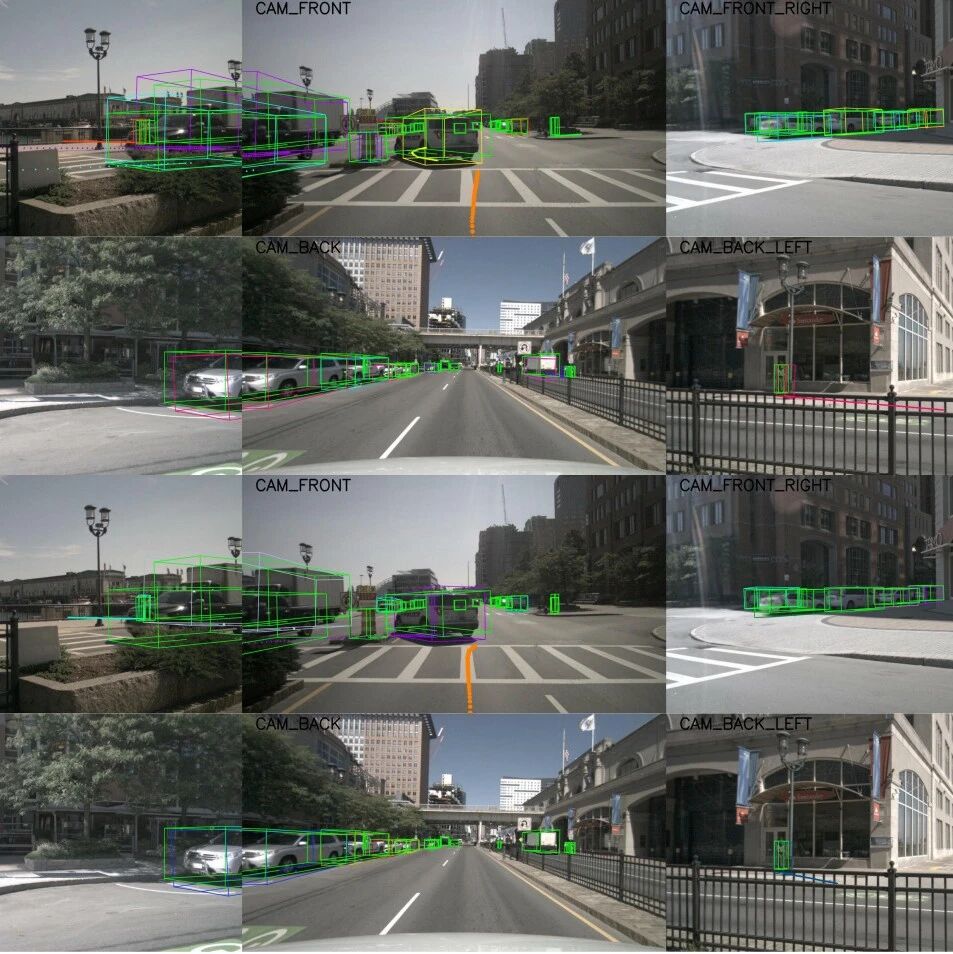
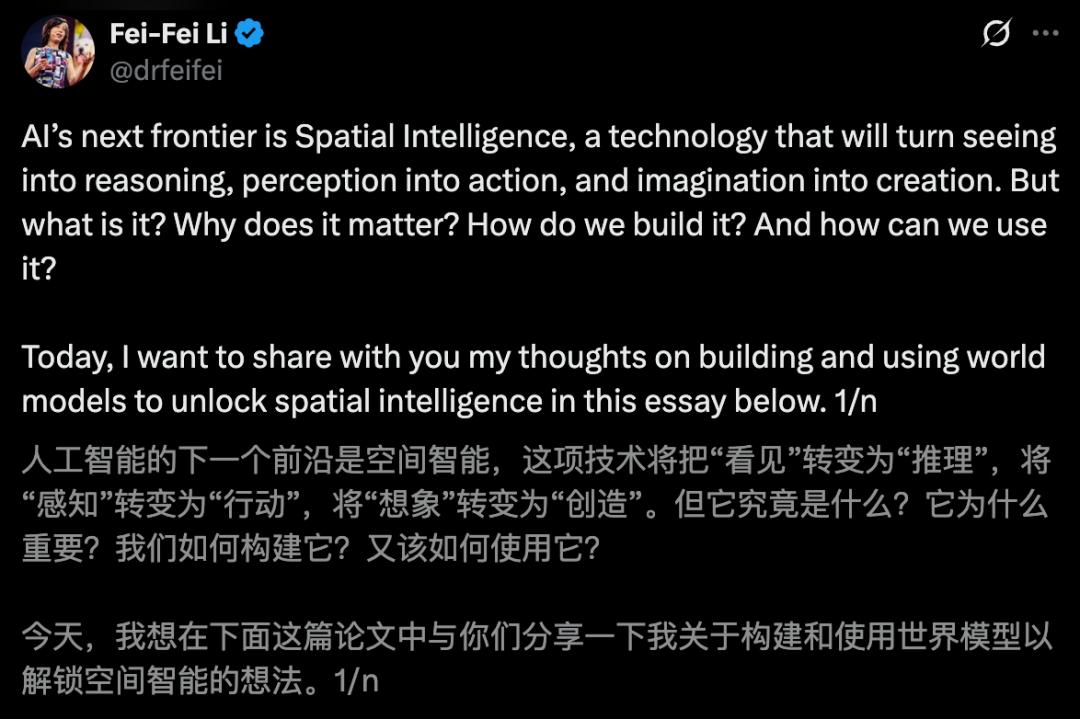
李飞飞最新长文:AI的下一个十年——构建真正具备空间智能的机器
机器之心· 2025-11-10 23:47
Core Insights - The article emphasizes the importance of spatial intelligence as the next frontier in AI, highlighting its potential to transform various fields such as storytelling, creativity, robotics, and scientific discovery [5][6][10]. Summary by Sections What is Spatial Intelligence? - Spatial intelligence is defined as a fundamental aspect of human cognition that enables interaction with the physical world, influencing everyday actions and creative processes [10][13]. - It is essential for tasks ranging from simple activities like parking a car to complex scenarios such as emergency response [10][11]. Importance of Spatial Intelligence - The article argues that spatial intelligence is crucial for understanding and manipulating the world, serving as a scaffold for human cognition [13][15]. - Current AI technologies, while advanced, still lack the spatial reasoning capabilities inherent to humans, limiting their effectiveness in real-world applications [14][15]. Building Spatial Intelligence in AI - To create AI with spatial intelligence, a new type of generative model called "world models" is proposed, which can understand, reason, generate, and interact within complex environments [17][18]. - The world model should possess three core capabilities: generative, multimodal, and interactive [18][19][20]. Challenges Ahead - The development of world models faces significant challenges, including the need for new training tasks, large-scale data, and innovative model architectures [23][24][25]. - The complexity of representing the physical world in AI is much greater than that of language, necessitating breakthroughs in technology and theory [21][22]. Applications of Spatial Intelligence - In creativity, spatial intelligence can enhance storytelling and immersive experiences, allowing creators to build and iterate on 3D worlds more efficiently [32][33]. - In robotics, spatial intelligence is essential for machines to understand and interact with their environments, improving their learning and operational capabilities [34][35][36]. - The potential impact extends to fields like science, medicine, and education, where spatial intelligence can facilitate breakthroughs and enhance learning experiences [38][39][40]. Conclusion - The article concludes that the pursuit of spatial intelligence in AI represents a significant opportunity to enhance human capabilities and address complex challenges, ultimately benefiting society as a whole [42].

模型战事未了,钱已流向别处:一场百人AI公司CEO闭门会后的资本真相
3 6 Ke· 2025-11-10 10:47
Core Insights - The article emphasizes that companies capable of creating AI products are more likely to generate profits than those solely focused on large models [2][3] Investment Landscape - Jinqiu Fund has invested in over 50 projects in the past year, positioning itself as a top player in the AI investment space [3] - The fund's investment distribution includes 56% in application layers, 25% in embodied intelligence, 10% in computing power, and nearly 8% in smart hardware [6] Industry Trends - The value of AI is shifting from model layers to specific products, scenarios, and solutions, indicating a maturation of the industry [6] - Models are viewed as commodities, while products that leverage these models, especially those that understand user needs, are considered scarce [6][10] Market Opportunities - The demand for inference chips is increasing, with three identified opportunities: the opening of the inference chip market, the positive feedback loop of chip software algorithms, and innovative teams using diverse technical solutions [7] - The robotics sector is anticipated to experience significant growth, with projections indicating that global market financing will reach five times the 2023 levels by 2025 [7] Paradigm Shift in AI - AI development is transitioning from pre-training reliant on computing power and data scale to post-training driven by reinforcement learning and experience [10] - The commercialization of AI is likened to the decline in internet bandwidth costs, suggesting that model capabilities will become more accessible [10] Content Creation Evolution - AI is reshaping content creation from merely recording reality to creating imaginative narratives, with a focus on interactive content [18] - The emergence of "reference live video" is seen as a new paradigm in video generation, allowing creators to upload subjects and direct them through language commands [11][14] Structural Risks in AI Companies - AI companies face a risk of being absorbed by foundational model companies if their products are not specialized enough [20] - The decline of AI companies is characterized by a "cliff-like drop," emphasizing the need for entrepreneurs to establish unique barriers in data, industry knowledge, or distribution channels [20]

第八届 「GAIR 全球人工智能与机器人大会」即将启幕:穿越AI长夜,共睹群星闪耀
雷峰网· 2025-11-10 10:05
Core Insights - The GAIR Global Artificial Intelligence and Robotics Conference will take place on December 12-13, 2025, in Shenzhen, focusing on the advancements in AI and robotics [2][10] - The conference will feature discussions on large models, embodied intelligence, computational power transformation, reinforcement learning, and world models, showcasing the forefront of AI exploration [3][4] - The event aims to bridge academia and industry, highlighting the importance of collaboration in advancing AI technologies and their applications in the real world [4][9] Group 1 - The conference will host top scholars from Europe, the United States, Japan, and China to explore the deep integration of AI with the physical world [4] - The commercialization of AI is described as a challenging journey, with entrepreneurs and industry giants sharing their practical methodologies [4] - The focus on computational power as a critical area for economic development will include insights into market and policy dynamics surrounding large-scale computational infrastructure [4] Group 2 - GAIR has evolved since its inception in 2016, consistently attracting leading scientists and researchers, including Turing and Nobel Prize winners [5][7] - The conference has marked significant milestones in the history of AI in China, such as the participation of influential female scientists and the attendance of over 5,000 AI experts [7] - The event serves as a platform for connecting ideas and practices, fostering collaboration between different generations of researchers and practitioners in the AI field [9]