卫星互联网

Search documents
全球“追星”!我国新增超20万颗申请,马斯克也有大消息
券商中国· 2026-01-10 12:06
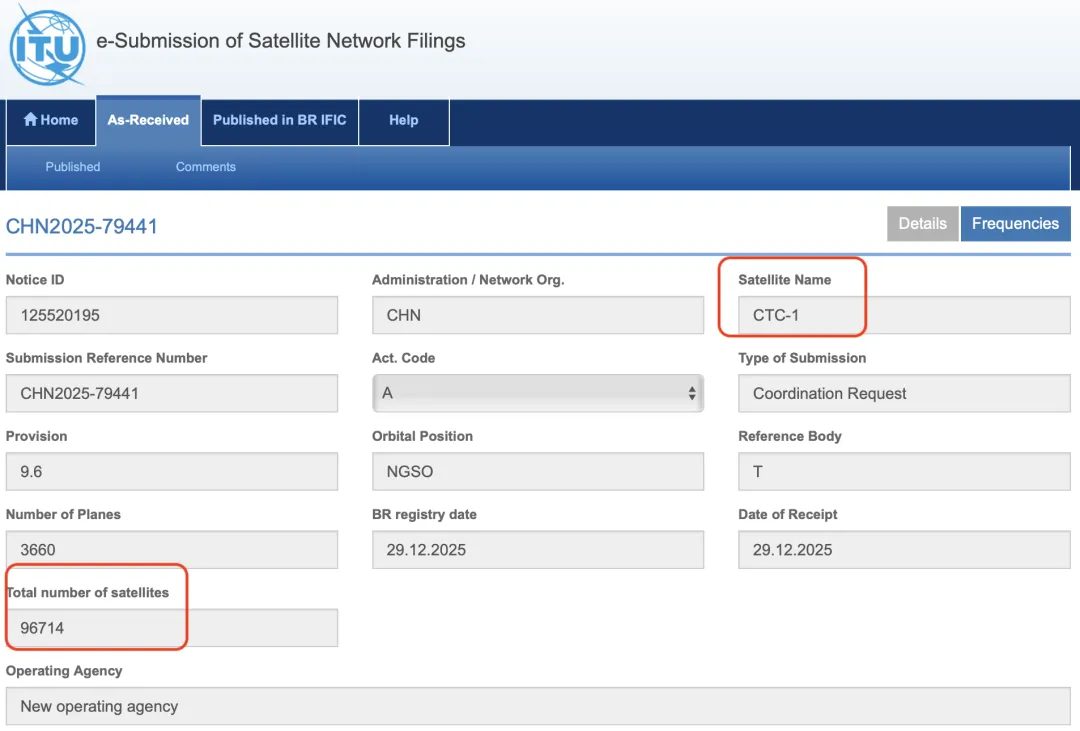
Core Viewpoint - The global space race is intensifying, with significant developments in satellite deployment and frequency resource applications from both China and the United States [1][10]. Group 1: China's Satellite Plans - China has applied to the International Telecommunication Union (ITU) for frequency resources for over 200,000 satellites, with more than 190,000 satellites coming from the Radio Innovation Institute [2][3]. - The application includes 14 satellite constellations, with the CTC-1 and CTC-2 constellations each applying for 96,714 satellites, making them the main contributors to this application [3]. - The Radio Innovation Institute, established in Xiong'an New Area, aims to serve the satellite internet industry and focus on spectrum resource development and technological innovation [4]. Group 2: ITU Regulations - The ITU, responsible for managing global radio frequency and satellite orbit resources, mandates that new satellite applications must launch their first satellite within seven years and complete deployment within 14 years [5]. - Failure to meet these deployment milestones will result in a proportional reduction of frequency rights based on the actual number of satellites launched [5][6]. Group 3: SpaceX Developments - On January 9, 2023, the U.S. Federal Communications Commission (FCC) approved SpaceX's plan to deploy an additional 7,500 second-generation Starlink satellites, bringing the total approved number to over 15,000 [7][9]. - The FCC's decision supports SpaceX's expansion in the global internet service market and allows for significant technological upgrades, including operations across five frequency bands [8][9]. - The new satellites are expected to enhance network performance, potentially achieving internet speeds of up to 1 Gbps, and will provide direct-to-cell services outside the U.S. [9]. Group 4: Global Satellite Landscape - As of May 12, 2025, there are approximately 10,824 satellites in low Earth orbit, with a utilization rate of about 18% of the theoretical capacity of 60,000 satellites [10]. - The U.S. currently leads in the number of operational spacecraft, accounting for 75.94% of the global total, while China holds about 9.43% [10]. - China's commercial satellite constellations are taking shape, with significant deployment deadlines set for various projects, indicating a future surge in satellite launches [10]. Group 5: Future Industry Outlook - The commercial space industry is expected to experience multiple catalysts in 2026, particularly with the introduction of reusable and high-capacity rockets, which will alleviate previous bottlenecks in satellite communication development [11]. - With ongoing policy support and technological advancements, China's rocket launch capacity and frequency are projected to see significant growth, further accelerating the development of the satellite internet sector [11].


我国新增20万颗卫星申请,权威解读来了
华尔街见闻· 2026-01-10 10:48
Core Viewpoint - The article discusses China's strategic application for over 200,000 satellite frequency resources to enhance its satellite internet capabilities and compete with global leaders like SpaceX [2][5]. Group 1: Satellite Resource Application - China has applied for over 200,000 satellite frequency resources from the International Telecommunication Union (ITU), with more than 190,000 satellites coming from the newly established Radio Innovation Institute [2][3]. - The largest satellite constellations in this application are CTC-1 and CTC-2, each consisting of 96,714 satellites [3][4]. - Other significant constellations include CHINAMOBILE-L1 with 2,520 satellites, SAILSPACE-1 with 1,296 satellites, and TIANQI-3G with 1,132 satellites [3]. Group 2: Establishment of Radio Innovation Institute - The Radio Innovation Institute was registered on December 30, 2025, in Xiong'an New Area, Hebei, and is the first new-type research institution in China's radio management technology field [5]. - This institute aims to serve the satellite internet industry, research electromagnetic space technology, and explore the value potential of frequency resources [5]. - The institute is a collaboration among seven entities, including the National Radio Monitoring Center and China Satellite Network Group [5]. Group 3: Strategic Importance and Future Prospects - The application for such a large number of satellites indicates China's commitment to a systematic layout in low Earth orbit and its capability to compete with Western countries [5]. - The ITU's "first come, first served" rule emphasizes the importance of timely applications for frequency and orbital positions to avoid losing access to these resources [7]. - Even if the ITU approves the application, deployment is not guaranteed, and the successful applicant must complete 10% of the deployment within seven years to retain rights [9]. - The potential for deploying 200,000 satellites over a decade is feasible given the large market for low Earth orbit satellites in China [9]. Group 4: Industry Impact - The application by the Radio Innovation Institute is seen as a positive signal for the satellite launch industry, potentially affecting how frequency resources are allocated [10]. - The presence of a national entity applying for such a large number of satellites may change the dynamics of frequency applications, especially for smaller satellite companies [10].

我国新增20万颗卫星申请
财联社· 2026-01-10 09:29
Core Viewpoint - The application for satellite frequency resources has reached a national strategic level in China, with over 200,000 satellites applied for by December 2025, indicating a significant push in the satellite internet sector [1][2]. Group 1: Satellite Frequency Resource Application - China has applied for over 200,000 satellite frequency resources from the International Telecommunication Union (ITU) by December 2025, with more than 190,000 satellites coming from the newly established Radio Innovation Institute [1]. - The application process is still in the declaration stage, and approval from the ITU does not guarantee successful deployment of the satellites [2]. Group 2: Strategic Implications and Industry Outlook - Experts believe that the Radio Innovation Institute will act as a "national team" for satellite internet, integrating industry resources and leveraging China's large market advantage to accelerate the country's progress in the satellite sector, potentially surpassing SpaceX [2].

我国新增20万颗卫星申请
Shang Hai Zheng Quan Bao· 2026-01-10 08:12
尽管这些卫星资源仍处于申报阶段,ITU尚未批准,批准也并不意味着能成功部署,但专家看好无线电 创新院作为卫星互联网"国家队",整合产业资源,发挥我国超大规模市场优势,加快我国产业赶超 SpaceX。 (文章来源:上海证券报) 记者查询国际电信联盟(ITU)官网获悉,我国2025年12月向ITU申请了超20万颗卫星的频轨资源。 其中超19万颗卫星来自近期刚刚成立的无线电创新院。记者采访上海社会科学院信息研究所副所长丁波 涛及头部商业卫星公司的专家了解到,这意味着卫星频轨资源申请已上升至国家战略层面。 ...
我国新增20万颗卫星申请 专家:卫星频轨资源申请已上升至国家战略层面
Xin Lang Cai Jing· 2026-01-10 08:09
【我国新增20万颗卫星申请 专家:卫星频轨资源申请已上升至国家战略层面】智通财经1月10日电,记 者查询国际电信联盟(ITU)官网获悉,我国2025年12月向ITU申请了超20万颗卫星的频轨资源。其中 超19万颗卫星来自近期刚刚成立的无线电创新院。记者采访上海社会科学院信息研究所副所长丁波涛及 头部商业卫星公司的专家了解到,这意味着卫星频轨资源申请已上升至国家战略层面。尽管这些卫星资 源仍处于申报阶段,ITU尚未批准,批准也并不意味着能成功部署,但专家看好无线电创新院作为卫星 互联网"国家队",整合产业资源,发挥我国超大规模市场优势,加快我国产业赶超SpaceX。(上证报) 转自:智通财经 ...
我国新增20万颗卫星申请 权威解读来了
Shang Hai Zheng Quan Bao· 2026-01-10 07:42
记者查询国际电信联盟(ITU)官网获悉,我国2025年12月向ITU申请了超20万颗卫星的频轨资源。 其中超19万颗卫星来自近期刚刚成立的无线电创新院。记者采访上海社会科学院信息研究所副所长丁波涛及头部商业卫星公司的专家了解到,这意味着卫 星频轨资源申请已上升至国家战略层面。 尽管这些卫星资源仍处于申报阶段,ITU尚未批准,批准也并不意味着能成功部署,但专家看好无线电创新院作为卫星互联网"国家队",整合产业资源, 发挥我国超大规模市场优势,加快我国产业赶超SpaceX。 CTC-1和CTC-2的申请时间是2025年12月29日,申请单位无线电创新院的全称是无线电频谱开发利用和技术创新研究院(Institute of Radio Spectrum Utilization and Technological Innovation)。 记者从国家无线电监测中心官网获悉,无线电创新院于2025年12月30日在河北雄安新区登记注册。这是我国无线电管理技术领域首家以技术创新和成果转 化为目标的新型研发机构。 无线电"国家队"申请超大规模卫星资源 超20万颗卫星来自十余个卫星星座,每个星座的卫星数量从十余颗到9万余颗不等, ...
2026年开市即爆!卫星互联网板块领涨,多股周内涨幅突破40%
Hua Xia Shi Bao· 2026-01-10 00:17
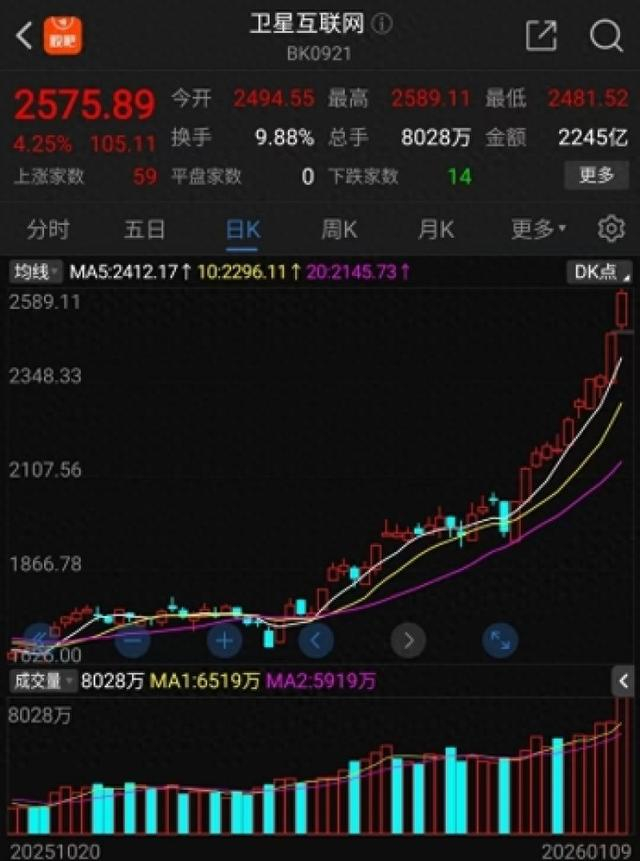
Core Viewpoint - The satellite internet sector in the A-share market has emerged as a leading star, experiencing significant price increases and attracting substantial market attention at the beginning of 2026, driven by favorable policies and heightened market activity [2][4]. Market Performance - The A-share market has shown a strong upward trend, with the Shanghai Composite Index surpassing 4100 points by January 9, 2026, following a robust start to the year [3][4]. - The satellite internet concept has been a major contributor to this growth, with multiple stocks within the sector achieving significant gains, including several reaching their daily limit up [3][4]. Stock Price Increases - From January 5 to January 9, 2026, four companies in the satellite internet sector saw their stock prices rise by over 40%, specifically, Zhenlei Technology (48.18%), Leike Defense (45.82%), Tongyu Communication (42.34%), and Aerospace Hanyu (42.28%) [5]. - Other notable stocks, including China Satellite Communications, Qianzhao Optoelectronics, Aerospace Electronics, and Zhenyou Technology, also experienced substantial increases, all exceeding 30% [5]. Fundamental Performance - Despite the sharp rise in stock prices, some companies in the sector have reported relatively flat or declining revenue figures. For instance, Zhenlei Technology's revenue increased from 234 million yuan in 2022 to 302 million yuan in 2025, showing slow growth [6]. - Conversely, Leike Defense's revenue has been on a downward trend, dropping from 1.364 billion yuan in 2022 to 933 million yuan in 2025 [6]. - Tongyu Communication also experienced a decline in revenue, from 1.407 billion yuan in 2022 to 815 million yuan in 2025 [6]. Policy Support - The rise of the satellite internet sector is attributed to strong policy support, particularly the National Space Administration's action plan aimed at promoting high-quality development in commercial aerospace by 2027 [4][6]. - This policy environment has fostered optimism about the sector's growth potential, leading to increased investment in related stocks [4]. Market Risks - Several companies have issued announcements regarding abnormal stock price fluctuations, warning investors of potential risks associated with the rapid price increases [7][8]. - For example, Tongyu Communication reported a cumulative stock price increase of 191.65% since November 27, 2025, significantly outpacing the industry average [8]. - Aerospace Hanyu also noted a 200.81% increase in stock price since November 21, 2025, prompting them to clarify that their business fundamentals remain stable despite the price surge [8].


美国联邦通信委员会批准SpaceX再部署7500颗星链卫星的计划
Xin Lang Cai Jing· 2026-01-10 00:05
美国联邦通信委员会(FCC)于周五宣布,已批准太空探索技术公司(SpaceX)新增部署 7500 颗第二 代 "星链" 卫星的申请,助力该公司进一步拓展全球互联网服务业务。 美国联邦通信委员会表示,埃隆・马斯克旗下的太空探索技术公司(SpaceX)现已获准额外运行 7500 颗第二代 "星链" 卫星,此举将使其全球在轨卫星总数达到 1.5 万颗。该委员会同时批准SpaceX对卫星 进行技术升级,并允许其使用五个频段开展运营;此外,委员会还豁免了此前限制卫星信号覆盖重叠、 制约网络容量提升的相关规定。 该机构指出,新增卫星将为美国以外地区提供卫星直连蜂窝网络服务,并强化美国本土的网络覆盖能 力,不仅能支撑下一代移动通信服务,还可实现最高每秒 1 千兆比特的上网速率。 责任编辑:王永生 美国联邦通信委员会(FCC)于周五宣布,已批准太空探索技术公司(SpaceX)新增部署 7500 颗第二 代 "星链" 卫星的申请,助力该公司进一步拓展全球互联网服务业务。 美国联邦通信委员会表示,埃隆・马斯克旗下的太空探索技术公司(SpaceX)现已获准额外运行 7500 颗第二代 "星链" 卫星,此举将使其全球在轨卫星总数达到 ...
打造“天空之城”与中国商业航天新一极,广州明确10年计划
Di Yi Cai Jing· 2026-01-09 13:16
Core Insights - Guangzhou aims to establish itself as a global hub for low-altitude economy and commercial aerospace by 2035, with a focus on developing intelligent aircraft and key enterprises in the commercial aerospace sector [1] Low-altitude Economy - The planning document outlines Guangzhou's ambition to become a manufacturing and design center for low-altitude economy, with applications in various sectors such as agriculture, emergency services, and urban management [1] - The city plans to explore "drone + smart logistics" initiatives, including urban drone delivery and intercity drone transport, to enhance logistics efficiency [2] - Guangzhou has a competitive advantage in the low-altitude economy due to its concentration of high-tech companies, a supportive electric vehicle industry, and established regulatory frameworks [2] Commercial Aerospace - The planning document emphasizes strengthening Guangzhou's capabilities in communication and navigation equipment manufacturing, aiming to capitalize on satellite internet opportunities [3] - The city plans to support the development of a complete industrial chain for the Beidou satellite system, integrating various technologies such as 5G and artificial intelligence [3] - Challenges in the commercial aerospace sector include navigating complex airspace environments and the lack of launch facilities, which need to be addressed for effective development [4] Industry Collaboration and Development - To enhance competitiveness, Guangzhou must focus on integrating various industry segments and fostering collaboration among enterprises [3] - The city is encouraged to provide policy support for commercial aerospace companies and promote capital operations to attract new businesses [6] - Emphasis on research in key areas such as rocket recovery technology is necessary to build a solid technological foundation for the industry [6]
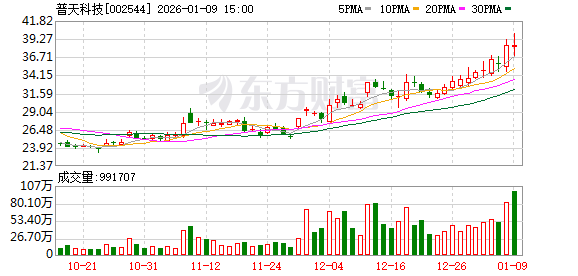
普天科技:卫星互联网是公司核心战略方向之一
Zheng Quan Ri Bao· 2026-01-09 12:37
Core Viewpoint - The company, as a listed platform under China Electronics Corporation, emphasizes satellite internet as a core strategic direction and aims to build an ecosystem that meets industry development needs [2] Group 1: Strategic Initiatives - The company is actively involved in the research and standard-setting for multi-mode collaborative networking through organizations like the China Communications Standards Association (CCSA) [2] - The company has established a joint laboratory with Xi'an University of Electronic Science and Technology to conduct research and talent development in integrated terrestrial and satellite information networks [2] Group 2: Product Development - The company is accelerating the development of low-orbit satellite communication products and is launching proprietary products aimed at satellite terminal fields [2] - The company is focusing on the research and application of BeiDou satellite navigation system products to enhance comprehensive positioning service capabilities [2] Group 3: Manufacturing and Innovation - The company leverages its advantages in aviation-grade intelligent manufacturing to provide high-quality and reliable product components, such as PCB design and manufacturing for satellite-related equipment [2] - The company has established an innovative R&D institution to increase investment in satellite internet research and gradually build an integrated capability system [2]