
二十四节气

Search documents
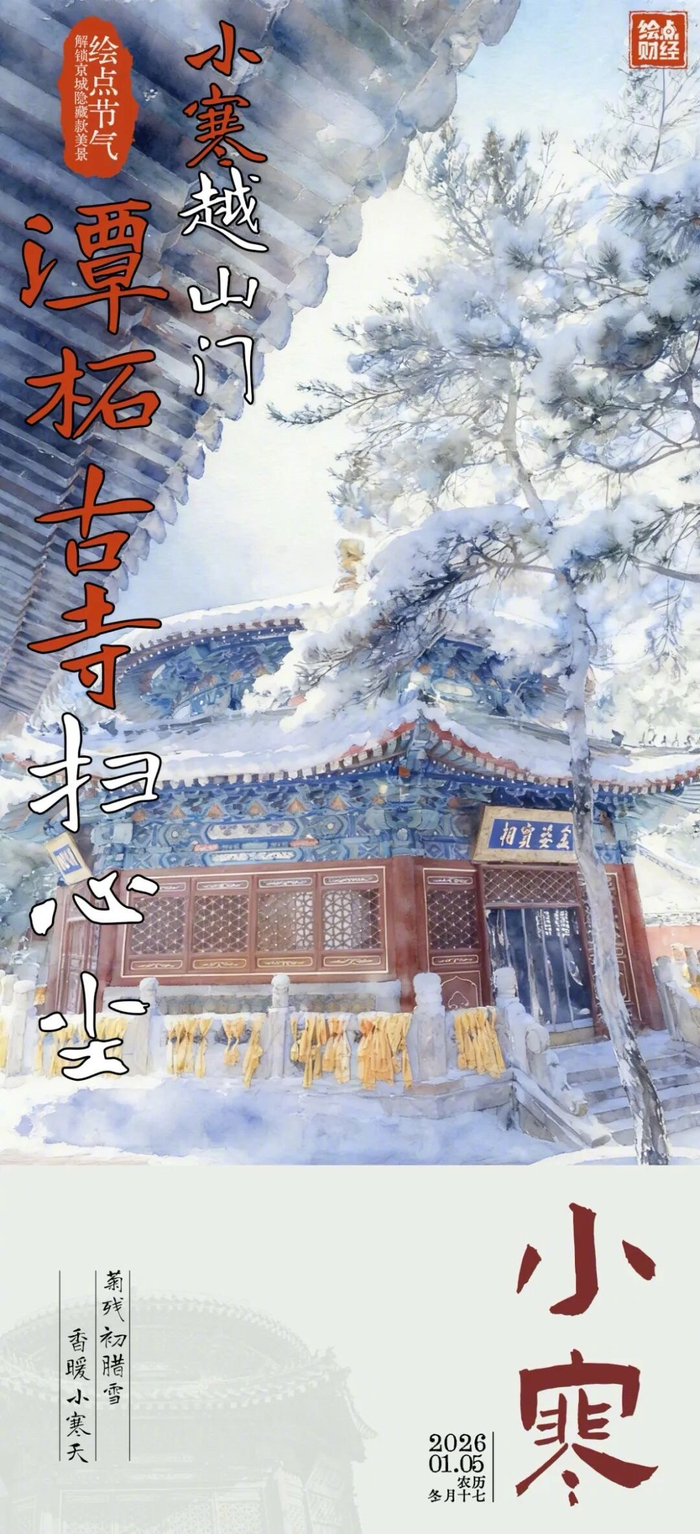
小寒时节潭柘寺古韵更显,游客可享静谧冬日
Bei Jing Shang Bao· 2026-01-05 02:54
Group 1 - The article discusses the significance of the "Minor Cold" solar term, which is the 23rd of the 24 solar terms in China, indicating that the coldest days are approaching [1] - It highlights the traditional saying "cold in the three nines," suggesting that the coldest period typically falls within the Minor Cold solar term [1] - The article suggests that visiting Tanzhe Temple during this time is ideal due to the tranquility and the serene atmosphere created by the winter season [1] Group 2 - The winter scenery at Tanzhe Temple is described as quiet, with ancient trees and buildings appearing more solemn in the cold air [1] - The article notes that although the leaves have fallen, the ancient architecture's charm becomes more pronounced, allowing visitors to experience the temple's ambiance without the usual crowds [1]

今日小寒
中国能源报· 2026-01-04 23:05
Group 1 - The article discusses the solar term "Xiaohan," which is the 23rd solar term in the 24 solar terms, indicating cold weather but not at its peak [1] - It highlights that during Xiaohan, the cold air accumulates, leading to freezing rivers and frozen soil, particularly in northern China [1] - The article mentions the saying "Xiaohan is colder than Dahan," suggesting that Xiaohan is often colder than the subsequent solar term, Dahan [1]
小寒时节天气冷 记得加衣保暖
Yang Shi Xin Wen· 2026-01-04 23:02
Core Viewpoint - The article discusses the arrival of the "Minor Cold" solar term, indicating a significant drop in temperatures across various regions, symbolizing a time for nature to gather strength in anticipation of renewal [1] Group 1 - The "Minor Cold" is the 23rd solar term in the 24 solar terms, marking the onset of severe cold in most areas [1] - The article highlights the current weather conditions, emphasizing the cold and the impact it has on the environment [1]
小寒大寒,究竟哪个更冷?
Xin Lang Cai Jing· 2026-01-03 02:48
Core Viewpoint - The article discusses the differences between the solar terms "Xiao Han" (Minor Cold) and "Da Han" (Major Cold), highlighting that despite their names, the actual temperature data often shows that Xiao Han is colder than Da Han in many regions of China [1][2]. Group 1: Temperature Comparison - Xiao Han marks the beginning of severe cold, while Da Han represents the accumulation of cold [1]. - Meteorological data indicates that during Xiao Han, average temperatures in Beijing range from -5 to -10 degrees Celsius, while Da Han is typically 1 to 2 degrees warmer [2]. - In the Yellow River basin, extreme low temperatures during Xiao Han can drop below -10 degrees Celsius [2]. Group 2: Climate Dynamics - The colder temperatures during Xiao Han are attributed to the strong cold air masses and the "lag effect" of ground heat loss [2]. - After the winter solstice, the ground continues to lose heat, leading to the lowest temperatures being recorded during Xiao Han [2]. - By Da Han, although cold air activity remains, the average temperature slightly increases due to longer daylight and increased solar radiation [2]. Group 3: Regional Variations - In northern China, the cold is characterized as "dry cold," with temperatures often dropping to -20 or -30 degrees Celsius [3]. - In southern China, the cold is described as "wet cold," with temperatures typically between 0 and 10 degrees Celsius during Xiao Han, but more frequent cold air activity during Da Han can lead to lower temperatures [3]. - The perception of cold varies regionally, with southern areas experiencing more discomfort due to humidity and precipitation during Da Han [3]. Group 4: Cultural Significance - Xiao Han symbolizes a period of hidden strength, while Da Han signifies a turning point towards the arrival of spring [3]. - Both terms reflect ancient Chinese sensitivity to seasonal changes and respect for nature [3].
小寒大寒哪个更冷?(文化中国行·二十四节气二十四问)
Ren Min Wang· 2026-01-03 01:12
Core Viewpoint - The article discusses the differences between the solar terms "Minor Cold" and "Major Cold," highlighting their climatic significance and cultural implications in Chinese tradition [2][3][4]. Group 1: Climatic Differences - Minor Cold is characterized by lower average temperatures, often ranging from -5 to -10 degrees Celsius in Beijing, while Major Cold is slightly warmer by 1 to 2 degrees Celsius [3]. - The phenomenon of "Minor Cold being colder than Major Cold" is attributed to the strong cold air and the lag effect of ground heat loss during Minor Cold, leading to extreme low temperatures [3]. - In the Yellow River region, extreme low temperatures during Minor Cold can often drop below -10 degrees Celsius, reinforcing the saying that "Minor Cold surpasses Major Cold" [3]. Group 2: Regional Variations - In northern China, the cold is described as "dry cold," with temperatures often dropping to -20 or -30 degrees Celsius, while in southern China, the cold is perceived as "wet cold," with temperatures typically between 0 and 10 degrees Celsius [4]. - Southern regions experience more frequent cold air activities during Major Cold, leading to a higher probability of temperatures dropping below 0 degrees Celsius compared to Minor Cold [4]. Group 3: Cultural Significance - Minor Cold symbolizes a period of hidden strength, while Major Cold represents a turning point towards the arrival of spring, reflecting the cyclical nature of seasons [4]. - The article emphasizes the importance of adapting to seasonal changes and maintaining warmth during the coldest times of the year, rather than merely comparing which term signifies greater coldness [4].
当节气不再是老黄历
Xin Lang Cai Jing· 2025-12-30 12:58
Core Insights - The article discusses how the ancient Chinese solar terms, particularly "Summer Solstice," are being reinterpreted and integrated into modern life through the lens of contemporary youth and technology [1][2] - It highlights the connection between ancient practices and modern scientific endeavors, exemplified by the mention of the "Chang'e" lunar probe and its reliance on astronomical principles established by ancient civilizations [1] Group 1: Cultural Significance - The narrative emphasizes the transformation of solar terms from mere cultural relics to living wisdom that can be engaged with in daily life [2] - The exploration of solar terms reflects a journey from reverence for nature to a more proactive understanding and utilization of natural laws [1] Group 2: Modern Interpretation - Young individuals are portrayed as actively participating in the reinterpretation of solar terms, using contemporary language and methods to breathe new life into these ancient concepts [2] - The article illustrates how traditional architectural practices, such as the design of courtyard houses, align with solar terms, showcasing a harmonious relationship between human habitation and natural cycles [1]
2028年有个“闰五月”,会有两个端午节吗?
Xin Lang Cai Jing· 2025-12-24 11:38
Core Viewpoint - The year 2262 will have two "Spring Festivals" due to the occurrence of a "leap January," with the first day of the lunar new year falling on January 21 and the leap month on February 20 [1] Group 1: Leap Year Mechanism - The lunar calendar is a traditional Chinese calendar that combines lunar and solar cycles, with a lunar year averaging about 354 days, which is approximately 11 days shorter than a solar year [2] - To reconcile this time difference and avoid seasonal misalignment, the ancient Chinese implemented a "leap" system, adding a leap month approximately every two to three years based on the "19 years, 7 leap months" principle [4] Group 2: Occurrence of Leap Months - Leap months are related to solar terms, with leap months typically added in months that do not contain a "middle solar term" [7] - Leap May is relatively common, with examples in 1998, 2009, and 2028, while leap August is less frequent, occurring in 1957, 1976, and 1995, with the next occurrence in 2052 [8][10] - Leap January is rare, with no occurrences from the 18th to the 22nd century, and the next leap January will be in 2262 [10] Group 3: Cultural Impact - The discussion around having two Spring Festivals reflects the influence of traditional culture on people's lives, highlighting the richness and wisdom of cultural practices related to festivals and solar terms [10]

立竿见影,原来古人这样测四时节气(字载匠心·惊艳时光的中国智慧)
Ren Min Ri Bao Hai Wai Ban· 2025-12-23 22:59
Core Viewpoint - The article discusses the historical significance and scientific contributions of the ancient Chinese astronomical instrument, the gnomon, which reflects the pursuit of scientific exploration and the integration of human civilization with the cosmos [6][12]. Group 1: Measurement of Time - In ancient times, the Chinese viewed the night sky as a "heavenly clock," leading to the development of the gnomon for measuring time based on the sun's shadow [7]. - The gnomon consists of two parts: the "gnomon" (a vertical stick) and the "scale" (a horizontal base with markings) [7]. - The earliest known gnomon was discovered at the Shanxi Taosi site, dating back approximately 4,300 to 4,000 years [7][8]. Group 2: Calendar Development - The need for a unified time standard for coordinating activities led to the establishment of calendars based on astronomical observations [9]. - The gnomon was crucial for observing the sun's shadow changes, which provided data for creating calendars, including the 24 solar terms [9]. - The 24 solar terms were documented in the Han Dynasty, indicating a well-established system that integrated astronomy, agriculture, and social practices [9]. Group 3: Continuous Exploration - The gnomon was not only a time-measuring tool but also essential for determining geographical orientation and site selection for capitals [10]. - The peak of Chinese astronomy occurred during the Yuan Dynasty, where advancements in gnomon design significantly improved measurement accuracy [10]. - The construction of the Star Observatory in Dengfeng, led by Guo Shoujing, exemplified these advancements, featuring a large gnomon that enhanced observational precision [10][11]. Group 4: Historical Impact - The gnomon transcended mere measurement, symbolizing the legitimacy and sacred order of dynasties in ancient China [12]. - The term "guinance" originated from the gnomon, representing standards and principles, reflecting its cultural significance [12]. - Despite modern advancements in astronomy, the wisdom embodied in the gnomon continues to inspire contemporary exploration of the cosmos [13].

央视新闻丨藏在民谚里的科学密码·二十四节气之冬至
Yang Shi Wang· 2025-12-21 08:06
Group 1 - The article does not contain any relevant content regarding company or industry analysis [1] Group 2 - The article does not contain any relevant content regarding company or industry analysis [2]
节令之美丨冬至:冰雪王国启新章
Xin Hua She· 2025-12-21 06:38
Core Viewpoint - The winter solstice marks the shortest day and longest night in the Northern Hemisphere, symbolizing the beginning of the return of sunlight and the celebration of traditional customs in China, particularly in Heilongjiang province [1][2]. Group 1: Cultural Significance - The winter solstice is known by various names such as "数九," "冬节," and "长至节," and is one of the earliest established solar terms in China [1]. - Traditional customs include eating dumplings in the north and tangyuan in the south, reflecting the cultural significance and warmth of family gatherings during this time [1][2]. - A popular saying emphasizes the importance of eating dumplings on this day, highlighting local wisdom in coping with extreme cold [1]. Group 2: Economic and Artistic Aspects - Heilongjiang's winter is characterized by a vibrant ice and snow economy, with the frozen Songhua River serving as a natural resource for ice harvesting, which is a traditional practice [2]. - The 27th Harbin Ice and Snow World, themed "Ice World of Fairy Tales," has opened, covering an area of 1.2 million square meters and utilizing 400,000 cubic meters of ice and snow, marking the largest scale in its history [2]. - The park features ice structures inspired by historical landmarks, showcasing the integration of local culture and modern artistic expression [2]. Group 3: Tourism and Visitor Experience - The winter solstice in Heilongjiang attracts tourists, with visitors expressing awe at the beauty of the ice sculptures and the winter landscape [3]. - The region serves as a stage for both the harshness of nature and the brilliance of human creativity, using ice and snow to create a unique cultural experience [3].