
大气污染防治

Search documents
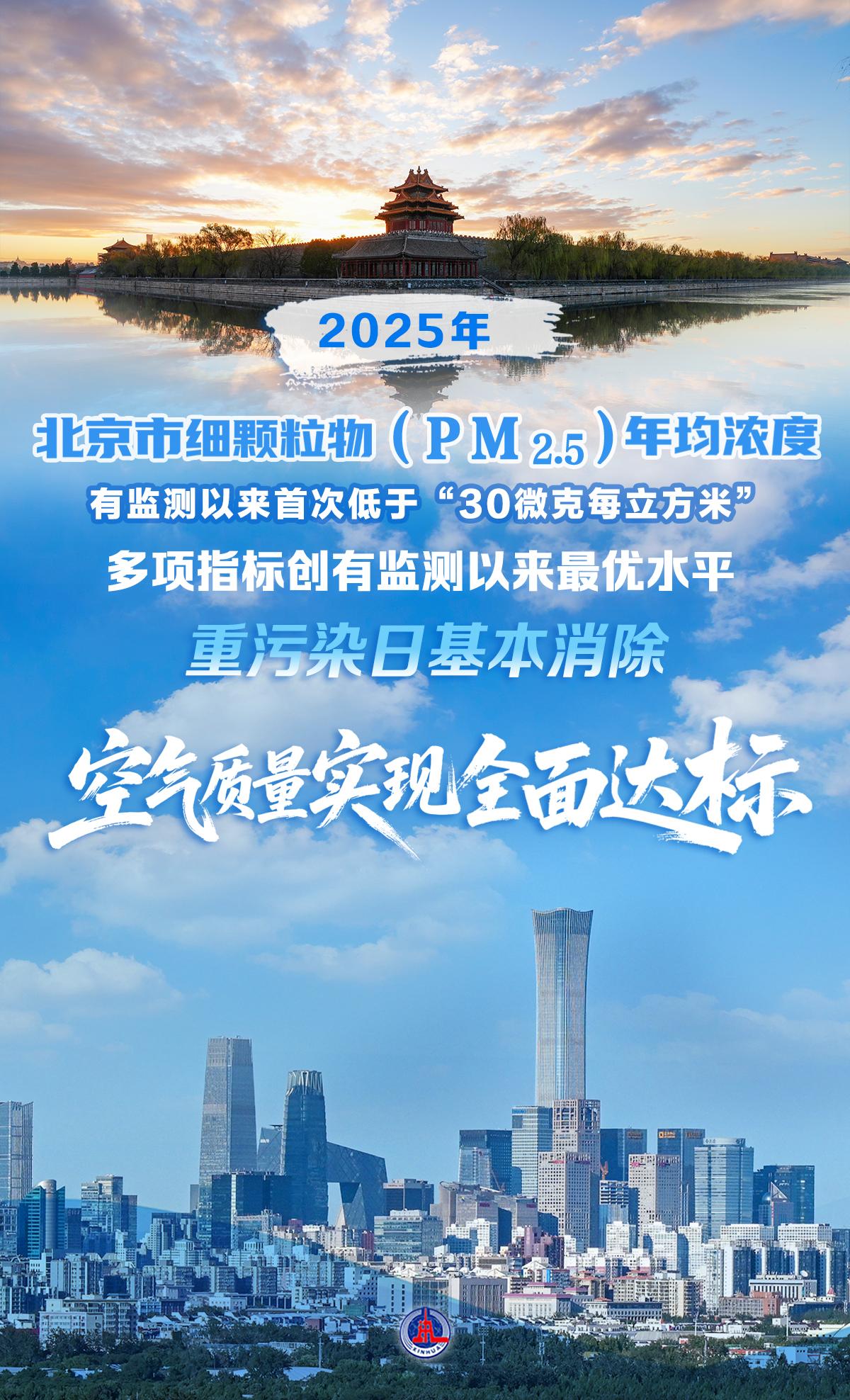
蓝天成为常态!北京空气质量多项指标创监测以来最优
Xin Hua She· 2026-01-04 02:24
Core Viewpoint - Beijing has achieved significant improvements in air quality, with PM2.5 annual average concentration dropping to 27.0 micrograms per cubic meter in 2025, marking the first time it has fallen below 30 micrograms since monitoring began [1][4]. Group 1: Air Quality Improvements - In 2025, Beijing recorded 348 days of good air quality, an increase of 144 days compared to 2013, which translates to nearly five additional months of clean air [4]. - The number of heavy pollution days decreased dramatically from 58 days in 2013 to just 1 day in 2025, representing a reduction of over 98% [4]. - All six major pollutants, including inhalable particles, nitrogen dioxide, and ozone, met national standards, indicating comprehensive compliance with air quality requirements [4]. Group 2: Government Initiatives - The Beijing government has launched an extensive "Blue Sky Defense War" to combat air pollution, treating it as a major political task and a vital public welfare project [4]. - Various pollution control plans have been implemented in a phased and focused manner, addressing mobile source pollution, coal burning, industrial emissions, dust pollution, and domestic source pollution [4]. - The government emphasizes the integration of air pollution control into the broader economic and social development strategy, aiming for a green transformation of the economy [5]. Group 3: Future Goals - Over the next five years, Beijing aims to continue its efforts in air pollution prevention, focusing on PM2.5 reduction and synergizing pollution reduction with carbon reduction [5]. - The city plans to implement a "0.1 microgram" action plan to further enhance air quality and continue the narrative of a beautiful Beijing [5].

市政府第七十四次常务会议召开 传达学习习近平总书记重要指示 学习贯彻省委和市委经济工作会议精神
Zheng Zhou Ri Bao· 2025-12-30 02:46
Group 1 - The meeting emphasized the importance of implementing Xi Jinping's thoughts on the moral and ideological development of minors, focusing on creating a collaborative education mechanism among schools, families, and society to foster a healthy growth environment for minors [1] - The meeting highlighted the need to align thoughts and actions with the provincial and municipal economic work deployment, focusing on high-quality economic development and early planning for the next year's economic work to achieve a strong start in the first quarter [1] - The meeting discussed measures to enhance consumer confidence during the upcoming holidays, ensuring the supply and price stability of essential goods, and maintaining social safety and stability [1] Group 2 - The meeting reviewed the "Three-Year Action Plan for Urban Renewal in Zhengzhou," aiming to improve urban functions, enhance living environments, and revitalize underutilized resources while preserving historical and ecological aspects [2] - The meeting also approved measures to support technological innovation, emphasizing the implementation of an innovation-driven development strategy to establish Zhengzhou as a strong city for science and technology with national influence [2] Group 3 - The meeting addressed additional matters related to the protection of historical buildings and the development of museum initiatives [3]
2025.12.27《来宾新闻》完整版
Xin Lang Cai Jing· 2025-12-27 13:35
Group 1 - The meeting of the municipal party committee focused on deploying air pollution prevention efforts to ensure the success of the blue sky defense campaign [1] - The government emphasized high-quality and clean governance to drive high-quality development [1] - The municipal government held a meeting to boost consumption and strengthen the foundation for stable economic growth [1] Group 2 - The city is promoting the "Famous Rural Action" initiative, which aims to enhance rural revitalization through place name construction [1] - A report meeting was held to celebrate exemplary deeds, fostering a culture of positivity and community building [1]
构建常态化标准化精细化网格管理机制 群策群力坚决打赢大气污染防治攻坚战
Xin Lang Cai Jing· 2025-12-27 00:11
Core Viewpoint - The city is intensifying efforts to combat air pollution through a standardized and refined grid management mechanism, emphasizing collective action to win the battle against air pollution [1][2]. Group 1: Air Pollution Prevention Measures - The city has implemented key initiatives to enhance grassroots grid management in response to the severe air pollution situation [1]. - A focus on industrial emissions reduction, mobile source emissions reduction, and non-point source pollution control is critical for achieving set goals [2]. - The city aims to establish a long-term urban grid management mechanism, leveraging advanced cities as benchmarks and developing an integrated urban management system [2]. Group 2: Organizational Responsibilities - Responsibilities are being reinforced at the county, town, and village levels to ensure effective oversight and rapid response to pollution issues [2]. - The emphasis is on timely detection, quick handling, effective resolution, and strong supervision of pollution control measures [2]. - The city encourages collaboration among grassroots units to create a comprehensive management and control framework [2].
钟埭中队三项行动 解锁2025冬季清新空气
Xin Lang Cai Jing· 2025-12-25 23:32
Group 1 - The article discusses the implementation of new air pollution prevention regulations in Pinghu City, focusing on three major issues: straw burning, construction site dust, and restaurant oil smoke during winter [1][2] - The enforcement team has established a dual-track inspection system combining technology and human resources to effectively monitor and control straw burning, utilizing AI technology for rapid detection of smoke and fire [1] - For construction site dust management, the team employs a combination of preemptive guidance and strict enforcement, ensuring compliance with dust control measures from the project approval stage [1] Group 2 - The team has intensified inspections on restaurants, particularly those involved in grilling and frying, to ensure compliance with new national standards and to address community concerns [2] - Since the fourth quarter, the team has conducted 16 rounds of inspections on 35 restaurants, resulting in a significant decrease in oil smoke complaints and achieving zero cases of related grievances [2] - Moving forward, the team aims to maintain a long-term focus on air pollution prevention goals through rigorous enforcement and meticulous management to ensure clean air becomes a norm [2]
扬州广陵:全面发力冲刺蓝天目标 决战大气污染防治收官月
Yang Zi Wan Bao Wang· 2025-12-25 03:15
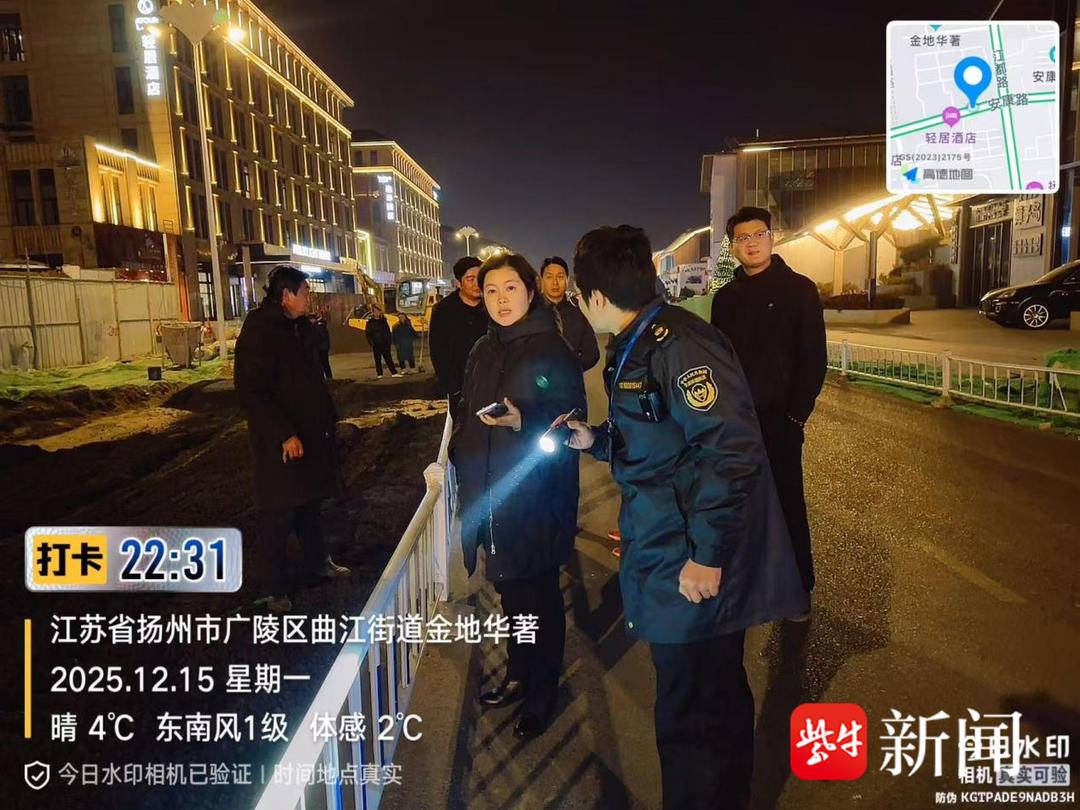
Core Viewpoint - The air quality in Guangling District, Yangzhou, is facing severe challenges due to adverse weather conditions and regional pollution transmission, prompting a decisive response to achieve annual blue sky goals [2][5]. Group 1: Enforcement and Monitoring - Guangling District has established a unified and efficient emergency response platform to address heavy pollution weather alerts, involving core departments such as ecology, public security, construction, urban management, and transportation [2]. - The ecological environment bureau has initiated a "law enforcement + three-shift blitz" model, conducting 24-hour inspections to monitor pollution sources, including construction dust, cooking fumes, and open burning [4]. - Since December, the district has filed cases against 2 industrial enterprises for air pollution violations, 1 construction site violation, and 2 cases of non-compliant emissions from non-road mobile machinery [4]. Group 2: Collaborative Efforts and Technological Integration - The district has mobilized personnel from various departments to form special support teams, assisting grassroots efforts to tackle PM2.5 and PM10 levels [4]. - Advanced technologies such as drones and patrols are utilized to accurately identify pollution sources, ensuring immediate reporting and rectification of issues [2]. - Increased frequency of mechanical road cleaning operations is being implemented to reduce dust accumulation, contributing to overall air quality improvement [4][5]. Group 3: Strategic Goals and Commitment - Guangling District is committed to consolidating air pollution control achievements through systematic scheduling, precise governance, regular enforcement, and collaborative governance [5]. - The district aims to deliver excellent results in pollution prevention and contribute to the overall improvement of air quality in the city [5].
麻痹大意,来宾市半个月内2次被通报,市长召开紧急部署会议
Xin Jing Bao· 2025-12-24 02:51
12月23日,来宾市大气污染防治攻坚工作紧急部署会议召开。会议贯彻落实自治区党委、政府关于秋冬 季大气污染防治攻坚工作部署要求,压紧压实各方责任,以更高标准、更严要求抓实抓细污染防治,全 力以赴完成年度考核指标任务。来宾市市长廖和明出席并讲话。 廖和明指出,大气污染防治关系群众利益和发展大局。当前正值秋冬季防治关键阶段,各级各部门要提 高政治站位,增强危机感、使命感、紧迫感,认清当前形势严峻性和工作极端重要性,坚决摒弃麻痹思 想、杜绝侥幸心理,迅速进入攻坚应急状态,不折不扣落实应对措施,全力压降细颗粒物浓度,全力以 赴打好大气污染防治攻坚战。 廖和明强调,要坚持精准、科学、依法治污,聚焦重点污染源、时段、区域,加大重点行业企业、交通 运输、秸秆焚烧、烟花爆竹燃放、建筑工地扬尘等管控力度,严格落实污染天气应急响应涉气企业停 产、工地停工、烧烤停业、矿山停开、汽修停喷、秸秆禁烧"五停一禁"措施,全力减少污染物排放。要 加强协调联动,以应急响应为令,严格落实《来宾市重污染天气应急预案》职责分工,最大程度"削峰 降值",提升应急管控实效。要压紧压实属地管理、部门监管和企业主体责任,上下联动、齐抓共管, 确保各项措施落 ...
环保行业点评报告:环境空气质量标准提标修订,分阶段实施明确,大气治理需求中长期释放龙净环保受益
Soochow Securities· 2025-12-22 07:31
Investment Rating - The report maintains an "Accumulate" rating for the environmental protection industry, indicating a positive outlook for the sector in the medium to long term [1]. Core Insights - The revision of the environmental air quality standards is set to be implemented in phases, which will lead to a long-term increase in demand for air pollution control, benefiting companies like Longjing Environmental Protection [4]. - The new air quality standards will tighten limits on pollutants, with significant reductions in annual and daily concentration limits for PM2.5 and PM10, among others, compared to the current standards [4][5]. - The 2026 environmental protection special fund budget has been set at 52.8 billion yuan, with a notable increase in the proportion allocated to air pollution control, which is expected to accelerate investment in this area [4]. Summary by Sections Air Quality Standards - The revised air quality standards will implement stricter limits, with PM2.5 annual and daily secondary limits reduced to 25 µg/m³ and 50 µg/m³ respectively, representing a year-on-year decrease of 29% and 33% [4]. - The first phase of implementation (2026-2030) will have transitional limits, while the second phase (from 2031) will enforce the stricter revised limits [4]. Environmental Improvement Goals - The report highlights that air quality improvement is entering a quality enhancement phase, with significant progress made in reducing annual concentrations and the frequency of heavy pollution events [4]. - The goal is to achieve an average concentration of PM2.5 below 25 µg/m³ by 2035, aligning with the broader "Beautiful China" initiative [4]. Funding and Investment - The 2026 budget for environmental protection is significantly higher than in previous years, with air pollution control receiving 46% of the total budget, up from 21% in 2025 [4]. - The budget for air pollution control has increased by 19% year-on-year, indicating strong governmental support for environmental initiatives [4].

以抓铁有痕的韧劲守护澄澈蓝天
Xin Lang Cai Jing· 2025-12-21 13:34
Core Viewpoint - The article emphasizes the importance of persistent and rigorous efforts in tackling air pollution during the autumn and winter seasons, highlighting the need for effective implementation of environmental governance measures to ensure tangible improvements in air quality [1][2][3]. Group 1: Environmental Governance - The article stresses that confidence and determination are crucial in ecological environment governance, warning against complacency after achieving initial results [1][2]. - It advocates for a hands-on approach to identify and address pollution sources, treating each source as a "fortress" that must be conquered [2]. - The need for tailored solutions for key areas and industries is highlighted, with a focus on detailed plans to effectively tackle pollution [2]. Group 2: Accountability and Action - The article calls for strict oversight and accountability in air pollution prevention efforts, emphasizing that there are no shortcuts and that all actions must yield visible results [2]. - It underscores the importance of translating commitment into tangible actions, ensuring that every measure taken is effective and can withstand public scrutiny [3]. - The article concludes that a good ecological environment is a fundamental public good and that the community expects real changes and effective pollution control measures [3].
刘文萍主持召开全市大气污染防治工作调度会
Xin Lang Cai Jing· 2025-12-21 12:29
举措再精准 管控再精细 坚决打赢大气污染防治攻坚主动仗 刘文萍主持召开全市大气污染防治工作调度会 12月18日,市委副书记、市长刘文萍主持召开全市大气污染防治工作调度会,强调要深入学习贯彻习近 平生态文明思想,全面落实省委经济工作会议精神,突出精准管控,聚力重点攻坚,坚决打赢大气污染 防治攻坚主动仗。省生态环境厅副厅长何立涛、市领导郑传记参加并讲意见。 转自:邢台发布 会上,省专家组分析了近期大气污染防治形势,市生态环境局汇报了当前工作重点、下步工作举措。刘 文萍指出,当前正值岁末年初关键期,大气污染防治形势严峻复杂。各级各部门要树牢危机意识,紧盯 重点因子和关键时段,科学分析,精准施策,针对性强化企业帮扶,常态化严控烟花爆竹、露天焚烧、 散煤、扬尘和移动源污染,坚决巩固提升空气质量改善成效,以高水平环境保护支撑高质量发展。要全 力打好开年主动仗,深刻把握能耗双控全面转向碳排放双控的新要求,锚定明年空气质量改善目标,逐 因子制定攻坚举措,逐污染源落实管控要求,为全年工作争取主动。要健全网格化管理机制,完善监 测、指挥、落实"三位一体"责任体系,充分发挥微站网格作用,精准锁定污染源头,做到实时发现、随 时交办、 ...