
宽基指数

Search documents
A股市场快照:宽基指数每日投资动态-20251219
Jianghai Securities· 2025-12-19 05:31
- The report provides a snapshot of the A-share market, highlighting the performance of broad-based indices on December 18, 2025, with the SSE 50 and CSI 2000 indices showing gains, while the ChiNext and CSI 300 indices experienced the largest declines[2][3] - The report compares the indices with their moving averages, noting that except for the SSE 50 and CSI 300, all other tracked indices fell below their 5-day moving averages, and except for the SSE 50, all other indices fell below their 10-day and 60-day moving averages[16] - The report details the trading volume and turnover rates of the indices, with the CSI 2000 having the highest trading volume share at 25.25%, followed by the CSI 300 and CSI 1000[19] - The distribution of daily returns is analyzed, showing that the ChiNext index has the largest negative kurtosis deviation, while the CSI 1000 has the smallest[25][27] - The risk premium of the indices relative to the 10-year government bond yield is examined, with the SSE 50 and CSI 2000 having relatively high 5-year percentile values, while the CSI 300 and ChiNext have lower values[30][33] - The PE-TTM ratios of the indices are analyzed, with the CSI 500 and CSI 1000 having relatively high percentile values, while the CSI 2000 and ChiNext have lower values[44][45] - The stock-bond yield ratio is compared historically, showing that no index is above its 80th percentile, and the CSI 500 is below its 20th percentile[48] - The dividend yield of the indices is tracked, with the ChiNext and CSI 1000 having relatively high 5-year historical percentile values, while the CSI 2000 and CSI 500 have lower values[53][55] - The report also discusses the net break rate, indicating the proportion of stocks with a price-to-book ratio less than 1, with the current net break rates for the indices provided[59]
“A系列”宽基指数震荡上行,A500ETF易方达(159361)半日净申购近7亿份
Sou Hu Cai Jing· 2025-12-19 05:23
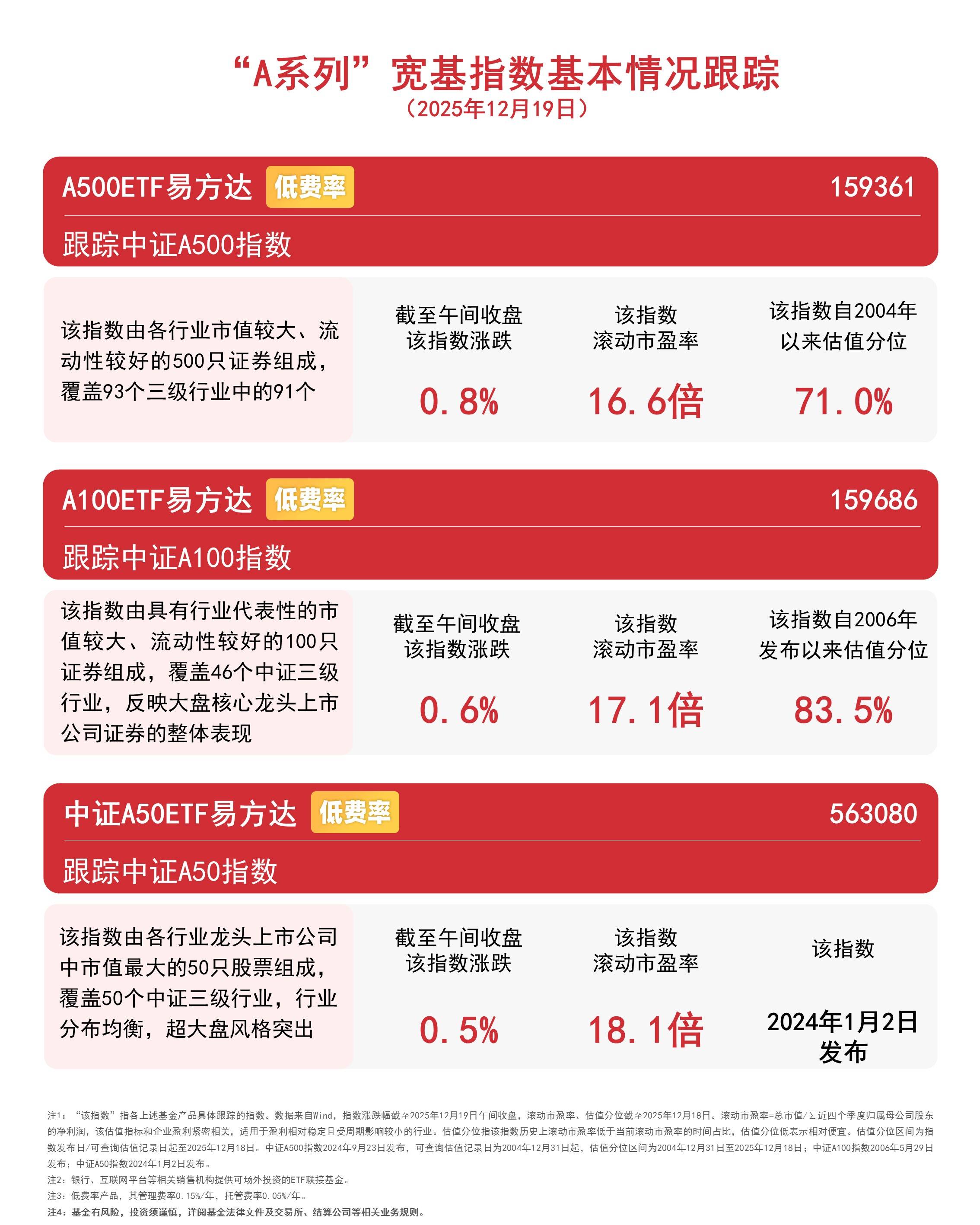
Group 1 - The "A series" broad-based indices collectively rose in the morning session, with the CSI A500 index up by 0.8%, the CSI A100 index up by 0.6%, and the CSI A50 index up by 0.5% [1] - The A500 ETF from E Fund (159361) recorded a trading volume of nearly 5 billion yuan in the first half of the day, with a net subscription of nearly 700 million shares [1] - According to Wind data, the A500 ETF from E Fund (159361) attracted over 1.2 billion yuan in total inflows over the past three trading days [1] Group 2 - CITIC Construction Investment Securities indicated that the underlying logic of the bull market remains intact, driven by structural market trends and capital market reform policies [1] - The market has largely completed its adjustment phase, and with institutional rankings stabilizing, a new wave of market activity is expected as the year-end approaches [1]

A500ETF南方(159352)震荡高开,连续三个交易日单日成交额超70亿元,机构预计市场延续高位震荡态势不变
Sou Hu Cai Jing· 2025-12-19 01:52
Group 1 - The A500ETF Southern (159352) has shown a positive performance with a 0.25% increase and a trading volume of 23.02 million yuan as of December 19, 2025 [1] - The CSI A500 Index, which the A500ETF tracks, has risen by 0.24%, with notable increases in constituent stocks such as Dongfang Risheng (up 11.48%) and Xibu Chao (up 5.55%) [1] - The total scale of CSI A500 index funds has exceeded 290 billion yuan, with eight products managing over 10 billion yuan each, and 108 funds showing a net value growth rate exceeding 15% this year [1] Group 2 - The CSI A500 Index covers high-quality large and mid-cap A-share companies, focusing on emerging manufacturing and consumption upgrade sectors, and is designed to reflect the value of Chinese assets [2] - The index is recognized for its balanced industry and market capitalization distribution, making it a suitable investment vehicle for long-term capital [2] - The A500ETF Southern has a low tracking error and a significant excess return rate, providing advantages of low deviation and precise tracking [2] Group 3 - The CSI A500 Index is considered a benchmark for China's new productive forces, utilizing a unique compilation logic that prioritizes industry leaders and excludes negative ESG factors [3] - The top ten weighted stocks in the index include major companies like CATL, Kweichow Moutai, and China Ping An, reflecting a strong alignment with national strategic industries [3] - The A500ETF Southern offers the lowest fee rates in the industry, enhancing its appeal as a cost-effective investment option [3]
A股市场快照:宽基指数每日投资动态-20251218
Jianghai Securities· 2025-12-18 05:51
Content: --------- <doc id='1'>证券研究报告·金融工程报告 2025 年 12 月 18 日 江海证券研究发展部 金融工程定期报告 金融工程研究组 A 股市场快照:宽基指数每日投资动态 2025.12.18 ◆市场表现:2025 年 12 月 17 日, 各宽基指数(表 1)全部上涨,其中创业板指(3.39%) 投资要点:</doc> <doc id='2'>分析师:梁俊炜 执业证书编号:S1410524090001 A 股市场快照:宽基指数每日投资动 和中证 500(1.95%)涨幅最大。当年涨跌情况,创业板指(48.3%)涨幅最大,其 次是中证 2000(30.48%)和中证 500(24.66%),中证 1000(22.34%)和中证全指 (21.17%)涨幅扩大,而上证 50(11.43%)涨幅最小。 ◆均线比较:除了中证 1000 和中证 2000,其余跟踪指数已突破 5 日及 20 日均线。 创业板指率先突破 60 日均线。各跟踪指数单日修复程度较大。 ◆资金占比与换手:2025 年 12 月 17 日, 沪深 300(25.34%)交易金额占比最高, 相关研究报告</doc> <doc id='3'>态 2025.12.17 A 股市场快照:宽基指数每日投资动 态 2025.12.16 A 股市场快照:宽基指数每日投资动 态 2025.12.15 其次是中证 2000(23.94%)和中证 1000(20.51%)。各宽基指数当前换手率分别 为中证 2000(3.88),创业板指(2.41),中证 1000(2.24),中证全指(1.63), 中证 500(1.56),沪深 300(0.54)和上证 50(0.23)。 ◆日收益率分布:创业板指的峰度负偏离最大,中证 1000 的峰度负偏离最小。上 证 50 和创业板指的负偏态最大,中证 1000 和中证 2000 的负偏态最小。 ◆风险溢价:2025 年 12 月 17 日, 创业板指(97.14%)和中证 500(96.59%)风险 溢价近 5 年分位值较高,中证 1000(88.41%)和中证 2000(69.05%)较低。</doc> <doc id='4'>◆PE-TTM:中证 500(95.04%)和中证 1000(93.47%)分位值较高,而中证 2000 (79.17%)和创业板指(57.69%)分位值较低。 ◆股债性价比:没有指数高于其 80%分位,中证 500 低于其 20%分位。 ◆股息率:创业板指(63.22%)和中证 1000(51.65%)所处近 5 年历史分位值较 高,而中证 2000(31.32%)和中证 500(24.55%)较低。 ◆破净率:当前,各指数破净率为上证 50(22.0%),沪深 300(16.33%),中证 500(11.2%),中证 1000(8.3%),中证 2000(3.8%),创业板指(nan%)和中 证全指(6.51%)。 ◆风险提示:本报告可能存在数据缺失、数据错误、数据不及时、模型处理错误 等风险。本报告仅从金融工程角度,对重要指数的市场数据进行跟踪、统计、分 析,不构成对市场指数、行业或个股进行预测或推荐。</doc> <doc id='6'>| 市场衣乳… | | --- | | 1.1 指数表现 … | | 1.2 指数与均线的比较 | | 1.3 资全占比与换手率 … | | 2 日收益分布 | | 2.1 收益区间分布对比 | | 22 分布形态变化对比 | | 3 风险溢价 … | | 3.1 各宽基指数的风险溢价 | | 32 风险溢价历史分布 | | 4 PE-TTM. | | 4.1 各宽某指数 PE-TTM 和分位值 | | 4.2 PE-TTM 历史对比… | | 4.3 股债性价比历史对比… | | 5 吸血率… | | 5.1 近一年各宽某指数股息率变化情况, | | 5.2 股息率历史对比… | | 6 玻璃率 | | 7 风险提示 . |</doc> <doc id='8'>| 表 1、各宽基指数表现情况 | | --- | | 表 2、各宽基指数与均线、近250交易日高位和低位的比较 … | | 表 3 、各宽基指数分布形态变化 … | | 表 4、各宽基指数和十年期国债即期收益率的风险溢价 | | 表 5、各宽基指数 PE-TTM 分位值和历史值 | | 表 6、各宽基指数当前股息率和历史情况 | | 图 1、各宽基指数交易全额占比和换手率 | | 图 2、各宽基指数每日收益率分布情况 | | 图 3、各宽基指数相对十年国债即期收益率的风险溢价 | | 图 4、各宽基指数相对沪深 300 的风险溢价的近 5年分布 . | | 图 5 、各宽基指数 PE-TTM 及其分位值 | | 图 6、各宽基指数的股债性价比… | | 图 7、各宽基指数股息率 | | 图 8、各宽基指数破净个股数和占比………………………………………………………………………………………………………………………………………………………………………………………………………………………………………………………………………… 10 |</doc> <doc id='10'>1 市场表现 本报告将从指数涨跌幅、连阴连阳、上涨下跌分布等维度对各宽基指数进 行评价和跟踪。 1.1 指数表现 </doc> <doc id='11'>2025 年 12 月 17 日, 各宽基指数(表 1)全部上涨,其中创业板指(3.39%) 和中证 500(1.95%)涨幅最大。当周涨跌情况,各跟踪指数全部下跌,其中 中证 2000(-1.22%)和中证 1000(-1.12%)跌幅最大。当月涨跌情况,各跟踪 指数涨跌各现,其中创业板指(4.04%)和中证 500(1.51%)涨幅最大,而中 证 2000(-0.89%)和中证 1000(-0.62%)下跌。当季涨跌情况,各跟踪指数除 了上证 50(0.09%)外全部下跌,其中中证 1000(-3.78%)和中证 500(-3.7%) 跌幅最大。当年涨跌情况,创业板指(48.3%)涨幅最大,其次是中证 2000(30.48%) 和中证 500(24.66%),中证 1000(22.34%)和中证全指(21.17%)涨幅扩大, 而上证 50(11.43%)涨幅最小。 表 1、各宽基指数表现情况 指数名称 指数代码 当日涨幅% 当周涨幅% 当月涨幅% 当季涨幅% 当年涨幅% 日K </doc> <doc id='12'>| 指数名称 | 指数代码 | 当日涨幅% | 当周涨幅% | 当月涨幅% | 当季涨幅% | 当年涨幅% | 日K 连阴连阳 | 周K 连阴连阳 | 月K 连阴连阳 | 季K 连阴连阳 | 年K 连阴连阳 | | | --- | --- | --- | --- | --- | --- | --- | --- | --- | --- | --- | --- | --- | | 上证50 | 000016.SH | 1.25 | -0.10 | 0.74 | 0.09 | 11.43 | | | |
不破不立?!指数高点回撤近5%,宽基ETF或迎“低吸”机会
Sou Hu Cai Jing· 2025-12-17 08:38
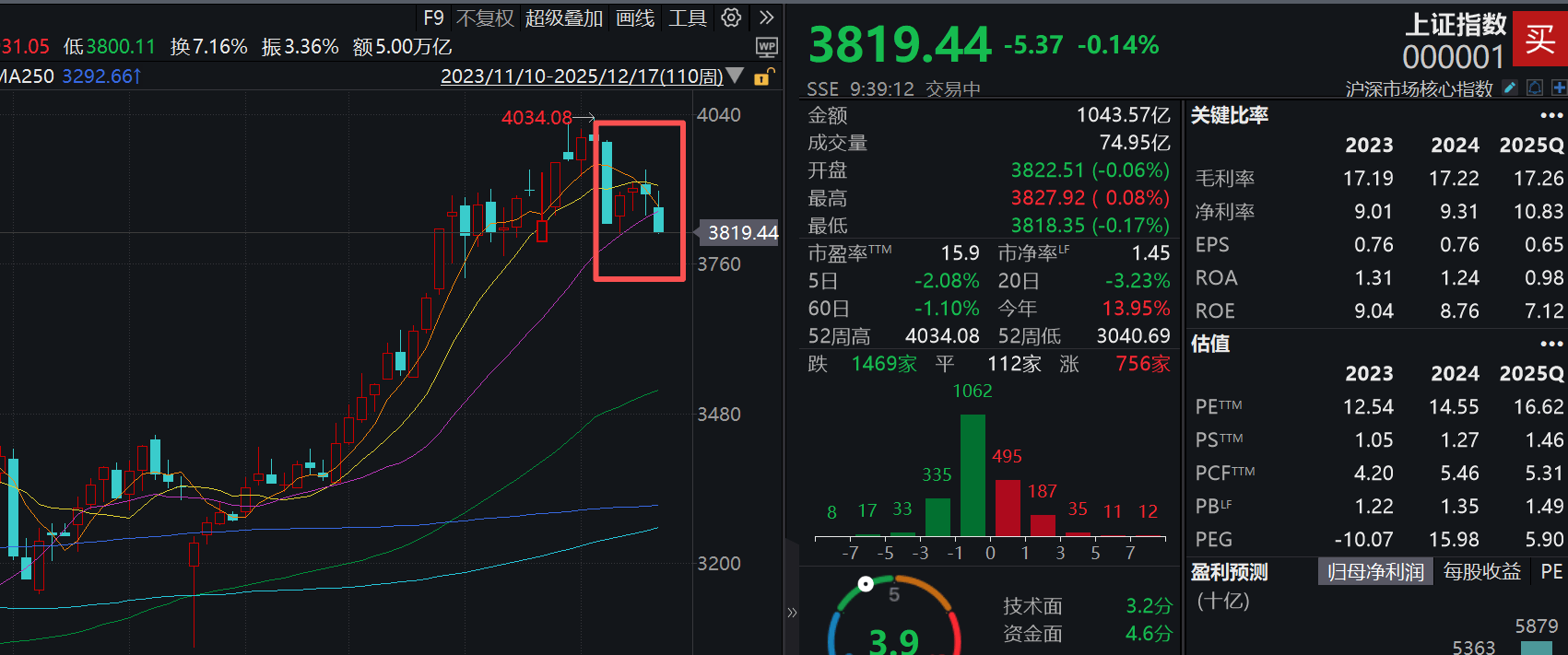
Group 1 - The market is experiencing a correction, with the Shanghai Composite Index retreating to around 3800 points, which has caused confusion among investors who were previously optimistic when the index surpassed 4000 points [1][2] - The recent market adjustment is attributed to a combination of emotional reactions rather than a fundamental collapse, triggered by external factors such as the potential interest rate hike by the Bank of Japan [4] - Small-cap stocks have seen significant declines, with the micro-cap index dropping over 6% in December, while larger indices like the Shanghai 50 and CSI 300 have only seen minor declines, indicating a divergence in market performance [5] Group 2 - Recent policy announcements aimed at expanding domestic demand have not met immediate expectations, leading to disappointment among some investors, despite positive underlying economic indicators such as GDP growth and manufacturing PMI [6] - The current market adjustment is likened to a temporary emotional outburst rather than a fundamental issue, suggesting that the long-term outlook remains positive due to supportive policies and a stable economic foundation [6] - There is a growing interest in broad-based ETFs, particularly the CSI 500 index, which has seen significant inflows, indicating a shift in investor preference towards more stable investment vehicles amid market volatility [8][9] Group 3 - The CSI 500 index has become a focal point for investors, with several ETFs linked to it experiencing substantial growth in assets under management, reflecting its increasing popularity [9][11] - The broad-based index funds are viewed as a reliable means for investors to achieve average market returns, especially in the context of China's economic transition towards high-quality growth [10][11] - The market is expected to present better allocation opportunities as it stabilizes, particularly for broad-based ETFs, which are currently perceived as undervalued compared to historical averages [7][10]
A股市场快照:宽基指数每日投资动态-20251217
Jianghai Securities· 2025-12-17 04:10
- The report primarily focuses on tracking and analyzing the performance of broad-based indices in the A-share market, including their daily, weekly, monthly, and yearly returns, as well as their relative positions to moving averages and historical highs and lows[1][10][14] - The analysis includes metrics such as trading turnover rates, with indices like CSI 2000 (3.93) and CSI 1000 (2.34) showing the highest turnover rates among the broad-based indices on December 16, 2025[17] - The report evaluates the distribution of daily returns for indices, highlighting characteristics such as kurtosis and skewness. For instance, the ChiNext Index exhibits the largest negative kurtosis deviation, while CSI 1000 shows the smallest negative kurtosis deviation. Similarly, the ChiNext Index has the largest negative skewness, and CSI 1000 has the smallest[23][25] - Risk premium analysis is conducted using the 10-year government bond yield as a risk-free rate benchmark. Indices like SSE 50 (12.22%) and CSI 2000 (10.56%) have relatively high 5-year percentile values, while ChiNext Index (8.25%) and CSI 500 (8.17%) are lower[27][31] - The report also examines valuation metrics such as PE-TTM. CSI 500 (93.88%) and CSI 1000 (93.14%) have the highest 5-year percentile values, while CSI 2000 (78.51%) and ChiNext Index (55.12%) are relatively lower[39][43] - Dividend yield analysis reveals that ChiNext Index (67.44%) and CSI 1000 (55.04%) are at higher 5-year historical percentiles, whereas SSE 50 (32.23%) and CSI 500 (28.1%) are at lower percentiles[51][53] - The report tracks the percentage of stocks trading below their book value (PB ratio < 1). As of the report date, the PB ratio percentages are as follows: SSE 50 (24.0%), CSI 300 (16.67%), CSI 500 (11.2%), CSI 1000 (8.3%), CSI 2000 (3.95%), and CSI All Share (6.61%)[57]
螺丝钉指数地图来啦:指数到底如何分类|2025年12月
银行螺丝钉· 2025-12-17 04:01
Core Viewpoint - The article presents an index map that includes various commonly used stock indices, their codes, selection rules, industry distribution, average and median market capitalization of constituent stocks, and the number of constituent stocks, which will be updated regularly for easy reference [1]. Group 1: Types of Indices - The index map includes several categories of stock indices: broad-based indices, strategy indices, industry indices, thematic indices, and overseas indices [3]. - Specific industry indices mentioned include the China Internet 50, Biotech, Hong Kong Stock Connect Technology, and various healthcare indices [4]. Group 2: Broad-based Indices - The broad-based indices include the CSI 300, CSI 500, CSI 800, CSI 1000, and CSI 2000, with their respective average market capitalizations and constituent stock counts detailed [6]. - For example, the CSI 300 has an average market capitalization of 210.50 billion and includes 300 constituent stocks [6]. Group 3: Strategy Indices - Strategy indices such as the CSI Dividend, Shanghai Dividend, and Shenzhen Dividend are designed to reflect the performance of high dividend yield stocks [9]. - The CSI Dividend index consists of 100 stocks with stable dividends and an average market capitalization of 214.37 billion [9]. Group 4: Industry Indices - Industry indices like the CSI Consumer, CSI Healthcare, and CSI Real Estate are selected based on specific industry criteria, with average market capitalizations and constituent stock counts provided [12]. - For instance, the CSI Consumer index has an average market capitalization of 112.82 billion and includes 38 constituent stocks [12]. Group 5: Market Capitalization Distribution - The article provides a detailed distribution of market capitalization across various sectors, indicating the percentage representation of sectors such as materials, financials, and information technology [7][10]. - For example, the financial sector represents 22.97% of the indices, while information technology accounts for 20.30% [7].

每日钉一下(保险机构喜欢哪些指数呢,对普通投资者有何启示?)
银行螺丝钉· 2025-12-16 14:03
Group 1 - The article emphasizes the importance of smart fund investment strategies, particularly for lazy investors, and suggests that a well-prepared investment plan is crucial [2][3] - It introduces a free course that aims to help individuals understand how to effectively plan and execute fund investments [2][3] Group 2 - Insurance institutions have adjusted their investment strategies regarding indices like the CSI 300 and the Low Volatility Dividend Index, indicating a shift towards allocating more funds to these assets [6][7] - The concept of risk factors is explained, highlighting that insurance companies must maintain sufficient capital reserves to manage potential risks associated with their investments [8] - Different indices are assigned varying risk levels by institutions, which can serve as a reference for ordinary investors when making investment decisions [10][12] - The article categorizes indices based on their risk factors, with broad-based and value-style indices considered lower risk, making them suitable for novice investors [9][10] - Growth-style indices, such as those from the ChiNext and STAR Market, are noted for their higher volatility, leading to more cautious investment approaches from insurance institutions [11] - Smaller individual stocks not included in major indices carry higher risk factors, resulting in limited investment proportions from insurance companies [12][13]

A股市场快照:宽基指数每日投资动态-20251216
Jianghai Securities· 2025-12-16 03:30
- The report primarily focuses on tracking and analyzing the performance of broad-based indices in the A-share market, including their daily price movements, moving averages, turnover rates, and risk premiums[1][2][3] - The turnover rate for each index is calculated using the formula: $ \text{Turnover Rate} = \frac{\Sigma(\text{Circulating Shares of Component Stocks} \times \text{Turnover Rate of Component Stocks})}{\Sigma(\text{Circulating Shares of Component Stocks})} $ This provides insights into the liquidity and trading activity of the indices[17] - The risk premium is measured relative to the 10-year government bond yield, serving as a benchmark for risk-free rates. This metric evaluates the relative investment value and deviation of each index. For instance, the current risk premium for the CSI 500 is -0.79%, with a 5-year historical percentile of 21.98%[27][31] - The PE-TTM (Price-to-Earnings Trailing Twelve Months) ratio is used as a valuation reference. For example, the CSI 500 has a current PE-TTM value of 32.45, with a 5-year historical percentile of 94.96%, indicating a relatively high valuation compared to its historical range[39][43] - Dividend yield is analyzed as a measure of cash return. For instance, the CSI 500 has a current dividend yield of 1.45%, with a 5-year historical percentile of 24.96%, reflecting its position in the historical distribution of dividend yields[48][53] - The report also examines the net asset value (NAV) break rate, which represents the proportion of stocks trading below their book value. For example, the CSI 500 has a current NAV break rate of 11.0%, suggesting market sentiment and valuation levels[54][57]
A股市场快照:宽基指数每日投资动态-20251215
Jianghai Securities· 2025-12-15 03:18
- The report primarily focuses on tracking and analyzing the performance of broad-based indices in the A-share market, including metrics such as daily returns, moving averages, turnover rates, risk premiums, PE-TTM, dividend yields, and net asset ratios[1][3][4] - The analysis includes a detailed comparison of indices' daily returns, showing that indices like the CSI 500 and ChiNext Index had the highest daily gains on December 12, 2025, at 1.23% and 0.97%, respectively[11][14] - Moving average analysis reveals that the CSI 500 and ChiNext Index broke above their 5-day moving averages, while all indices surpassed their 10-day and 20-day moving averages. The SSE 50 and CSI 2000 also broke above their 60-day moving averages[14] - Turnover rate analysis indicates that the CSI 2000 had the highest turnover rate at 4.1%, followed by the ChiNext Index at 2.66% and the CSI 1000 at 2.5%[16] - Risk premium analysis, using the 10-year government bond yield as the risk-free rate, shows that the CSI 500 and SSE 50 had the highest 5-year percentile values at 86.75% and 76.83%, respectively, while the CSI 1000 and CSI 2000 had lower values at 74.13% and 65.16%[26][30] - PE-TTM analysis highlights that the CSI 1000 and CSI 500 had the highest 5-year percentile values at 96.61% and 95.45%, respectively, indicating relatively high valuations. In contrast, the ChiNext Index had a lower 5-year percentile value of 57.77%[41][42] - Dividend yield analysis shows that the ChiNext Index and CSI 1000 had relatively high 5-year percentile values at 66.61% and 47.19%, respectively, while the CSI 500 and CSI 2000 had lower values at 15.7% and 12.56%[51][53] - Net asset ratio analysis reveals that the SSE 50 had the highest proportion of stocks trading below their net asset value at 24.0%, while the ChiNext Index had the lowest at 1.0%[55]