广义货币(M2)

Search documents
【金融街发布】人民银行:2025年人民币贷款增加16.27万亿元 社会融资规模存量同比增长8.3%
Xin Hua Cai Jing· 2026-01-15 07:15
Core Insights - The People's Bank of China reported that by the end of 2025, the total social financing scale reached 442.12 trillion yuan, marking an 8.3% year-on-year increase [1][2] Group 1: Social Financing Scale - The total social financing scale increased by 35.6 trillion yuan in 2025, which is 3.34 trillion yuan more than the previous year [4] - The balance of RMB loans to the real economy was 268.4 trillion yuan, reflecting a 6.3% year-on-year growth [2] - The balance of foreign currency loans to the real economy, converted to RMB, was 1.05 trillion yuan, showing an 18% decline [2] Group 2: Loan and Deposit Statistics - By the end of December, the balance of RMB loans was 271.91 trillion yuan, with a year-on-year growth of 6.4% [7] - The total increase in RMB loans for the year was 16.27 trillion yuan, with household loans increasing by 4.42 trillion yuan [7] - The total balance of deposits in RMB and foreign currencies was 336.14 trillion yuan, with a year-on-year increase of 9% [6] Group 3: Monetary Supply - The balance of broad money (M2) was 340.29 trillion yuan, reflecting an 8.5% year-on-year increase [5] - The balance of narrow money (M1) was 115.51 trillion yuan, with a year-on-year growth of 3.8% [5] - The cash in circulation (M0) reached 14.13 trillion yuan, marking a 10.2% year-on-year increase [5] Group 4: Foreign Exchange and Cross-Border Transactions - The foreign exchange reserves stood at 3.36 trillion USD by the end of December [9] - The total amount of cross-border RMB settlements under the current account was 17.86 trillion yuan in 2025 [9]

新华社权威快报|2025年我国社融规模增量超35万亿元
Xin Hua She· 2026-01-15 07:12
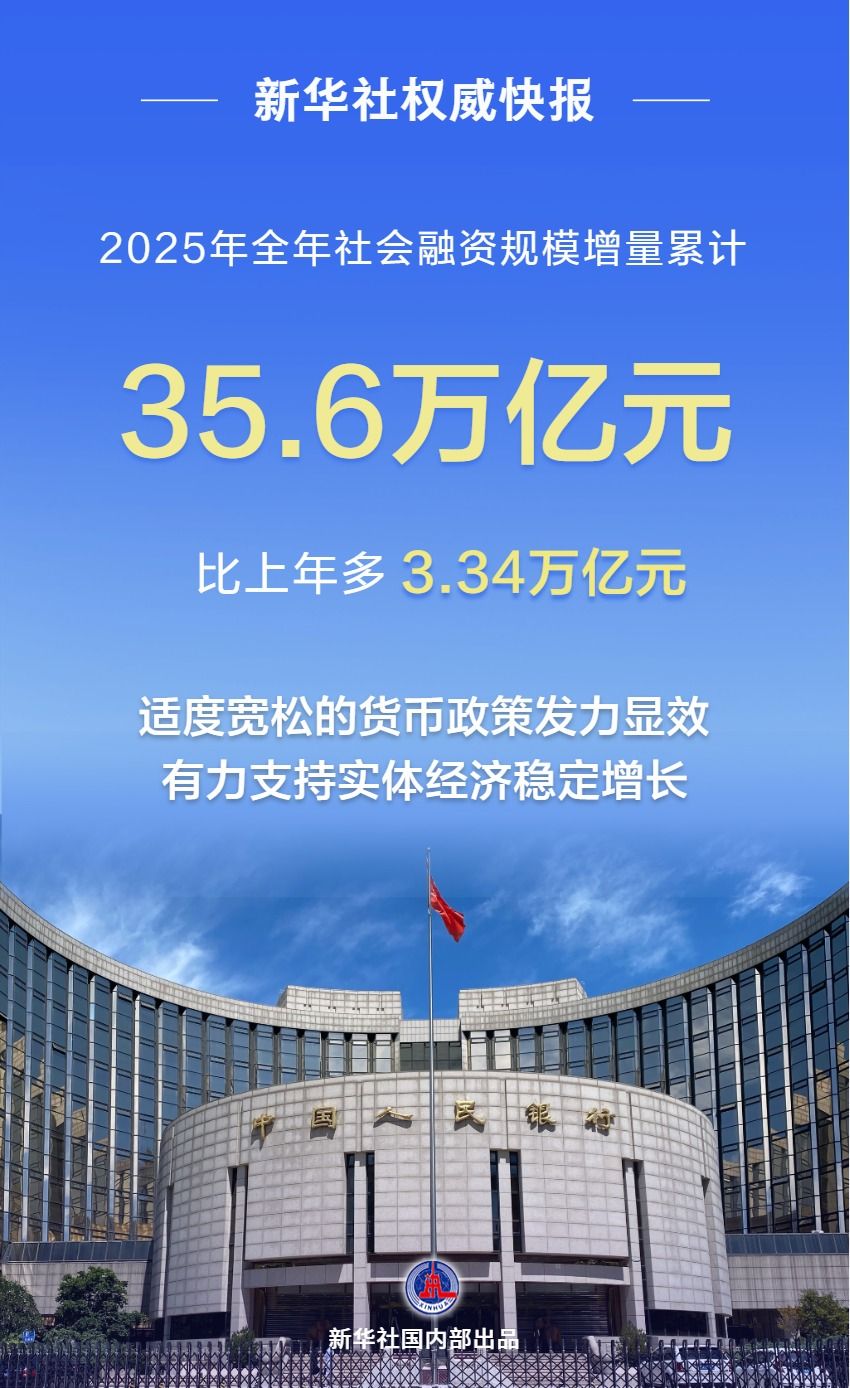
Group 1 - The total social financing scale increment for the year 2025 reached 35.6 trillion yuan, an increase of 3.34 trillion yuan compared to the previous year [1][2] - The broad money supply (M2) balance at the end of December 2025 was 340.29 trillion yuan, reflecting a year-on-year growth of 8.5% [2] - The balance of RMB loans stood at 271.91 trillion yuan, with a year-on-year increase of 6.4% [2] Group 2 - The implementation of a moderately loose monetary policy has effectively supported stable growth in the real economy [1][2]

央行:2025年12月末广义货币余额增长8.5%
Zheng Quan Shi Bao Wang· 2026-01-15 07:08
人民财讯1月15日电,央行发布数据,2025年12月末,广义货币(M2)余额340.29万亿元,同比增长 8.5%。狭义货币(M1)余额115.51万亿元,同比增长3.8%。流通中货币(M0)余额14.13万亿元,同比增长 10.2%。全年净投放现金1.31万亿元。 ...
央行:12月末广义货币(M2)余额340.29万亿元 同比增长8.5%
Mei Ri Jing Ji Xin Wen· 2026-01-15 07:05
每经AI快讯,1月15日,据央行数据,12月末,广义货币(M2)余额340.29万亿元,同比增长8.5%。狭义 货币(M1)余额115.51万亿元,同比增长3.8%。流通中货币(M0)余额14.13万亿元,同比增长10.2%。全年 净投放现金1.31万亿元。 ...
韩国央行对货币供应和流动性统计数据进行全面修改
Xin Lang Cai Jing· 2025-12-30 06:20
Core Insights - The Bank of Korea has announced a comprehensive revision of its monetary and liquidity statistics, excluding highly volatile beneficiary securities from the broad money (M2) measure, aligning with international standards set by the IMF [1][3] Group 1: Monetary Supply Changes - Since January 2023, the growth of Korea's monetary supply has been below the long-term average, with the new M2 figure for October reported at 4,056.8 trillion KRW (approximately 2.82 trillion USD), down from 4,466.3 trillion KRW under the previous standard [1][2] - The year-on-year growth rate of M2 has decreased from 8.7% under the old standard to 5.2% under the new standard [1][2] Group 2: Rationale and Context - The adjustments come amid criticism that the Bank of Korea's loose monetary policy has led to excess liquidity, contributing to the depreciation of the Korean won and rising housing prices [1][2] - The new framework is expected to enhance the international comparability of Korea's monetary statistics, as similar exclusions of beneficiary securities are being adopted by major developed countries like the United States [2][3]
2025年11月国内金融数据概览
Sou Hu Cai Jing· 2025-12-18 03:31
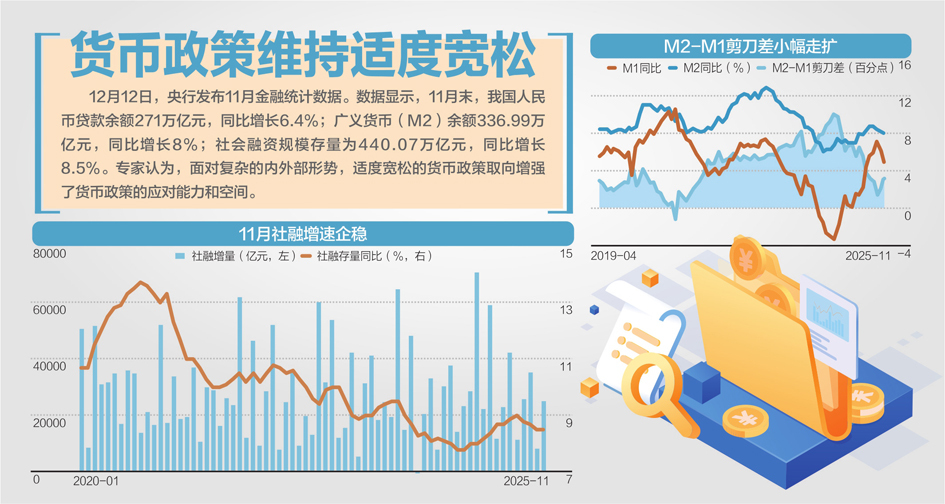
Group 1 - As of the end of November, the broad money supply (M2) reached 336.99 trillion yuan, showing a year-on-year growth of 8% [1] - The narrow money supply (M1) was 112.89 trillion yuan, with a year-on-year increase of 4.9% [1] - The currency in circulation (M0) amounted to 13.74 trillion yuan, reflecting a year-on-year growth of 10.6% [1] Group 2 - The cumulative increase in social financing for the first eleven months was 33.39 trillion yuan, which is 3.99 trillion yuan more than the same period last year [2] - The increase in RMB loans to the real economy was 14.93 trillion yuan, which is a decrease of 1.28 trillion yuan compared to the previous year [2] - Net financing through corporate bonds reached 2.24 trillion yuan, an increase of 3.125 trillion yuan year-on-year [2] Group 3 - By the end of November, the total social financing stock was 440.07 trillion yuan, representing a year-on-year growth of 8.5% [3] - The balance of RMB loans to the real economy was 267.42 trillion yuan, with a year-on-year increase of 6.3% [3] - The balance of government bonds was 94.24 trillion yuan, showing a significant year-on-year growth of 18.8% [3] Group 4 - The total increase in RMB loans for the first eleven months was 15.36 trillion yuan [4] - By the end of November, the balance of RMB loans was 271 trillion yuan, reflecting a year-on-year growth of 6.4% [4] - Household loans increased by 533.3 billion yuan, while loans to enterprises increased by 14.4 trillion yuan [4] Group 5 - The total increase in RMB deposits for the first eleven months was 24.73 trillion yuan [5] - By the end of November, the balance of RMB deposits was 326.96 trillion yuan, with a year-on-year growth of 7.7% [5] - Household deposits increased by 12.06 trillion yuan during this period [5] Group 6 - In November, the weighted average interbank lending rate was 1.42%, down 0.13 percentage points from the same period last year [6] - The weighted average rate for pledged repos was 1.44%, which is 0.15 percentage points lower than the previous year [6] Group 7 - The one-year loan market quoted rate was 3.0%, and the rate for loans over five years was 3.5%, both down 0.1 percentage points from the end of last year [7] Group 8 - By the end of November, the CFETS RMB exchange rate index was 97.92, down 3.5% from the end of last year [8] - The RMB to USD exchange rate was 7.0789, appreciating 1.55% compared to the end of last year [8] - The RMB to Euro exchange rate was 8.2078, depreciating 8.31% from the end of last year [8]
11月末社融存量同比增长8.5%
Mei Ri Jing Ji Xin Wen· 2025-12-14 13:56
Group 1 - The core viewpoint of the article highlights the current state of China's financial statistics, indicating a stable growth in social financing and monetary supply, which supports economic development [1][3][7] - As of November 2025, the total social financing scale reached 440.07 trillion yuan, with a year-on-year growth of 8.5% [1][7] - The broad money (M2) balance stood at 336.99 trillion yuan, reflecting a year-on-year increase of 8%, which is 0.9 percentage points higher than the same period last year [3] Group 2 - In the first eleven months of the year, the increase in social financing was 33.39 trillion yuan, which is 3.99 trillion yuan more than the previous year [7] - The total amount of new government debt this year reached 1.186 trillion yuan, an increase of 290 billion yuan compared to last year, leading to a higher proportion of government bonds in the social financing scale [1] - The growth rate of loans has slightly decreased, with a total increase of 15.36 trillion yuan in RMB loans for the first eleven months, and a month-on-month increase of 390 billion yuan in November [4][6] Group 3 - The balance of RMB loans to the real economy accounted for 60.8% of the total social financing scale, which is a decrease of 1.3 percentage points year-on-year [5] - Experts indicate that the decline in loan growth reflects the transition of economic drivers from traditional investment to consumption, with reduced reliance on bank loans for new growth points [6] - The financial institutions' loan write-offs exceeded 1 trillion yuan this year, which also contributed to the downward pressure on loan growth, although these funds continue to support the real economy [4][6] Group 4 - The article emphasizes the need for a scientific and robust monetary policy framework, focusing on optimizing the mechanisms for basic currency issuance and maintaining reasonable growth in financial totals [8][10] - It suggests that a market-oriented approach should guide financial institutions in optimizing their financing structures, enhancing the quality and efficiency of financial services to the real economy [10] - Recent innovations in monetary policy tools, such as including government bond trading in the monetary policy toolbox, are expected to improve liquidity management in the financial system [10]
央行披露:同比多增近4万亿元!
新华网财经· 2025-12-13 06:31
Core Viewpoint - The article highlights the stable growth of social financing, M2, and RMB loans in China, indicating a moderately loose monetary policy that supports high-quality economic development [2][3][5]. Group 1: Financial Statistics - As of the end of November, the total social financing stock was 440.07 trillion yuan, a year-on-year increase of 8.5%, which is 0.7 percentage points higher than the same period last year [4][8]. - In the first eleven months, the cumulative increase in social financing was 33.39 trillion yuan, which is 3.99 trillion yuan more than the same period last year [4][6]. - The RMB loan balance reached 271 trillion yuan by the end of November, with a year-on-year growth of 6.4%, and a total increase of 15.36 trillion yuan in the first eleven months [10][11]. Group 2: Government Bonds and Financing - Government bonds have been a key driver of social financing growth, with the balance of government bonds reaching 94.24 trillion yuan, a year-on-year increase of 18.8% [7][8]. - The net financing amount of government bonds is expected to exceed 12 trillion yuan this year, with the contribution of government bonds to social financing significantly increasing due to a rise in the fiscal deficit rate [7][8]. - By the end of November, government bonds accounted for 21.4% of social financing, an increase of 1.8 percentage points year-on-year, with government bond financing contributing to 40% of the increase in social financing [8][9]. Group 3: Loan Quality and Structure - The average interest rate for newly issued corporate loans was approximately 3.1%, which is about 30 basis points lower than the same period last year [16]. - The growth of inclusive small and micro loans and medium to long-term loans for manufacturing continues to outpace overall loan growth, indicating a focus on supporting key sectors [16]. - The article emphasizes the need to analyze financial data from a broader perspective, considering social financing scale and money supply rather than just loan growth to assess financial support for the real economy [14][15].
新华社权威快报|前11个月我国社融规模增量超去年全年
Xin Hua She· 2025-12-12 15:21
Group 1 - The core viewpoint of the article highlights that China's social financing scale has exceeded last year's total by reaching 33.39 trillion yuan in the first 11 months of the year, indicating a robust financial growth [2] - As of the end of November, the broad money supply (M2) stood at 336.99 trillion yuan, reflecting an 8% year-on-year increase [2] - The balance of RMB loans reached 271 trillion yuan, with a year-on-year growth of 6.4%, demonstrating the effectiveness of the moderately accommodative monetary policy [2]

央行重磅数据发布
中国基金报· 2025-12-12 12:33
Core Viewpoint - The People's Bank of China has reported that the growth rates of M2 and social financing scale remain high, creating a favorable monetary and financial environment for economic recovery [1][3]. Group 1: Social Financing and M2 Growth - As of the end of November, the social financing scale reached 440.07 trillion yuan, with a year-on-year growth of 8.5%. The increase in government debt significantly supported this growth [3]. - In the first eleven months of the year, the incremental social financing totaled 33.39 trillion yuan, which is 3.99 trillion yuan more than the same period last year, indicating strong government bond contributions [3]. - The M2 balance stood at 336.99 trillion yuan, growing by 8.0% year-on-year, which is 0.9 percentage points higher than the previous year [3]. Group 2: Credit and Loan Dynamics - The balance of RMB loans was 271 trillion yuan at the end of November, with a year-on-year growth of 6.4%, and an increase of 15.36 trillion yuan in the first eleven months [5]. - After adjusting for local government debt impacts, the loan growth rate is approximately 7.5%, still exceeding nominal economic growth [5]. - The decline in loan growth reflects a shift in economic dynamics, where traditional credit demand is decreasing while new growth points are less reliant on bank loans [5][6]. Group 3: Policy Coordination - The macroeconomic policies have intensified counter-cyclical adjustments, with fiscal policies actively supporting the real economy. The issuance of government bonds has been accelerated, leading to significant early financing [8]. - It is estimated that the net financing amount of government bonds this year may exceed 1.2 trillion yuan, with government bond financing accounting for 40% of the increase in social financing scale [8]. - The coordination between monetary and fiscal policies is crucial for supporting growth and structural adjustments, as evidenced by the consumer loan interest subsidy policy [8]. Group 4: Economic Transition and Price Trends - Recent macroeconomic policies have led to a reasonable recovery in prices, with core CPI growth exceeding 1% and PPI declines narrowing [9]. - The economy is undergoing a transformation towards high-quality development, with traditional demand receding and new growth points emerging [10]. - The long-term economic development foundation remains strong, with favorable conditions for a return to reasonable price levels [10].