无核三原则

Search documents
全球瞭望|日媒社论:日本政府强军扩武威胁地区和平、损害国计民生
Xin Hua She· 2026-01-10 06:07
Group 1 - The core argument of the articles is that Japan's government is significantly increasing its military spending, which threatens regional peace and negatively impacts the livelihoods of its citizens [1][2] - In 2026, Japan is expected to face a critical year regarding opposition to large-scale military expansion, with the government planning to revise its security documents to include offensive capabilities [1] - The total defense budget for the fiscal years 2023 to 2027 is projected to reach approximately 43 trillion yen, with a goal to have defense spending account for 2% of GDP by 2025 [1] Group 2 - The current administration is also seeking to fully lift restrictions on the export of lethal weapons and amend the "Three Non-Nuclear Principles," which could lead to Japan exporting combat equipment [2] - If Japan proceeds with these changes, it may exacerbate international conflicts and alter its historical stance as a proponent of nuclear disarmament [2] - The proposed amendments to the "Three Non-Nuclear Principles" are viewed as unacceptable, given Japan's unique history as the only nation to have suffered atomic bombings [2]
长崎及广岛市要求日本政府坚持“无核三原则”
Yang Shi Xin Wen· 2026-01-10 01:07
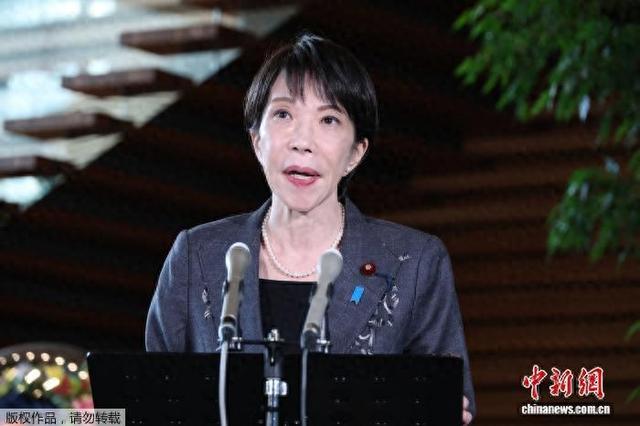
Group 1 - The Nagasaki and Hiroshima city councils passed resolutions on the 8th and 9th, respectively, urging the Japanese government to uphold the "Three Non-Nuclear Principles" which state "not possessing, not producing, and not allowing nuclear weapons" [1][3] - The Nagasaki city council's resolution emphasized that previous Japanese cabinets have consistently adhered to the "Three Non-Nuclear Principles" and expressed strong opposition to any attempts by the government to amend these principles [1] - The Hiroshima city council unanimously passed a resolution expressing concern over the ruling party's attempts to modify the "Three Non-Nuclear Principles" and urged the government to take the sentiments of the citizens of the atomic bombed cities seriously [1][3] Group 2 - The "Three Non-Nuclear Principles" were officially adopted as national policy by the Japanese Diet in 1971, and the 2022 security documents reaffirmed that the basic stance of adhering to these principles would not change [3] - The ability of Japan to adhere to the "Three Non-Nuclear Principles" is viewed by the international community as a key indicator of whether Japan is genuinely pursuing a path of peaceful development [3] - There are concerns regarding Prime Minister Sanae Takaichi's consideration to amend the principle of not allowing nuclear weapons during the revision of the security documents [3]

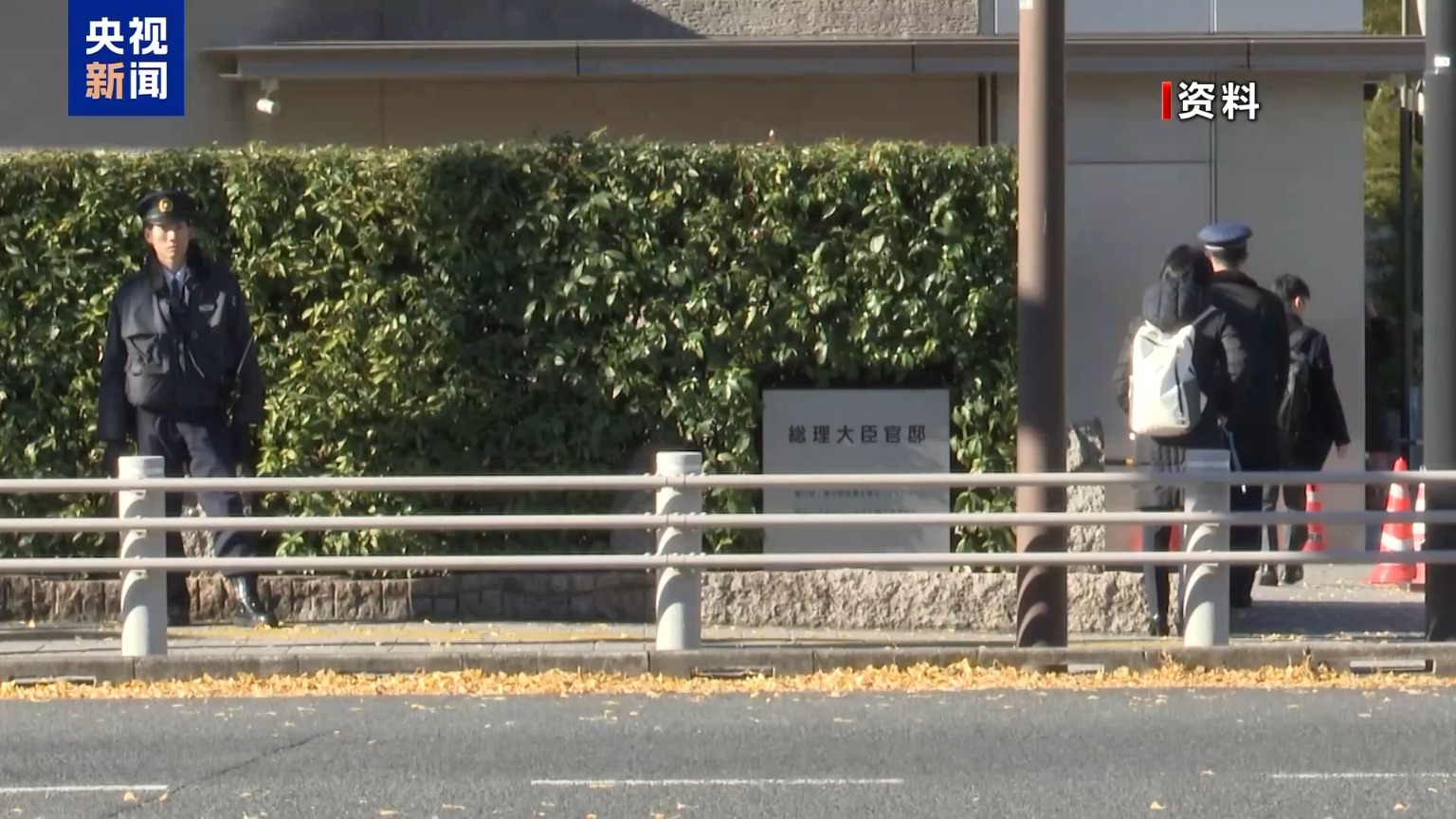
日本民众抗议高市对美军事打击委内瑞拉“失声”
Xin Lang Cai Jing· 2026-01-09 14:34
Core Viewpoint - A large number of Japanese citizens protested against Prime Minister Suga Yoshihide's silence on the U.S. military actions in Venezuela and the government's recent military policy changes, expressing concerns over Japan's potential alignment with militaristic actions [1] Group 1: Public Sentiment - Protesters gathered in front of the Prime Minister's residence, holding signs with messages such as "Force cannot create peace" and "No war anywhere on Earth," indicating a strong anti-war sentiment among the public [1] - Citizens criticized the U.S. military's actions in Venezuela, calling for the Suga administration to make a clear and responsible statement regarding the situation [1] Group 2: Political Implications - Protesters expressed strong concerns over Prime Minister Suga's plans to amend Japan's "Three Non-Nuclear Principles," viewing it as a dangerous shift in military policy [1] - One protester highlighted the contradiction of Suga, as the only nation to have suffered from nuclear attacks, not condemning the U.S. actions and instead considering changes to nuclear policy [1] Group 3: International Context - The international community has condemned the U.S. military's large-scale actions against Venezuela, which included the forced control of President Maduro and his family [1] - Despite widespread criticism, Prime Minister Suga has avoided making a clear statement on the U.S. military actions, leading to further public discontent and criticism from Japanese media [1]
明确反对!日本长崎市议会要求坚持“无核三原则”
Xin Lang Cai Jing· 2026-01-09 06:19
Core Viewpoint - The Japanese government, under Prime Minister Sanna Takashi, is facing significant opposition regarding the potential modification of the "Three Non-Nuclear Principles," which state that Japan will not possess, manufacture, or introduce nuclear weapons. This opposition is particularly strong from the cities of Nagasaki and Hiroshima, both of which are historically significant due to their experiences with nuclear bombings [1][3]. Group 1 - The Nagasaki City Council has passed a resolution urging the central government to uphold the "Three Non-Nuclear Principles" with a majority vote [1]. - The Hiroshima Prefectural Assembly has also expressed its stance against any modification of the "Three Non-Nuclear Principles," reinforcing the opposition from both cities affected by nuclear attacks [3]. - The "Three Non-Nuclear Principles" were established in 1967 by then-Prime Minister Eisaku Satō and have been a fundamental policy of the Japanese government regarding nuclear weapons since their formal adoption in 1971 [3]. Group 2 - The Japanese government had previously affirmed its commitment to the "Three Non-Nuclear Principles" in the 2022 "Security Three Documents," indicating that this fundamental policy would not change [3]. - Recent media reports suggest that Prime Minister Takashi is attempting to revise the "Three Non-Nuclear Principles" during the amendment of the National Security Strategy and other security documents, raising concerns within Japan [3].
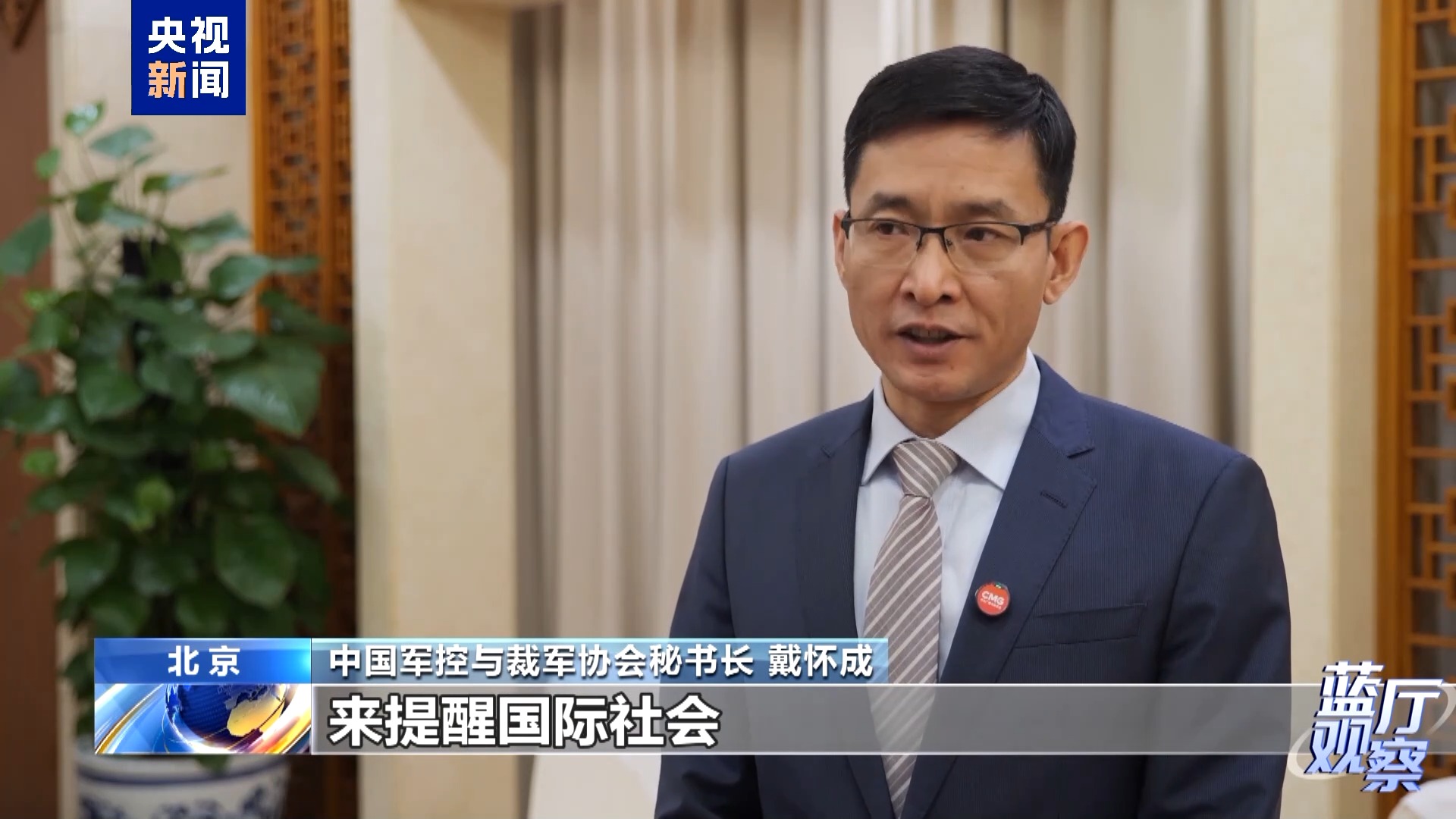
蓝厅观察丨日本右翼核野心日益膨胀 国际社会当联合遏止
Yang Shi Xin Wen Ke Hu Duan· 2026-01-09 05:50
Core Viewpoint - Japan's right-wing ambitions for nuclear weapons development pose a serious threat to global peace, as highlighted in a recent report released in Beijing [1][3][15]. Group 1: Japan's Nuclear Ambitions - The report outlines Japan's historical pursuit of nuclear weapons, its capability to produce weapon-grade nuclear materials, and its military potential to deploy nuclear weapons [3][5]. - Japan has accumulated plutonium far exceeding its civilian nuclear energy needs, indicating it is just a step away from crossing the nuclear threshold [3][9]. - The right-wing's increasing nuclear ambitions signal a dangerous resurgence of Japanese militarism, warranting heightened vigilance from the international community [3][9]. Group 2: Policy Changes and Military Expansion - Recent statements from Japanese officials suggest a potential abandonment of the "Three Non-Nuclear Principles," with discussions around nuclear submarine acquisition and the need for Japan to possess nuclear weapons [7][11]. - The push for nuclear sharing and enhanced deterrence commitments reflects a broader trend of Japan's military rearmament and rightward shift in policy [7][10]. - Japan's defense budget has seen continuous growth for 14 years, with projections indicating a 40% increase in revenue for its top five defense companies in 2024 [11]. Group 3: International Implications - The report emphasizes that Japan's right-wing movements are not isolated incidents but part of a calculated strategy to revive militarism and escape international constraints [7][9]. - Japan's actions could significantly elevate nuclear risks in the region and globally, challenging the principles of nuclear non-proliferation and disarmament [15]. - The international community is urged to closely monitor Japan's nuclear developments, especially in light of the upcoming review conference for the Treaty on the Non-Proliferation of Nuclear Weapons [15].
日本国内和国际社会批评日本政府扩张军备、损害民生 加剧地区紧张局势
Yang Guang Wang· 2026-01-09 01:33
Core Viewpoint - The remarks made by Japanese Prime Minister Sanae Takaichi have sparked criticism both domestically and internationally, with opposition parties accusing her of steering Japan towards becoming a "war state" [1] Group 1: Domestic Reactions - The Japanese Communist Party Chairperson, Tomoko Tamura, described Takaichi's comments as extremely dangerous, indicating a serious situation in Japan-China relations and highlighting the government's lack of effective diplomatic capability [1] - Professor Junichiro Kusumoto from Toyo University emphasized that Japan's "Three Non-Nuclear Principles" are considered a national policy, and the country is legally bound by the Non-Proliferation Treaty, which restricts the possession or development of nuclear weapons [1] Group 2: Economic Context - The general public in Japan is facing difficult living conditions, with rising prices and stagnant wages, suggesting that the government should allocate more resources towards improving citizens' daily lives in budget planning and policy-making [1] Group 3: International Perspective - Ismail Debesh, President of the Algeria-China Friendship Association, criticized Japan's remarks as irrational and illogical, arguing that they do not align with Japan's interests or those of its people, especially given the over $300 billion trade relationship with China [1] - The international community, including Japan's allies and countries friendly to China, has condemned Japan's erroneous statements, asserting that China holds sovereignty over Taiwan and Japan has no right to interfere in China's internal affairs [1]
日本右翼核野心对世界和平造成严重威胁
Xin Lang Cai Jing· 2026-01-08 23:08
Core Viewpoint - The report titled "Japan's Right-Wing Nuclear Ambitions: A Serious Threat to World Peace" highlights the growing nuclear ambitions of Japan's right-wing forces and the dangers of a resurgence of Japanese militarism, urging the international community to remain vigilant and work together to maintain post-war international order and nuclear non-proliferation systems [1]. Group 1 - The report was jointly released by the China Arms Control and Disarmament Association and the China Nuclear Strategic Planning Research Institute, emphasizing the need for Japan to adhere to its international obligations as a non-nuclear weapon state under the Treaty on the Non-Proliferation of Nuclear Weapons [1]. - Japanese Prime Minister Fumio Kishida has hinted at modifying the "Three Non-Nuclear Principles," with some officials suggesting that Japan should possess nuclear weapons, which poses a challenge to international order and reflects a desire for re-militarization [1]. - The report systematically reviews Japan's attempts to modify the "Three Non-Nuclear Principles," analyzing its advanced nuclear industrial capabilities and the accumulation of sensitive nuclear materials far exceeding civilian energy needs [1]. Group 2 - The report contains approximately 13,000 words and presents "ten recommendations," including urging the Japanese Prime Minister to clarify erroneous statements and calling for adherence to the "Three Non-Nuclear Principles" [2]. - It emphasizes the need for Japan to fulfill its international nuclear non-proliferation obligations and address the severe imbalance in plutonium supply and demand [2]. - The report calls for increased oversight from the International Atomic Energy Agency regarding Japan's nuclear activities and encourages related countries to strengthen constraints on Japan, ensuring that nuclear cooperation is solely for peaceful purposes [2].
促日停止试探国际正义的底线红线
Xin Lang Cai Jing· 2026-01-08 23:08
Core Viewpoint - The report titled "Japan's Right-Wing Nuclear Ambitions: A Serious Threat to World Peace" highlights the growing nuclear ambitions of Japan's right-wing factions, which pose a significant threat to global peace and stability [1][2] Group 1: Japan's Nuclear Ambitions - The Japanese government's recent actions indicate a troubling rise in right-wing nuclear ambitions, with officials advocating for the revision of the "Three Non-Nuclear Principles" and suggesting the introduction of nuclear submarines [1] - The report details Japan's secret development of nuclear weapons, accumulation of sensitive nuclear materials, and potential for nuclear weapon development, emphasizing the negative impact of these actions on international peace and security [2] Group 2: International Response - The international community, including various sectors within Japan, has expressed strong opposition to Japan's nuclear ambitions, viewing them as a serious challenge to the international non-proliferation regime established by the Treaty on the Non-Proliferation of Nuclear Weapons [1][2] - There is a call for Japan to clarify its stance on nuclear weapons and adhere to its obligations under the Treaty on the Non-Proliferation of Nuclear Weapons and the "Three Non-Nuclear Principles" [2]
日本右翼日益膨胀的核野心对世界和平稳定构成严重威胁
Xin Lang Cai Jing· 2026-01-08 19:02
Core Viewpoint - The report titled "Japan's Right-Wing Nuclear Ambitions: A Serious Threat to World Peace" highlights the growing nuclear ambitions of Japan's right-wing factions, signaling a dangerous resurgence of militarism that poses a significant threat to global peace and stability [1][2] Group 1: Japan's Nuclear Ambitions - The report indicates that Japan's right-wing factions are increasingly revealing their nuclear ambitions since the new government took office, with officials advocating for the revision of the "Three Non-Nuclear Principles" and suggesting the introduction of nuclear submarines [1] - The report cites Japan's secret development of nuclear weapons, accumulation of sensitive nuclear materials, and potential for nuclear weapon development as alarming facts [2] Group 2: International Response - The Chinese government urges Japan to clarify its stance on nuclear weapons and adhere to its obligations under the Treaty on the Non-Proliferation of Nuclear Weapons and the "Three Non-Nuclear Principles" [2] - There is a call for the international community to remain vigilant regarding Japan's nuclear ambitions and to cautiously engage in nuclear cooperation with Japan, while continuing discussions on monitoring and restricting Japan's nuclear aspirations [2]
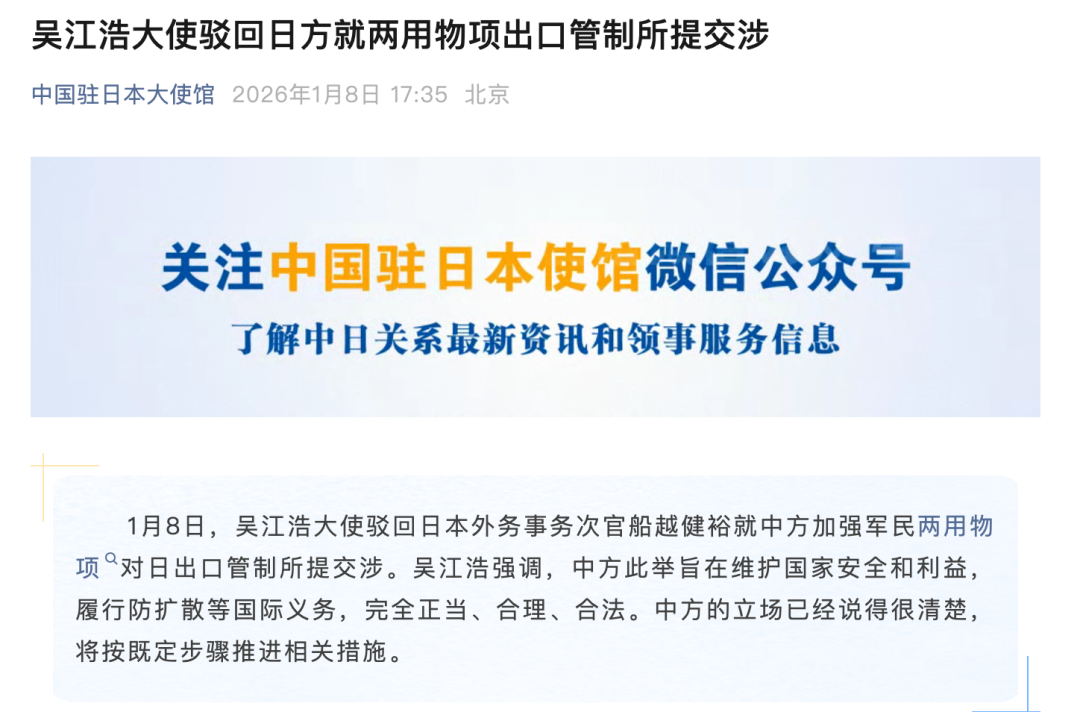
日方提出交涉,中国大使:驳回,“将按既定步骤推进”!高市早苗遭在野党批评:“将日本引向战争国家”
Mei Ri Jing Ji Xin Wen· 2026-01-08 16:22
Group 1 - The Chinese government has strengthened export controls on dual-use items to Japan, citing national security and international obligations as the primary reasons for this decision [1][3][5] - The announcement prohibits all dual-use items from being exported to Japanese military users and any entities that could enhance Japan's military capabilities, with legal consequences for violations [3][5] - The Chinese Ministry of Commerce emphasized that this measure is aimed at preventing Japan's militarization and nuclear ambitions, asserting its legality and reasonableness [5][6] Group 2 - Japanese Prime Minister Kishi Nobuo's recent statements and significant increases in defense spending have raised concerns and criticisms from various sectors in Japan, with opposition parties labeling his administration as the most dangerous since World War II [6][10] - The Japanese government is planning to revise its "Security Three Documents," with discussions expected to focus on enhancing defense capabilities, budget scales, and funding sources, aiming for completion by the end of the year [10][12] - Key points of the planned revisions include increasing defense spending, modifying the "Three Non-Nuclear Principles," and lifting restrictions on arms exports, alongside strengthening military cooperation with other countries [12][14]