
日本央行加息

Search documents
植田和男开年首秀:只要物价达标,日本央行将继续加息!
Xin Lang Cai Jing· 2026-01-05 09:24
Core Viewpoint - The Bank of Japan (BOJ) is likely to continue raising interest rates if economic and price developments align with its forecasts, as stated by Governor Kazuo Ueda [1][3]. Group 1: Economic Conditions - Despite the impact of increased tariffs from the U.S. on corporate profits, Japan's economy experienced moderate recovery last year [1][3]. - Ueda indicated that wages and prices are likely to rise moderately in sync, suggesting that adjustments in monetary support could facilitate sustained economic growth [1][3]. Group 2: Interest Rate Changes - The BOJ raised its policy interest rate from 0.5% to 0.75%, marking a 30-year high and signaling the end of decades of large-scale monetary support and near-zero borrowing costs [1][3]. - The actual borrowing costs in Japan remain negative, as consumer inflation has exceeded the BOJ's 2% target for nearly four years [1][3]. Group 3: Market Reactions - The weak yen has increased import costs and broader inflation, prompting some committee members to call for further gradual interest rate hikes [2][4]. - On the same day, the dollar rose slightly against the yen, with market expectations for further BOJ rate hikes pushing the yield on the benchmark 10-year Japanese government bond to a 27-year high of 2.125% [2][4]. Group 4: Future Outlook - The market is focused on the BOJ's quarterly outlook report scheduled for January 22-23, which will provide insights into how the committee views the inflation impact of the recent yen depreciation [1][3].
【央行圆桌汇】2025年美元指数黯然收官 美联储主席动向将左右后市行情(2026年1月5日)
Xin Hua Cai Jing· 2026-01-05 05:23
Global Central Bank Dynamics - The People's Bank of China has officially released an action plan for the digital yuan, which will implement a new measurement framework and management system starting January 1, 2026. This marks China's transition from "digital cash" to "digital deposit currency," making it the first economy to offer interest on central bank digital currency [1] - The Federal Reserve's December meeting minutes reveal significant internal divisions regarding interest rate cuts, with some officials expressing that the decision is a "delicate balance" and suggesting that rates could remain unchanged [1] - The Bank of Japan's December meeting minutes indicate support for further interest rate hikes, with one member suggesting flexible adjustments to monetary policy every few months [2] - The Bank of Korea announced a comprehensive revision of monetary and liquidity statistics, resulting in a decrease in the year-on-year growth rate of M2 from 8.7% to 5.2% under the new standards [2] Market Observations - Barclays maintains its expectation for the Federal Reserve to cut rates twice in 2026, with anticipated cuts of 25 basis points each in March and June [3] - BlackRock strategists suggest that the Federal Reserve will implement limited rate cuts in 2026, as it approaches neutral interest rates after a cumulative reduction of 175 basis points [3] - Analysts from Mitsubishi UFJ report that the US dollar has experienced its worst annual performance since 2017 and is expected to weaken further in 2026 [4]
荷兰国际:日本央行加息步伐将相当渐进
Sou Hu Cai Jing· 2026-01-02 02:23
Core Viewpoint - The report from ING suggests that the Bank of Japan's interest rate hikes may be "rather gradual" due to concerns over Japan's long-term fiscal health and rising debt repayment burdens [1] Group 1: Economic Outlook - Min Joo Kang, the chief economist for Japan and Korea at ING, indicates that the Japanese financial market may remain volatile, which could impact economic performance [1] - Further fiscal stimulus could have counterproductive effects on the economy, according to Kang [1] Group 2: Policy Stance - The current government is likely to maintain an expansionary policy stance, which poses significant risks to the economy by 2026 [1] - ING believes that the next interest rate hike by the Bank of Japan is most likely to occur in October [1]
荷兰国际:日本央行加息可能将“相当渐进”
Xin Lang Cai Jing· 2026-01-02 02:10
Core Viewpoint - The report from ING indicates that the Bank of Japan's interest rate hike may be "rather gradual" due to concerns over long-term fiscal health and increasing debt burdens, which could lead to instability in the financial market and affect economic performance [1][1]. Summary by Relevant Categories Economic Outlook - Concerns regarding Japan's long-term fiscal health and rising debt burdens may lead to instability in the financial market, potentially impacting the country's economic performance [1][1]. - Further fiscal stimulus could have counterproductive effects on the economy, according to the report [1][1]. Policy Stance - The current government is likely to maintain its expansionary policy stance, which poses significant risks to the economy in 2026 [1][1]. - October is identified as the most likely time for the next interest rate hike by the Bank of Japan [1][1].

交易员权衡日央行加息时机及政府干预风险 日元小幅回升
智通财经网· 2025-12-29 08:58
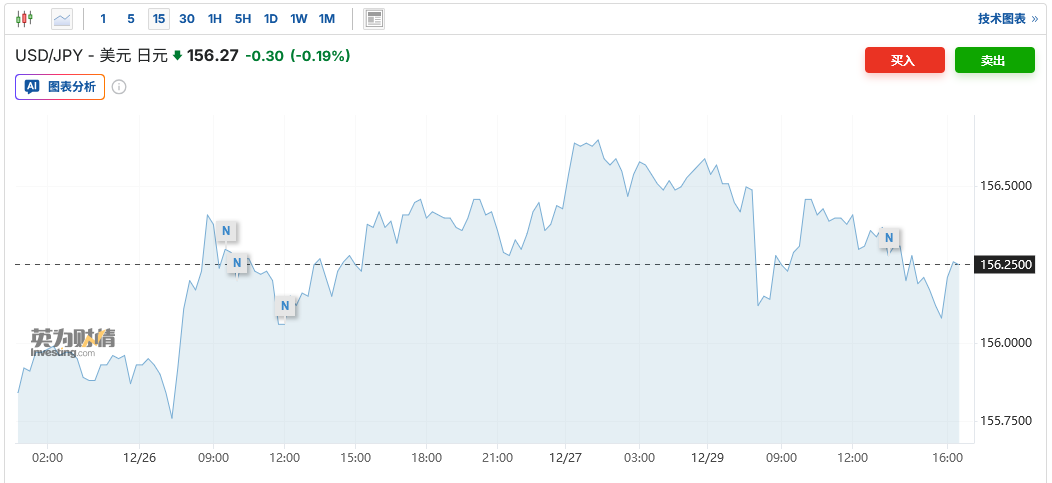
Core Viewpoint - The Japanese yen has recovered some losses as the market weighs the timing of further interest rate hikes by the Bank of Japan and the potential for intervention by Japanese authorities during the year-end trading lull [1] Group 1: Bank of Japan's Policy and Market Reactions - The Bank of Japan raised its policy interest rate by 25 basis points to 0.75% in December, the highest level since 1995, indicating a potential for further tightening if inflation expectations are met [3] - Despite the rate hike, the yen weakened as the market was disappointed by the lack of clear guidance on future monetary tightening from the Bank of Japan [3] - Japanese Finance Minister Satsuki Katayama warned against speculative movements in the yen, stating that authorities have the "absolute freedom" to take bold actions if currency trends do not align with fundamentals [3] Group 2: Market Sentiment and Predictions - There is a growing bearish sentiment towards the yen, particularly after the Bank of Japan's December rate hike failed to provide sustained support, reinforcing the view of the yen's structural weakness [3] - Strategists from institutions like JPMorgan and BNP Paribas predict that the yen could depreciate to 160 yen per dollar or weaker by the end of 2026, driven by significant US-Japan interest rate differentials and ongoing capital outflows [4] - The chief strategist at JPMorgan highlighted the yen's weak fundamentals, suggesting little change in the situation for the coming year, with predictions of the yen reaching 164 yen per dollar by the end of 2026 [4] Group 3: Capital Outflows and Economic Factors - Japanese retail investors have shown a strong preference for overseas assets, with net purchases through investment trusts hovering around 9.4 trillion yen (approximately 60 billion USD), indicating a trend that may continue to suppress the yen [5] - Corporate capital outflows are also a significant factor, with stable foreign direct investment from Japan, largely unaffected by cyclical factors or interest rate changes, contributing to the yen's weakness [5] - Analysts expect the yen's weak position to persist, with predictions of the dollar-yen exchange rate reaching 165 by the end of 2026, as the Federal Reserve's interest rate cycle appears to be nearing completion [5] Group 4: Long-term Outlook - Some observers remain optimistic about the yen's long-term strength, with Goldman Sachs forecasting that the yen could eventually strengthen to 100 yen per dollar over the next decade, despite acknowledging short-term challenges [6]

每日机构分析:12月26日
Zhong Guo Jin Rong Xin Xi Wang· 2025-12-26 10:38
Group 1: Asset Environment and Economic Outlook - CITIC Securities predicts that the asset environment in 2026 may exhibit characteristics of marginal liquidity easing and moderate economic recovery, with the 10-year China bond yield expected to fluctuate between 1.5% and 1.8% and the 10-year US Treasury yield maintaining a range of 3.9% to 4.3% [1] - The report anticipates that Brent crude oil will oscillate between $58 and $70 per barrel, while gold prices may continue to be strong, potentially reaching $5,000 per ounce, supported by liquidity easing and geopolitical risks [1] - Copper prices are expected to rise to an average of $12,000 per ton due to supply constraints and electricity demand [1] Group 2: Currency and Foreign Investment - Huatai Securities indicates that the current appreciation of the RMB is likely to enhance foreign investors' interest in RMB-denominated assets, creating a positive cycle for capital inflows and easing financial conditions [2] - The report notes that despite seasonal declines in capital flows and risk appetite towards the end of the year, the strengthening of the RMB will continue to boost the valuation of both onshore and offshore RMB assets [2] Group 3: Silver Market Dynamics - Silver prices have surged nearly 150% this year, driven by strong industrial demand, low global inventories, and its inclusion in key mineral lists [2] - Analysts suggest that silver is breaking away from its traditional role as a "by-product" of gold, with its independent investment logic being re-evaluated by the market [2] - Predictions indicate that silver prices could reach $100 per ounce by 2026, especially if monetary instability increases [2] Group 4: Japanese Economic Indicators - Tokyo's inflation rate has shown a greater-than-expected decline, with the CPI rising 2.3% year-on-year in December, down from 2.8% the previous month, primarily due to easing food price increases and lower energy costs [3] - Despite the slowdown, inflation remains above the Bank of Japan's 2% target, suggesting continued tightening of monetary policy [3] - The Japanese economy is expected to rebound from a contraction in Q3, with forecasts indicating production growth of 1.2% and 1.8% in December and January 2026, respectively [3] Group 5: Japanese Government Bond Issuance - The Japanese Finance Ministry plans to reduce the issuance of ultra-long government bonds to the lowest level in 17 years, cutting nearly 20% from the previous fiscal year to approximately 17.4 trillion yen [4] - The total issuance of Japanese government bonds for the next fiscal year is projected to be 180.7 trillion yen, a decrease of nearly 5% from the current fiscal year [4] Group 6: South Korean Currency Intervention - The South Korean won has strengthened against the US dollar due to verbal interventions and measures from authorities, with the government expressing a firm commitment to alleviate pressure on the currency [4] - Recent measures may lead to a dollar sell-off of up to $23 billion, although there are risks that the outcomes may not meet expectations [4]
日本国债价格走势分化 首相表态或成债市支撑
Xin Lang Cai Jing· 2025-12-24 08:08
Core Viewpoint - The performance of Japanese government bonds is mixed, influenced by Prime Minister Fumio Kishida's concerns regarding domestic debt issuance, which may provide support for bond prices [1] Group 1: Government Debt Concerns - Prime Minister Kishida expressed worries about Japan's high national debt levels and opposed "irresponsible" debt issuance or tax cuts [1] - Kishida's statements may contribute to stabilizing bond prices amid investor concerns [1] Group 2: Currency and Interest Rates - The recent pause in the depreciation of the yen may alleviate investor fears regarding rising import prices and potential acceleration of interest rate hikes by the Bank of Japan [1] - The yield on 10-year Japanese government bonds decreased by 2 basis points to 2.020%, while the 30-year yield increased by 1 basis point to 3.435% [1]
瑞银:日本央行逐步加息及美联储温和降息不太可能令美元兑日元显著下跌
Sou Hu Cai Jing· 2025-12-24 06:36
Core Viewpoint - UBS believes that the gradual interest rate hikes by the Bank of Japan and the Federal Reserve's moderate rate cuts next year are unlikely to lead to a significant decline in the USD/JPY exchange rate [1] Group 1: Economic Indicators - Concerns regarding Japan's fiscal budget remain, with the latest forecast indicating that the primary balance deficit will persist [1] - The debt-to-GDP ratio is expected to decline [1] Group 2: Inflation and Price Data - The Tokyo core consumer price index is predicted to slow from a year-on-year rate of 2.8% in November to 2.6% in December due to falling electricity prices [1] - The core consumer price index is expected to remain at 2.8% [1] Group 3: Upcoming Data Releases - Attention is focused on the upcoming releases of Tokyo's consumer price index, industrial production, and wage data [1]

见证历史!现货黄金首次涨破4500美元/盎司关口
新华网财经· 2025-12-24 02:26
12月24日, 现货黄金首次升破4500美元/盎司,日内涨0.48%。今年累涨超1870美元。 受近期国际金价影响,以人民币计价的黄金价格再创新高。 12月23日, 多个品牌足金饰品报价首次 冲上每克1400元。 周生生足金饰品 标价1403元/克,较前一日1367元/克 的价格 上涨36元/克; 周大福、周大生足金饰品标价1403元/克,较前一日1368元/克 的价格 上 涨35元/克; 老凤祥足金饰品标价1399元/克,较前一日1365元/克的价格上涨34元/克;老庙黄金足金饰品标价1402元/克,较前一日 1367元/克的价格 上涨35元/克。 | 今日黄金最新价格 | 单位:元/克 更新时间:12-23 | | | | | | --- | --- | --- | --- | --- | --- | | ■** 周大福 | 周六福 | 輝 周生生 | | | | | 1403.00 | 1389.00 | 1403.00 | | | | | 金条价格 1230.00 金条价格 1284.00 金条价格 1231.00 | | | | | | | ■ 潮宏基 | 图大生 | 一六福珠宝 | | | | | ...

美元:美三季度数据不佳或致明年降息,日元或施压
Sou Hu Cai Jing· 2025-12-23 14:13
本文由 AI算法生成,仅作参考,不涉投资建议,使用风险自担 【12月23日消息:美国三季度成长数据若逊预期,美元将很脆弱】XTB分析师称,若美国第三季成长数 据不如预期,美元会极为脆弱。降温迹象或强化美联储明年进一步降息预期,拉低收益率并削弱美元。 年末流动性减少与全球货币政策变化,会加剧这种敏感性。日本央行近期加息或吸引资本流入日元,若 美国数据不佳,将进一步打压美元。 ...