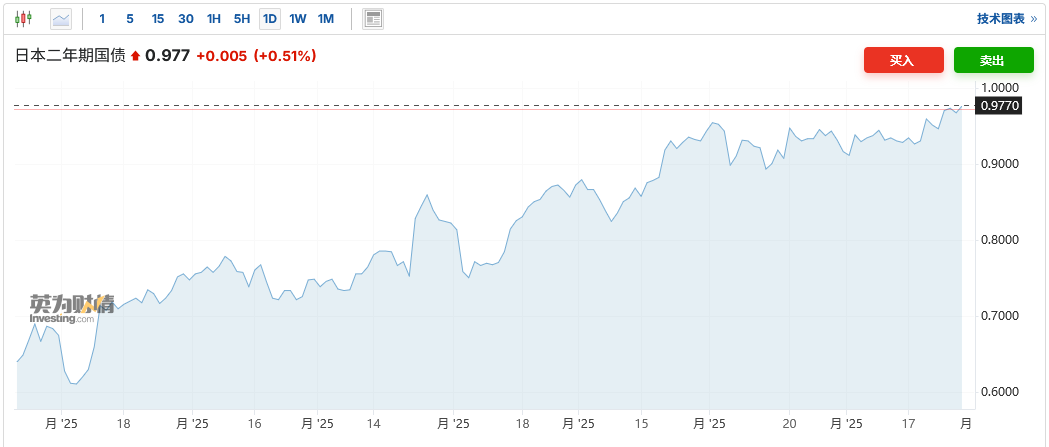
日本两年期国债

Search documents
日本两年期国债收益率上涨0.5个基点,至1.23%
Mei Ri Jing Ji Xin Wen· 2026-02-18 00:43
Group 1 - The core point of the article is that Japan's two-year government bond yield has increased by 0.5 basis points to 1.23% [1]
日本两年期国债收益率上涨1.5个基点,至1.230%
Mei Ri Jing Ji Xin Wen· 2026-01-23 03:53
Group 1 - The core point of the article is that Japan's two-year government bond yield has increased by 1.5 basis points to 1.230% [1]
日本两年期国债收益率下跌2.5个基点至1.140%
Mei Ri Jing Ji Xin Wen· 2026-01-08 00:37
Group 1 - The yield on Japan's two-year government bonds decreased by 2.5 basis points to 1.140% [1]
日本两年期国债拍卖遇冷、收益率应声上扬 市场押注央行加大加息力度
Zhi Tong Cai Jing· 2025-12-25 07:39
Group 1 - The demand for Japan's two-year government bonds is weak, leading to an increase in yields for this maturity, with the auction bid-to-cover ratio recorded at 3.26, lower than the previous 3.53 and the 12-month average of 3.65 [1] - The two-year government bond yield rose by 1 basis point to 1.11%, while the ten-year government bond futures opened high but subsequently declined [1] - The Bank of Japan recently raised its policy interest rate to the highest level in 30 years, but the governor did not provide clear guidance on future rate paths, contributing to a weaker yen and rising bond yields [1] Group 2 - The two-year government bond yield reached its highest level since 1996 earlier this week, while the ten-year breakeven inflation rate hit a record high since 2004 [3] - Japan's Finance Minister warned that the government has the freedom to take decisive measures against exchange rate fluctuations that do not align with economic fundamentals, which has somewhat eased the yen's depreciation and rising yield trend [3] - Investors are closely monitoring the bond issuance plan related to the fiscal year 2026 budget, which is expected to be approved by the cabinet soon, with suggestions to increase the issuance of two-year, five-year, and ten-year bonds while reducing the issuance of ultra-long-term bonds [3]

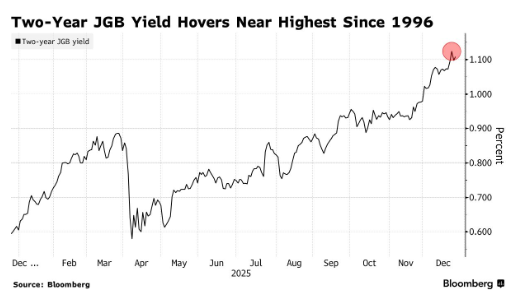
TMGM:日本两年期国债拍卖在即,市场观望情绪浓厚?
Sou Hu Cai Jing· 2025-12-25 04:49
Core Viewpoint - The Japanese bond market is closely watching the upcoming two-year government bond auction, which is seen as a critical indicator of investor sentiment amid rising inflation and discussions on potential further tightening by the Bank of Japan [1] Group 1: Auction Context - The auction occurs less than a week after the Bank of Japan raised its policy interest rate to a 30-year high, with no clear guidance on future tightening from Governor Kazuo Ueda [1] - The two-year government bond yield reached its highest level since 1996 earlier this week, indicating a market re-evaluation of future policy paths [1] - The 10-year breakeven inflation rate has risen to its highest level since 2004, reflecting sustained increases in medium- to long-term inflation expectations [1] Group 2: Market Sentiment - Market sentiment is cautious due to concerns over the speed of the central bank's policy response and the upward adjustment of inflation expectations and neutral interest rates [4] - Despite verbal warnings from Japanese authorities regarding exchange rates, the yen's depreciation and rising yields have not fully stabilized the market [4] - Overnight index swaps indicate a possibility of another rate hike by the Bank of Japan before September next year [4] Group 3: Auction Expectations - The upcoming auction may be the first issuance of two-year bonds with yields exceeding 1%, but uncertainty remains due to the recent rate hike and unclear policy outlook [4] - Traders currently price in the next 25 basis point rate hike only by September 2026 [4] - Investors are also focused on the upcoming fiscal year 2026 budget proposal, which is expected to increase the issuance of two-year, five-year, and ten-year bonds while reducing ultra-long bond issuance [4] Group 4: Auction Metrics - The auction results will be announced on Thursday at 12:35 Tokyo time, with key metrics such as bid-to-cover ratio and the "tail" between average and minimum accepted prices being closely monitored [5] - The previous auction in November had a bid-to-cover ratio of 3.53, which will serve as a benchmark for assessing market sentiment [5] - Increased issuance of two-year bonds may lead to a higher risk of short-term paper losses [5]
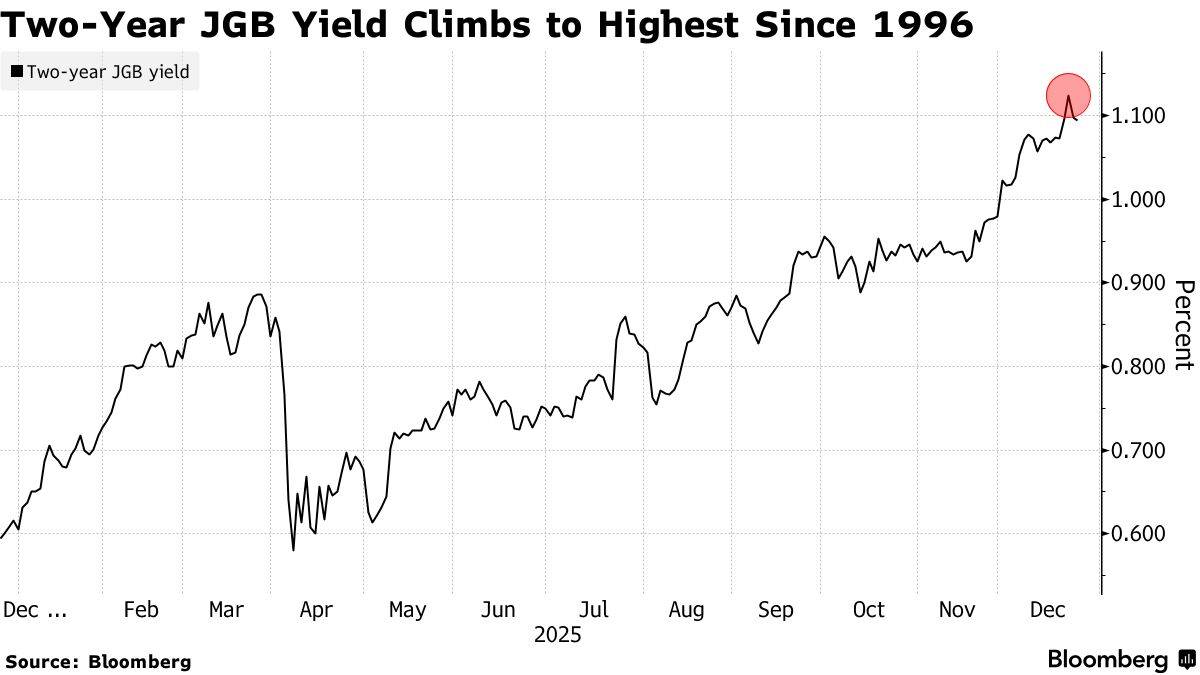
加息阴云笼罩+供给压力!日本两年期国债标售恐遇冷
Zhi Tong Cai Jing· 2025-12-24 23:55
Group 1 - The market is anticipating a significant increase in interest rates by the Bank of Japan to curb inflation and support the yen, with a two-year government bond auction scheduled soon after the central bank raised policy rates to a 30-year high [1][3] - The two-year government bond yield has reached its highest level since 1996, reflecting heightened sensitivity to monetary policy expectations, while the 10-year breakeven inflation rate has also surged to its highest since 2004 [1] - Concerns about the Bank of Japan lagging behind in policy adjustments and rising inflation expectations have created unease in the market regarding the upcoming bond auction, which is seen as a key indicator of market sentiment towards the central bank's stance [3] Group 2 - The upcoming auction is expected to be the first issuance of two-year bonds with yields exceeding 1%, although there are doubts about its performance following the recent rate hike by the Bank of Japan [3] - Investors are worried about the government's bond issuance plan related to the fiscal year 2026 budget, which is anticipated to exceed the initial plan for the current fiscal year [3] - The auction results will be closely monitored for the bid-to-cover ratio and the 'tail' difference, which indicates demand and pricing dynamics in the bond market [4]
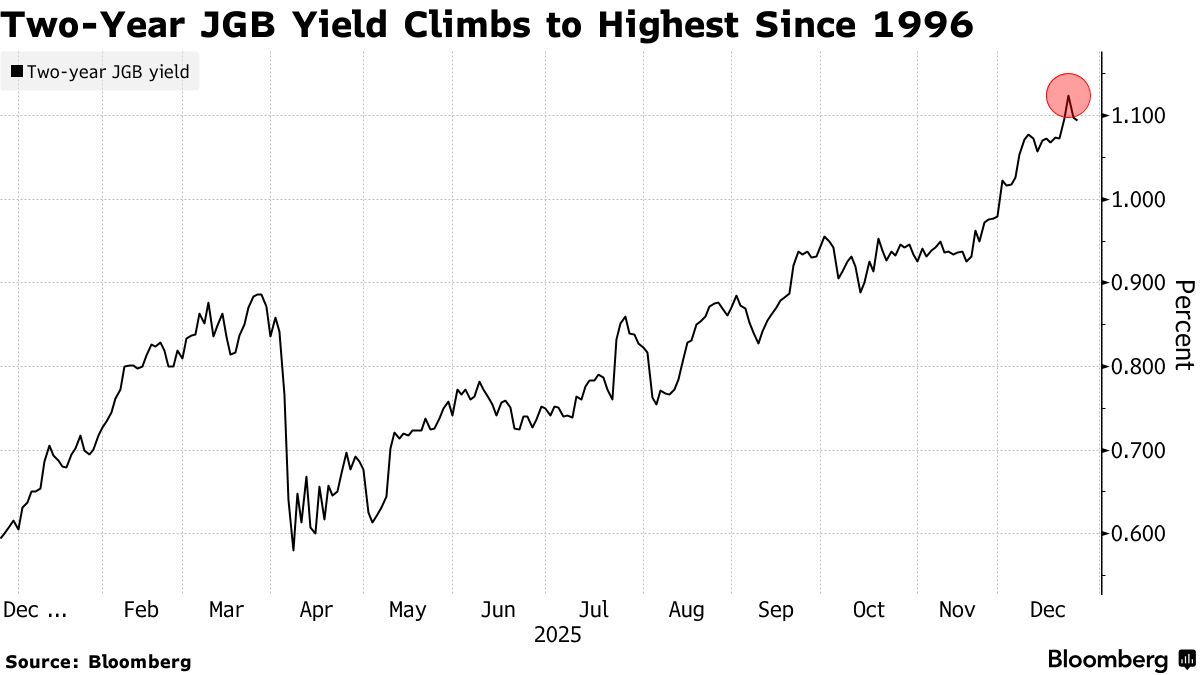
日本两年期国债收益率升至1.03%,创2007年8月来最高
Mei Ri Jing Ji Xin Wen· 2025-12-05 03:53
Core Viewpoint - Japan's two-year government bond yield has risen to 1.03%, marking the highest level since August 2007 [1] Group 1 - The increase in the two-year bond yield indicates a significant shift in the Japanese bond market [1] - This rise in yield may reflect changing investor sentiment and expectations regarding monetary policy in Japan [1] - The current yield level could impact borrowing costs and investment decisions within the Japanese economy [1]
【特稿】日本两年期国债收益率升至2008年以来最高水平
Sou Hu Cai Jing· 2025-12-01 12:43
Group 1 - The yield on Japan's two-year government bonds rose to its highest level since 2008, reaching 1.015% on December 1, influenced by expectations of a potential interest rate hike by the Bank of Japan [1] - The yields on five-year and ten-year government bonds also increased, reaching 1.382% and 1.858% respectively, with a minimum rise of 6.5 basis points [1] - The market's expectation for a rate hike by the Bank of Japan has strengthened, with an 80% probability for a decision at the December 19 meeting, up from just 30% two weeks prior [1] Group 2 - The Japanese Ministry of Finance plans to increase the issuance of short- to medium-term government bonds to fund Prime Minister Fumio Kishida's economic stimulus plan, including an increase of 300 billion yen (approximately 1.93 billion USD) for two-year and five-year bonds, and an additional 6.3 trillion yen (approximately 40.5 billion USD) in treasury bills [2] - A recent auction for two-year government bonds showed weak demand, indicating cautious investor sentiment amid rising interest rate risks [2]
日本两年期国债收益率升至2008年以来最高水平
Sou Hu Cai Jing· 2025-12-01 12:33
Group 1 - Japanese government bonds experienced a significant drop on December 1, influenced by indications that the Bank of Japan may soon raise interest rates, with the two-year bond yield reaching its highest level since 2008 at 1.015% [1][4] - The yields on five-year and ten-year Japanese government bonds also increased, reaching 1.382% and 1.858% respectively, with a minimum rise of 6.5 basis points [1][4] - The Japanese yen strengthened against the US dollar, rising to 155.4 yen per dollar on the same day [1] Group 2 - Bank of Japan Governor Kazuo Ueda stated that the bank will consider the pros and cons of raising interest rates and make decisions accordingly [4] - Market expectations for a rate hike by the Bank of Japan have intensified, with an 80% probability of a decision at the December 19 meeting, increasing to over 90% before the January meeting [4] - The Japanese Ministry of Finance plans to increase the issuance of medium- and short-term bonds to fund Prime Minister Fumio Kishida's economic stimulus plan, including an increase of 300 billion yen (approximately 1.93 billion USD) for two-year and five-year bonds, and an additional 6.3 trillion yen (approximately 40.5 billion USD) in treasury bills [4]
债市用脚投票!加息预期升温拖累下两年期日债拍卖遇冷 投资者焦点转向植田和男讲话
智通财经网· 2025-11-28 07:26
Core Viewpoint - The expectation of an interest rate hike by the Bank of Japan (BOJ) has intensified, leading to a decline in demand for Japanese two-year government bonds, as evidenced by lower bid ratios and increased tail spreads in recent auctions [1][3][4]. Group 1: Bond Market Dynamics - The bid-to-cover ratio for the recent two-year bond auction was 3.53, down from 4.35 in the previous auction and below the 12-month average of 3.66 [1]. - The tail spread for the auction reached 0.012, significantly higher than the previous auction's 0.002, indicating weaker demand [1]. - The yield on two-year government bonds rose to 0.977%, the highest level since 2008, reflecting market reactions to the BOJ's potential policy changes [1]. Group 2: Economic Indicators - Tokyo's core consumer price index (CPI) rose by 2.8% year-on-year in November, slightly above the median forecast of 2.7%, suggesting persistent inflationary pressures [4]. - Industrial output in October increased by 1.4%, far exceeding market expectations of a 0.6% decline, indicating stronger economic performance [4]. - Early signs from labor negotiations suggest robust wage growth, with Japan's largest labor union aiming for a 5% increase in 2026, supporting the case for further rate hikes [4]. Group 3: Central Bank Officials' Statements - Former BOJ official Kazuo Ueda indicated that the recent depreciation of the yen increases the likelihood of a rate hike in December, suggesting that no significant negative signals are needed to justify such a move [5]. - Political pressure to maintain low interest rates appears to be easing, with Prime Minister Fumio Kishida's administration likely to support BOJ's rate normalization efforts [5]. - New BOJ policy committee member Masayoshi Amamiya noted that the timing for a rate hike is approaching, reflecting a shift in the central bank's stance [5]. Group 4: Investor Sentiment and Future Outlook - Investors are cautious ahead of BOJ Governor Kazuo Ueda's upcoming speech, which is anticipated to provide insights into the central bank's interest rate trajectory [6]. - Concerns over Japan's fiscal situation, including a projected supplementary budget of approximately 18.3 trillion yen for FY2025, are contributing to investor apprehension [6]. - Major dealers are requesting increased issuance of shorter-term bonds while reducing long-term bond issuance, indicating a cautious market sentiment [7].