
现代化人民城市建设

Search documents
【新华解读】现代化人民城市建设明确城市高质量发展目标 “好房子”和城市更新深度融合
Xin Hua Cai Jing· 2025-08-29 15:34
Core Viewpoint - The release of the "Opinions on Promoting High-Quality Urban Development" aims to accelerate the transformation of urban development methods and promote high-quality urban growth in China [1][2]. Group 1: Urban Development Transition - China's urbanization is shifting from a rapid growth phase to a stable development phase, with urban development transitioning from large-scale expansion to improving existing stock [2]. - The "Opinions" deepen and implement the spirit of the Central Urban Work Conference, encouraging local governments to adopt tailored measures for urban development [2][3]. Group 2: Modern Urban System Optimization - The first task outlined in the "Opinions" is to optimize the modern urban system, addressing the imbalance caused by the rapid growth of mega-cities [3]. - The current urban system is undergoing significant changes, with urban clusters and metropolitan areas becoming dominant, necessitating timely optimization to prevent long-term structural issues [3][4]. Group 3: Housing and Urban Renewal - The "Opinions" emphasize the integration of "good housing" and urban renewal to create livable cities, which is essential for meeting the public's aspirations for a better life [5][6]. - The construction of "good housing" and the implementation of urban renewal plans are seen as key pillars for enhancing urban living quality and stimulating economic activity [6]. Group 4: Long-term Goals - The "Opinions" set a long-term goal for significant progress in modern urban construction by 2030 and the basic establishment of modern urban areas by 2035, linking urban development with national modernization objectives [7].
中央明确城市高质量发展路线图,你的安居生活将有什么新变化?
Bei Ke Cai Jing· 2025-08-29 07:49
Core Points - The document titled "Opinions on Promoting High-Quality Urban Development" was officially released on August 28, outlining a roadmap for urban development over the next 10 to 15 years, directly impacting housing, community life, and urban environments for citizens [1][4][5] - The document serves as a key implementation tool for the Central Urban Work Conference held in July, marking a shift from large-scale expansion to enhancing existing urban quality [4][6] - The construction of modern urban areas is aligned with China's modernization strategy, aiming for significant progress by 2030 and basic completion by 2035 [5][7] Urban Development Goals - By 2030, significant advancements in modern urban construction are expected, including improved policies for high-quality urban development, enhanced living standards, and a strong focus on green transformation [7] - The document outlines seven major tasks, which have been further detailed into 23 specific opinions, focusing on enhancing urban development dynamics and activating existing resources [8][9] Housing and Community Focus - A significant emphasis is placed on housing, with initiatives aimed at creating "good houses" and complete community constructions, addressing diverse housing needs and improving service quality [9][10] - The concept of "good houses" is defined as not just large or expensive homes, but as quality housing that meets the needs of all citizens, including affordable and rental options [11][12] Urban Renewal as a Strategy - Urban renewal is identified as a crucial strategy for high-quality urban development, with plans for the gradual renovation of old neighborhoods and the promotion of integrated urban planning [14][16] - The document emphasizes the need for collaboration between government and market forces to fund urban renewal projects, suggesting the issuance of special bonds and the involvement of social capital [16]
《中共中央 国务院关于推动城市高质量发展的意见》近日发布
Yang Guang Wang· 2025-08-29 01:58
Core Viewpoint - The document outlines the "Opinions on Promoting High-Quality Urban Development" issued by the Central Committee of the Communist Party of China and the State Council, emphasizing the importance of urban modernization and high-quality development in line with Xi Jinping's thoughts and directives [1][2]. Group 1: Goals and Objectives - By 2030, significant progress in modern urban construction is expected, with improved policies for high-quality urban development, accelerated transformation of old and new growth drivers, enhanced living quality, deepened green transition, solidified safety foundations, and increased cultural appeal [2] - By 2035, the basic establishment of modern urban cities is anticipated [2]. Group 2: Key Requirements - The document specifies requirements in several areas: optimizing the modern urban system, fostering new growth drivers for urban development, creating high-quality urban living spaces, promoting green and low-carbon urban transformation, enhancing urban safety resilience, encouraging cultural prosperity, and improving urban governance capabilities [2].
我国2035年现代化人民城市基本建成
Bei Jing Shang Bao· 2025-08-28 17:17
Core Viewpoint - The "Opinions on Promoting High-Quality Urban Development" emphasizes the transition of urbanization in China from rapid growth to stable development, focusing on improving existing urban quality rather than large-scale expansion, with significant progress expected by 2030 and the establishment of modernized cities by 2035 [1][3]. Group 1: Urban Development Strategy - The document outlines major tasks including optimizing the modern urban system, fostering new urban development drivers, creating high-quality urban living spaces, promoting green and low-carbon urban transformation, and enhancing urban safety resilience [3]. - It supports the development of world-class city clusters in regions like Beijing-Tianjin-Hebei, Yangtze River Delta, and Guangdong-Hong Kong-Macau Greater Bay Area, while controlling the scale of mega cities and enhancing their core functions [3][4]. Group 2: Economic and Financial Framework - The "Opinions" propose establishing a sustainable urban construction and operation financing system, emphasizing the role of local governments in coordinating financial resources and attracting social capital [4][5]. - It encourages the development of advanced manufacturing clusters, smart construction, and the production and service industries, while also promoting new economic sectors such as the silver economy and low-altitude economy [4]. Group 3: Urban Living Quality - The document advocates for the systematic promotion of quality housing and complete community construction, enhancing the design, construction, and maintenance of housing to create safe, comfortable, and green living environments [6]. - It emphasizes the importance of cultural heritage preservation and the integration of historical elements into urban development, aiming to create a unique urban aesthetic that reflects Chinese culture [6].

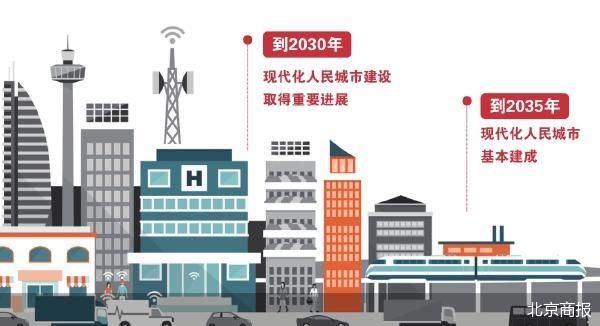
到2035年 现代化人民城市基本建成
Qi Huo Ri Bao· 2025-08-28 16:12
Core Viewpoint - The "Opinions on Promoting High-Quality Urban Development" emphasizes the transition of urbanization in China from rapid growth to stable development, focusing on enhancing existing urban quality rather than large-scale expansion [1][2]. Group 1: Goals and Objectives - By 2030, significant progress in modern urban construction is expected, with improved policies for high-quality urban development, accelerated conversion of old and new growth drivers, enhanced living quality, deepened green transformation, solidified safety foundations, and improved governance levels [2][3]. - By 2035, the basic establishment of modern urban areas is anticipated [2]. Group 2: Specific Requirements - The document outlines 23 specific requirements across seven areas, including optimizing urban systems, fostering new growth drivers, creating high-quality living spaces, promoting green low-carbon transitions, enhancing urban safety resilience, cultural prosperity, and improving governance capabilities [2][3]. Group 3: Urban Development Strategies - The strategy emphasizes tailored approaches to urban development based on local resources and conditions, fostering innovation ecosystems, and enhancing collaboration between technological and industrial innovation [3]. - It advocates for the establishment of a sustainable urban construction and operation financing system, involving local government responsibilities and diverse funding sources [3]. Group 4: Energy Efficiency and Carbon Reduction - The document calls for energy-saving and carbon reduction initiatives in production, including industrial efficiency improvements, promotion of green technologies, and management of high-energy-consuming projects [4]. - It also highlights the importance of developing green buildings and advancing low-carbon construction practices [4].
事关城市高质量发展,中央重磅文件对外公布
21世纪经济报道· 2025-08-28 11:48
Core Viewpoint - The document outlines the central government's opinions on promoting high-quality urban development, emphasizing the transition from rapid urbanization to stable development, focusing on improving existing urban structures and enhancing quality rather than merely expanding quantity [5][7]. Overall Requirements - The document stresses the importance of adhering to Xi Jinping's thoughts on socialism with Chinese characteristics, emphasizing a people-centered approach, and promoting urban development that is innovative, livable, beautiful, resilient, civilized, and smart [8]. Optimizing Modern Urban Systems - The document advocates for the orderly integration of urban clusters and metropolitan areas, supporting the development of world-class urban clusters and enhancing the competitiveness of mega-cities [9][10]. - It emphasizes improving the capacity of small and medium-sized cities and county towns, promoting urbanization that leverages local conditions [11]. Cultivating New Urban Development Momentum - The document highlights the need for tailored strategies to enhance urban development dynamics, focusing on innovation and the cultivation of new productive forces [12]. - It calls for activating the potential of existing urban resources and establishing a sustainable urban construction and operation financing system [13]. Creating High-Quality Urban Living Spaces - The document promotes the construction of quality housing and complete communities, aiming to meet diverse housing needs and improve urban living conditions [15]. - It emphasizes the importance of optimizing urban infrastructure and enhancing public service quality to ensure equitable access [16]. Promoting Green and Low-Carbon Urban Transformation - The document outlines strategies for energy conservation and carbon reduction in production, advocating for the development of green buildings and low-carbon lifestyles [17][18]. - It stresses the need for effective urban ecological environment governance to improve air quality and manage pollution [19]. Enhancing Urban Safety Resilience - The document emphasizes the importance of safety management for buildings and municipal infrastructure, advocating for comprehensive safety measures and emergency preparedness [19]. - It highlights the need for improved public health response capabilities and disaster risk management systems [20][21]. Promoting Cultural Prosperity in Cities - The document encourages the protection and utilization of historical and cultural resources, aiming to enhance urban cultural heritage and community identity [21]. - It calls for the enrichment of urban spiritual and cultural life, promoting core socialist values and innovative cultural expressions [22]. Improving Urban Governance Capabilities - The document advocates for a comprehensive urban governance system that encourages public participation and collaboration among various stakeholders [23][24]. - It emphasizes the need for digital transformation in urban governance to enhance efficiency and responsiveness [23]. Strengthening Organizational Implementation - The document stresses the importance of centralized leadership and coordinated efforts across different levels of government to ensure effective implementation of urban development strategies [25].
经济日报:城市工作应更贴合群众需求
Jing Ji Ri Bao· 2025-08-15 01:36
Group 1 - The core objective of the recent Central Urban Work Conference is to establish a modernized people-oriented city, emphasizing innovation, livability, beauty, resilience, civilization, and intelligence [1] - The meeting highlights the importance of a people-centered development approach, addressing fundamental questions about urban development and construction [1][2] - Urbanization in China is transitioning from rapid growth to stable development, focusing on quality improvement and efficiency in existing urban structures [1] Group 2 - The strategy for urban development includes optimizing urban structure, transforming economic drivers, enhancing quality, promoting green transitions, and improving governance, all centered around people's needs [2] - Specific measures include accelerating the establishment of a new model for real estate development and implementing effective solutions for urban ecological issues such as air quality and water source protection [2] - There is a strong emphasis on investing in human capital, prioritizing residents' core demands in employment, education, healthcare, and living environments in urban planning [2] Group 3 - The development of cities requires the collective wisdom and strength of the people, encouraging participation from citizens, enterprises, and social organizations in urban governance [3] - The ultimate goal of a people-oriented city is to achieve the comprehensive development of individuals, ensuring that urban development aligns with the needs of the populace [3]
金观平:城市工作应更贴合群众需求
Jing Ji Ri Bao· 2025-08-15 00:02
Group 1 - The core objective of the recent Central Urban Work Conference is to establish a modernized people-oriented city, emphasizing innovation, livability, beauty, resilience, civilization, and intelligence [1] - The meeting highlights the importance of a people-centered development approach, addressing fundamental questions about urban construction and development [1][2] - China's urbanization is transitioning from rapid growth to stable development, focusing on quality improvement and efficiency in existing urban structures [1] Group 2 - The strategy for urban development includes optimizing urban structure, transforming economic drivers, enhancing quality, promoting green transitions, and improving governance, all centered around people's needs [2] - Specific measures include accelerating the establishment of a new model for real estate development and addressing urban ecological issues such as air quality and water source protection [2] - There is a strong emphasis on investing in human capital, prioritizing residents' core demands in employment, education, healthcare, and living environments in urban planning [2] Group 3 - The development of cities requires the collective wisdom and strength of the people, encouraging participation from citizens, enterprises, and social organizations in urban governance [3] - The ultimate goal of a people-oriented city is to achieve the comprehensive development of individuals, ensuring that urban development aligns with the needs of the populace [3]
徐曙海主持召开市政府常务会议 加快建设现代化人民城市 以更优服务繁荣文旅市场
Zhen Jiang Ri Bao· 2025-08-01 23:58
Group 1: Urban Development and Governance - The meeting emphasized the importance of fully understanding and implementing the spirit of the Central Urban Work Conference, focusing on the concept of "People's City built by the people, for the people" [1] - The city aims to accelerate the construction of a modernized people's city, with a vision of being an "innovation and entrepreneurship paradise, a garden city" [1] - There is a commitment to high-level planning to support high-quality development, integrating production, living, and ecological spaces [1] Group 2: Ecological Environment Protection - The meeting highlighted that ecological civilization construction is fundamental for the sustainable development of the Chinese nation [2] - There is a strong focus on implementing ecological environment protection tasks, addressing feedback from ecological inspections, and ensuring strict compliance with rectification measures [2] - The city aims to continue efforts in protecting blue skies, clear waters, and clean land, while promoting high-end, intelligent, and green industrial development [2] Group 3: Science and Technology Promotion - The meeting recognized that science and technology popularization is essential for achieving innovative development [2] - There is a plan to enhance science popularization capabilities and improve infrastructure for science communication, aiming to elevate public scientific literacy [2] - The integration of science popularization with technological innovation is a priority, with efforts to create platforms for the dissemination of scientific achievements [2] Group 4: Cultural and Tourism Development - The meeting discussed the need for innovative collaborative mechanisms to better serve the cultural and tourism market [3] - There is a focus on market-oriented approaches, emphasizing demand-side reforms to support the development of immersive and digital cultural tourism products [3] - The city aims to expand consumption scenarios and enhance service standards, promoting regional cooperation to convert cultural tourism resources into consumption growth [3]
守好用好地标性历史设施
Jing Ji Ri Bao· 2025-07-28 21:54
Group 1 - The recent renovation of landmark sites in Changchun, Jilin Province, has received widespread acclaim, focusing on a people-centered approach [1] - The People's Square, after 22 years of closure, has been transformed into a public space that integrates history, culture, and leisure, addressing the conflict between pedestrians and vehicles through the construction of an underground passage [1] - Changchun's Xinmin Street has been enhanced with open green spaces and new cultural facilities, such as beverage shops and art galleries, responding to public needs and modern trends [1] Group 2 - The recent Central Urban Work Conference emphasized the importance of adapting to changing circumstances and prioritizing a people-centered urban development philosophy [2] - Landmark historical facilities in cities should be protected and utilized to preserve collective memories and meet the cultural consumption demands of citizens [2] - The protection and revitalization of historical landmarks are essential for enhancing cultural confidence and driving high-quality urban development [3]