AI产业革命

Search documents
东南亚研究 | 美联储降息周期下的港股再审视
Sou Hu Cai Jing· 2025-10-08 02:25
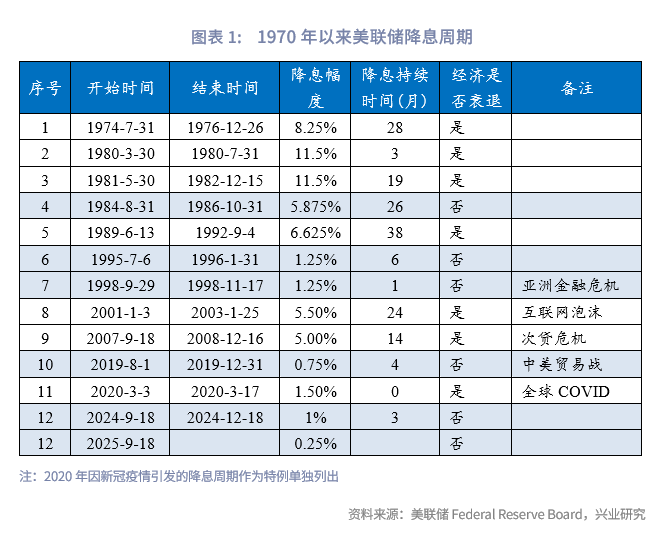
Core Viewpoint - The recent Federal Reserve interest rate cut on September 18, 2024, is set against a complex macroeconomic backdrop, including risks of stagflation in the U.S. and misalignment in the economic cycles of China and the U.S., suggesting that the Hong Kong stock market may not replicate historical trends but instead exhibit significant structural differentiation [1][2]. Group 1: Historical Context and Market Behavior - Historical experience indicates that during Fed rate cut cycles, the Hong Kong stock market typically shows a "preventive rate cut rally" or a "recessionary rate cut decline" pattern [1]. - In terms of market style, the Hang Seng Technology Index has demonstrated a "high win rate and high return" characteristic during preventive rate cut cycles, while other styles have not shown independent trends [1][2]. - Industry-wise, defensive sectors like utilities and consumer staples tend to perform better during recessionary rate cuts, while high-growth sectors such as technology and pharmaceuticals excel during preventive rate cuts [1][2][3]. Group 2: Current Economic Landscape - The current macroeconomic environment is more complex than historical experiences, with the U.S. economy facing stagflation risks and ongoing misalignment with China's economic cycle, making it difficult for the Hong Kong market to follow a straightforward trend [2][3]. - The upcoming October monetary policy meeting is crucial for assessing the future pace and intensity of rate cuts, influenced by various structural variables, including political pressures and the ongoing AI industry revolution [3][4]. Group 3: Future Outlook and Scenarios - The performance of the Hong Kong stock market in the next one to two quarters will depend not only on the Fed's rate cut path but also on the recovery process of the Chinese economy [2][52]. - Three potential scenarios are outlined: 1. **Baseline Scenario**: Gradual Fed rate cuts with a moderate recovery in the Chinese economy, favoring growth-sensitive sectors [52][53]. 2. **Optimistic Scenario**: More aggressive Fed cuts without triggering recession fears, leading to a favorable liquidity environment for growth stocks [55]. 3. **Pessimistic Scenario**: Fed pauses or slows rate cuts due to persistent inflation, putting pressure on the Hong Kong market, which will depend heavily on the recovery of the Chinese economy [56]. Group 4: Structural Opportunities - The analysis indicates that different types of rate cut cycles lead to distinct long-term performances in the Hong Kong market, with preventive rate cuts generally resulting in positive returns for the Hang Seng Index [9][10]. - The Hang Seng Technology Index has shown superior performance during preventive rate cuts, benefiting from lower discount rates and improved financing conditions [12][13]. - Defensive sectors tend to outperform during recessionary rate cuts, while growth sectors thrive in preventive cut environments, highlighting the importance of sector selection in investment strategies [13][14].

英伟达,重大宣布!
证券时报· 2025-08-25 03:57
Core Viewpoint - NVIDIA has announced the launch of the Spectrum-XGS Ethernet technology, aimed at connecting distributed data centers to create an AI super factory with a computing capacity of hundreds of billions [1][3][4] Group 1: Spectrum-XGS Ethernet Technology - The Spectrum-XGS Ethernet technology is part of the NVIDIA Spectrum-X Ethernet platform and addresses the limitations of existing Ethernet infrastructure, which has high latency and unpredictable performance [3] - This technology introduces a "scale-across" infrastructure, which is considered the third pillar of AI computing, alongside vertical and horizontal scaling, enabling the integration of multiple distributed data centers into a massive AI super factory [3][4] - Key features of Spectrum-XGS Ethernet include adaptive congestion control, improved latency management, and an end-to-end telemetry system to ensure predictable performance across geographically dispersed clusters [3][4] Group 2: Upcoming Robotics Product - NVIDIA's robotics account teased a new product, referred to as a "new brain" for robots, set to be unveiled on August 25, 2025 [5][6] - The teaser included a video showing a humanoid robot interacting with a gift box, suggesting that the new brain will be compatible with various humanoid robot models [6][7] - NVIDIA has been deepening its strategic focus on robotics, with CEO Jensen Huang emphasizing that the next wave of AI will be in the form of physical AI, which involves robots that can understand and interact with the physical world [8][9]

ETF盘中资讯|金融科技ETF(159851)午后涨1.73%触及历史高点!指南针涨超6%创新高,机构:牛市初期金融IT弹性最大
Sou Hu Cai Jing· 2025-08-13 06:01
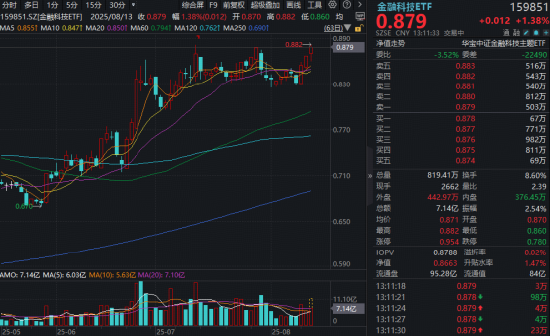
Core Viewpoint - The financial technology sector is experiencing strong performance, with significant increases in stock prices and ETF values, indicating a bullish trend in the market [1][2][3][4]. Group 1: Financial Technology Sector Performance - The China Securities Financial Technology Theme Index rose over 1.5%, with leading stocks such as Digital Certification up over 10% and Hengbao Co. up over 8% [1]. - The Financial Technology ETF (159851) reached a historical high, with a price increase of 1.73% and a trading volume exceeding 700 million CNY, showing a notable increase in liquidity [2][4]. Group 2: Market Dynamics and Investor Behavior - Increased market participation and trading volume, along with a rise in personal investor software usage and improved institutional performance, are driving the fundamentals of the financial IT sector [3]. - The financial IT sector is characterized by its dual attributes of technology and finance, benefiting from enhanced liquidity and risk appetite, which contribute to significant valuation increases [3]. Group 3: Catalysts for Growth - Key catalysts for the financial IT sector's growth include technological penetration, business demand, and policy incentives, with historical performance during previous bull markets highlighting its potential [3]. - The transition from the mobile internet era to the AI era is expected to further propel the financial IT sector, with large language models playing a crucial role in driving demand and innovation [3]. Group 4: Investment Opportunities - Investors are encouraged to focus on the Financial Technology ETF (159851) and its associated funds, which comprehensively cover various popular themes such as internet brokerage, financial IT, cross-border payments, and AI applications [4]. - As of August 8, the Financial Technology ETF had a scale exceeding 8 billion CNY, with an average daily trading volume of over 600 million CNY, indicating strong market interest and liquidity [4].

金融科技ETF(159851)午后涨1.73%触及历史高点!指南针涨超6%创新高,机构:牛市初期金融IT弹性最大
Xin Lang Ji Jin· 2025-08-13 06:01
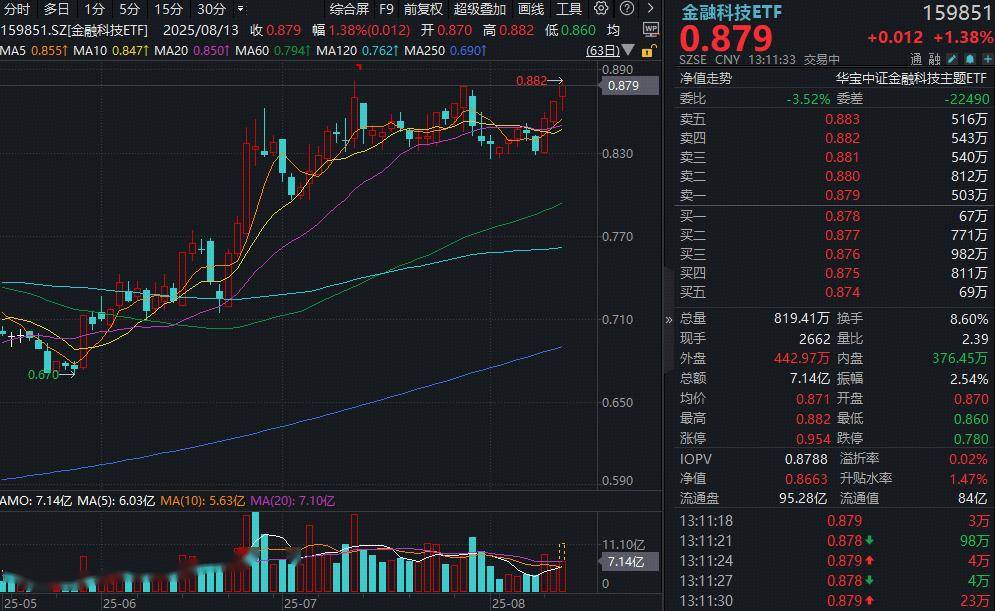
Group 1 - The core viewpoint of the articles highlights the strong performance of the fintech sector, with the China Securities Financial Technology Theme Index rising over 1.5% and individual stocks like Digital Certification and Hengbao Co. leading the gains [1][3] - The financial IT sector is characterized by significant elasticity during the early stages of a bull market, with notable price increases and valuation expansions driven by heightened risk appetite [3] - The financial IT sector benefits from a combination of technological penetration, business demand, and policy incentives, with the rise of internet finance and increased investment from financial institutions acting as key growth drivers [3] Group 2 - The financial technology ETF (159851) is recommended for investment, with a scale exceeding 8 billion yuan and an average daily trading volume of over 600 million yuan, indicating strong liquidity and market interest [4] - The ETF covers a wide range of themes including internet brokerage, financial IT, cross-border payments, AI applications, and Huawei's HarmonyOS, making it a comprehensive investment vehicle in the fintech space [4] - The articles suggest that the ongoing transition from the mobile internet era to the AI era will further propel the financial IT sector, with large language models expected to play a crucial role in driving demand and innovation [3]