
AI产业革命

Search documents
英伟达,营收大增
Guo Ji Jin Rong Bao· 2026-02-26 00:48
Core Viewpoint - Nvidia reported strong financial results for Q4 and the full fiscal year 2026, indicating robust demand for AI chips and alleviating concerns about an "AI bubble" in the market [1] Financial Performance - Q4 revenue reached $68.1 billion, a 73% year-over-year increase, surpassing market expectations of $65.684 billion and up from $39.331 billion in the same quarter last year [1] - Full fiscal year 2026 revenue was $215.9 billion, a 65% year-over-year growth, marking a historical high [1] Guidance and Market Reaction - Nvidia projected Q1 revenue for fiscal year 2027 to be between $76.44 billion and $79.56 billion, exceeding market estimates of $72.78 billion [1] - Following the earnings report and guidance, Nvidia's stock surged over 4% in after-hours trading, while the Nasdaq index fell by 0.4% [1] Industry Insights - Analysts noted that Nvidia's results and guidance could ease the prevailing "AI bubble" concerns, as demand for Nvidia's AI chips remains strong [1] - Nvidia's CEO, Jensen Huang, emphasized the exponential growth in computing demand and the rapid investment by enterprises in AI computing, which he described as the driving force behind the AI industry revolution [1]

十大券商一周策略:A股将迎“春季躁动”胜率最高阶段,涨价仍是核心配置线索,重视关税税率下降后出口链修复机会
Jin Rong Jie· 2026-02-24 00:10
Group 1 - The core investment theme post-Spring Festival revolves around "price increases" and "revaluation of physical assets," particularly in resource, chemical, and midstream manufacturing sectors, leveraging China's pricing power amid global uncertainties [1][2] - The technology sector, particularly driven by AI, remains a key focus, with sub-sectors like computing power, applications, and robotics expected to remain active due to industrial catalysts [1][2] - The recovery of export chains, non-bank financials, and certain consumer and real estate chains are seen as important supplements to market trends under the backdrop of internal and external demand recovery [1] Group 2 - CITIC Securities emphasizes that price increases are a core configuration clue for Q1, with a focus on sectors like chemicals, non-ferrous metals, power equipment, and new energy, while also increasing exposure to undervalued insurance and brokerage stocks [2] - Historical data indicates that February and the period around the Spring Festival are strong for market movements, with small-cap stocks showing a 100% probability of rising from the Spring Festival to the Two Sessions [3] - Guojin Securities highlights the importance of balancing global physical assets against Chinese assets, recommending commodities like copper, aluminum, and oil, as well as sectors with global comparative advantages like equipment exports and domestic manufacturing [4] Group 3 - Industrial sectors experiencing structural price increases due to supply-demand gaps are primarily in midstream materials and manufacturing, with a focus on chemicals, steel, and high-end manufacturing [5] - The potential for recovery in the export chain is noted, particularly in industries with significant exposure to the U.S. market that will benefit from reduced tariffs [5] - The policy uncertainty surrounding tariffs and trade is expected to favor gold as a risk hedge, with market participants anticipating potential shifts in U.S. trade policy [6] Group 4 - Attention is drawn to the post-holiday inventory replenishment in commodities, with a continued positive outlook on technology applications, particularly in semiconductors and AI [7] - Quantum technology is highlighted as a sector receiving dual catalysts from policy and technological advancements, with significant developments in quantum key distribution networks [8] - The AI industry revolution is identified as a key investment theme, focusing on computing power, storage, and applications, with a strong emphasis on the performance of high-growth sectors [9] Group 5 - Localized opportunities are expected in AI applications linked to overseas trends and robotics associated with the Spring Festival, with a cautious approach to market movements anticipated [10] - The current bull market logic remains intact, with a recommendation for investors to maintain confidence despite short-term volatility, focusing on sectors with high securities ratios [11]
马年开市在即,券商集体看多A股!这些板块值得关注
Nan Fang Du Shi Bao· 2026-02-23 14:28
Core Viewpoint - The A-share market is expected to experience a "slow bull" trend in the Year of the Horse, driven by corporate earnings recovery and a shift from valuation-driven to profit-driven growth, with a focus on technology and domestic demand recovery [1][2][3]. Market Outlook - Historical data shows a 60% probability of the Shanghai Composite Index and ChiNext Index rising on the first trading day after the Spring Festival, indicating a significant "calendar effect" [2]. - Major brokerages have a unified outlook on the A-share market, predicting a stable opening, oscillating upward trend, and a gradual increase in index levels [2]. - Corporate earnings are anticipated to recover, with a projected growth rate of 5%-10% for non-financial A-share companies by 2026, supported by new capital inflows from insurance, foreign investment, and household savings [2][3]. Investment Themes - The focus for investment in the Year of the Horse is on four main themes: technology growth, domestic demand recovery, high-end manufacturing, and low-valuation value stocks [4]. - The AI industry chain is highlighted as a primary investment direction, with expectations that 2026 will mark the year of AI application implementation, expanding from upstream computing power to downstream applications [4][5]. - The robotics sector is expected to see significant growth, with 2026 being defined as the "year of mass production" for humanoid robots, driven by policy support and accelerated commercialization [5]. Sector-Specific Insights - The AI sector is projected to benefit from advancements in computing power, hardware, and applications, with a focus on AI giants' strategic positioning [4][5]. - The low-altitude economy and commercial aerospace are identified as emerging sectors with clear policy direction, potentially becoming "dark horse tracks" in the market [5]. - The robotics industry is anticipated to transition from experimental phases to practical applications, with significant production expected from leading companies in 2026 [5].
沪指收复4100点 逾4600只股飘红
Xin Lang Cai Jing· 2026-02-09 17:11
Group 1 - The A-share market showed strong performance on Monday, with all three major indices rising, and the Shanghai Composite Index reclaiming the 4100-point mark, closing up 1.41% at 4123.09 points [1] - The trading volume in the Shanghai, Shenzhen, and Beijing markets reached 2.27 trillion yuan, an increase of 106.7 billion yuan compared to the previous trading day [1] - Almost all industry sectors experienced gains, with notable increases in cultural media, photovoltaic equipment, glass fiber, internet services, communication equipment, electronic chemicals, small metals, power equipment, and semiconductors, while the mining and gas sectors declined [1] Group 2 - According to CICC's latest report, commodities are benefiting from global capital diversification, with valuations in energy and chemicals potentially at the bottom range, indicating that the structural market for commodities may not be over yet [1] - Tianfeng Securities identified three main investment directions based on economic recovery and market liquidity: opportunities in AI industry revolution, the "stronger get stronger" trend in the economic recovery, and the potential for style rotation and bottom reversal in certain sectors [2] - Galaxy Securities noted that the current A-share market reflects the dynamic relationship between macroeconomic totals and the A-share market, with signs of economic recovery expected by 2025, while the market shows a significant "calendar effect" around the Spring Festival [3]
天风证券:建议投资主线降维为三个方向
Jin Rong Jie· 2026-02-09 00:37
Group 1 - The core investment themes are identified as three directions: 1) Opportunities in the AI industry revolution focusing on computing power, storage, electricity, and applications [1] - The economic recovery and market liquidity suggest a "stronger gets stronger" bull market style, with cyclical stocks likely to perform better in the latter half of the cycle [1] - The concept of odds thinking is introduced, considering the potential for style rotation and bottom reversal, particularly in sectors like food and beverage, agriculture, social services, and pharmaceuticals that have underperformed for three consecutive years but have a higher probability of outperforming in the fourth year [1] Group 2 - The progress of AI industry trends depends on breakthroughs in both AI applications and consumer adoption, emphasizing the importance of AI giants' strategies [1] - In the early stages of a bull market, funds tend to favor a few high-growth sectors, while later stages see a focus on main themes, making it harder for new funds to achieve profits [1] - Cyclical stocks are characterized by low valuations and high beta, which can lead to better performance as the fundamentals improve, attracting incremental capital [1]

节前A股震荡分化 如何调仓换股?
Guo Ji Jin Rong Bao· 2026-02-05 14:37
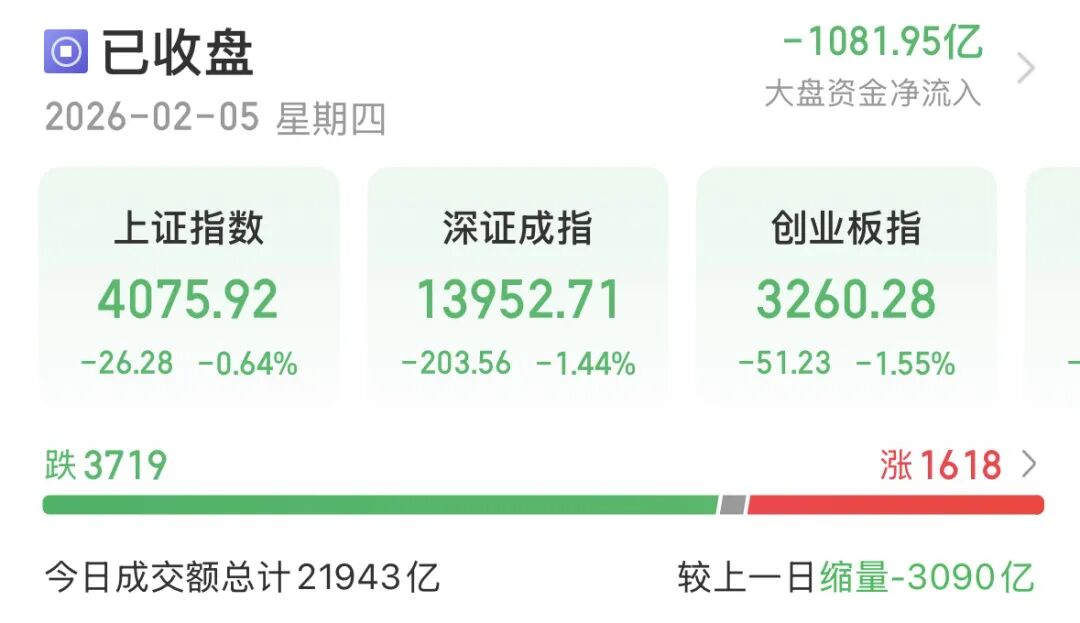
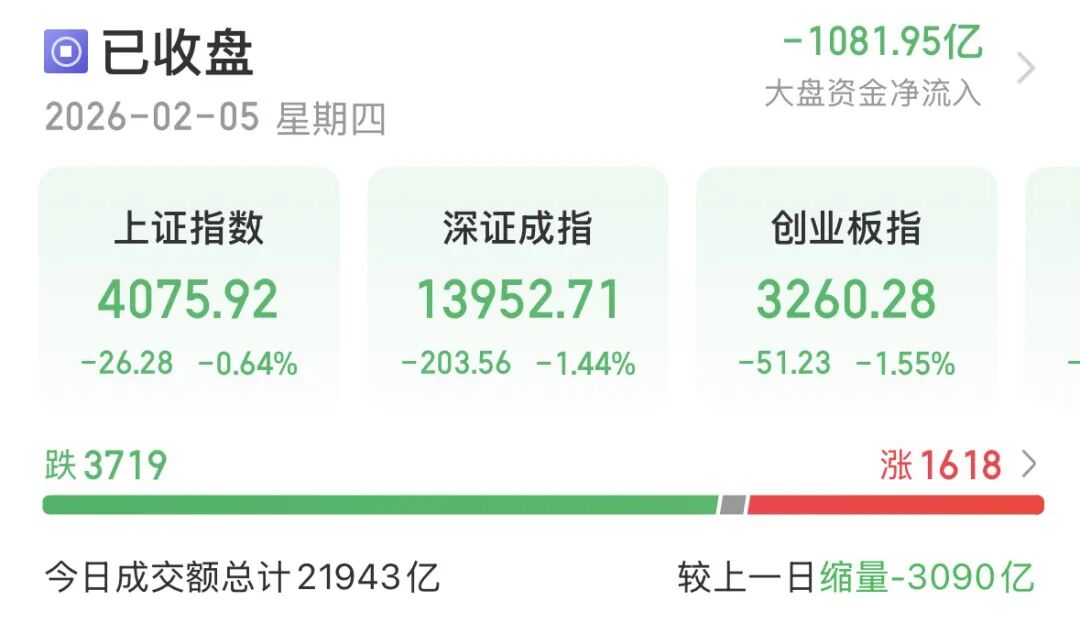
Core Viewpoint - The A-share market continues to experience a downward trend, with significant selling pressure on resource and technology stocks, while consumer staples like liquor and banking stocks show relative resilience [1][3][11]. Market Performance - The A-share market saw a notable decline, with the Shanghai Composite Index down 0.64% to 4075.92 points, and the ChiNext Index down 1.55% to 3260.28 points. The total trading volume decreased to 2.19 trillion yuan, a reduction of 309 billion yuan from previous days [4][5]. - A total of 3719 stocks closed lower, with 23 hitting the daily limit down, while 1618 stocks rose, with 56 hitting the daily limit up. Notable declines included New Yisheng and Zijin Mining, both down over 4% [5][6]. Sector Analysis - Defensive sectors such as consumer staples, banking, and retail showed positive performance, with the beauty care sector up over 3% and food and beverage stocks also gaining [8][9]. - Conversely, resource stocks, including non-ferrous metals and coal, faced significant declines, with the non-ferrous metals sector down 4.57% and electric power equipment down 3.41% [10][11]. Investment Strategy - Analysts suggest maintaining a moderate cash position and selectively accumulating positions in the liquor sector, while advising against aggressive bottom-fishing in technology and resource stocks [3][12]. - The market is expected to remain volatile as investors adopt a cautious stance ahead of the upcoming holiday, with a focus on defensive strategies [11][12]. Future Outlook - The market is likely to experience a "shock and bottom" phase as it approaches the holiday, with limited upside potential due to reduced trading volumes and cautious investor sentiment [15][19]. - Long-term investment opportunities may arise post-holiday as liquidity returns and policy expectations improve, particularly in sectors with strong fundamentals [17][19].

节前A股震荡分化,如何调仓换股?
Guo Ji Jin Rong Bao· 2026-02-05 14:14
Core Viewpoint - The A-share market continues to experience a downward trend, with significant selling pressure on resource and technology stocks, while consumer staples like liquor and banking stocks show relative resilience [1][3][11]. Market Performance - The A-share market saw a notable decline, with the Shanghai Composite Index down 0.64% to 4075.92 points, and the ChiNext Index down 1.55% to 3260.28 points. The total trading volume decreased significantly to 2.19 trillion yuan, down 309 billion yuan from previous days [4][5]. - A total of 3719 stocks closed lower, with 23 hitting the daily limit down, while 1618 stocks rose, with 56 hitting the daily limit up [5][10]. Sector Analysis - Consumer sectors such as beauty care, food and beverage, and retail showed positive performance, with beauty care up 3.21% and food and beverage up 1.31% [8][9]. - Conversely, resource stocks, including metals and coal, faced significant declines, with the non-ferrous metals sector down 4.57% and electric equipment down 3.41% [10][11]. Investor Sentiment - Investor sentiment is cautious ahead of the holiday, with a shift in funds from high-performing sectors like technology and resources to defensive sectors such as banking and consumer staples [11][12]. - The market is characterized by a "reduction game" due to a lack of incremental capital, leading to a focus on stocks with strong performance and industry logic [12][14]. Recommendations - Investors are advised to maintain a moderate position and retain cash flexibility, with suggestions to gradually accumulate positions in the liquor sector while avoiding aggressive bottom-fishing in technology and resource stocks [3][19]. - The liquor sector is highlighted as a potential defensive investment due to its strong fundamentals and increasing demand ahead of the Spring Festival [19]. Future Outlook - The market is expected to remain in a consolidation phase with limited upward momentum due to reduced trading volume and cautious investor behavior [15][16]. - There is potential for recovery post-holiday as liquidity returns and policy expectations improve, but investors should remain vigilant and avoid high-risk stocks without clear performance indicators [14][18].

指数继续分化,大小盘个股变盘!题材有变化,还有哪些投资机会?
Sou Hu Cai Jing· 2026-02-04 07:17
Group 1 - The investment strategy is focused on three main directions: 1) Opportunities in technology related to AI, including computing power, storage, electricity, and applications, 2) Economic recovery leading to a "stronger stronger" market style, with cyclical stocks likely to perform better in the latter half, 3) Considering the potential for style rotation and bottom reversal in sectors like food and beverage, agriculture, social services, and pharmaceuticals, which have underperformed for three consecutive years but have a higher probability of outperforming in the fourth year [1] - The AI industry trend's progress depends on breakthroughs in both application and consumption ends, with a focus on the Hang Seng Internet sector [1] - In the early stages of a bull market, funds prefer high-growth sectors, while in later stages, they concentrate on main lines, making it harder for new funds to profit, whereas cyclical stocks, with low valuations and high beta, are likely to show good performance as fundamentals improve [1] Group 2 - The profitability of bulk chemicals is expected to hit a ten-year low by the second half of 2025 due to weak demand and the end of supply-side increments, with industry-wide losses or minimal profits observed in petrochemical products [3] - The fixed asset completion growth rate in the chemical raw materials and products industry is projected to turn negative starting June 2025, with limited new capacity expected in 2026-2027 [3] - The chemical raw materials and products sector is at a turning point from active destocking to passive restocking, with downstream textile and plastic products experiencing continuous inventory declines [3] Group 3 - The strategic importance of global rare earth resources is increasing, entering a new era of high-quality development, with supply constraints and rising demand from sectors like electric vehicles and robotics expected to drive long-term growth [6] - A significant outflow of funds from bank stocks has been noted, with A-shares and H-shares showing differing performances, indicating that A-share banks are more affected by fund outflows and style influences [6] - The investment value of banks in 2026 is expected to stem from a reassessment of systemic risks and the stable return characteristics of bank equities under the RMB asset allocation framework [6]

国泰海通|策略前瞻:美联储换帅前瞻:历史复盘与影响展望
国泰海通证券研究· 2026-01-27 14:03
Core Viewpoint - The current global easing cycle is leading to increased correlation among various asset classes, and the change in the Federal Reserve's leadership is expected to reshape the global monetary policy path and market landscape [2] Group 1: Global Market Correlation - Since the Federal Reserve initiated a rate-cutting cycle in September 2024, major economies like China and Europe have also moved towards easing, creating a global liquidity environment. This phenomenon is fundamentally a "debt restructuring" aimed at reducing funding costs and alleviating government debt servicing pressures [4][10] - The equity markets have shown synchronized strength, with indices such as the Nasdaq 100 and Nikkei 225 leading the gains, while emerging market indices like the Shanghai Composite and Ho Chi Minh Index have also performed well [4][14] - Precious and industrial metal prices have risen in tandem, indicating a strong correlation between commodity and equity markets, driven by the pricing of easing trades [4] Group 2: Federal Reserve's Institutional Development and Leadership Change - The Federal Reserve has undergone significant changes over the past 40 years, transitioning from secretive decision-making to a more transparent and data-driven approach. This includes extensive communication with the market prior to policy announcements and the establishment of economic databases to support decision-making [5][22] - The process of selecting a new Federal Reserve Chair involves a nomination by the President followed by a Senate confirmation hearing, which can introduce uncertainty regarding the independence of the Fed's decision-making [24][35] Group 3: Potential Candidates and Policy Attitudes - The current candidates for the Federal Reserve Chair include Kevin Walsh, Rick Reed, Christopher Waller, and Kevin Hassett, with Walsh and Reed being frontrunners. The candidates generally lean towards dovish policies, suggesting a high probability of continued easing and high liquidity in the global environment [6][30] - Each candidate's background and policy stance vary, with Walsh having significant experience within the Fed and strong market trust, while Reed is noted for his independence and clear interest rate targets [33][34] Group 4: Impact of the 2026 Federal Reserve Leadership Change - The new chair is likely to maintain a loose monetary policy, with a continued weak dollar trend. The candidates' differing views on interest rate cuts and balance sheet reduction will significantly influence market dynamics [37] - For precious metals, a potential Hassett appointment could raise concerns about the Fed's independence, while Walsh and Reed's dovish stances would likely support gold and silver prices [38] - In equity markets, while all candidates show some inclination towards tightening, the overall sentiment remains positive for global equities, particularly if Walsh, Reed, or Waller are appointed [39][42]

美联储换帅前瞻:历史复盘与影响展望
GUOTAI HAITONG SECURITIES· 2026-01-27 12:09
Group 1 - The report highlights that the correlation among global capital markets has significantly increased since the Federal Reserve initiated a rate-cutting cycle in September 2024, with major economies like China and Europe also pursuing similar monetary easing policies [7][10][11] - The easing monetary policies have led to a strong performance in equity markets, with indices such as the Nasdaq 100 and Nikkei 225 showing substantial gains, while emerging markets like the Shanghai Composite and Ho Chi Minh indices have also performed well [12][14] - The report indicates that the current global easing cycle is fundamentally a "debt reduction action," aimed at lowering funding costs and alleviating government debt servicing pressures, which has resulted in a synchronized upward trend in various asset classes [10][11] Group 2 - The Federal Reserve's operational mechanisms have evolved over the past 40 years, transitioning from secretive decision-making to a more transparent and data-driven approach, enhancing market communication and expectation management [19][20] - The report outlines the general process for selecting a new Federal Reserve Chair, which involves presidential nomination followed by Senate confirmation, emphasizing the potential for political influences on monetary policy [22][24] - The report identifies four main candidates for the upcoming Federal Reserve Chair position, noting their varying degrees of dovishness and potential impacts on monetary policy, with Kevin Walsh and Rick Reed being prominent contenders [28][31][32] Group 3 - The report anticipates that the new Federal Reserve Chair will likely maintain a dovish monetary policy stance, which could lead to a weaker dollar and continued support for precious metals and equity markets [39][40][41] - It discusses the potential impacts of each candidate on the dollar index, precious metals, and global equity markets, suggesting that regardless of who is appointed, the overall market sentiment may remain positive due to expected rate cuts [41][43] - The report emphasizes that the ongoing economic transformation in China, coupled with favorable liquidity conditions and regulatory reforms, supports the continuation of a bullish trend in the Chinese equity market [44]