AI音乐

Search documents
星空华文,一度放量大跌30%
Di Yi Cai Jing Zi Xun· 2025-11-17 03:23
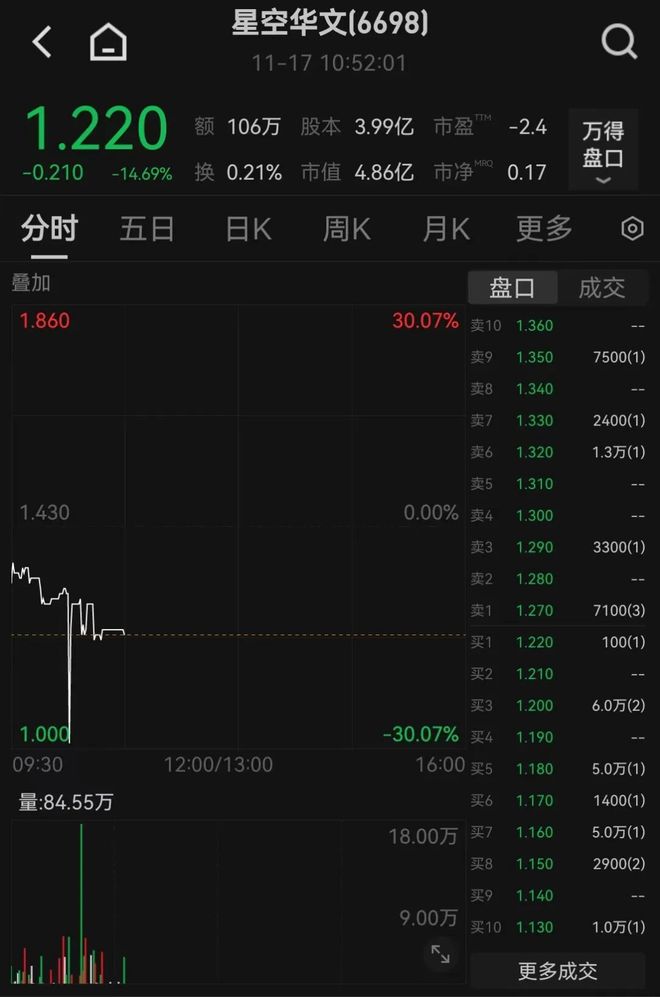
Group 1 - The stock of Starry Sky Chinese (06698.HK) experienced a significant drop, falling over 30% at one point and currently down over 14% with a trading volume exceeding 1 million Hong Kong dollars [1][2] - As of November 17, the stock price was reported at 1.220 HKD, with a market capitalization of 486 million HKD and a price-to-earnings ratio of -2.4 [2] - The stock's trading activity showed a drastic decline, with a peak drop of 30.07% noted during the trading session [2] Group 2 - On November 14, Starry Sky Chinese announced a joint venture agreement to establish a company focused on AI music business, with its subsidiary Shanghai Jiuwu Yisheng investing 115 million yuan [3] - The joint venture will have a registered capital of 320,000 yuan, with the total investment from Shanghai Jiuwu Yisheng and its partner amounting to 2.59 billion yuan [3] - After the establishment of the joint venture, Shanghai Jiuwu Yisheng will hold a 32% stake, while its partner will hold 68% [3]

星空华文,一度放量大跌30%
第一财经· 2025-11-17 03:13
Core Viewpoint - The company, 星空华文, has announced the establishment of a joint venture to operate AI music business, indicating a strategic move into the technology-driven entertainment sector [2]. Group 1: Joint Venture Details - On November 14, 星空华文 announced that its indirect wholly-owned subsidiary, 上海久吾一生, has signed a joint venture agreement with partners to establish a company focused on AI music [2]. - 上海久吾一生 will invest 115 million yuan, with 320,000 yuan allocated as registered capital and the remaining 115 million yuan designated for capital reserves [2]. - The joint venture partners will invest 244 million yuan, with 680,000 yuan as registered capital and 244 million yuan for capital reserves [2]. - After the establishment of the joint venture, 上海久吾一生 will hold a 32% stake, while the partners will hold a 68% stake [2].

TME们的黄金时代,迎来AI终结者
3 6 Ke· 2025-11-14 11:16
Core Insights - The traditional business model of music streaming platforms, which relies on a vast library of copyrighted content and subscription fees, is facing structural collapse due to the rise of AI-generated music [1][3][4]. Group 1: Impact of AI on Copyright - The scarcity of music copyrights, which has allowed platforms like TME and NetEase Cloud to charge subscription fees, is being undermined by AI music, which can produce industry-level content without the need for traditional music production processes [5][6]. - AI-generated music does not depend on record labels or copyright institutions, leading to a situation where the value of music copyrights diminishes, threatening the core business model of platforms like TME and Spotify [9][10]. Group 2: User Behavior Shift - The transition from "listening" to "generating" music means that TME is now competing not only with similar platforms but also with tech companies that excel in disruptive innovation and have access to larger user bases [10][12]. - TME's recent performance shows a decline in active users and a slowdown in the growth of paying subscribers, indicating a shift in user behavior towards AI-generated music [10][11]. - The traditional music consumption path is being replaced by a new model where users can generate music based on their emotions or preferences, which could lead to a decline in the need for subscription-based streaming services [16][19]. Group 3: Future of the Music Industry - The future music industry is likely to be dominated by models and algorithms that can provide unlimited personalized content, marginalizing platforms that cling to outdated business models [22]. - The emergence of AI music signifies the end of an era dominated by copyright scarcity, suggesting a fundamental shift in the music industry's structure [19][22].


星空华文(06698.HK)联合北京无界音场成立AI音乐合营公司
Ge Long Hui· 2025-11-14 00:08
Group 1 - The core point of the announcement is the establishment of a joint venture between Shanghai Jiuwu Yisheng and Beijing Wujie Yinchang Cultural Media Co., Ltd. to operate AI music business in China [1][2] - Shanghai Jiuwu Yisheng will invest a total of RMB 115 million, with RMB 320,000 as registered capital and RMB 114.68 million allocated to capital reserves [1] - The joint venture will be owned 32% by Shanghai Jiuwu Yisheng and 68% by the joint venture partner, making it a non-wholly owned subsidiary of the partner [1] Group 2 - The joint venture will focus on AI music services, including AI music creation, artist management, music library operations, AI concerts, and AI music education [2] - The partner company has a strong background in organizing cultural and artistic events, leveraging a "technology + content + ecosystem" advantage to complement the group's strengths [2] - The collaboration aims to integrate both parties' content and technological capabilities to achieve data-driven, large-scale personalized AI music creation, marking a strategic move in the AI music industry [2]
Suno V5让整个B站开始文艺复兴了。
数字生命卡兹克· 2025-11-04 01:33
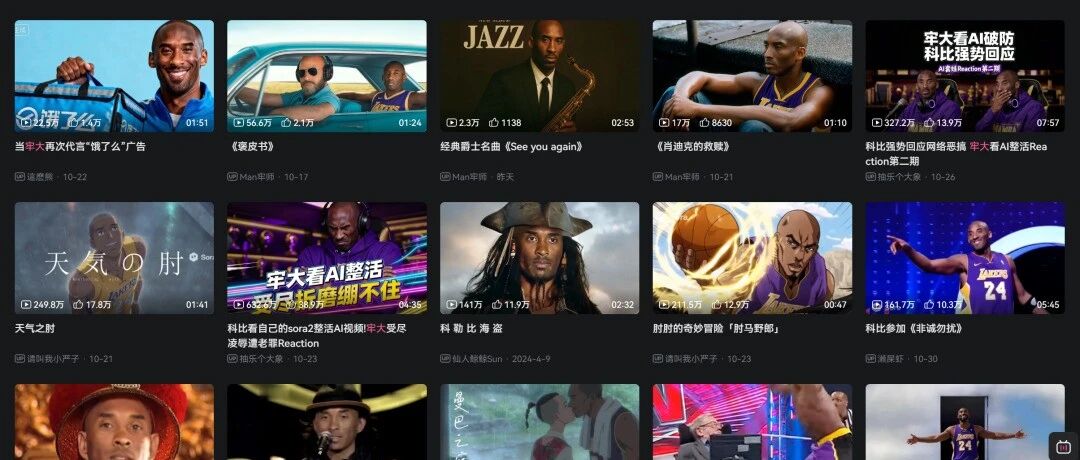
Core Viewpoint - The article discusses the resurgence of creativity in the "Kichiku" (鬼畜) genre on Bilibili, driven by advancements in AI music generation, particularly the Suno V5 model, which has enabled creators to produce high-quality content with ease [44][46][48]. Group 1: Resurgence of Kichiku Content - The Kichiku genre on Bilibili, once thriving, has seen a decline in creativity over the years [11][12]. - Recently, there has been a notable revival, with creators producing innovative and engaging Kichiku music, marking a "cultural renaissance" on the platform [24][43]. - The emergence of AI tools like Suno V5 has significantly lowered the barriers for creators, allowing them to focus on artistic expression rather than technical skills [44][48]. Group 2: Impact of AI on Music Creation - The Suno V5 model has been highlighted as a game-changer, enabling creators to produce music that surpasses many mainstream songs in quality [46][47]. - The ease of use of AI tools allows individuals without extensive musical training to create complex compositions quickly [51][90]. - The article emphasizes that the AI tools provide a platform for expressing emotions and creativity, reminiscent of the original spirit of Kichiku [100][101]. Group 3: Community and Cultural Significance - The article reflects on the nostalgia associated with Kichiku content, noting that despite changes in creators' lives, the essence of sharing joy through content remains [104][105]. - The community aspect of Bilibili continues to thrive, with users engaging in shared experiences and laughter, reminiscent of earlier days [102][104]. - The revival of Kichiku content is seen as a bridge connecting past and present, allowing older users to relive their youthful experiences while engaging with new creations [101][105].
奥特曼抢走小扎印钞机,Meta「占领」OpenAI,20%都是前同事
3 6 Ke· 2025-10-27 00:46
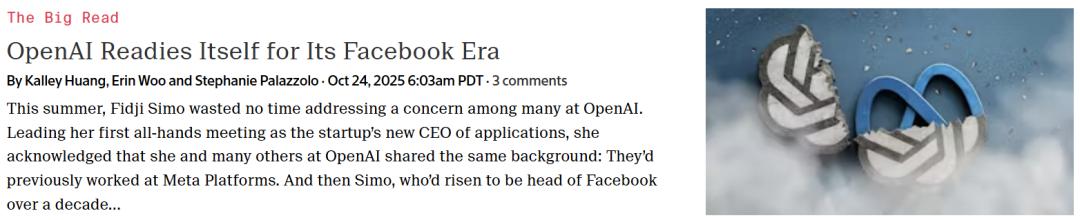
Core Insights - OpenAI is increasingly adopting a business model similar to Meta, focusing on monetization through advertising and commercial applications [3][20][55] - The influx of former Meta executives into OpenAI's leadership is reshaping its strategic direction, emphasizing product development and market strategies [4][10][12] Group 1: Leadership and Structure - OpenAI has hired a significant number of former Meta employees, with approximately 630 out of 3000 employees (20%) having a Meta background [7][18] - Key leadership positions at OpenAI are now held by former Meta executives, including Fidji Simo as CEO of Applications and Vijaye Raji as Chief Technology Officer of Applications [8][12] - The company is structured into three main lines: product and management, technology, and strategy and marketing, all influenced by the experience of former Meta leaders [10][11] Group 2: Shift Towards Commercialization - OpenAI is transitioning from a pure research lab to a more commercial entity, with plans to explore advertising and new applications like the video social app Sora [20][29] - The company aims to increase user engagement, targeting a goal of reaching one billion weekly active users for ChatGPT [24][35] - OpenAI is investigating how to integrate advertising into its offerings, with a focus on user benefit and potential customization based on user data [31][34] Group 3: New Initiatives and Market Expansion - OpenAI is venturing into the music generation space, collaborating with prestigious institutions to develop AI capable of creating music [39][42] - The company is exploring the integration of music generation tools with existing products like Sora, aiming to enhance user experience in content creation [45][51] - OpenAI's expansion into music follows a trend of significant growth in the AI music market, with competitors already achieving substantial revenue [48][55]

腾讯研究院AI速递 20251027
腾讯研究院· 2025-10-26 16:41
Group 1: ChatGPT Enterprise Version Updates - The new "Company Knowledge" feature in ChatGPT Enterprise allows integration with internal tools like Slack, Google Drive, GitHub, and SharePoint for multi-source retrieval and comprehensive answers [1] - This feature is available only to Business, Enterprise, and Edu versions, utilizing a specialized GPT-5 for cross-data source retrieval and synthesis, supporting multiple searches and time filtering [1] - Enterprise administrators can control application connection permissions, ensuring ChatGPT only accesses content the user has permission for, with OpenAI not using data for model training, and supporting security measures like SSO and SCIM [1] Group 2: OpenAI's AI Music Commercialization - OpenAI has partnered with Juilliard School to label a vast amount of sheet music for training music models, actively exploring the AI music B2B market, particularly in advertising [2] - Suno, leveraging a subscription model, achieved an ARR of $150 million this year with a gross margin exceeding 60%, indicating a lucrative market that OpenAI aims to enter [2] - OpenAI previously launched MuseNet in 2019 and Jukebox in 2020, and this renewed focus on music comes after hitting a wall with Scaling Law, seeking new product directions that can generate revenue [2] Group 3: Tencent's ima 2.0 Upgrade - Tencent officially released ima 2.0, introducing a "Task Mode" that integrates agent capabilities into a personal knowledge base, capable of understanding complex tasks and autonomously breaking down steps to complete processes [3] - The new version includes AI-generated structured summaries, supports parallel multitasking, and collaborative sharing, having served over 20 industries with a cumulative knowledge base of 200 million documents [3] - It supports intelligent generation of podcast content, customizable roles, and voice tones, applicable in diverse scenarios such as education, marketing, and personal creation, with a planned official launch on October 27 [3] Group 4: Alibaba's Quark AI Glasses Launch - Alibaba's first self-developed AI glasses, Quark AI glasses, officially went on sale, with a minimum price of 3,329 yuan for 88VIP members, quickly reaching the top of the Tmall smart glasses real-time rankings within half a day [4] - The glasses are equipped with Qualcomm AR1 chip and Hengxuan BES2800 co-processor, integrating various Alibaba ecosystem services, and feature a dual-battery and replaceable battery design for 24-hour battery life [4] - They include dual optical machines for binocular display and custom waveguide lenses, achieving a "prescription integration + waveguide display" solution, with frame width and thickness 40% thinner than mainstream products [4] Group 5: Japan's Call for OpenAI's Sora 2 - Japan's Minister of Intellectual Property Strategy, Minoru Kikuichi, publicly urged OpenAI to avoid copyright infringement when launching Sora 2, emphasizing that manga and anime characters are "cultural treasures" of Japan [5][6] - This marks the first positive stance from a sovereign nation regarding Sora, as many Japanese anime characters were repurposed by AI, while Disney characters are less frequently infringed due to strong legal teams [6] - Japan has enacted the "Generative AI Promotion Law" to provide a policy basis for government intervention in AI issues, potentially using legal frameworks to constrain OpenAI's actions and demanding respect for the intellectual property system from the outset [6] Group 6: OpenAI Acquires SAI - OpenAI has acquired SAI, a company that developed a natural language interface for macOS, planning to integrate Sky's technology into ChatGPT and absorb a team of about 12 people [7] - All three co-founders of SAI have backgrounds at Apple, with the CEO previously founding Workflow, which evolved into Shortcuts after being acquired by Apple; Sky can "understand" screen content and perform operations on behalf of users [7] - This move suggests that OpenAI is not only interested in Sky's technology but is also paving the way for ChatGPT to enter the operating system space, causing concern for Microsoft, a major shareholder, which simultaneously released a new version of Copilot with 12 new features [7] Group 7: Yoshua Bengio's Milestone - Computer scientist Yoshua Bengio has become the first scientist to exceed 1 million citations on Google Scholar, recognized as one of the "three giants" of deep learning alongside Hinton and LeCun [8] - His notable works include the GAN paper co-authored with Goodfellow, which has over 100,000 citations, and the book "Deep Learning," co-authored with Hinton and LeCun, which has over 86,000 citations [8] - At 61 years old, Bengio continues to publish papers as the first author, transitioning from a pure scientist to an active advocate for ethics, leading the writing of AI safety reports and founding the non-profit organization LawZero [8] Group 8: Neuralink's Milestone in Artificial Vision - The journal Nature published research on the PRIMA artificial vision technology, which helped a 70-year-old AMD patient regain sight, led by Max Hodak, co-founder of Neuralink [9] - The PRIMA system consists of a photovoltaic retinal implant and special glasses, with an implant thickness comparable to a human hair, restoring functional central vision in 84% of patients and achieving a 0.2 logMAR level improvement in 80% of cases [9] - The device has been submitted for approval to European regulators, with plans for a launch next year, while the FDA approval process is also underway, with future iterations aiming for smaller pixels, higher efficiency, and color vision capabilities [9] Group 9: ChatGPT's Engagement Strategy - The Atlantic Monthly reported that ChatGPT employs a "chat bait" strategy, using continuous questioning to extend conversations indefinitely, making each interaction a "free labor" opportunity for training AI [10] - This strategy results in longer dialogues, which may lead to more personal data collection and increased product loyalty, but could also cause vulnerable individuals to fall into spirals of delusion or depression [10] - Meta is training AI bots to proactively message users to improve retention rates, while OpenAI has launched ChatGPT Pulse to break the passive response model, allowing AI to initiate conversations [10] Group 10: Future of Developers in AI Era - AWS Chief Evangelist Jeff Barr announced a shift from being a news blog author to focusing on deep technical practice, transitioning from a "narrator" in cloud computing to a "developer" in the AI era [12] - He believes that as AI agents take over implementation, the core value of developers will shift from "communicating with machines" to "communicating with people," predicting that successful developers will be more open and socially adept [12] - The work of developers in the AI era will transition from "primarily writing code" to "primarily reading and reviewing code," with the potential emergence of billion-dollar "solo unicorns" created by individual developers [12]
OpenAI放大招:进军音乐模型
财联社· 2025-10-25 14:40
Core Viewpoint - OpenAI is developing an AI music model in collaboration with students from the Juilliard School, aiming to enhance its AI ecosystem and user engagement through music generation capabilities [2][3]. Group 1: OpenAI's Music Model Development - OpenAI's engineers are working on annotating music scores to train the new AI music model, which can generate music based on text and audio prompts [2]. - The music model could allow users to create background music for short videos, significantly lowering the content creation barrier [2]. - OpenAI currently has over 800 million active users, and the music model is expected to further enhance user stickiness within its ecosystem [3]. Group 2: Commercial Potential and Integration - The music model has potential applications in both personal entertainment and commercial scenarios, such as aiding advertising companies in creating lyrics and melodies [4]. - OpenAI has previously launched music generation models like MuseNet and Jukebox, but these have not been integrated into ChatGPT or Sora due to technical and cost limitations [6]. Group 3: Global AI Music Competition - The advancement in computing power and model architecture has made music generation technology more practical, marking it as a new focus in the AI technology competition [7]. - Google has launched its second-generation music production model, Lyria, which aligns with OpenAI's commercial direction for its music model [7]. - Startups like Suno and Udio have successfully commercialized their AI music generation products, with Suno achieving an annual recurring revenue of $150 million, nearly quadrupling from the previous year [7]. Group 4: Emergence of Chinese AI Music Models - Chinese companies are rapidly developing their AI music models, with ByteDance's Seed-Music and Alibaba's InspireMusic being notable examples [8][9]. - Kunlun Wanwei released the world's first music reasoning model, Mureka O1, which outperformed Suno V4 in several performance metrics [10]. - Tencent AI Lab has also introduced the SongGeneration model, focusing on improving sound quality, musicality, and generation speed [11].

杭州又将迎来一场国际盛会
Mei Ri Shang Bao· 2025-10-22 22:18
Group 1 - The 2025 Hangzhou International Music and Performing Arts Expo will take place from November 14 to 16, 2025, at Qianjiang Century City, focusing on the theme "Music Without Boundaries, Intelligence to Inspire the Future" [1] - The expo aims to gather top global music and performing arts talents, exploring the integration and innovation of music and performance driven by cutting-edge technology [1] - Key segments of the expo include the return of the highly anticipated China New Music Chart Awards Ceremony and the "MUSIC P.I.E Music and Art Exhibition," which will be open for free to the public [1] Group 2 - Over 40 leading music and technology companies, including Tencent Music Entertainment Group, NetEase Cloud Music, Douyin, Kuaishou, and the International Federation of the Phonographic Industry, will participate, showcasing core industry insights, advanced AI music technology, and immersive interactive experiences [1] - The Lai Fu Island Life Festival, a popular outdoor music IP, is scheduled for November 16, 2025, with the theme "Echoes of the Four Seasons," continuing the "Music Festival +" concept to create a dreamlike world for music fans [2]

AI音乐的“野蛮”时代,要结束了
3 6 Ke· 2025-10-21 12:34
Group 1 - AI music startup Suno is negotiating to raise over $100 million in a funding round, which would increase its valuation to over $2 billion, quadrupling its previous valuation [1] - Suno currently generates over $100 million in annual recurring revenue [1] - Spotify announced plans to collaborate with major record labels and independent music organizations to develop responsible AI music products that prioritize artists [1] Group 2 - The legal landscape for AI music companies is intensifying, with major record labels and independent musicians escalating lawsuits against Suno and Udio for copyright infringement [3][17] - The recent settlement of $1.5 billion between Anthropic and several authors has emboldened record labels to adopt more aggressive legal strategies against AI companies [3][13] Group 3 - Suno and Udio are launching new tools and models, such as Suno's V5 model and Suno Studio, which are transforming music production processes [4][6] - Suno Studio allows users to create music without traditional music theory knowledge, significantly lowering the technical barrier for music creation [8][12] Group 4 - ElevenLabs has entered the AI music space with its product Eleven Music, which emphasizes simplicity and user-friendly design, while also securing strategic investments and licensing agreements [10][12] - The competition among AI music platforms is shifting from technical capabilities to compliance with copyright laws and regulations [21][23] Group 5 - The music industry is witnessing a transformation where AI is reshaping the roles of artists, managers, and collective rights organizations, leading to a reallocation of power within the industry [28][30] - The ongoing legal disputes highlight the need for clear licensing agreements and data governance as AI music becomes more integrated into the commercial landscape [27][30]