
Artificial Intelligence(人工智能)

Search documents
BMO(BMO) - 2025 Q4 - Earnings Call Transcript
2025-12-04 14:30
Financial Data and Key Metrics Changes - Adjusted EPS for Q4 2025 was $3.28, up from $1.90 the previous year, with full-year EPS at $12.16, reflecting a 26% growth [4][17] - Record net income of $9.2 billion for the year, with a return on equity (ROE) increase of 150 basis points from 9.8% to 11.3%, and exiting Q4 at 11.8% [4][6] - Total provision for credit losses (PCL) decreased by $768 million year-over-year, with impaired provisions moderating to 44 basis points this quarter [5][30] Business Line Data and Key Metrics Changes - Wealth Management reported a 28% increase in net income, driven by strong revenue performance and growth in client assets [25] - Canadian Personal and Commercial Banking delivered record revenue with PPPT growth of 7%, while U.S. Banking net income rose to $627 million, up from $262 million [23][24] - Capital Markets net income increased to $532 million, reflecting strong PPPT performance and revenue growth of 14% [25][26] Market Data and Key Metrics Changes - Average loans grew 1% year-over-year, with higher residential mortgages and commercial loans in Canada, while customer deposits also increased by 1% [18] - Net interest income was up 10% from the prior year, supported by margin expansion and balance growth in Canadian P&C and wealth [19] - Non-interest revenue increased by 9%, driven by strong wealth management fees and underwriting fees in capital markets [19] Company Strategy and Development Direction - The company is focused on rebuilding ROE and achieving profitable earnings growth, with a clear strategy to optimize capital and enhance digital capabilities [4][6] - A digital-first, AI-powered strategy is being implemented to reshape operations and improve client service, with significant investments in technology and talent [6][7] - Plans to add 150 new branches over the next five years, particularly in California, to strengthen market presence [13] Management's Comments on Operating Environment and Future Outlook - The economic environment remains resilient, with modest GDP growth expected in the U.S. (1.8%) and Canada (1.4%) [14] - Challenges include a Canadian unemployment rate above 7% and trade uncertainties, but there are signs of optimism in client activity and pipelines [14][39] - The company anticipates continued market share gains and improving conditions in 2026, supported by fiscal initiatives and lower borrowing costs [27] Other Important Information - The CET1 ratio stands at 13.3%, above the target of 12.5%, with ongoing share buybacks and a recent dividend increase of 5% [6][22] - The company is committed to disciplined expense management, with a projected upfront charge of CAD 225 million for workforce optimization expected to yield annualized savings of CAD 250 million [20][21] Q&A Session Summary Question: Regarding ROE targets and timeline for achieving 15% - Management confirmed that the 15% target remains, with a medium-term outlook of three to five years for achieving it [34][35] Question: Comfort level with CET1 ratio and potential for dropping below 13% - Management expressed comfort with the 12.5% target, emphasizing a disciplined approach to capital management [36][37] Question: Outlook for commercial loan growth in the U.S. and Canada - Management noted general optimism among clients in the U.S. and highlighted strong pipelines, while in Canada, there is pent-up demand but low utilization rates [38][40] Question: Concerns about the Canadian credit card book and delinquency rates - Management acknowledged rising delinquency rates in the Canadian credit card segment but emphasized strong performance in the premium segment [41][42] Question: Potential for M&A and impact on ROE targets - Management stated that any M&A activity would not sacrifice ROE targets, focusing on strategic and financial alignment [45][46] Question: Clarification on corporate segment performance - Management indicated that there was no unique action taken in the corporate segment that led to better-than-expected performance [49]

Is This the Only AI Stock You Need to Own in 2026?
The Motley Fool· 2025-12-03 12:45
Core Viewpoint - AI infrastructure spending is projected to significantly increase, with Taiwan Semiconductor Manufacturing Company (TSMC) positioned to benefit greatly from this trend in 2026 [1][4]. Industry Insights - AI technology is being widely adopted across various sectors, including manufacturing, advertising, supply chain management, and healthcare [2]. - Major tech companies and AI specialists are investing heavily in infrastructure to support the growing demand for AI applications [2]. Company Analysis: TSMC - TSMC is recognized as the leading semiconductor foundry, with a market share of 71% as of Q2 2025, significantly ahead of its closest competitor, Samsung, which holds only 8% [6][7]. - The company’s fabrication facilities for 3nm and 5nm chips are fully booked for 2026, indicating strong demand from major clients like Apple, Nvidia, Qualcomm, and MediaTek [8]. - TSMC's production capacity is expected to reach 100% utilization in the first half of 2026, which may lead to price increases for its chips due to its dominant market position [8]. Financial Projections - UBS forecasts global capital spending on AI infrastructure to reach $571 billion in 2026, a 34% increase from the current year's expenditure [4]. - Analysts predict TSMC's earnings growth to be 47% in 2025, with a potential slowdown to 21% in 2026, although some indicators suggest it could achieve 40% growth next year [10][12]. - If TSMC achieves a 40% growth, its earnings per share could reach $14.46 in 2026, leading to a projected stock price of $483, representing a potential gain of 65% from current levels [12][13].



Thinking Beyond U.S. Stocks? This Global ETF Provides Access to Worldwide Opportunities.
The Motley Fool· 2025-11-30 14:23
Core Viewpoint - The long dominance of U.S. stocks may be coming to an end as they are near record high valuations, creating a significant valuation gap compared to international stocks [1][6] Group 1: U.S. Stock Performance - U.S. stocks have outperformed international stocks by over 500% from 2010 through last year [1] - The S&P 500 index has risen by 66% over the past three years [3] - The current valuation of the S&P 500 is near its highest on record, driven by enthusiasm for artificial intelligence among major tech companies [4][6] Group 2: International Stock Opportunities - Non-U.S. stocks have begun to gain momentum, with the Vanguard Total International Stock ETF rising by 24% since January, outperforming the S&P 500 by 10 percentage points [3] - The Vanguard Total International Stock ETF includes over 8,400 non-U.S. stocks, making it a convenient option for investors looking to diversify [2][9] - The ETF's top holdings include significant companies like Taiwan Semiconductor, ASML, Tencent, and Alibaba, which are critical in various sectors including technology and healthcare [8][11] Group 3: Vanguard Total International Stock ETF Features - Vanguard is a leading investment fund company with a low expense ratio of 0.05%, allowing investors to retain most of their returns [10][12] - The ETF is accessible with a minimum investment of only $1, making it suitable for a wide range of investors [12] - The ETF provides a way to invest in high-quality non-U.S. stocks, which can help diversify investment portfolios [13]

$826 Billion AI Market: The Only ETF You Need for Explosive Growth.
The Motley Fool· 2025-11-30 14:05
Core Viewpoint - The article emphasizes the potential of investing in the AI industry through ETFs, particularly the Vanguard Information Technology ETF, which provides diversified exposure to leading technology companies involved in AI [1][3]. Industry Overview - The global AI market is projected to exceed $826 billion by 2030, indicating significant growth potential despite its unpredictability [1]. - Advancements in AI could lead to developments such as humanoid robotics, transitioning from science fiction to reality [2]. ETF Analysis - The Vanguard Information Technology ETF (VGT) is highlighted as a suitable investment for those seeking growth without the complexities of selecting individual AI stocks [3]. - Although not a dedicated AI ETF, VGT includes many leading AI companies among its top holdings, such as Nvidia, Apple, and Microsoft, which are integral to the AI ecosystem [4][5]. - The ETF's top 10 holdings include major players in the technology sector, reinforcing its relevance to the AI market [6]. Performance Metrics - VGT has a long-standing track record of outperforming the broader stock market, attributed to the increasing importance of technology in the economy [9]. - The ETF charges a low expense ratio of 0.09%, which is significantly lower than many dedicated AI ETFs, potentially enhancing long-term investment returns [8]. Market Dynamics - The technology sector, including AI, is becoming increasingly vital across various industries, with traditional sectors adopting technology for efficiency and optimization [10]. - Despite the potential for explosive growth, the ETF and technology stocks are subject to volatility, with historical declines noted during market downturns [12][13].





The Smartest Technology ETF to Buy With $100 Right Now
The Motley Fool· 2025-11-29 23:03
Core Insights - The technology sector is experiencing significant growth, primarily driven by advancements in artificial intelligence (AI) [1] - Investing in a technology exchange-traded fund (ETF) allows for diversified exposure to leading tech companies without the need to pick individual winners [2] Investment Strategy - The Vanguard Information Technology ETF (VGT) offers investment across 300 small- and large-cap technology companies, tracking the MSCI US Investable Market Information Technology 25/50 Index [3] - The fund has over 51% of its holdings in semiconductor and software companies, providing significant diversification and exposure to both established and emerging players in the tech industry [4] Historical Performance - Technology stocks have been a major contributor to market growth since the 1990s, with the Vanguard Information Technology ETF achieving an average annual return of 14.4% since its inception in 2004 [5][6] Cost Efficiency - The Vanguard Information Technology ETF has a low expense ratio of 0.09%, which is significantly lower than the average fee of 0.94% for similar funds, allowing investors to retain more of their gains [9][10] Investment Approach - A buy-and-hold strategy is recommended for ETFs, similar to individual stocks, to maximize potential returns over time [11] - Holding the Vanguard Information Technology ETF for at least five years is suggested to build a strong investment portfolio [12]

Alibaba Unveils AI Smart Glasses: S1 Model Starts at $537
Youtube· 2025-11-27 10:35
Core Viewpoint - Alibaba is making a significant entry into the consumer hardware market with its new metal eyeglasses, which are expected to be competitively priced and technologically advanced compared to existing products in the market [1][2]. Group 1: Product Overview - Alibaba's new metal eyeglasses are priced at approximately $545, significantly lower than competitors like Apple's, which cost around $800 [3]. - The technology for these eyeglasses is readily available, suggesting a strong market opportunity in China, similar to the popularity seen in the US and European markets [2]. Group 2: Market Context - The introduction of Alibaba's eyeglasses reflects an inevitable evolution in consumer hardware, indicating a growing trend towards integrating advanced technology into everyday products [2]. - The eyeglasses are designed to allow users to maintain normal activities while overlaying digital information, differentiating them from other products like the Apple Vision [4].


Morgan Stanley's Kathleen Entwistle talks positioning your portfolio ahead of the new year
Youtube· 2025-11-26 23:30
Core Viewpoint - The current market environment presents opportunities for strategic adjustments in investment portfolios, particularly in response to volatility and the performance of large-cap technology stocks [2][4]. Group 1: Market Strategy - The company is advising clients to take advantage of market volatility by adding investments during downturns and reducing exposure during upswings [2]. - There is a shift from an overweight position in large-cap technology stocks to a more equal-weighted approach, driven by recent performance issues and the desire for diversification [4]. - The focus is on identifying opportunities among the remaining 493 stocks in the S&P 500 that have not performed as well as the top seven stocks [3][4]. Group 2: Investment in Private Markets - The trend of companies staying private longer has led the company to encourage clients to invest in private markets to capture growth before IPOs [8]. - Investment opportunities include private infrastructure, which has evolved to include data centers and cell towers, reflecting current market demands [10]. - The company is positioning clients to access these private market opportunities, which are seen as lucrative areas for investment [9][10]. Group 3: Portfolio Allocation - The traditional 60/40 equity to fixed income allocation is being adjusted, with a potential reduction in equity exposure to around 55% and an increase in alternative investments [12]. - The company maintains a positive outlook on municipal bonds, anticipating strong performance in the first quarter of the following year [12]. - There is an ongoing conversation about incorporating cryptocurrency into portfolios, primarily through ETFs, as clients seek to understand and engage with this asset class [13][14].

Meet the Marvelous Vanguard ETF With 59% of Its Portfolio Invested in the "Magnificent Seven" Stocks
The Motley Fool· 2025-11-26 10:47
Core Insights - The "Magnificent Seven" refers to a group of seven leading technology companies that are significantly outperforming the broader market, collectively valued at $20.6 trillion [1][2] - These companies have achieved a median return of 217% since the beginning of 2023, far exceeding the S&P 500's 72% gain during the same period [2] Group 1: Magnificent Seven Overview - The Magnificent Seven includes Nvidia, Apple, Microsoft, Alphabet, Amazon, Tesla, and Meta Platforms, all of which are heavily involved in innovative technologies such as AI, cloud computing, and electric vehicles [1][6] - Nvidia leads the group with a portfolio weighting of 14.28%, followed by Apple at 12.20% and Microsoft at 11.73% [6] Group 2: Vanguard Mega Cap Growth ETF - The Vanguard Mega Cap Growth ETF holds only 66 stocks, which represent 70% of the total market capitalization of 3,498 stocks in the CRSP U.S. Total Market Index, highlighting the concentration of wealth in the tech sector [5][6] - This ETF allocates 59% of its value to the Magnificent Seven, making it a strategic investment for those looking to gain exposure to high-growth technology stocks [4][6] Group 3: Performance and Returns - The Vanguard Mega Cap Growth ETF has delivered a compound annual return of 14% since its inception in 2007, with an impressive 18.3% return over the last decade [10] - A hypothetical investment of $20,000 split between the Vanguard Total World Stock ETF and the Vanguard Mega Cap Growth ETF would have yielded $83,118, demonstrating the potential benefits of including high-growth stocks in a diversified portfolio [12]



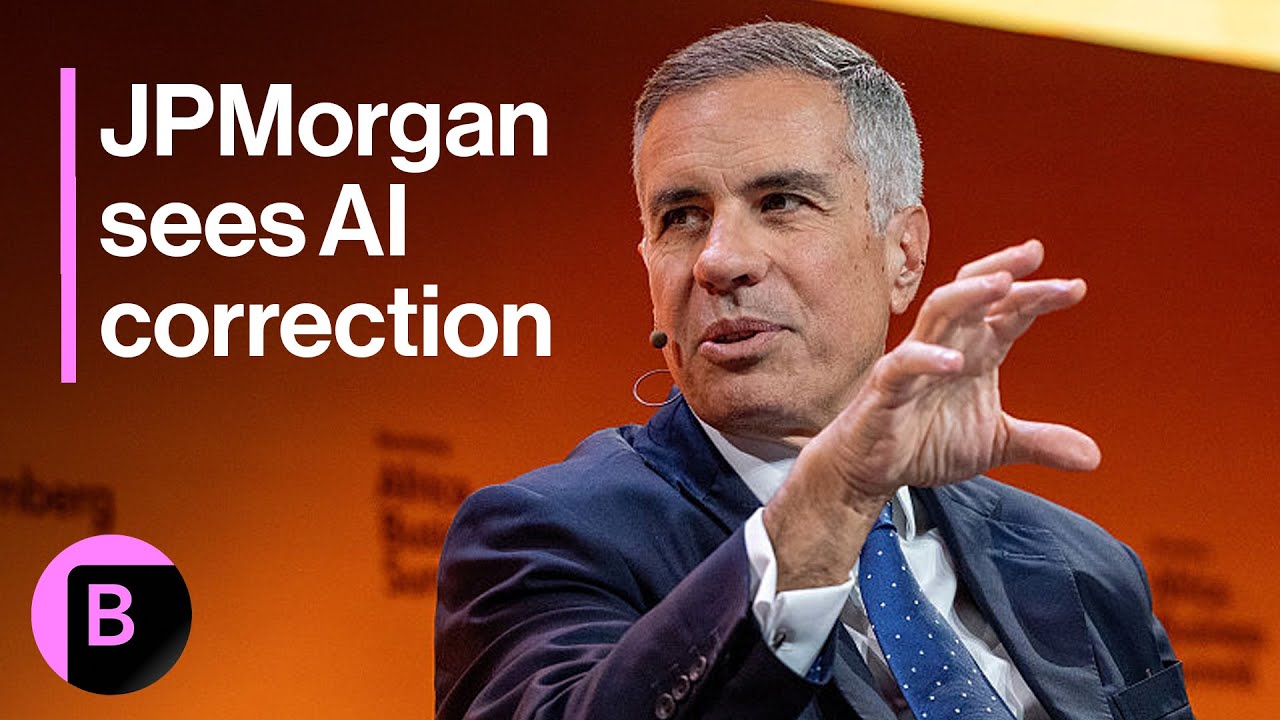
AI Stocks: JPMorgan's Daniel Pinto Sees Likely Correction in Valuations
Youtube· 2025-11-18 10:34
Economic Outlook - The economy is expected to grow less next year but is likely to avoid a recession, with tariffs not having their full impact yet, although fiscal expansion may provide some compensation [4] - Credit conditions are solid across various sectors, including credit cards and corporates, but a normalization of the credit cycle is anticipated as the economy slows down [1][2] Market Analysis - Current market pricing reflects a very benign scenario, with the S&P 500 at approximately 6700, indicating a healthy valuation at 23 times earnings [5] - There is a belief that the upside potential in the market is relatively limited, suggesting a possible correction in valuations [6][10] Technology and Productivity - Companies are increasingly deploying large language models to enhance productivity across operations, technology, fraud detection, credit decision-making, and client experience [7] - The impact of these technologies on the labor market is expected to be significant, with job creation and elimination occurring, but the overall capacity and revenue generation remain uncertain [9] Future Projections - A recovery in consumption is anticipated in the first quarter of next year, despite some current reductions [3] - The market may be overestimating the speed of productivity improvements necessary to justify current valuations [10]
瑞声科技-均热板、人工智能眼镜、边缘人工智能设备、可折叠手机将推动未来增长;目标价上调至 68.6 港元;买入评级
2025-11-17 02:42
Summary of AAC (2018.HK) Conference Call Company Overview - **Company**: AAC Technologies Holdings Inc. (2018.HK) - **Industry**: Technology, specifically focusing on components for smartphones and AI devices Key Points and Arguments Growth Drivers 1. **Vapor Chamber (VC) Adoption**: - AAC's vapor chamber is expected to see increased adoption in smartphones, particularly with the rise of foldable phones and AI smartphones. - Revenue contribution from VC is projected to rise from 1% in 2024 to 5% and 10% in 2025 and 2026 respectively [4][17] 2. **Acoustics and Haptics for AI Glasses**: - The growth of generative AI is anticipated to drive demand for edge AI devices, including AI/AR glasses. - Current AI functions in these glasses include live captioning, real-time translation, and AR navigation, which are expected to enhance user interaction and comfort [4] 3. **Smartphone Form Factor Changes**: - The shift towards slimmer and foldable phones is expected to increase demand for AAC's components, leading to higher dollar content per device [4] Financial Projections 1. **Earnings Revisions**: - Revenue estimates for 2025 have been revised up by 1% to Rmb 32.329 billion, 4% for 2026 to Rmb 38.130 billion, and 6% for 2027 to Rmb 42.428 billion [18] - Net income projections have also been adjusted upwards, with 2025 net income expected to be Rmb 2.493 billion, 2026 at Rmb 2.938 billion, and 2027 at Rmb 3.326 billion [18] 2. **Target Price Adjustment**: - The target price has been raised to HK$68.6 from HK$63.6, based on a revised P/E ratio of 25.6x for 2026E [24] Market Position 1. **Apple Revenue Exposure**: - AAC has a higher revenue exposure to Apple compared to industry peers, which is expected to benefit from the ongoing demand for iPhones and other Apple products [7] 2. **Competitive Landscape**: - Key risks include competition in low-margin camera modules and potential changes in business strategy towards more assembly operations [25] Valuation Metrics 1. **P/E Ratio**: - AAC is currently trading at a forward P/E of 16x, which is below the industry average of 17x, indicating potential for upside [22][24] 2. **PEG Ratio**: - The target price implies a PEG ratio of 0.9x, consistent with peers' range of 0.3-0.9x, suggesting that AAC is fairly valued relative to its growth prospects [24] Additional Important Information - **Market Cap**: HK$46.6 billion / $6.0 billion - **Investment Rating**: Buy with a significant upside potential of 72.8% based on the target price [26] - **Earnings Growth**: Expected net income growth of 15% YoY for 2026-27E [23] This summary encapsulates the key insights from the conference call regarding AAC's growth prospects, financial outlook, market positioning, and valuation metrics.
