Vibe Coding

Search documents
实测如何一分钟内用 Gemini 3.0 Pro 搭建一款网页/游戏
深思SenseAI· 2025-11-19 10:34
Core Insights - Google has officially released Gemini 3.0 Pro, which emphasizes enhanced reasoning and understanding capabilities, allowing users to receive higher quality responses without needing detailed prompts [1] - In authoritative benchmark tests, Gemini 3.0 Pro achieved a leading score of 72.1% in factual accuracy assessments and 23.4% in mathematical tests, indicating its reliability across various disciplines [1] Benchmark Performance - Gemini 3.0 Pro outperformed its predecessor Gemini 2.5 Pro and competitors like Claude Sonnet 4.5 and GPT-5.1 in multiple benchmarks, including: - 91.9% in scientific knowledge (GPQA Diamond) [2] - 95.0% in mathematics (AIME 2025) [2] - 81.0% in multimodal understanding (MMMU-Pro) [2] - 72.1% in parametric knowledge (SimpleQA Verified) [2] User Experience and Practical Applications - The model's capabilities allow users to generate product interfaces solely through natural language prompts, achieving a level comparable to professional UI designers [5][6] - Gemini 3.0 Pro can create interactive games from static images, demonstrating its versatility and ease of use [7][8] - The model significantly reduces the time and effort required for product development, enabling rapid prototyping and deployment [9][10] Future Implications - Gemini 3.0 Pro represents a shift in software production methods, lowering the marginal cost of trial and error in product development [10] - The model is expected to set a new standard in the industry, potentially transforming the capabilities of individual developers and small teams [10]



程序员不再写代码,而是靠“感觉”,年度热词Vibe Coding背后的编程革命
3 6 Ke· 2025-11-10 06:53
Core Insights - The term "vibe coding" has been officially recognized by Collins Dictionary as the word of the year for 2025, symbolizing a shift in programming from logic-based coding to a more intuitive, feeling-based approach [1][10][24] - This new programming style emphasizes collaboration with AI, where programmers use natural language to describe their needs, allowing AI to assist in code generation and logic completion [5][15][22] Group 1: Evolution of Vibe Coding - "Vibe coding" originated from a humorous tweet by Andrej Karpathy, highlighting a new way of programming that prioritizes intuition over strict coding rules [5][6] - The term quickly gained popularity across various tech forums and social media, becoming a cultural symbol of how AI is reshaping the programming landscape [8][17] - The definition of "vibe coding" has evolved to represent the act of using natural language prompts to have AI assist in writing computer code, marking a significant cultural shift in the tech community [10][20] Group 2: Impact on Programming Practices - AI tools like GitHub Copilot and Replit Ghostwriter are enabling programmers to focus on high-level ideas rather than syntax, transforming the coding process into a more collaborative and intuitive experience [15][16] - The programming environment is shifting towards AI-assisted development, where the emphasis is on setting the tone and intent rather than controlling every line of code [22][23] - This transformation is seen as a paradigm shift in software development, with AI taking a more central role in the coding process [21][24] Group 3: Language and Communication Changes - The rise of "vibe coding" reflects a broader change in how humans communicate with machines, moving from precise technical language to more emotional and intuitive expressions [25][27] - Research indicates that prolonged interaction with AI influences human language habits, leading to a more AI-like style of communication [25][28] - The blending of human emotional expression with machine logic suggests a future where creativity and computation coexist, redefining the boundaries between human and machine interactions [24][29]
AI首胜人类博士,顶会论文秒变代码,港大90后开源刷爆8k星
3 6 Ke· 2025-11-03 05:14
Core Insights - The article discusses the challenges in reproducing algorithms and experimental results from academic papers in the AI field due to the lack of critical implementation details [1][2] - DeepCode, an open-source tool developed by a team from the University of Hong Kong, addresses these challenges by analyzing paper content and automatically generating runnable code [2][4] Group 1: DeepCode Performance - DeepCode has shown outstanding performance in benchmark tests, surpassing human experts and other advanced AI coding tools [3][4] - In the PaperBench benchmark, DeepCode achieved an overall accuracy of 75.9%, exceeding the human expert group’s score of 72.4% [5][6] - DeepCode scored 84.8% in a comparison with commercial code assistants, significantly outperforming Claude Code, which scored 58.7% [17][19] Group 2: Benchmark Testing - The benchmark tests included comparisons against human experts, state-of-the-art commercial code assistants, scientific code assistants, and large model-based agents [3][4] - DeepCode consistently received the highest scores across all four benchmark tests [4] - The PaperBench benchmark involved reproducing 20 ICML2024 conference papers, with 8316 independently scoreable components evaluated [8][9] Group 3: DeepCode's Core Capabilities - DeepCode's primary capabilities include transforming academic papers into production-level code, generating responsive web pages from natural language descriptions, and creating high-performance backend services from functional requirements [24][25][27] - The tool employs a systematic three-phase framework for code generation, which includes architecture blueprint construction, automated code building, and dynamic validation and optimization [29][35] Group 4: Challenges and Future Directions - Current AI programming tools excel in code completion and simple tasks but struggle with complex tasks requiring deep understanding [36][38] - The development of DeepCode indicates that specialized architecture design can lead to better performance in specific domains, although general deep understanding capabilities remain limited [38][39] - The evolution of AI coding tools from simple assistants to comprehensive development partners raises questions about maintaining developer control and ensuring code quality [40][42]
美团的这种技术面试形式,会成为新的趋势吗?
猿大侠· 2025-10-16 03:44
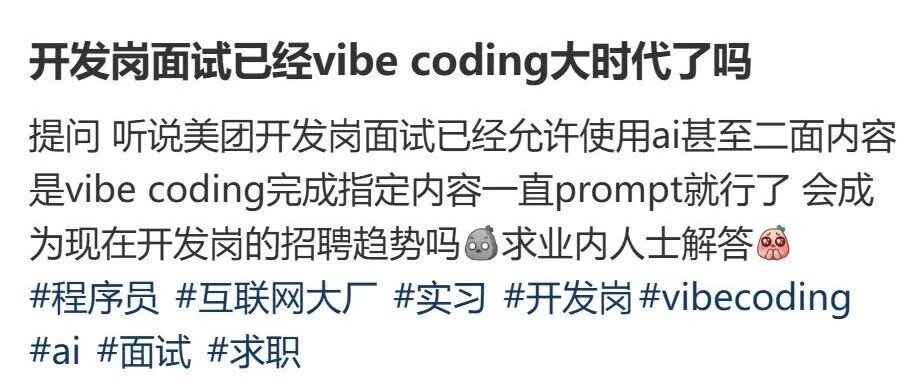
Core Viewpoint - The article discusses the integration of AI in recruitment processes, particularly focusing on Meituan's use of AI interviewers and the emerging trend of "Vibe Coding" in software development [7][28][38]. Group 1: AI Integration in Recruitment - Meituan has implemented AI interviewers in its recruitment process, with a significant portion of its code (approximately 52%) generated by AI [7][8]. - The AI interview experience has been reported positively by candidates, indicating a shift in how technical interviews are conducted [17][18]. - The AI interview questions cover both technical and general abilities, reflecting a comprehensive assessment approach [15][18]. Group 2: Vibe Coding Concept - "Vibe Coding" is introduced as a new software development methodology where developers use natural language prompts to guide AI tools in generating and debugging code [29][30]. - This approach emphasizes speed and iterative development, allowing even non-programmers to create software by describing desired functionalities [30][31]. - The article argues that the future of programming will heavily involve AI, making it essential for developers to adapt to this collaborative model [34][36]. Group 3: Future of Interviews - The article suggests that future interviews should assess candidates' ability to collaborate with AI tools, rather than just their technical knowledge [38][39]. - Different levels of developers will have varying expectations regarding their proficiency in using AI tools, from basic usage for junior developers to leadership in AI development processes for senior developers [36][37]. - The shift in interview focus from traditional knowledge to understanding and collaboration with AI represents a significant paradigm change in recruitment practices [38][46].
百度秒哒负责人朱广翔:AI开发革命的终局,是让创意本身成为唯一的“代码”
AI科技大本营· 2025-10-13 10:14
Core Insights - The article discusses the concept of "Vibe Coding" proposed by Andrej Karpathy, which allows developers and non-developers to create applications through natural language descriptions, potentially revolutionizing the application development landscape [1][9][10] - The traditional application development model is constrained by the "impossible triangle" of low cost, high quality, and personalization, which has led to the emergence of new tools like 秒哒 that aim to address these challenges [3][5][24] Group 1: Impossible Triangle in Application Development - The "impossible triangle" highlights the inherent conflict in traditional development methods where achieving low cost, high quality, and personalization simultaneously is challenging [3][5][24] - Traditional coding ensures high quality and personalization but is costly, while low-code platforms reduce costs but lack personalization [8][24] - Chatbots offer low cost and some personalization but often fall short in quality, leading to a need for a new approach [8][24] Group 2: AI-Driven Development - The formula for effective AI-native applications is defined as AI UI + Agent, where AI UI focuses on user-centered design and Agent executes complex tasks [3][9][12] - 秒哒 aims to unlock the 90% of long-tail application demands that traditional software development overlooks, promoting a new era of "everyone can create" [3][13][16] - Multi-agent collaboration is crucial for 秒哒, simulating a high-functioning development team to transform vague requirements into fully functional applications [3][25] Group 3: Future of Roles in Development - AI is expected to elevate the roles of product managers and programmers rather than replace them, allowing product managers to directly interface with AI for prototyping [4][21] - The boundaries between product managers and programmers may blur, with product managers leveraging AI tools to create prototypes without needing extensive coding knowledge [21][22] - The evolution of roles will focus on higher-level tasks such as logic design and creative input, while AI handles execution [20][34] Group 4: Market Growth and Demand - The global software market is projected to grow at a compound annual growth rate of 11.8%, from $659.2 billion in 2023 to $2,248.3 billion by 2034, driven by increasing application development demands [5] - The emergence of AI-native applications is reshaping user habits, as seen in the shift towards AI-assisted writing and application creation [7][30] - The demand for applications is shifting from high-frequency needs to long-tail requirements, which traditional development methods have largely ignored [16][34]
Exclusive: Supabase raises $100 million at $5 billion valuation as vibe coding soars
Fortune· 2025-10-03 11:04
Core Insights - The vibe coding movement has evolved through multiple waves, with the current phase focusing on mobile app development and seamless transitions between devices [2] - Supabase, an open-source application development platform, has seen significant growth, increasing its user base from 1 million to over 4 million developers in the past year, with AI builders making up about 30% of new signups [2][3] - Supabase recently raised $100 million in Series E funding, achieving a valuation of $5 billion, bringing total funding to $500 million since its inception in 2020 [3][4] Company Developments - Supabase's Series E funding round was primarily restricted to existing investors, with Figma being the only new institutional investor [4] - The company aims for a future valuation of $50 billion to $100 billion, emphasizing the importance of existing investors in achieving this goal [5] - Supabase's CEO believes that while coding may become easier, there will still be a strong interest in coding and development, leading to a potential increase in the number of people wanting to build applications [5]


Figma MCP + GPT-Codex:新的 Vibe Coding 之王
歸藏的AI工具箱· 2025-09-25 10:25
Core Viewpoint - The article discusses the recent updates to Figma's remote MCP service and how it enhances the integration with AI tools like GPT-5 Codex, improving design and coding efficiency. Group 1: Figma MCP Service Update - The new Figma remote MCP service eliminates the need for complex installation processes and local clients, streamlining user experience [5][21] - Users can easily set up the MCP by copying a JSON code into the Cursor settings, simplifying the connection process [6][7] - The service requires a subscription, and alternative access methods are mentioned [8] Group 2: Integration with AI Tools - The integration with AI IDEs like Cursor allows for direct usage of GPT-5 Codex, enhancing design capabilities [5][9] - Users can utilize commands in Claude Code to access Figma MCP, facilitating the design process [10] - The AI can generate web pages from design drafts, but the quality of the output depends on the original design's structure [15][16] Group 3: Design and Development Process - The article emphasizes the importance of using high-quality design drafts to ensure effective AI output [15][16] - It suggests a step-by-step approach for complex designs, allowing the AI to handle components incrementally [15] - The article provides specific design guidelines for creating a visually appealing web page, including color schemes and layout styles [19][20] Group 4: Future Implications - The update indicates significant growth potential for Vibe Coding infrastructure, enhancing efficiency in design and coding [21] - The integration of AI does not eliminate the need for design skills; rather, it enhances productivity while maintaining the necessity for aesthetic judgment and foundational knowledge [21]
Vibranium Labs Raises $4.6M To Fix Vibe Coding Failures With AI Agents After Engineers Admit These Apps 'Are Definitely Going To Break'
Yahoo Finance· 2025-09-23 16:01
Core Insights - Vibranium Labs has raised $4.6 million in seed funding to enhance its Vibe AI platform, which is designed to manage IT incidents automatically before human intervention is needed [2][5] - The company aims to address the increasing demand for efficient IT incident response solutions, particularly in light of recent large-scale outages like the CrowdStrike incident in July 2024 [3][5] - Vibe AI is positioned as the first AI Site Reliability Engineer, targeting industries such as finance, healthcare, defense, retail, and media [4] Funding and Investment - The funding round was led by Calibrate Ventures and Mirae Asset, with participation from notable investors including a16z, Franklin Templeton, and others [5] - The capital will be used to advance product development, expand technical and sales teams, and strengthen partnerships across various sectors [6] Market Context - The rise of "vibe coding," where applications are generated from text prompts, has increased the need for robust incident response solutions, as developers may overlook critical details that could lead to outages [4][5] - The current landscape of rising outage risks and new coding methodologies has created a favorable environment for investment in companies like Vibranium Labs [5]
对话吴穹:软件开发的终局,是我们将迎来自己的“黑灯工厂”
AI科技大本营· 2025-09-15 00:50
Core Viewpoint - The article discusses the evolution of software engineering in China, emphasizing the need for a localized methodology that integrates agile principles with the unique cultural and organizational context of Chinese enterprises [5][12][14]. Group 1: Historical Context and Evolution - Wu Qiong, a key figure in the software engineering field, introduced Rational Unified Process (RUP) to China, significantly impacting the development practices of many companies [5][6]. - After experiencing the agile development wave in the U.S., Wu Qiong recognized the cultural mismatch when applying Western agile methodologies in Chinese companies, leading to the realization that a tailored approach was necessary [6][7][12]. Group 2: Challenges and Adaptation - The article highlights the contradictions between Western agile practices, which promote self-organization and flexibility, and the more controlled, hierarchical nature of Chinese corporate culture [7][12]. - Wu Qiong's transition from merely importing methodologies to creating a localized framework, known as Adapt, reflects the need for a more suitable approach for Chinese enterprises [8][14]. Group 3: The Impact of AI - The introduction of AI into software engineering is seen as a transformative force, with the potential to disrupt traditional practices and create new challenges in productivity and management [9][21]. - The article discusses the dual perception of AI tools as both productivity enhancers for management and distractions for employees, highlighting the need for a balanced approach to AI integration [9][36]. Group 4: Future Directions - The future of software engineering is expected to involve a more specialized and differentiated approach to AI agents, moving away from a one-size-fits-all model to tailored solutions for specific tasks and industries [24][25]. - The concept of managing AI agents as team members is proposed, suggesting a shift in organizational structures to accommodate this new dynamic [35][38]. Group 5: Methodology and Tools - The Adapt methodology emphasizes the importance of aligning organizational structures, task management, and data flow to enhance efficiency and effectiveness in software development [30][32][49]. - The "Zhiwei" platform is introduced as a flexible management tool that can adapt to the unique needs of organizations, contrasting with rigid off-the-shelf software solutions [52][53].
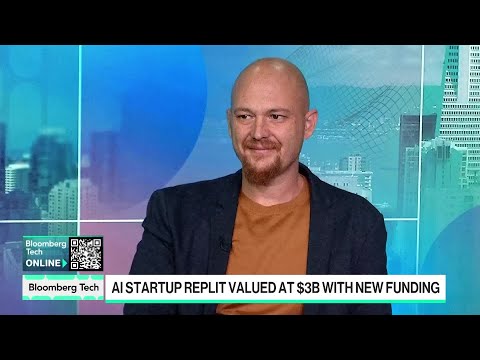
Vibe-Coding Startup Replit Hits $3 Billion Valuation
Bloomberg Technology· 2025-09-11 19:52
Core Technology & Product Innovation - AI驱动的软件开发正在实现,用户可以通过自然语言创建软件 [2][5] - "Vibe coding" 赋能非专业人士进行编程,促进各领域人员自动化工作流程和构建工具 [7][8] - Rappler Agents 允许用户通过输入提示词创建应用,无需查看代码 [6] - Agent 3 的工作时长已达 200 分钟,接近一个程序员的工作量 [9] Business Performance & Growth - 公司最初的愿景是赋能 10 亿人创造软件 [13] - 公司在商业化之前花费了 8-9 年时间构建平台,简化软件创建的复杂性 [14] - 年初的年度经常性收入(ARR)约为 300 万美元,发布 Rapid Agent 1 后迅速增长至 900 万美元,年底达到 900-1000 万美元,之后增长 15 倍至 25 亿 美元 [15] Customer Impact & Industry Transformation - 客户(如 Duolingo 和 Zillow)的产品开发周期缩短高达 50% [10] - 产品经理可以直接生成原型,加快与设计师和工程师的迭代速度,提高公司生产力 [12] Talent & Future Vision - 移民对于吸引全球顶尖人才至美国至关重要,同时美国本土也存在大量人才 [19] - 学生现在学习软件开发非常容易,可以在 15-20 分钟内创建第一个软件 [19][20] - 未来将涌现大量人才,他们不仅会编码,还会使用 ChatGPT、Midjourney 等工具进行设计和视频创作 [20]