
固态电池技术

Search documents
优美科携手宝马与Solid Power推动固态电池技术迈向现实应用
鑫椤锂电· 2025-08-28 07:55
Core Viewpoint - The collaboration between BMW, Solid Power, and Umicore aims to advance solid-state battery technology, marking a significant step towards commercial application and industry transformation [1][2][3]. Group 1: Collaboration and Innovation - Solid-state batteries replace traditional liquid electrolytes with solid electrolytes, offering advantages in safety, efficiency, and energy density [2]. - Umicore is actively pushing the development of advanced cathode materials for next-generation battery cells through its partnership with Solid Power [2]. - The BMW i7 vehicle's testing with solid-state batteries represents a key outcome of this collaboration [2][3]. Group 2: Testing and Validation - BMW plays a crucial role in validating solid-state battery technology through real-world driving tests of the BMW i7 in Munich [3]. - The testing aims to comprehensively assess the performance of solid-state batteries in actual driving conditions [3]. - Umicore's strategy emphasizes early partnerships to drive sustainable and scalable applications in the solid-state battery market [3]. Group 3: Industry Leaders' Perspectives - Umicore's Vice President, Karena Cancilleri, highlights the potential of solid-state batteries to surpass traditional lithium-ion batteries, enhancing electric mobility's performance and sustainability [3]. - BMW's Vice President, Martin Schuster, underscores the importance of open technological thinking and collaboration in advancing new battery technologies [3]. - Solid Power's Vice President, Berislav Blizanac, expresses pride in contributing to the significant milestone of the BMW i7 testing vehicle powered by their solid-state battery technology [3].


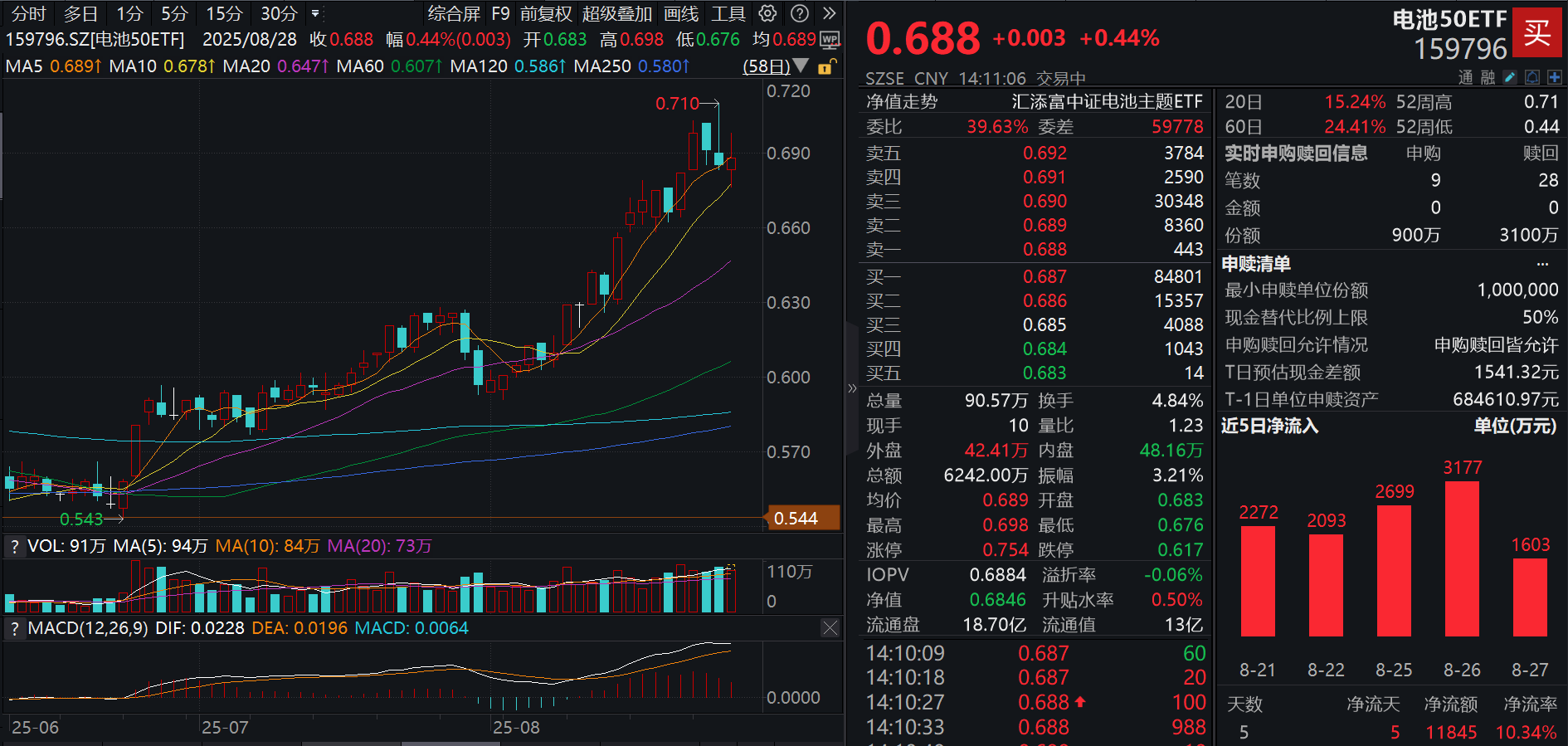
璞泰来绩后一度触及涨停!电池50ETF(159796)深V反转,超1亿元资金连续5日涌入!产业周期与技术进步共振,电池板块迎配置良机?
Xin Lang Cai Jing· 2025-08-28 06:47
Core Viewpoint - The A-share market shows resilience with the hard technology sector and major weight stocks rising, while over 4,000 stocks experienced a pullback, leading to a positive performance of the Shanghai Composite Index [1] Group 1: Market Performance - The Battery 50 ETF (159796) experienced a reversal in the afternoon, rising by 0.44%, with funds flowing into the battery sector for five consecutive days, accumulating over 100 million yuan from August 21 to August 27 [1] - The index components of the Battery 50 ETF showed mixed performance, with Peking University leading the gains, hitting the daily limit, while other stocks like Sunshine Power and Sanhua Intelligent Control also saw increases [2][3] Group 2: Key Stocks in Battery 50 ETF - The top ten components of the Battery 50 ETF include Sunshine Power, CATL, and Sanhua Intelligent Control, with Sunshine Power showing a rise of 3.74% and CATL experiencing a decline of 1.41% [4] - Sunshine Power holds a weight of 12.62% in the index, while CATL has a weight of 8.21% [4] Group 3: Industry Developments - The solid-state battery sector is experiencing significant growth, with Peking University reporting a revenue of 7.088 billion yuan and a net profit of 1.055 billion yuan for the first half of 2025, reflecting year-on-year growth of 11.95% and 23.03% respectively [5] - Solid-state batteries are expected to become the next upgrade for lithium-ion batteries, addressing safety and performance issues, with a projected global shipment of 614.1 GWh by 2030 [6] - Major automotive manufacturers are accelerating their adoption of solid-state batteries, with a focus on sulfide as the primary route, indicating a shift in the industry towards advanced battery technologies [6]

汽车零部件龙头,“低价收购”固态电池大厂
DT新材料· 2025-08-27 16:04
Core Viewpoint - Huayu Automotive plans to acquire a 49% stake in Shanghai SAIC Qingtao Energy Technology Co., Ltd. from its controlling shareholder SAIC Group for 206 million yuan, marking an internal asset restructuring within SAIC Group [2] Group 1: Acquisition Details - The acquisition price of 206 million yuan is considered low due to Huayu Automotive being a state-owned enterprise controlled by SAIC Group, indicating an internal asset restructuring rather than a market transaction [2] - After the acquisition, SAIC Qingtao will be renamed to "Qingtao Power Technology (Shanghai) Co., Ltd." [2] Group 2: Business Focus and Strategy - Huayu Automotive focuses on three major technology platforms: intelligent driving, intelligent cockpit, and intelligent power, covering various fields including interior and exterior parts and functional components [2] - The acquisition allows Huayu Automotive to enter the solid-state battery sector, enhancing its "intelligent power" product matrix and facilitating the synergy between solid-state battery business and other areas like electric drive and thermal management [2] Group 3: Industry Ecosystem and Production Capacity - Qingtao Energy has established a complete industrial ecosystem encompassing "new energy materials - solid-state lithium batteries - automated equipment - comprehensive utilization of lithium battery resources - research results incubation - industrial investment" [3] - The first-generation semi-solid-state battery utilizes an oxide + polymer technology path, while the second-generation solid-state battery will adopt an oxide + halide + polymer path, with plans to develop the second generation by 2025 and mass production of the third generation by 2027, targeting an energy density exceeding 500 Wh/kg and a cost reduction of 40% compared to equivalent lithium iron phosphate or ternary batteries [3] Group 4: Production Bases - Qingtao Energy has established solid-state battery production bases in multiple locations, including Urumqi, Chengdu (15 GWh), Yichun, Jiangxi (10 GWh), Kunshan, Jiangsu (10 GWh), and Taizhou, Zhejiang (20 GWh), with a total planned production capacity of 65 GWh [3] Group 5: Client Applications - Qingtao Energy's solid-state batteries have been applied in various models, including the Zhiji L6 and Foton Lefoo series. Recent announcements indicate that three new models equipped with Qingtao Energy's semi-solid-state batteries have entered the market, demonstrating the company's presence in passenger vehicles, commercial vehicles, and logistics vehicles [4]


国泰海通|新能源:固态电池正负极&集流体发展方向
国泰海通证券研究· 2025-08-27 14:35
Core Viewpoint - Solid-state batteries are considered the next generation of lithium batteries due to their high energy density and safety compared to liquid batteries [1][2]. Group 1: Positive Electrode Development - The positive electrode is evolving towards high voltage and high specific capacity, with initial reliance on high nickel ternary materials, transitioning to lithium-rich manganese-based and ultra-high nickel materials in the future [1]. - Lithium-rich manganese-based (LMR) materials have a theoretical specific capacity of 320mAh/g and a voltage platform of 3.7V-4.6V, significantly outperforming traditional ternary and lithium iron phosphate materials [1]. - The raw material cost for lithium-rich manganese-based materials is approximately 15-20% lower than that of ternary materials, with energy cost per watt-hour close to that of lithium iron phosphate [1]. Group 2: Negative Electrode Development - Short-term focus for negative electrodes is on silicon-carbon composites, while lithium metal is expected to become the mainstream material post achieving an energy density of 400Wh/kg [2]. - The theoretical specific capacity of lithium metal (3860mAh/g) is vastly superior to that of traditional graphite electrodes (372mAh/g), contributing to enhanced energy density [2]. - Current mainstream preparation methods for lithium metal electrodes include rolling, with future advancements in vapor deposition techniques expected to facilitate their implementation [2]. Group 3: Current Collector Innovations - Future developments in solid-state batteries may center around lithium metal electrodes and sulfide electrolytes, with porous copper foils being utilized to suppress lithium dendrite growth, thereby enhancing safety and cycle life [2]. - Nickel-based and stainless steel current collectors are proposed as suitable alternatives to address the corrosion issues associated with sulfide electrolytes [2].

2025起点户储及便携式储能电池技术论坛9月深圳举办!
起点锂电· 2025-08-27 03:54
Core Insights - The article discusses the growth and competitive landscape of the home energy storage and portable energy storage markets, highlighting significant trends and forecasts for 2024 and beyond [3][4][5]. Home Energy Storage - In 2024, the global home energy storage shipment is projected to reach 27.8 GWh, marking a 19% year-on-year increase, with Chinese companies accounting for 75% of the shipments [3]. - The leading regions for home energy storage consumption include Europe, the USA, Ukraine, Japan, Australia, Africa, the Middle East, ASEAN, and Russia, with Europe being the largest and most mature market [3]. - The USA, Ukraine, Australia, South Africa, Nigeria, and Brazil are expected to see rapid growth in 2024 due to declining electricity prices and increasing demand [3]. - SPIR forecasts that the global home energy storage market will reach 180 GWh by 2030, representing a 547% increase from 2024 [3]. - The top 10 companies in global home energy storage shipments include Huawei, BYD, Airo Energy, and others [3]. Portable Energy Storage - The global portable energy storage shipment is expected to reach 11 million units in 2024, reflecting a 90% year-on-year growth [4]. - The USA is identified as the largest and most mature market for portable energy storage, driven by outdoor activities and a developed RV market [4]. - Ukraine is projected to experience the fastest growth in 2024 due to energy shortages caused by the ongoing conflict, increasing the demand for emergency power solutions [4]. - By 2030, the global portable energy storage market is anticipated to reach 28 million units, a 156% increase from 2024, fueled by outdoor economy growth and emergency power needs [4]. - The top 10 companies in global portable energy storage shipments include EcoFlow, BLUETTI, Jackery, and others [5]. Industry Trends and Challenges - The article notes the emergence of new technologies and materials in battery technology, such as fast charging, solid-state, sodium batteries, and full-tab designs, while also highlighting ongoing safety challenges [5]. - The implementation of new national standards for portable power sources is expected to raise safety requirements across the industry [5]. - The upcoming 2025 Peak Forum on Home and Portable Energy Storage Battery Technology will focus on high safety standards and collaborative innovation within the industry [6][8]. Event Details - The 2025 Peak Forum will take place on September 26, 2025, in Shenzhen, gathering over 600 key decision-makers from the industry [11][10]. - The forum will cover various topics, including safety systems, market trends, and technological advancements in home and portable energy storage [9][10].

国泰海通:固态电池未来或为下一代电池 正负极往高电压高比容量方向发展
智通财经网· 2025-08-27 02:25
Group 1 - The core viewpoint is that solid-state batteries exhibit superior energy density and safety compared to liquid batteries, positioning them as the next generation of lithium batteries [1] - The main electrolyte options for solid-state batteries include oxides, polymers, halides, and sulfides, with sulfides being the primary choice for all-solid-state batteries [1] - The positive electrode is evolving towards high voltage and high specific capacity, initially utilizing high nickel ternary materials, and later transitioning to lithium-rich manganese-based and ultra-high nickel materials [1] Group 2 - The theoretical specific capacity of lithium-rich manganese-based (LMR) materials can reach 320mAh/g, with a voltage platform of 3.7V to 4.6V, significantly surpassing traditional ternary and lithium iron phosphate materials [1] - The cost of raw materials for lithium-rich manganese-based materials is approximately 15-20% lower than that of ternary materials, with watt-hour costs approaching those of lithium iron phosphate [1] Group 3 - For the negative electrode, silicon-carbon composites are currently favored, while lithium metal is expected to become the mainstream material after energy densities exceed 400Wh/kg [2] - The theoretical specific capacity of lithium metal (3860mAh/g) is substantially higher than that of traditional graphite electrodes (372mAh/g), contributing to enhanced energy density [2] Group 4 - The development of current collectors is focused on porous copper foils and nickel-based collectors, which are compatible with solid-state battery systems [3] - Porous copper foils help suppress lithium dendrite growth, enhancing the safety and cycle life of solid-state batteries [3] - Nickel-based and stainless steel current collectors are considered suitable alternatives to address the corrosion of copper foils by sulfides [3]

领湃科技2025年中报简析:亏损收窄,存货明显上升
Zheng Quan Zhi Xing· 2025-08-26 23:09
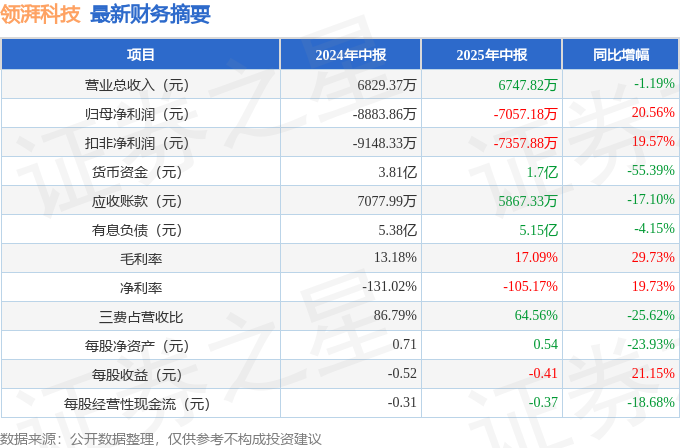
Core Viewpoint - Lingpai Technology (300530) reported a slight decline in total revenue for the first half of 2025, with a notable increase in net loss compared to the previous year, indicating ongoing financial challenges despite improvements in certain profitability metrics [1][3]. Financial Performance Summary - Total revenue for the first half of 2025 was 67.48 million yuan, a decrease of 1.19% year-on-year [1]. - The net profit attributable to shareholders was -70.57 million yuan, an improvement of 20.56% year-on-year [1]. - The gross margin increased to 17.09%, up 29.73% year-on-year, while the net margin was -105.17%, improving by 19.73% year-on-year [1]. - Total expenses (selling, administrative, and financial) amounted to 43.56 million yuan, accounting for 64.56% of revenue, a decrease of 25.62% year-on-year [1]. - Inventory levels rose significantly, with a year-on-year increase of 51.89% [1]. Cash Flow and Debt Analysis - Cash and cash equivalents decreased by 55.39% to 170 million yuan [1]. - The net cash flow from operating activities decreased by 18.68%, indicating reduced cash inflow from operations [3]. - The company’s debt situation is concerning, with a debt-to-asset ratio of 40.39% and negative cash flow from operations over the past three years [4]. Market Position and Future Outlook - The company is focusing on solid-state battery technology, indicating a strategic shift towards enhancing its competitive edge and sustainability [5]. - Lingpai Technology has faced significant challenges, with a historical average return on invested capital (ROIC) of 11.06%, but a poor performance in 2024 with a ROIC of -44.28% [3][4].

固态电池五大“误区”
起点锂电· 2025-08-26 09:47
Group 1 - The core viewpoint of the article is that solid-state batteries are often misunderstood regarding their energy density, cycle life, and ability to suppress lithium dendrite growth, necessitating a clearer understanding of the technology and its potential breakthroughs [2][3][17] Group 2 - Solid-state batteries are generally believed to have higher energy density, but this is not accurate. When using the same electrode materials, solid-state batteries often have lower energy density than liquid batteries due to the higher density of solid electrolytes [3][4][6] - For example, energy densities for different types of batteries are calculated as follows: liquid electrolyte (370 Wh kg⁻¹), polymer electrolyte (313 Wh kg⁻¹), sulfide electrolyte (248 Wh kg⁻¹), and oxide electrolyte (125 Wh kg⁻¹) [5][6] - The effective strategy to enhance energy density in solid-state batteries involves using new electrode materials, such as ultra-thin lithium metal anodes and high-voltage rich lithium manganese-based cathodes, which can significantly increase energy density to 700 Wh kg⁻¹ [5][6] Group 3 - Solid-state batteries face multiple challenges regarding cycle life, primarily due to the brittleness of oxide solid electrolytes, which can lead to mechanical damage and reduced ion transport pathways [7][8] - In contrast, liquid electrolytes can dynamically repair interface defects, maintaining a stable chemical environment over thousands of cycles, which solid-state batteries struggle to achieve [7][8] Group 4 - The fast charging performance of solid-state batteries is often overestimated, as their actual performance is limited by ionic conductivity and interface behavior, making it difficult to surpass liquid batteries [9][11] - Solid-state Ion Energy Technology (Wuhan) Co., Ltd. has developed a new polymer electrolyte system that enhances lithium ion migration, achieving an ionic conductivity of 2.95 × 10⁻³ S cm⁻¹ at 30 °C, enabling fast charging and discharging capabilities [9][13] Group 5 - The development of solid-state batteries should not strictly follow a path from liquid to semi-solid to solid-state, as the focus should be on achieving high performance rather than merely transitioning to solid-state technology [14][15] - The true advantages of solid-state batteries lie in their high safety and wide operating temperature range, with oxide electrolytes being non-flammable, while sulfide electrolytes present safety risks due to their flammability [15][16] Group 6 - Solid-state Ion Energy Technology (Wuhan) Co., Ltd. has made significant technological breakthroughs in solid-state batteries, developing a fast-charging polymer solid-state lithium battery with an energy density of 260 Wh kg⁻¹ and a capacity retention rate of 77.2% after 3500 cycles [18][19] - The company’s polymer solid-state batteries also demonstrate excellent performance in extreme temperatures, maintaining a capacity retention rate of 55.6% at -40 °C and 89.5% at 100 °C [20]

某车企暂停自研电池并裁员
鑫椤锂电· 2025-08-26 04:04
Core Viewpoint - The article discusses Porsche's decision to suspend its high-performance electric vehicle battery development plan due to economic infeasibility and challenges in scaling production [2][3]. Group 1: Porsche's Battery Development Plan - Porsche has announced the cancellation of its plan to build high-performance battery production, citing lower-than-expected growth in the electric vehicle market and changes in the US-China market environment [3]. - The CEO, Oliver Blume, highlighted the lack of economies of scale and production limitations, stating that battery manufacturing requires significant investment and high levels of scalability, which are currently unachievable for Porsche [3]. - The Cellforce division, which had completed some cell development and initiated trial production, will now reduce operations and redirect its research outcomes to support the Volkswagen Group and V4Smart, a company acquired by Porsche [4]. Group 2: Impact on Workforce and Future Plans - As a result of the suspension, Cellforce may lay off approximately 200 employees from its current workforce of around 300, with remaining staff potentially transferred to Volkswagen's battery subsidiary, PowerCo [4]. - Porsche had previously announced plans to develop a new solid-state battery, aiming to increase the electric vehicle range to 1,300 kilometers, with further optimizations expected to enhance range by 30%-50% and charging power to 500 kW [5]. - After two years of effort, Porsche has recognized the difficulties in battery development and has opted to leave such specialized tasks to established battery giants like CATL [5].

化工ETF(159870)开盘15分钟净申购超5.36亿
Xin Lang Cai Jing· 2025-08-26 02:14
Group 1 - Goldman Sachs has raised short-term export expectations due to resilient shipping data and better-than-expected global growth, benefiting cyclical sectors like chemicals [1] - Institutions are optimistic about growth styles, with cyclical leaders and the chemical sector showing price elasticity potential, attracting incremental funds to low-priced assets [1] - Morgan Stanley's analyst believes that the A-share bull market is driven by improved liquidity and policy support, with anti-involution policies accelerating the exit of outdated capacity in the petrochemical industry, favoring leading chemical companies [1] Group 2 - Guojin Securities highlights solid-state batteries as an important technological direction in the basic chemical field, noting that the performance of solid electrolytes directly impacts key battery indicators [2] - Jiangsu Securities indicates that the chlor-alkali industry is currently at the bottom of the cycle and needs to wait for an industry recovery [2] - Both institutions focus on the technological evolution and cyclical characteristics of the chemical sub-sectors, providing reference dimensions for the fundamentals of targeted products [2] Group 3 - Related products include Chemical ETF (159870) and various linked funds [3] - Related stocks include Wanhu Chemical (600309), Yilake Co. (000792), Juhua Co. (600160), and others [3]