健康老龄化

Search documents
北京322个社区设老年人心理关爱点
Xin Jing Bao· 2025-06-23 02:36
Group 1 - Beijing has established 672 elderly-friendly medical institutions, including general hospitals, rehabilitation hospitals, nursing homes, and grassroots medical health institutions, along with 322 communities providing psychological care pilot services for the elderly [1][2] - The "14th Five-Year Plan for Healthy Aging" indicators have been met, with 1 national center for geriatric medicine and 3 national clinical research centers for geriatric diseases, and over 90% of secondary and above general hospitals having geriatric departments [2] - By the end of 2024, the health management service rate for elderly individuals aged 65 and above in urban and rural communities is expected to reach 69%, with a Chinese medicine health management rate of 76% [2] Group 2 - Free health services for residents aged 65 and above include annual health management services, lifestyle and health assessments, physical examinations, and personalized health guidance, especially for chronic disease patients [3] - Elderly individuals can receive flu and pneumonia vaccinations annually, and those in 322 communities with psychological care pilot programs can access free psychological health services [3] - Seniors aged 60 and above with medical insurance can enjoy reduced medical service fees at community health service institutions, and chronic disease patients can benefit from long-term prescription services [4]
每天一杯咖啡,真能“续命”?哈佛大学30年追踪研究:喝咖啡或有助于女性健康衰老
生物世界· 2025-06-08 05:53
Core Viewpoint - A long-term study from Harvard University suggests that moderate caffeine consumption, particularly from coffee, may be linked to healthier and longer lives for middle-aged women [2][4]. Group 1: Research Overview - The study, led by Professor Hu Pingchang from Harvard's Chan School of Public Health, tracked 47,513 women over 30 years, starting in 1984, collecting detailed dietary and lifestyle information [4][5]. - The core question of the research was how caffeine intake habits in middle age (ages 45-60) affect health in later years [5]. Group 2: Definition of Healthy Aging - The research team defined "healthy aging" strictly, requiring participants aged 70 and above to meet several criteria, including the absence of major chronic diseases and the ability to perform daily activities independently [6][7][8]. Group 3: Key Findings - Among the 3,706 women who achieved "healthy aging" by 2016, the average daily caffeine intake was about 315 mg, primarily from caffeinated coffee [10]. - Drinking an additional small cup (approximately 120ml) of caffeinated coffee daily was associated with a 2%-5% increased probability of achieving "healthy aging" [12]. - The study found no significant association between tea or decaffeinated coffee and improved "healthy aging" probabilities, while consuming caffeinated cola was linked to a 20%-26% decrease in the likelihood of achieving "healthy aging" [12]. Group 4: Research Significance - This study is notable for being the first to evaluate the comprehensive impact of coffee on multiple aging-related health aspects over a 30-year period, highlighting the unique role of caffeinated coffee [13][14]. Group 5: Recommendations - It is advised to choose caffeinated coffee for potential health benefits, with a recommended limit of no more than 2 cups (approximately 480ml) per day [17][18]. - The benefits of coffee are considered moderate and should be part of an overall healthy lifestyle, including balanced diet and regular exercise [19]. - Individuals sensitive to caffeine or with specific health conditions should consult with healthcare providers regarding coffee consumption [20].


昆药集团Q1“开门黑”,华润三九入主第三年靠什么兑现双位数增长? | 直击业绩会
Tai Mei Ti A P P· 2025-05-30 13:28
Core Viewpoint - Kunming Pharmaceutical Group's stock price has experienced significant volatility, with a sharp decline following a brief rise, raising concerns among investors regarding its performance and future growth plans [2][3]. Financial Performance - In 2024, Kunming Pharmaceutical Group reported revenue of 8.401 billion yuan, a slight decrease of 0.34% year-on-year, while net profit attributable to shareholders increased by 19.86% to 648 million yuan [3]. - However, in Q1 2025, the company faced a substantial decline in performance, with revenue dropping by 16.53% to 1.608 billion yuan and net profit falling by 31.06% to approximately 90.48 million yuan [3][7]. - The company aims for double-digit revenue growth in 2025, despite the challenges faced in the first quarter [5][7]. Strategic Transition - The company is undergoing a significant transformation in its sales and channel management, moving from a decentralized distribution model to a more integrated and structured approach [4][5]. - The new channel system aims to enhance brand recognition and operational efficiency, focusing on long-term brand building and better collaboration with distributors [5][7]. Market Focus - Kunming Pharmaceutical Group is targeting the aging population and chronic disease management, positioning itself as a leader in the "silver health industry" [7][8]. - The company’s product portfolio includes treatments for cardiovascular diseases, with a noted decline in revenue from this segment, which fell by 17.45% to 2.195 billion yuan in 2024 [8]. Product Performance - Sales of key products, such as the blood stasis series and Tianma injection, have shown mixed results, with significant declines in some areas, such as a 54.66% drop in sales volume for the freeze-dried blood stasis injection [9]. - The company is actively working to improve its market presence and sales channels, particularly in retail and smaller medical institutions [9].


新研究:女性中年饮食选择与老年生活质量相关
Xin Hua She· 2025-05-27 04:11
Core Findings - A new study reveals the link between dietary choices in middle age and quality of life in old age, particularly for women [1] - Increased intake of dietary fiber and high-quality (unrefined) carbohydrates is associated with better health outcomes in older age, while high consumption of refined carbohydrates and starchy vegetables is detrimental [1] Dietary Impact on Health Aging - The study indicates that total carbohydrate intake, high-quality carbohydrates from whole grains, fruits, vegetables, and dietary fiber can increase the likelihood of healthy aging by 6% to 37% [2] - Conversely, high intake of refined carbohydrates and starchy vegetables is linked to a 13% decrease in the likelihood of healthy aging [2] Research Methodology - The research analyzed health questionnaire data collected every four years from over 47,000 women aged 70 to 93 in 2016, focusing on their dietary habits during middle age and subsequent health status [1] - Healthy aging was defined as the absence of 11 major chronic diseases, no cognitive or physical functional impairments, and good mental health [1]
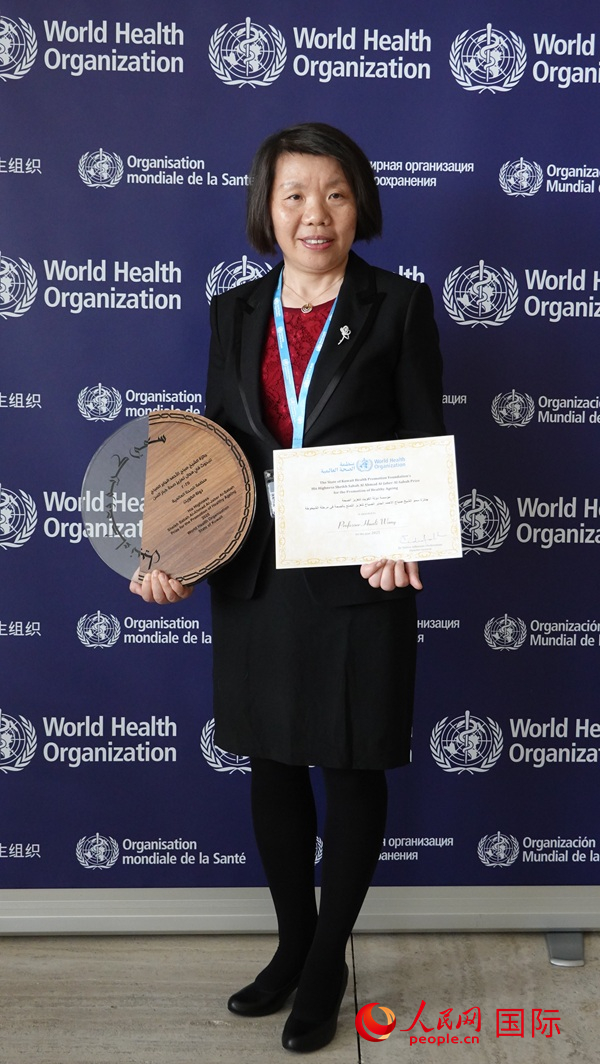
中国医生王华丽荣获世卫组织2025年度“促进健康老龄化奖”
人民网-国际频道 原创稿· 2025-05-24 07:41
Core Points - The World Health Organization awarded Dr. Wang Huali from Peking University Sixth Hospital the "Healthy Aging Award" for her outstanding contributions in elderly health care and health promotion [1][3] - This marks the first time a Chinese mental health expert has received this award since its establishment in 2003 [1][3] Group 1 - Dr. Wang Huali contributed to the development of China's "14th Five-Year Plan for Healthy Aging" and the "National Action Plan for Dementia (2024-2030)" [3] - She collaborated with the WHO to write global dementia guidelines and the iSupport online course [3] - Dr. Wang implemented a comprehensive management approach to dementia care, creating care guidelines and technical implementation plans used in 19 provinces [3] Group 2 - A community interdisciplinary service model combining professional and family support has been promoted in 150 teams across 27 regions in China [3] - Dr. Wang established the first dementia caregiver support group in China and created the first dementia patient-family association in 2000 [3] - Since 2006, she has advocated for cognitive function activation therapy in over 20 provinces [3]
NewLimit完成1.3亿美元B轮融资,推动AI赋能表观遗传重编辑疗法迈向临床
3 6 Ke· 2025-05-21 00:48
Core Insights - NewLimit, a startup focused on epigenetic reprogramming, raised $130 million in Series B funding led by Kleiner Perkins, with participation from existing investors like Founders Fund and Khosla Ventures, to address global health challenges posed by an aging population [1][15][16] - The company aims to leverage AI-driven epigenetic reprogramming technology to tackle the pressing issue of "healthy aging," as the global population aged 60 and above is projected to increase from 1 billion in 2020 to 2.1 billion by 2050 [1][15] Company Overview - Founded in 2021 by Brian Armstrong, co-founder of Coinbase, and Blake Byers, a former partner at Google Ventures, NewLimit embodies a "tech + bio" hybrid model, integrating venture capital and scientific expertise [2][3] - The company currently employs 34 scientists, engineers, and staff, with over 90% in technical roles, reflecting its commitment to innovation at the intersection of biotechnology and artificial intelligence [2] Scientific Foundation - NewLimit's approach is based on significant scientific discoveries, including the work of Shinya Yamanaka, who demonstrated that activating four key transcription factors can partially restore the youthful state of aging human skin cells [5][6] - The company aims to identify small molecules that can precisely modulate cellular epigenetic states, effectively "resetting" cells to a more youthful functional phenotype [5][6] Technological Advancements - NewLimit's "discovery engine" integrates high-throughput experimental platforms with AI predictive models, significantly enhancing the efficiency of drug target identification by hundreds of times [6] - The company has made substantial progress in transitioning from basic research to preclinical applications, with a focus on liver function restoration and immune rejuvenation [7][9] Clinical Applications - NewLimit's pipeline includes promising applications such as: - Liver function restoration targeting liver cells, with lead compound M003 showing an 85% recovery rate in alcoholic liver disease models [8][9] - Immune rejuvenation through specific transcription factor combinations that restore the functionality of aging CD8+ T cells [8][9] - The company has achieved key breakthroughs, including the establishment of a lipid nanoparticle delivery system for mRNA, facilitating the development of both small and large molecule therapies [9][11] Market Context - The global anti-aging market is projected to reach $348.3 billion by 2032, with a compound annual growth rate of nearly 5%, driven by the increasing population aged 60 and above [15][17] - NewLimit's funding trajectory reflects strong investor confidence in its technological approach and the broader trend of major tech companies entering the longevity economy [15][17] Implications for the Industry - NewLimit's development path offers insights for the Chinese anti-aging industry, emphasizing the importance of platform-based approaches, cross-disciplinary teams, and targeted applications in quantifiable functional restoration [19][20] - With ongoing advancements in AI, big data, and biomanufacturing, China is positioned to carve out a sustainable path in anti-aging technology development, contributing to high-quality growth in the biopharmaceutical sector [19][20]

最新研究显示,有钱人寿命更长、更健康,更易实现健康老龄化
生物世界· 2025-05-17 07:54
Core Viewpoint - The article discusses the increasing demand for health and social care due to aging populations and highlights the significant differences in frailty-free life expectancy and frailty life expectancy among different socio-economic groups [2][3][5]. Summary by Sections - The study conducted by Newcastle University and Manchester University analyzes the relationship between socio-economic characteristics and life expectancy without frailty, revealing that wealth is closely associated with both frailty-free and frailty life expectancy [3][5]. - Higher wealth correlates with significantly longer frailty-free life expectancy compared to poorer populations, with educated and married individuals also experiencing better health outcomes [3][6]. - The research utilized longitudinal data over 18 years to assess the life expectancy of individuals in frailty and non-frailty states, marking the first study to consider regional poverty and marital status in this context [5][6]. - The findings indicate that the wealthiest 20% of women have a frailty-free life expectancy that is 11.1 years longer than the poorest 20%, while the wealthiest men have a 9.8-year advantage [6][8]. - The overall life expectancy for the wealthiest individuals is 6.3 years longer for women and 6.4 years longer for men compared to the poorest [8]. - The disparities in frailty-free and frailty life expectancy highlight the importance of socio-economic factors, with wealth and regional poverty being the most significant determinants [8][9].