
去中心化金融

Search documents
币圈“极度恐慌”,市场为比特币跌向“80000美元”做准备
Hua Er Jie Jian Wen· 2025-11-18 00:21
Core Viewpoint - Bitcoin is experiencing a significant decline, with traders preparing for further downturns as protective demand for put options at lower price points has surged, indicating a bearish sentiment in the market [1][3]. Group 1: Market Sentiment and Price Movements - Bitcoin has fallen below $91,500, continuing its recent downward trend, with put options exceeding $740 million for contracts expiring at the end of November [1]. - The sentiment index from CoinMarketCap shows that cryptocurrency participants are in a state of "extreme fear," with many investors unable to buy more due to deep losses and unwilling to cut their losses [1]. - Ethereum, the second-largest cryptocurrency, has dropped to $2,975, marking a 24% decline since early October, reflecting weak performance [5]. Group 2: Impact on Crypto Treasury Companies - Digital asset "treasury companies" are under significant pressure, having accumulated large amounts of cryptocurrency earlier this year in an attempt to become concept stocks in the crypto market [2][3]. - Despite some companies like Michael Saylor's Strategy purchasing $835 million worth of Bitcoin, many peers are facing increasing pressure to sell assets to protect their balance sheets [3]. Group 3: Macro Factors Influencing the Market - Broader economic forces, including Federal Reserve policy expectations and discussions around the AI bubble, are contributing to negative market sentiment for cryptocurrencies and risk assets [6][7]. - Analysts indicate that the cryptocurrency market has been volatile since a significant liquidation event in early October, where approximately $19 billion in crypto assets were wiped out [7]. - The decline in open interest for cryptocurrency futures contracts, particularly for smaller tokens like Solana, has been noted, with some positions decreasing by more than half [7]. Group 4: General Market Conditions - The risk-averse sentiment has permeated the cryptocurrency market, reflecting broader macroeconomic anxieties rather than structural flaws within the crypto sector [8].
巴菲特谢幕时,他曾最鄙视的世界正在崛起
Sou Hu Cai Jing· 2025-11-12 06:36
Group 1 - Buffett announces retirement from public roles, stating he will no longer write the annual letter or attend shareholder meetings, marking the end of his role as a public commentator for Berkshire Hathaway [3] - Buffett endorses Greg Abel as the new CEO, describing him as an outstanding manager and communicator, and emphasizes his continued support as a significant shareholder during the transition [4] - Buffett accelerates charitable donations by converting Class A shares to Class B shares for four family foundations, clarifying that this does not reflect a negative outlook on Berkshire's future [5] Group 2 - Buffett acknowledges that the company's size has become a limiting factor for investment opportunities, but reassures shareholders that he remains optimistic about the company's prospects [5] - The contrast between Buffett's traditional value investment approach and the rising popularity of cryptocurrencies like Bitcoin and Ethereum is highlighted, with Bitcoin showing a cumulative increase of approximately 319% from 2015 to 2025 [7][8] - The emergence of stablecoins is changing the market dynamics, providing liquidity and facilitating decentralized finance, which indicates a shift in the perception of value and investment logic in the crypto space [8][10] Group 3 - The evolving financial landscape is characterized by a more diverse and dynamic definition of value, as traditional investment metrics are supplemented by new indicators such as network effects and community engagement in the crypto world [10][11]


Origin起源奥拉丁:挑战传统金融霸权的去中心化革命,试图用技术重构整个金融世界的运行规则
Sou Hu Cai Jing· 2025-11-09 00:12
Centralized Financial Monopoly - The traditional financial system is likened to a pyramid, with institutions like the Federal Reserve at the top, controlling the global economy through monetary policy [3] - This concentration of power leads to systemic risks and diminishes individual autonomy in financial activities [3] Decentralized Financial Revolution - The emergence of Bitcoin and Ethereum has opened the door to decentralized finance, but Origin aims to build a complete decentralized financial infrastructure [4] - Origin's ambition is to replace core functions of traditional financial institutions with technology and code [4] Key Innovations of Origin - Origin's ecosystem focuses on three innovations: privacy stablecoins for censorship-resistant payments, LGNS tokens for a resilient economic model, and the Anubis chain for fully autonomous governance [4] - The integration of zero-knowledge proofs and multi-party computation allows for a transaction verification speed of 2,300 per second while ensuring privacy [4] - The reserve management system operates across 23 jurisdictions, utilizing smart contracts for automated audits, eliminating human manipulation [4] Redefining Financial Infrastructure - Origin is redefining every aspect of financial infrastructure, from cross-border payments to derivatives trading [6] - The privacy payment protocol APay has processed $4.7 billion in transactions from sensitive regions, avoiding traditional monitoring systems like SWIFT [6] - Interest rates within Origin's ecosystem are algorithmically set based on supply and demand data from 8,500 nodes, rather than centralized decisions [6] Redefining Financial Sovereignty - Origin represents a fundamental restructuring of financial power dynamics, demonstrating that algorithms and community governance can replace centralized authority [8] - This decentralized finance movement offers a vision of a world where financial power is distributed, and individuals regain economic autonomy [8] - The movement signifies a shift from passive acceptance of the financial system to active participation in its construction [8]

小摩:历经暴跌洗礼后 比特币将向17万美元进发
智通财经网· 2025-11-07 06:57
Core Viewpoint - Morgan Stanley analysts predict that Bitcoin prices could rise to around $170,000 in the next 6 to 12 months as leverage resets are completed and Bitcoin's volatility relative to gold continues to improve [1][2]. Group 1: Market Analysis - The cryptocurrency market has retraced nearly 20% from recent highs, with the most significant drop occurring on October 10 due to record liquidations in the perpetual futures market [1]. - A smaller liquidation event occurred on November 3, triggered by a $120 million hack of the Balancer protocol in the decentralized finance sector, which further undermined investor confidence [1]. - Analysts believe that the deleveraging phase in perpetual futures is largely over, as the ratio of open interest in Bitcoin perpetual futures to market capitalization has returned to historical norms [1]. Group 2: Investment Insights - Analysts highlight that perpetual futures are currently the most noteworthy investment tool, with signs indicating that the deleveraging process may have concluded [2]. - The rising volatility of gold has made Bitcoin more attractive on a risk-adjusted return basis, with the volatility ratio of Bitcoin to gold dropping below 2.0, indicating that Bitcoin currently occupies about 1.8 times the risk capital of gold [2]. - To match the total investment scale of gold, which is approximately $6.2 trillion, Bitcoin's market capitalization of about $2.1 trillion would need to increase by nearly 67%, suggesting a theoretical price close to $170,000 [2]. - There remains a significant discount of about $68,000 from Bitcoin's current price relative to its fair value adjusted for volatility against gold, indicating substantial upside potential in the next 6 to 12 months [2].

美联储宣布降息25个基点,USDT钱包XBIT Wallet拆解最新市场动向
Sou Hu Cai Jing· 2025-11-06 07:10
Core Insights - The Federal Reserve announced a 25 basis point interest rate cut to a range of 3.75%-4.00%, marking a three-year low, reflecting the complexities in the global financial market [1] - The introduction of the XBIT Wallet decentralized web3 wallet provides a new security solution for USDT wallet users amid the economic turbulence [1] Federal Reserve Policy - The interest rate cut continues the Fed's "preventive" easing path, with dissenting opinions from Kansas City Fed President Esther George and Governor Michelle Bowman highlighting deep-seated policy conflicts [1] - The Fed's decision to restart its Treasury buying program and adjust its asset portfolio through MBS reinvestment signals a response to tightening liquidity in the money market [1] XBIT Wallet Features - The XBIT Wallet upgrade focuses on three core breakthroughs, including a unique "three-lock security system" for multi-layer encryption of private keys, addressing the urgent need for high-security USDT wallets [3] - The wallet employs a hierarchical mnemonic backup mechanism, generating 12 mnemonic words for enhanced security, balancing convenience for daily transactions and safety for large asset storage [3] - The introduction of a "dynamic private key rotation" feature generates temporary keys for each transaction, mitigating risks of man-in-the-middle attacks [3] User Education and Security - XBIT Wallet innovates with a "private key knowledge graph" system, providing a visual interface for users to understand the security protocols for private key management [4] - The system includes a "sandbox" mode for users to simulate private key operations in a risk-free environment, lowering the barriers to using decentralized wallets [4] Asset Management and Market Response - XBIT Wallet's asset management strategy aligns with the Fed's policy shifts, featuring an "intelligent asset allocation" function that adjusts USDT wallet asset distribution based on market volatility [6] - The wallet incorporates a "dual-factor authentication" system, enhancing security during periods of increased trading volume due to Fed policy changes [6] Industry Context - The global crypto market is undergoing structural changes, with Fed policy adjustments accelerating the integration of traditional finance and decentralized finance [7] - XBIT Wallet's security architecture is designed to address policy volatility risks, utilizing modular security components for scalable protection [7] - The innovative "safety circuit breaker" mechanism automatically freezes assets upon detecting abnormal transaction patterns, showcasing its proactive defense capabilities [7] Future Outlook - As the Fed's policy trajectory becomes clearer, the digital asset market is expected to face more complex volatility [9] - XBIT Wallet's continuous iteration of security solutions aims to build a protective moat for USDT wallet users, adapting to policy fluctuations [9] - The "security knowledge engine" system updates users on global policy changes and security threats, providing customized safety recommendations through AI algorithms [9]
市场情绪已接近底部,最新web3钱包XBIT Wallet或成突破历史新高的关
Sou Hu Cai Jing· 2025-11-06 04:04
Core Insights - The sentiment in the cryptocurrency market is nearing a bottom, with institutional investors and financial advisors increasing their allocation to Bitcoin, as evidenced by net inflows into ETFs like iShares Bitcoin Trust (IBIT) and Fidelity Wise Origin (FBTC) [1][5] - XBIT Wallet is positioned as a key tool for investors in the crypto market, leveraging three core advantages to reshape digital asset management [1][6] Group 1: XBIT Wallet Features - XBIT Wallet operates as the official wallet of the XBIT decentralized exchange, allowing users to have 100% control over their private keys through a decentralized architecture [1][3] - The wallet employs multi-signature technology to enhance asset security, enabling users to back up their wallets using 12 mnemonic words, which correspond to 11-bit binary data, generating a unique 128-bit seed entropy [1][3] - XBIT Wallet supports cross-chain asset management and seamless interaction with DeFi protocols, acting as a web3 economic passport [3][6] Group 2: Security and Compliance - The wallet adheres to BIP39 standards, requiring offline paper backups of mnemonic phrases to mitigate cloud storage risks, a design proven valuable after the Kiln staking incident [3][5] - XBIT Wallet utilizes hardware-level security modules for private key generation and storage, ensuring that signing operations occur within the secure chip environment [3][5] - The platform features on-chain transparent audit windows for real-time verification of all leveraged positions, aligning with the transparency requirements of the new generation of decentralized finance [5][6] Group 3: Market Performance and Future Outlook - XBIT Wallet's user asset scale continues to rise, with its decentralized exchange accounting for 14% of the total trading volume in the Solana ecosystem, marking it as one of the fastest-growing platforms [5][6] - The non-custodial staking model of XBIT Wallet provides users with stable income sources, converting technical risks into financial product credit risks, thus achieving risk diversification and stable returns [5][6] - As the web3 economy develops, XBIT Wallet is expected to play a more significant role, offering innovative non-custodial staking models and cross-chain asset management capabilities to inject new growth momentum into the crypto market [6]

WALL STREET SOUTH: Miami to take over as 'financial powerhouse' after Mamdani win
Youtube· 2025-11-05 17:30
And joining me now is the mayor of Miami. That would be his honor, Francis Suarez. Sir, your honor, this conference is is going to showcase your city as a financial powerhouse.Okay. What makes you say Miami is already a financial powerhouse. >> Well, first of all, Stuart, I just want to thank you uh as I sunset in this stage of my career as mayor into into the future.I just want to say thank you because you've always invited me on to your show. You've always been amazing with me and given me an opportunity ...

比特币跌至6月以来最低点,10月闪崩的“后遗症”仍在持续!
Jin Shi Shu Ju· 2025-11-04 14:15
周二,比特币连续第二个交易日走低,下破10.4万美元关口,日内一度大跌3.1%,创6月底以来的最低水平。以太坊跌幅最高达3.9%,多款所谓的 "山寨 币"也出现相近幅度的下跌。多项指标凸显加密货币交易者情绪低迷。 宏观经济环境同样不利。美联储12月降息的预期已经大幅回落,这意味着高利率环境可能持续更久。XS.com市场分析师Lin Tran指出,这 "推高了持有比特 币这类无收益资产的机会成本,同时抑制了短期投机动能"。 更大的不确定性来自去中心化金融领域的危机。周一包括基于以太坊的去中心化金融协议Balancer遭遇黑客攻击,超1亿美元数字资产被窃取。这一漏洞是 过去几周一系列看跌事件中的最新一起,令数字资产投资者提心吊胆。 此前,金融科技专家、Concord Fintech Solutions联合创始人奥莲娜・索西埃德卡(Olena Sosiedka)曾警告,在9月至10月初加密货币价格快速上涨后,比特 币将进入 "调整休整期"。这位专家预测:"显然,未来几周比特币将处于波动状态。" 她建议:"当前市场情绪极度敏感,因此重要的是不要追高,而应保持冷静,采取战略性、渐进式的行动。" 此次下跌发生在一场历史性 ...
比特币跌破10.5万美元 去中心化金融混乱与美元走强施压
Sou Hu Cai Jing· 2025-11-04 08:51
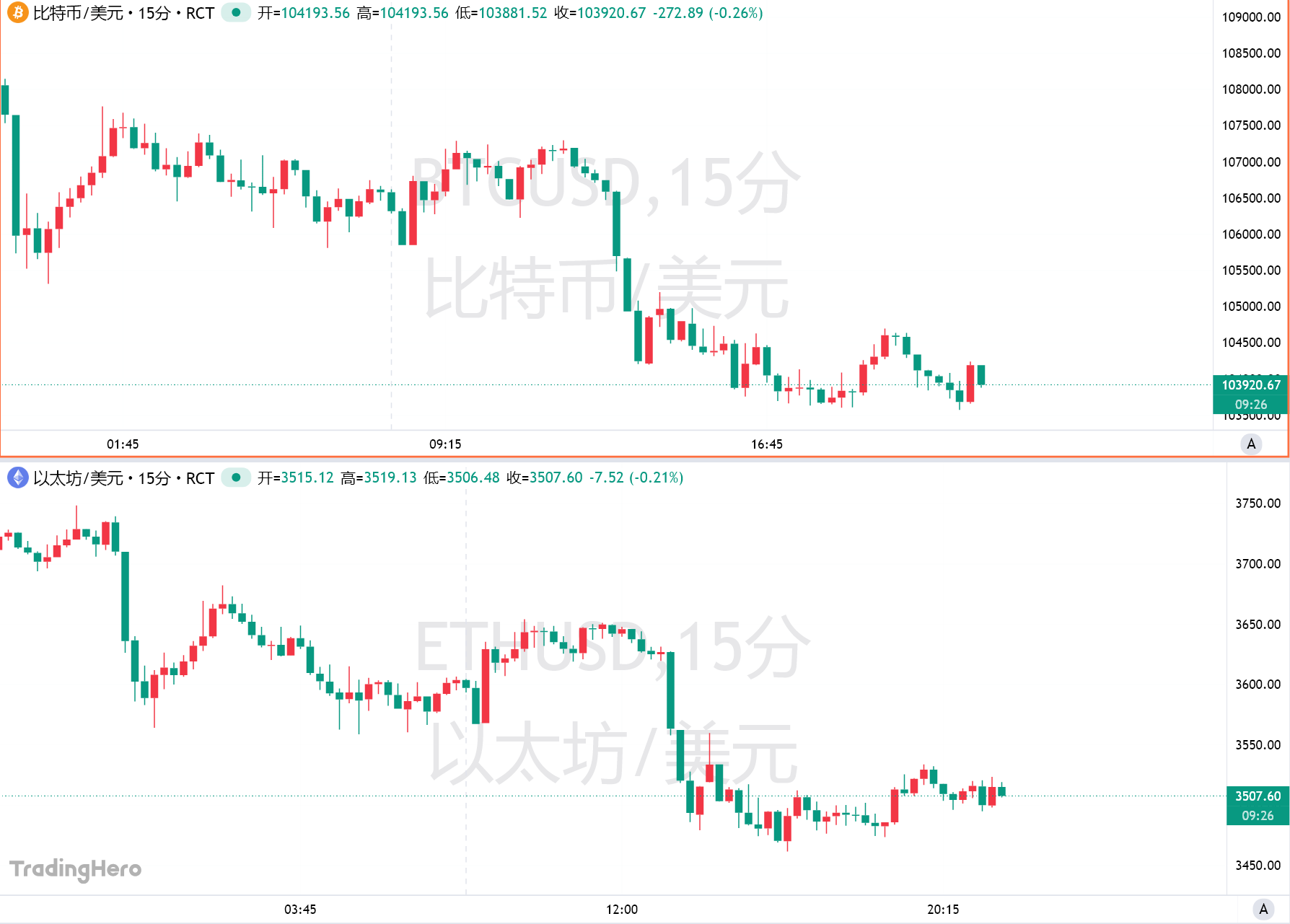
Core Viewpoint - Bitcoin continues to decline, extending its downward trend in October due to a stronger dollar and turmoil in the decentralized finance sector [1] Group 1: Market Performance - Bitcoin dropped by 2.5% to $104,200, marking its lowest level in over two weeks [1] - Ethereum fell by 3.4%, dropping below $3,500 [1] - The decline follows a historic sell-off three weeks ago, which resulted in the liquidation of leveraged positions in the crypto market, causing losses in the billions [1] Group 2: Investor Sentiment - Investors are cautious about Bitcoin's ability to rebound, with market makers indicating that traders are "still unwilling to return to large-scale positions" [1] - The total open interest in Bitcoin perpetual futures is approximately $68 billion, down about 30% from October's peak [1] - In the past 24 hours, the overall selling pressure in the crypto market led to the liquidation of approximately $1.2 billion in long positions [1] Group 3: Fund Flows - Over the past four trading days, investors have withdrawn more than $1.8 billion from Bitcoin and Ethereum spot ETFs [1]
比特币跌至两周低点 史诗级爆仓事件后风险偏好低迷难振
Sou Hu Cai Jing· 2025-11-04 08:29
Core Insights - Bitcoin continues to decline after a significant October, with a drop of 2.5% to $104,179, marking a two-week low [1] - Ethereum, the second-largest cryptocurrency, fell 3.4% to below $3,500, retreating from recent highs [1] - A historic liquidation event three weeks ago resulted in billions of dollars in leveraged cryptocurrency positions being wiped out, leading to investor reluctance to bet on a strong Bitcoin rebound [1]