移动互联网

Search documents
工业和信息化部:我国移动互联网用户数突破16亿户
Zhong Guo Qing Nian Bao· 2025-09-24 01:46
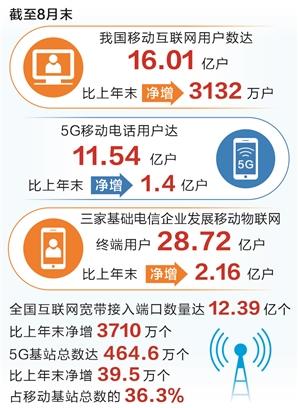
Group 1 - The core viewpoint of the article highlights the steady growth of China's telecommunications industry, with significant increases in mobile internet traffic and user numbers [1] - In the first eight months of the year, China's mobile internet traffic reached 2534 billion GB, representing a year-on-year growth of 16.4% [1] - As of the end of August, the number of mobile internet users in China reached 1.601 billion, with a net increase of 31.32 million users compared to the end of the previous year [1] Group 2 - The total telecommunications business revenue for the first eight months amounted to 118.21 billion yuan, reflecting a year-on-year growth of 0.8% [1] - The total telecommunications business volume, calculated at constant prices from the previous year, grew by 8.8% year-on-year [1] - The total number of fixed internet broadband access users reached 689 million, with a net increase of 18.85 million users since the end of the previous year [1] Group 3 - The total number of mobile phone users among the three major telecommunications companies and China Broadcasting reached 1.819 billion, with a net increase of 29.53 million users since the end of the previous year [1] - The number of 5G mobile phone users reached 1.154 billion, with a net increase of 14 million users since the end of the previous year [1] - As of the end of August, the total number of 5G base stations in China reached 4.646 million, with a net increase of 395,000 stations, accounting for 36.3% of the total mobile base stations [1]
时报数说 | 我国移动互联网用户数突破16亿户
Zheng Quan Shi Bao· 2025-09-23 18:20
Core Insights - The article discusses the recent trends and developments in the investment banking sector, highlighting key financial metrics and market dynamics [2] Group 1: Industry Overview - The investment banking industry has shown resilience despite economic fluctuations, with a notable increase in M&A activities [2] - Recent data indicates a 15% year-over-year growth in advisory fees, reaching approximately $25 billion [2] - The sector is experiencing a shift towards digital transformation, with firms investing heavily in technology to enhance service delivery [2] Group 2: Company Performance - Major investment banks reported a 10% increase in revenue for the last quarter, driven by strong trading performance and advisory services [2] - Cost management strategies have led to a 5% reduction in operational expenses across the top firms [2] - The average deal size in M&A transactions has risen to $1.2 billion, reflecting increased confidence in market conditions [2]

我国移动互联网用户数突破16亿户
Qi Huo Ri Bao· 2025-09-23 16:07
Core Insights - The Chinese telecommunications industry has shown stable performance in the first eight months of the year, with significant growth in mobile internet traffic and user numbers [1] Industry Performance - As of the end of August, the number of mobile internet users reached 1.601 billion, an increase of 31.32 million compared to the end of the previous year [1] - The total telecom business revenue for the first eight months was 1,182.1 billion yuan, reflecting a year-on-year growth of 0.8% [1] User Growth - The total number of mobile phone users among the three major telecom operators and China Broadcasting reached 1.819 billion, with 5G mobile phone users accounting for 1.154 billion, an increase of 14 million since the end of last year [1] - The number of mobile IoT terminal users grew rapidly, reaching 2.872 billion, which is an increase of 216 million from the end of the previous year [1]
我国移动互联网用户数突破16亿
Xin Jing Bao· 2025-09-23 04:22
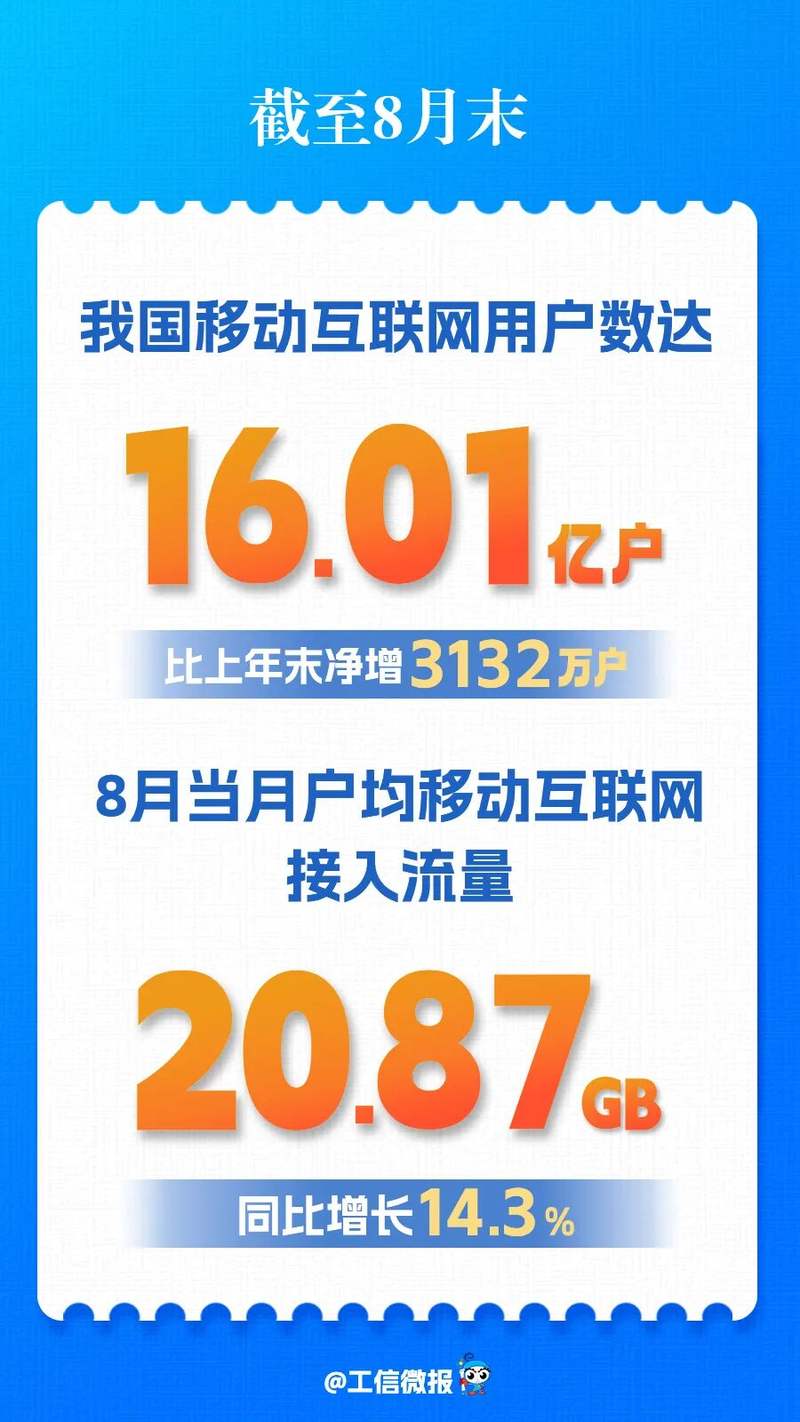
截至8月末 我国移动互联网用户数达 T 比上年未净增 3132元户 8月当月户均移动互联网 接入 流量 @ C C 编辑 刘佳妮 ...
2025年1-6月全国移动互联网接入流量统计分析:累计值为1866.81亿GB,累计增长16.4%
Chan Ye Xin Xi Wang· 2025-09-17 03:36
Group 1 - The total mobile internet access traffic in China from January to June 2025 reached 1866.81 billion GB, representing a cumulative growth of 16.4% [1] - In June 2025, the mobile internet access traffic was 330.03 billion GB, showing a year-on-year growth of 17.6% but a month-on-month decline of 2.3% [1]

广发基金孙迪:在科技制造浪潮中,捕捉真正具备“先进性”的企业
Zhong Guo Zheng Quan Bao· 2025-09-15 02:13
Core Viewpoint - The concept of "advanced" in investment transcends mere technology, embodying a depth of understanding and foresight in industry trends, company barriers, and global competitiveness [1] Group 1: Understanding "Advanced" - The definition of "advanced" encompasses multiple dimensions, including the industry lifecycle stage, company barriers, profitability, and global competitiveness [1][2] - The industry must be in a growth phase with significant market potential for a company to be considered advanced [2] - A company's competitive barriers, which may arise from technological breakthroughs or customer relationships, are crucial for maintaining an advantageous position in the market [2][3] Group 2: Profitability and Global Competitiveness - Strong profitability is a financial manifestation of advanced status, with a focus on companies that can escape homogenized competition and price wars through genuine innovation [3] - The ultimate test of advanced status is a company's ability to compete on a global scale, integrating into global supply chains and competing with industry giants [3] Group 3: Investment Strategy - The investment strategy involves a "three-layer screening" approach to identify and dynamically allocate opportunities [4][5] - The first layer focuses on major industry trends that can significantly alter lifestyles, such as AI and renewable energy, which present long-term investment opportunities [4] - The second layer targets traditional manufacturing and cyclical growth sectors when major industry opportunities are absent, identifying turning points based on supply and demand changes [4] - The third layer involves investing in high-quality companies with reasonable valuations during stable cycles to benefit from steady earnings growth [5] Group 4: Market Insights and Focus Areas - The current market is characterized by rapid sector rotation, yet the underlying trend favors strong industry directions, particularly in innovative pharmaceuticals and AI [7] - The AI industry is still in its early stages, with significant potential for growth, particularly in hardware infrastructure [7] - Within the semiconductor sector, the focus is on wafer manufacturing due to high barriers and ongoing demand, while also monitoring promising areas in chip design [8]
广发基金孙迪:深入理解“先进制造” 扎根AI挖掘长期价值
Zhong Guo Zheng Quan Bao· 2025-09-15 00:30
Core Viewpoint - The concept of "advanced" in investment transcends technology, representing a depth of understanding and foresight in industry trends, company barriers, and global competitiveness [1] Group 1: Understanding "Advanced" Manufacturing - "Advanced" is broken down into four interconnected dimensions: industry growth stage, competitive barriers, profitability, and global competitiveness [3][4] - The industry must be in a growth phase with significant market potential for a company to be considered advanced [3] - Companies must establish sufficient competitive barriers, which can stem from technological breakthroughs, channel control, or customer relationships [4] Group 2: Profitability and Global Competitiveness - Strong profitability is a financial manifestation of advanced manufacturing, focusing on companies that avoid homogenized competition and price wars [4] - The ultimate test of advanced manufacturing is the ability to compete on a global scale, integrating into global supply chains and competing with industry giants [4] Group 3: Investment Strategy - The investment strategy involves a "three-layer screening" approach to identify and dynamically allocate opportunities [5][6] - The first layer focuses on major industry trends that can significantly alter lifestyles, such as mobile internet and AI, which are expected to yield substantial returns [5] - The second layer targets traditional manufacturing and cyclical growth sectors when no major industry opportunities are present [5] - The third layer involves investing in high-quality companies with reasonable valuations during stable cycles [6] Group 4: AI and Semiconductor Investment Opportunities - The AI industry is viewed as a long-term investment opportunity, with the potential to rival the mobile internet wave [7] - Within the AI sector, hardware infrastructure, particularly overseas computing chains, is highlighted as a promising area due to its growth potential and favorable market conditions [7] - In the semiconductor sector, the focus is on wafer manufacturing, which is characterized by high barriers and sustained demand [8] Group 5: Long-term Value Discovery - Technology investment is framed as a marathon focused on discovering long-term value rather than chasing short-term trends [9] - The management strategy emphasizes core positions in overseas computing chains while monitoring the fundamentals of secondary companies [9]

深入理解“先进制造” 扎根AI挖掘长期价值
Zhong Guo Zheng Quan Bao· 2025-09-14 20:14
Core Viewpoint - The concept of "advanced" in investment transcends mere technology, embodying a depth of understanding and foresight in industry trends, company barriers, and global competitiveness [1][2] Understanding "Advanced" in Four Dimensions - The first dimension is the industry stage, where true advanced manufacturing should be in a growth phase with significant market potential, rather than in a stable or declining phase [2] - The second dimension focuses on the competitive barriers a company has established, which may arise from technological breakthroughs, channel control, or customer relationships [2] - The third dimension is the company's profitability, emphasizing the importance of escaping homogenized competition and price wars to achieve premium pricing through genuine innovation [2] - The fourth dimension assesses global competitiveness, where companies must integrate into global supply chains and compete directly with international giants to be considered truly advanced [2] Three-Layer Screening and Dynamic Validation - The first layer of the investment strategy involves identifying major industry trends that can significantly alter human lifestyles, such as mobile internet, AI, and new energy [3] - The second layer focuses on traditional manufacturing and cyclical growth sectors when no major industry opportunities are present, identifying turning points in supply and demand [3] - The third layer involves investing in high-quality companies with reasonable valuations during stable cycles to benefit from steady earnings growth [3] Investment Philosophy - The investment philosophy emphasizes a balance between offensive and defensive strategies, with a focus on industry concentration when clear trends are identified, and diversification when uncertainties arise [4] - The approach also includes avoiding investments in themes lacking performance support, ensuring that valuations remain within acceptable ranges [4] Long-Term Opportunities in AI Investment - The market has shown a preference for strong industry trends, with innovative pharmaceuticals and AI being recognized as the two most sustainable directions this year [4] - The AI industry is viewed as a potential investment opportunity comparable to the mobile internet wave, currently in its early stages with no breakout applications yet [5] Focus Areas within AI and Semiconductor Sectors - Within the AI industry, the hardware infrastructure, particularly overseas computing chains, is highlighted as having significant growth potential and favorable market conditions [5] - In the semiconductor sector, the current cycle is characterized as relatively weak, driven by AI, with a focus on wafer manufacturing due to its high barriers and ongoing demand [5]
AI投资如何选人?创世伙伴周炜:要经验丰富,但做AI不超3年的
Xin Lang Ke Ji· 2025-09-13 08:52
"在硅谷我们喜欢年轻的有挑战精神,但我们还是希望他至少还是遵守职业道德职业操守的。"周炜表 示。(文猛) "如果一个创业者做AI超过3年以上,我会很慎重,因为3年前的AI和现在的AI在他眼中是一个物种,但 在我看来不是一个物种。"周炜表示,因为他们会把这看作是同一个物种,所以始终在用上一代AI的观 点看这一代AI的事情。 责任编辑:张恒星 相比之下,由于现在中美两国的创业者环境、生态正在渐行渐远。周炜对于硅谷项目的投资,则更希望 投大学毕业没几年的创业者,因为他们"有挑战精神"。不过其也指出,"硅谷年轻创业者非常有挑战精 神,币圈化非常严重,无论机构还是个人都不遵守规则,这个规则打破也很很可怕。" 新浪科技讯 9月13日下午消息,在2025Inclusion外滩大会上,创世伙伴创投创始主管合伙人周炜分享中 指出,"自己在国内投资AI项目时,更倾向于投经验丰富,但做AI不超过三年的创业者。" "这有点像当年开始投移动互联网的时候,一帮PC互联网说这个事情我都懂,随时可以把它搬到手机 上,但其实不是那么回事,差别很大。"周炜解释道:"在国内我们会喜欢有经验的,但不希望他在AI上 经验时间太长,这反而是个负面。" ...

朱总瘦了
投中网· 2025-09-11 02:45
Core Viewpoint - The article reflects on the 20th anniversary of金沙江创投, highlighting its evolution, key figures, and investment strategies over the years, particularly focusing on朱啸虎's role and the firm's adaptability in the changing investment landscape [2][9]. Group 1: History and Formation - 金沙江创投 was initially named "中国新产业基金" and focused on "hard technology," later rebranding to signify its role in nurturing Chinese technology [3][4]. - The founding team included experienced professionals from various sectors, establishing a strategic partnership with Mayfield, a prominent Silicon Valley fund, to connect Chinese projects with global resources [4][3]. - The first fund raised $75 million in 2005, marking a significant milestone in China's VC landscape, with subsequent funds showing substantial growth [4][3]. Group 2: Investment Strategy and Key Projects - 朱啸虎 joined 金沙江创投 in 2007, becoming the youngest partner, and was involved in notable projects like 百姓网 and 拉手网, which later faced challenges [7][9]. - The firm experienced a shift in investment focus during the mobile internet boom, leading to successful investments in companies like 饿了么, 滴滴, and 小红书, which contributed to its reputation [9][10]. - In 2016, internal disagreements led to the departure of key partners, resulting in the establishment of separate entities, but 金沙江创投 continued to thrive under 朱啸虎's leadership [8][9]. Group 3: Recent Developments and Future Outlook - As of 2021, 金沙江创投 has not announced new fundraising, reflecting a period of consolidation and strategic planning for future investments [10][11]. - The firm has adapted to geopolitical risks by rebranding its U.S. operations and maintaining a focus on relevant investment opportunities without overextending [9][10]. - 朱啸虎's approach emphasizes quick returns and strategic exits, showcasing a balance between risk and opportunity in the current investment climate [10][11].