阿尔茨海默病治疗

Search documents
医药生物行业周报:2025AAIC大会总结阿尔茨海默病治疗领域更新-20250804
Guoxin Securities· 2025-08-04 13:09
Investment Rating - The report maintains an "Outperform" rating for the pharmaceutical and biotechnology sector [5][4]. Core Insights - The pharmaceutical sector has shown stronger performance compared to the overall market, with a 2.95% increase in the biopharmaceutical sector while the total A-share market declined by 1.01% [28][4]. - The report highlights significant advancements in Alzheimer's disease treatments presented at the 2025 AAIC conference, with multiple drugs updating their clinical research data [11][5]. - Roche's Trontinemab, a new generation Aβ antibody, demonstrated a 91% clearance rate of Aβ plaques in high-dose groups during Phase 1b/2a trials, indicating promising safety and efficacy [2][12]. Market Performance - The overall A-share market decreased by 1.01%, while the biopharmaceutical sector increased by 2.95%, with chemical pharmaceuticals leading with a 5.01% rise [28][4]. - The current price-to-earnings (P/E) ratio for the pharmaceutical sector is 39.10x, which is at the 80.69th percentile of its historical valuation over the past five years [33][4]. Key Companies and Investment Ratings - Mindray Medical (300760.SZ): Outperform, market cap 275.5 billion, projected net profit for 2024A is 11.67 billion [4]. - WuXi AppTec (603259.SH): Outperform, market cap 267 billion, projected net profit for 2024A is 9.35 billion [4]. - New Industries (300832.SZ): Outperform, market cap 42.6 billion, projected net profit for 2024A is 1.83 billion [4]. - Huatai Medical (688617.SH): Outperform, market cap 39.4 billion, projected net profit for 2024A is 670 million [4]. - Aier Eye Hospital (not listed): Outperform, focusing on rapid expansion in the ophthalmology service sector [37]. Clinical Research Developments - Trontinemab's Phase 1b/2a study showed significant reductions in Aβ plaque levels, with the 3.6 mg/kg dose group achieving a mean reduction from 119 CL to 21 CL after 12 weeks [14][12]. - The report emphasizes the strategic focus of overseas pharmaceutical companies on CNS (central nervous system) drug development, particularly in Alzheimer's treatments [2][25]. Recommendations - The report suggests monitoring the domestic and international AD detection and treatment drug-related industry chain, highlighting the potential for growth in this area [2][25].






医药生物周报(25年第30周):2025 AAIC 大会总结:阿尔茨海默病治疗领域更新-20250804
Guoxin Securities· 2025-08-04 09:57
Investment Rating - The report maintains an "Outperform" rating for the pharmaceutical and biotechnology sector [5][4]. Core Insights - The pharmaceutical sector has shown stronger performance compared to the overall market, with a 2.95% increase in the biopharmaceutical sector while the total A-share market declined by 1.01% [28]. - The report highlights significant advancements in Alzheimer's disease treatments presented at the 2025 AAIC conference, with multiple drugs updating their clinical research data [11][25]. - Roche's Trontinemab, a new generation Aβ antibody, demonstrated a 91% clearance rate of Aβ plaques in high-dose groups during Phase 1b/2a trials, indicating promising efficacy and safety [2][12]. Market Performance - The overall A-share market decreased by 1.01%, while the biopharmaceutical sector increased by 2.95%, with chemical pharmaceuticals leading with a 5.01% rise [28]. - The current price-to-earnings (P/E) ratio for the pharmaceutical sector is 39.10x, which is at the 80.69th percentile of its historical valuation over the past five years [28][33]. Key Companies and Investment Ratings - Mindray Medical (300760.SZ): Outperform, market cap 275.5 billion, projected net profit for 2024A is 11.67 billion [4]. - WuXi AppTec (603259.SH): Outperform, market cap 267 billion, projected net profit for 2024A is 9.35 billion [4]. - New Industries (300832.SZ): Outperform, market cap 42.6 billion, projected net profit for 2024A is 1.83 billion [4]. - Huatai Medical (688617.SH): Outperform, market cap 39.4 billion, projected net profit for 2024A is 670 million [4]. - Aier Eye Hospital (not listed in the table): Outperform, focusing on rapid expansion in the ophthalmology service sector [37]. Recommended Stocks - Mindray Medical: Strong R&D and sales capabilities, benefiting from domestic medical infrastructure and product upgrades [37]. - WuXi AppTec: Comprehensive service capabilities in new drug R&D, poised to benefit from the global outsourcing market [37]. - Aier Eye Hospital: Leading position in the domestic ophthalmology service sector, with a rapid expansion strategy [37].


医药生物周报(25年第30周):2025 AAIC 大会总结:阿尔茨海默病治疗领域更新:25年第30周-20250804
Guoxin Securities· 2025-08-04 08:41
Investment Rating - The report maintains an "Outperform" rating for the pharmaceutical and biotechnology sector [5][4]. Core Insights - The pharmaceutical sector has shown stronger performance compared to the overall market, with a 2.95% increase in the biopharmaceutical sector while the total A-share market declined by 1.01% [28]. - The report highlights significant advancements in Alzheimer's disease treatments presented at the 2025 AAIC conference, including promising data from various clinical trials [11][25]. - The current price-to-earnings (P/E) ratio for the pharmaceutical sector is 39.10x, which is at the 80.69th percentile of its historical valuation over the past five years [33]. Summary by Sections Market Performance - The overall A-share market decreased by 1.01%, with the Shanghai Composite Index down 1.75% and the ChiNext Index down 0.74%. In contrast, the biopharmaceutical sector increased by 2.95% [28]. - Within the biopharmaceutical sector, chemical pharmaceuticals rose by 5.01%, while medical devices saw a slight decline of 0.07% [28]. Clinical Research Updates - Roche's Trontinemab, a new generation Aβ antibody, demonstrated a 91% clearance rate of Aβ plaques in high-dose groups during Phase 1b/2a trials, with a low incidence of ARIA-E side effects [2][17]. - The report emphasizes the strategic focus of international pharmaceutical companies on Alzheimer's treatments, with FDA approvals for Biogen/Easai's Lecanemab and Lilly's Donanemab [25]. Company Earnings Forecasts - Major companies in the sector, such as Mindray Medical and WuXi AppTec, are projected to maintain strong earnings growth, with P/E ratios expected to decrease over the next few years [4]. - Mindray Medical is highlighted for its robust international expansion and product upgrades, while WuXi AppTec is noted for its comprehensive drug development services [37][38]. Recommended Stocks - The report recommends several companies, including Mindray Medical, WuXi AppTec, and Aier Eye Hospital, citing their strong market positions and growth potential in the pharmaceutical and medical services sectors [37][38].
阿尔茨海默病创新药长期随访结果如何?是否安全?最新数据公布
Di Yi Cai Jing· 2025-08-02 05:17
Core Insights - Early use of the drug Donanemab significantly benefits Alzheimer's patients, reducing the risk of disease progression to the next stage by 27% compared to those who start treatment later [1] Group 1: Drug Efficacy - Over 75% of early users of Donanemab achieved amyloid clearance within 76 weeks of treatment [2] - The rate of amyloid plaque re-deposition in patients who completed treatment was approximately 2.4 CL/year over a maximum observation period of 2.5 years [2] - Long-term follow-up showed no new safety signals during the extended phase of the study [2] Group 2: Safety Concerns - Previous treatments targeting amyloid have shown imaging-related abnormalities (ARIA), including edema/exudate (ARIA-E) and bleeding/hemosiderin deposition, which may lead to severe symptoms [2] - Brain swelling and bleeding related to amyloid-clearing drugs primarily occur within the first six months of treatment [2] Group 3: Market Context - Donanemab was officially introduced for clinical treatment in China at the end of March this year, with ongoing validation of its long-term efficacy in the Chinese patient population [2] - Another Alzheimer's drug, Lecanemab, has been in clinical use in China for over a year, showing a 34% slower cognitive decline compared to untreated patients after four years [3] - China has approximately 9.83 million Alzheimer's patients, with an estimated 20% being in the early stages of the disease, potentially benefiting from innovative treatments [3]
礼来:记能达对早期症状性阿尔茨海默病显示出三年持续增强获益
Zheng Quan Shi Bao Wang· 2025-08-02 02:29
Core Insights - Eli Lilly announced long-term extension results from its TRAILBLAZER-ALZ2 Phase 3 clinical study, showing significant disease progression slowdown in participants treated with donanemab compared to an untreated cohort from the Alzheimer's Disease Neuroimaging Initiative (ADNI) database [1] - The benefits of donanemab treatment continued to enhance over a three-year period, indicating sustained efficacy [1] - Participants who started treatment later still experienced benefits, but those who received early treatment had a significantly lower risk of progressing to the next stage of the disease compared to the delayed treatment group [1] - These findings were presented at the 2025 Alzheimer's Association International Conference (AAIC) held in Toronto [1]

渤健上调2025年财务指引,阿尔茨海默病药物销量持续增长
Huan Qiu Wang· 2025-08-01 07:10
Core Insights - Biogen has raised its financial guidance for 2025, driven by the continued growth in sales of its Alzheimer's drug, Leqembi, which has helped the company exceed Wall Street revenue expectations [1][3] Financial Performance - Biogen expects earnings per share for 2025 to reach $15.50 to $16.00, an increase from the previous forecast of $14.50 to $15.50 [3] - The company anticipates that total revenue for this year will remain flat compared to 2024, revising earlier expectations of a low single-digit percentage decline [3] - In Q2, Biogen reported total revenue of $2.6 billion, surpassing analyst expectations of $2.3 billion [3] Product Performance - Leqembi generated global revenue of $125 million in Q2, exceeding Wall Street expectations [3] - Sales of Leqembi in the previous two quarters were $96 million and $87 million, respectively [3] - The rare disease treatment Skyclarys achieved approximately $130 million in sales, aligning with expectations [3] Strategic Direction - Since taking office at the end of 2022, CEO Chris Viehbacher has focused on transforming Biogen by enhancing Leqembi sales, cutting costs, and reducing reliance on high-risk neurological drugs [3]



康哲药业(00867.HK):就治疗轻度至中度阿尔茨海默型痴呆症状的改良型新药ZUNVEYL中国上市许可申请已获受理
Ge Long Hui· 2025-07-28 09:41
Core Viewpoint - 康哲药业's new drug ZUNVEYL has received acceptance for its New Drug Application (NDA) from the National Medical Products Administration (NMPA) in China, aimed at treating mild to moderate Alzheimer's disease symptoms [1] Group 1: Product Details - ZUNVEYL is a new generation acetylcholinesterase inhibitor (AChEI) that improves cognitive and memory functions in Alzheimer's patients by increasing central acetylcholine levels [2] - The drug is a prodrug of galantamine, designed to reduce gastrointestinal side effects and improve patient tolerance, with recorded gastrointestinal adverse events below 2% [2] - ZUNVEYL is the second oral therapy for Alzheimer's approved by the FDA in the last decade, potentially enhancing medication adherence among patients [2] Group 2: Market Context - Alzheimer's disease is a chronic neurodegenerative condition, with Alzheimer's-type dementia accounting for 50% to 70% of all dementia cases, affecting approximately 9.83 million patients in China [3] - The increasing aging population is expected to raise the number of Alzheimer's patients, intensifying the disease burden [3] - Current Alzheimer's medications primarily focus on improving cognitive symptoms, with a significant demand for safer treatment options due to high side effect rates of existing drugs [3] Group 3: Strategic Partnerships - 康哲药业 has signed a licensing and collaboration agreement with Alpha Cognition Inc. for ZUNVEYL, granting exclusive rights for development and commercialization in Asia (excluding Japan and the Middle East), Australia, and New Zealand [4] - The agreement is set for an initial term of twenty years, with automatic five-year extensions unless terminated by either party [4] - ZUNVEYL is expected to diversify 康哲药业's innovative drug portfolio and enhance its competitive strength in the market, potentially benefiting the company's performance upon approval [4]
康哲药业(00867) - 自愿性及业务进展公告 就治疗轻度至中度阿尔茨海默型痴呆症状的改良型新药Z...
2025-07-28 09:31
自願性及業務進展公告 就治療輕度至中度阿爾茨海默型癡呆症狀的 改良型新藥ZUNVEYL中國上市許可申請已獲受理 China Medical System Holdings Limited(「本公司」,連同其附屬公司統稱為「本集團」) 欣然宣佈,改良型新藥ZUNVEYL(擬定通用名:葡萄糖酸苯加蘭他敏腸溶片) (「ZUNVEYL」或「產品」)新藥上市許可申請(NDA)已於二零二五年七月二十八 日獲得中國國家藥品監督管理局(NMPA)受理。產品擬用於治療成人輕度至中度阿爾 茨海默型癡呆症狀。 香港交易及結算所有限公司及香港聯合交易所有限公司對本公告的內容概不負責,對其 準確性或完整性亦不發表任何聲明,並表明概不就因本公告全部或任何部分內容而產生 或因倚賴該等內容而引致的任何損失承擔任何責任。 本公告乃由本公司自願刊發,旨在向潛在投資者及本公司股東通知本集團最新業務進 展,建議股東和投資者在進行本公司股票及其他證券的交易時謹慎操作。 ZUNVEYL於二零二四年七月獲得美國食品和藥物管理局(FDA)批准上市用於治療成 人輕度至中度阿爾茨海默型癡呆症狀,屬於新一代乙酰膽鹼酯酶抑制劑(AChEI),通 過抑制乙酰膽鹼酯酶 ...
中国博后一作兼通讯Nature论文:为阿尔茨海默病带来颠覆性治疗方法
生物世界· 2025-07-13 03:05
Core Viewpoint - The article discusses a groundbreaking study on tau protein disassembly in Alzheimer's disease, highlighting the potential of D-type peptides as a novel therapeutic strategy to combat neurodegenerative diseases [3][15]. Group 1: Alzheimer's Disease and Tau Protein - Alzheimer's disease (AD) is characterized by cognitive decline and is closely associated with the abnormal aggregation of tau protein and β-amyloid protein [2]. - Tau protein aggregation is more strongly correlated with the cognitive symptoms and severity of Alzheimer's disease compared to β-amyloid [2]. Group 2: Research Findings - A study published in Nature by Dr. Ke Hou from UCLA reveals that D-type peptides can disassemble tau fibrils without the need for enzymatic activity or external energy sources [3][15]. - The research introduces a new paradigm in amyloid protein studies, enhancing understanding of protein aggregation dynamics and inspiring innovative treatment strategies for Alzheimer's and other amyloid-related diseases [3][15]. Group 3: D-type Peptides Advantages - D-type peptides exhibit higher specificity and binding affinity compared to small molecules, with lower immunogenicity and resistance to proteolytic degradation [8]. - Previous studies indicated that D-type peptides could decompose tau protein fibers extracted from Alzheimer's patients and improve behavioral deficits in mouse models [8]. Group 4: Mechanism of Action - The study identified that D-type peptides assemble into amyloid-like fibers, which are essential for disassembling tau protein fibers [12]. - The tension released during the transition from left-handed to right-handed helical structures of these peptides is sufficient to disrupt local hydrogen bonds in tau fibers, leading to their disintegration [13][15]. Group 5: Implications for Treatment - The findings suggest that D-type peptides could revolutionize treatment methods for Alzheimer's disease and provide new tools for tackling other neurodegenerative diseases like Parkinson's and Huntington's disease [15]. - The stability, protease resistance, and good biocompatibility of D-type peptides allow them to cross the blood-brain barrier without eliciting harmful immune responses [15].

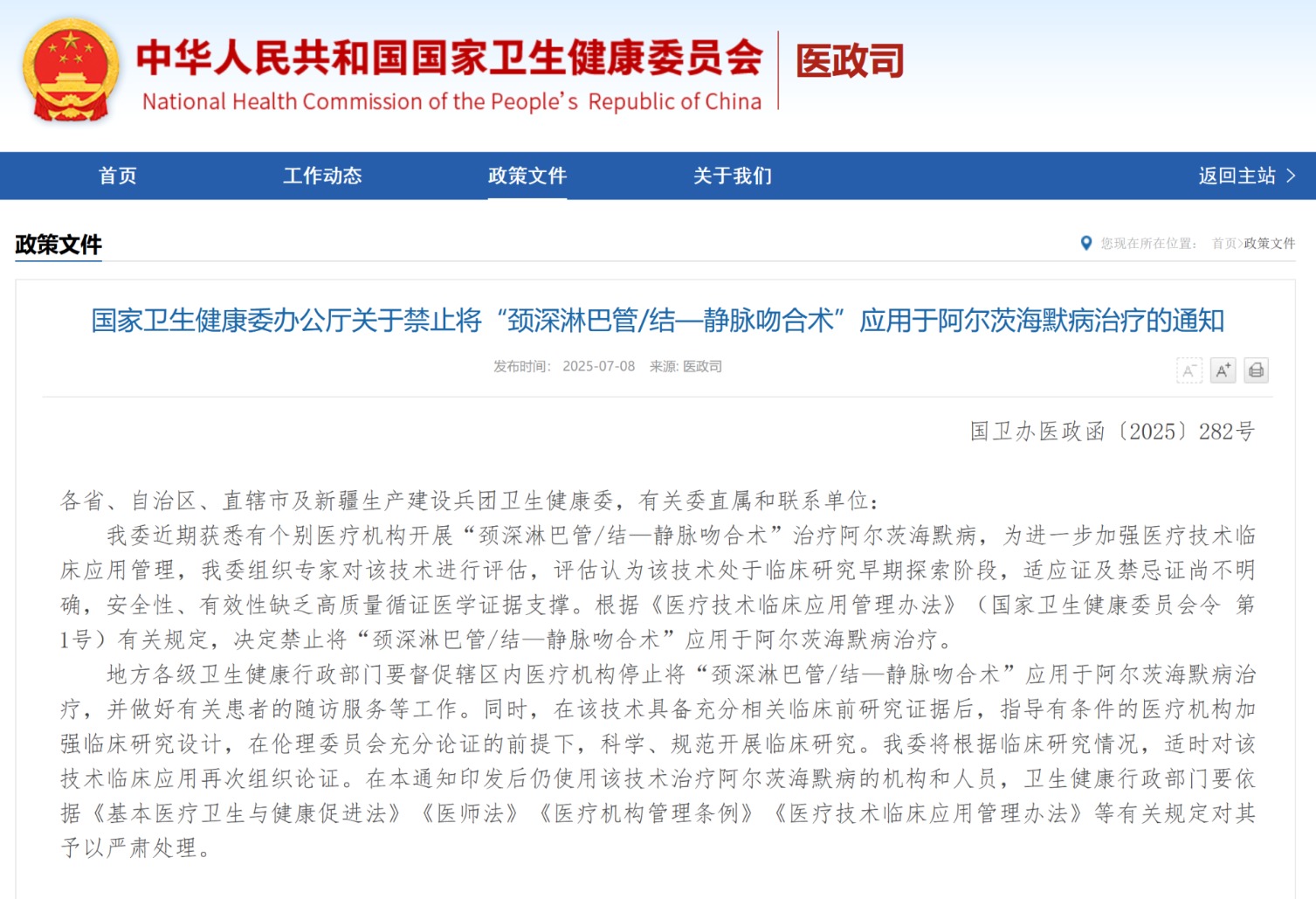
最高收费21万元!阿尔茨海默病手术被叫停背后:全国已做上千例 监管真空下医院借“创新治疗”之名收费
Mei Ri Jing Ji Xin Wen· 2025-07-10 14:52
Core Viewpoint - The National Health Commission of China has banned the use of "Lymphatic-Venous Anastomosis (LVA)" for the treatment of Alzheimer's disease due to a lack of long-term, statistically significant safety and efficacy data [1][2][15]. Group 1: Background of LVA Surgery - LVA surgery is not a new procedure; it was originally developed in the late 20th century for treating lymphatic diseases like lymphedema [2][12]. - The application of LVA for Alzheimer's treatment began in 2018 by Dr. Xie Qingping, leading to its widespread adoption in various medical institutions [2][12]. - Prior to the ban, over a hundred hospitals had been performing LVA surgeries, with total cases exceeding a thousand [7][12]. Group 2: Financial Aspects and Demand - The cost of LVA surgery ranges from tens of thousands to over 210,000 yuan, with many hospitals charging between 20,000 to 50,000 yuan [12][9]. - The financial burden of long-term care for Alzheimer's patients often makes LVA surgery an attractive option for families, as it can be more cost-effective compared to ongoing care [12][9]. - Hospitals have been motivated to promote LVA surgery due to the potential for significant revenue generation, especially in light of financial struggles faced by many medical institutions [12][13]. Group 3: Regulatory and Clinical Concerns - The rapid promotion of LVA surgery occurred in a regulatory vacuum, with many institutions conducting the procedure without sufficient clinical trial data to support its safety and efficacy [14][15]. - The National Health Commission's ban highlights the need for rigorous clinical trials and ethical guidelines for new treatments, as many hospitals had been charging for a procedure that lacked proper validation [15][16]. - There are currently only 12 registered clinical trials for LVA surgery in Alzheimer's treatment, indicating a significant gap in clinical research [15][16].