ESG投资理念

Search documents
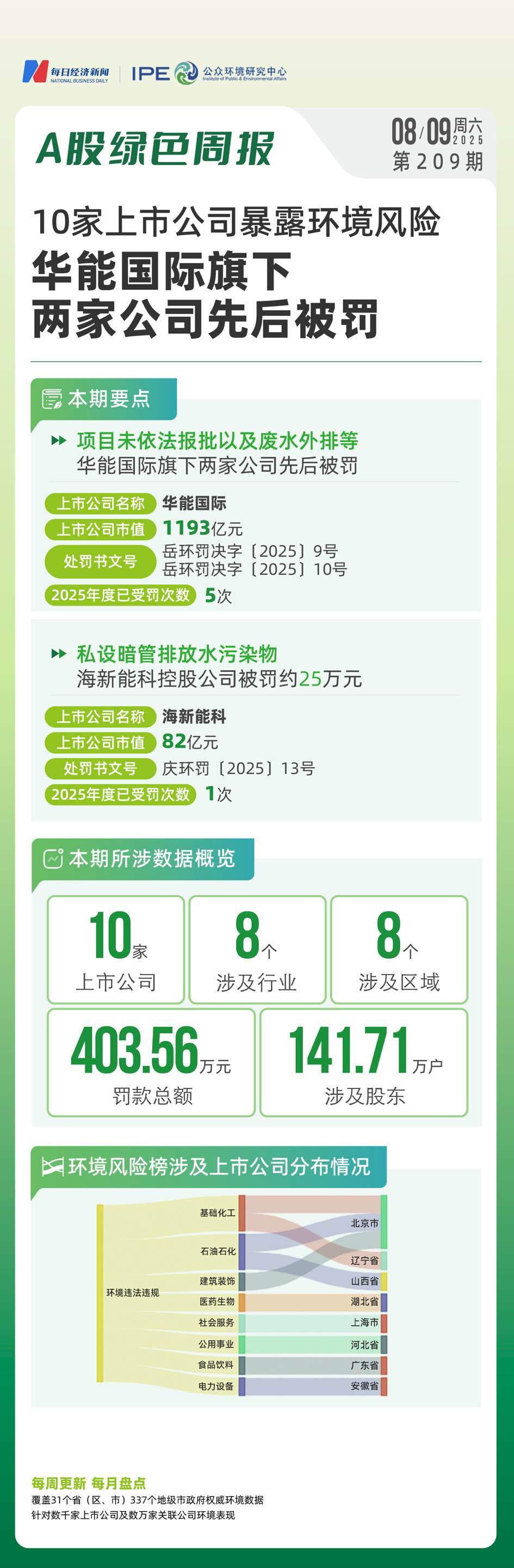
A股绿色周报丨10家上市公司暴露环境风险 华能国际旗下两家公司先后被罚
Mei Ri Jing Ji Xin Wen· 2025-08-09 12:11
Core Viewpoint - Environmental risks are increasingly becoming a significant operational risk for listed companies, impacting their development and corporate image [5]. Group 1: Environmental Violations and Penalties - Huaneng International's two subsidiaries were fined a total of 350,000 yuan for failing to legally approve environmental documents and for wastewater discharge issues [4][9]. - Hai Xin Neng Ke's subsidiary was fined 246,400 yuan for illegally discharging pollutants through a secret pipeline [10][11]. - A total of 10 listed companies were identified as having environmental risks, with 6 being state-controlled enterprises [7][8]. Group 2: Regulatory Framework and Public Awareness - The A-share Green Report project collects and analyzes environmental data from thousands of listed companies, aiming to enhance transparency in corporate environmental practices [4][12]. - The legal framework for environmental information disclosure has improved, ensuring public access to environmental data and participation in environmental protection [12].


高股息股票是长期热点
Bei Jing Shang Bao· 2025-08-06 16:05
Core Viewpoint - High dividend stocks are emerging as a stable investment choice amidst the rapid rotation of market themes, providing a safe haven for funds when other hotspots are absent [1][2][3] Group 1: Market Characteristics - The A-share market is currently exhibiting a dual-style characteristic, with thematic investments leading to rapid intra-day sector rotations while high dividend sectors like banks and utilities attract long-term capital [1][2] - High dividend stocks have shown their substitute value during market volatility, as funds quickly flow into blue-chip stocks with dividend yields exceeding 5% when thematic investments face collective pullbacks [1][2] Group 2: Economic and Regulatory Context - In the context of macroeconomic transformation, high dividend companies often operate in monopolistic industries or possess stable consumer attributes, leading to strong cash flow predictability [2] - The implementation of the registration system is shifting the A-share market from growth premium to value discovery, aligning high dividend strategies with ESG investment principles, which are favored by international capital [2] Group 3: Future Trends - The development of high dividend stocks is expected to follow three major trends: expansion from traditional sectors to stable cash flow industries like consumer goods and pharmaceuticals, the integration of dividend yield with other valuation metrics, and the growth of financial derivatives that enhance the efficiency of capital utilization [2]
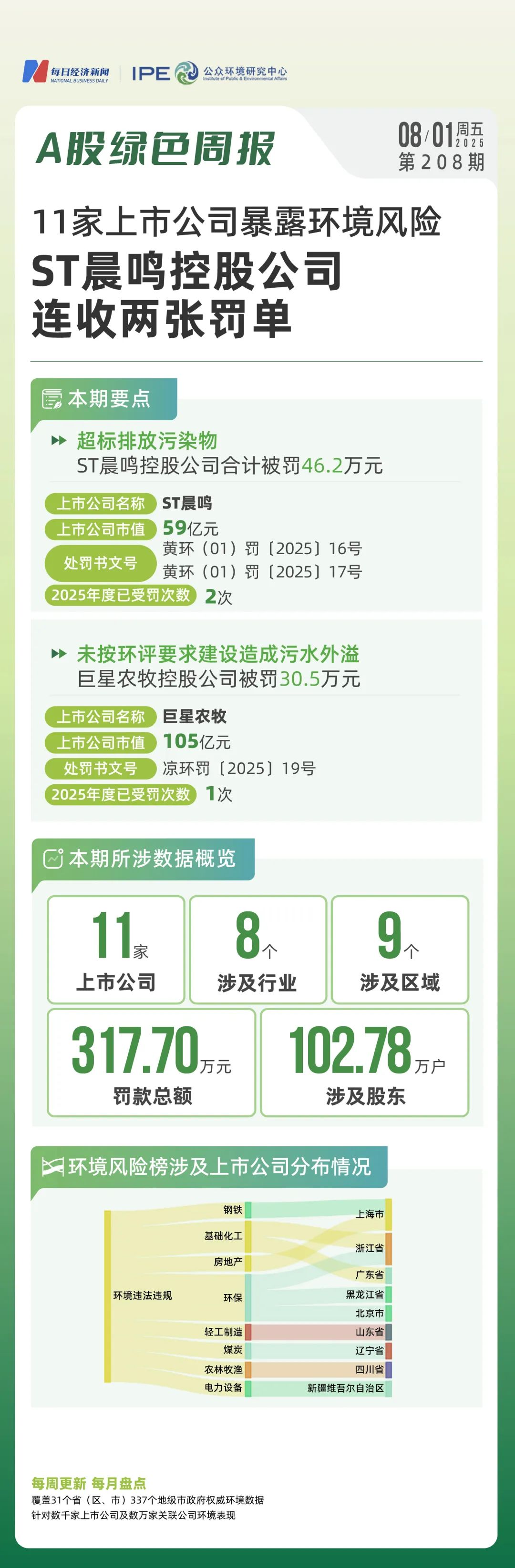
11家上市公司暴露环境风险,ST晨鸣控股公司连收两张罚单|A股绿色周报
Mei Ri Jing Ji Xin Wen· 2025-08-01 12:44
Core Viewpoint - Environmental risks are increasingly becoming a significant operational risk for listed companies, impacting both their development and corporate image [6][8]. Group 1: Environmental Violations and Penalties - ST晨鸣控股公司 was fined a total of 462,000 yuan for exceeding water pollution discharge standards [8][10]. - 巨星农牧控股公司 faced a penalty of 305,000 yuan due to construction not adhering to environmental impact assessment requirements, leading to wastewater overflow [10]. - A total of 11 listed companies were identified with environmental risks during the fourth and fifth weeks of July, with 6 of them being state-controlled enterprises [7][8]. Group 2: Regulatory Context and Data Collection - The "A股绿色周报" is published weekly, analyzing environmental information from thousands of listed companies based on data from 31 provinces and 337 cities [5][12]. - The report aims to enhance transparency regarding environmental information in the operational activities of listed companies [5][12]. - The increasing emphasis on ESG (Environmental, Social, and Governance) investment principles highlights the importance of companies' sustainable development capabilities [11][12].


从A到AA:陆控ESG实践获国际权威认可 审慎经营策略助可持续发展
Sou Hu Cai Jing· 2025-07-23 15:36
Core Viewpoint - Lufax Holding (06623.HK, NYSE.LU) has received an upgrade in its ESG rating from MSCI, moving from A to AA, indicating significant improvements in consumer rights protection and performance in privacy, data security, and human capital development compared to industry averages [2][7]. Group 1: ESG Rating and Recognition - MSCI's upgrade of Lufax's ESG rating reflects the company's commitment to consumer rights protection and its overall governance standards [2][8]. - The upgrade is expected to attract significant capital interest, as companies with higher ESG ratings often draw billions in investment [7][11]. Group 2: Business Strategy and Performance - Lufax has adopted a "quality first" cautious management strategy, focusing on a dual-engine model of "microfinance + consumer finance," which has led to improved asset quality and sustained growth in consumer finance [7][11]. - As of June 30, the total amount of new loans facilitated by the company reached 48.9 billion RMB, an 8.1% increase year-on-year, with consumer finance loans in Q2 amounting to 28.9 billion RMB, a 30.6% increase from the previous year [7][12]. Group 3: Consumer Rights and Technological Integration - Lufax has implemented a comprehensive consumer protection mechanism that covers all stages of the customer journey, ensuring strict management in areas like responsible marketing and debt management [8][9]. - The company leverages advanced technologies such as big data, AI, blockchain, and cloud computing to enhance its financial services and expand its reach to more small businesses and consumers [8][12]. Group 4: Market Position and Future Outlook - Lufax's strong ESG performance and prudent business strategy position it favorably in the domestic microfinance sector, likely leading to continued business growth and improved financial performance [11][13]. - The increasing global interest in ESG-compliant companies suggests that Lufax will continue to attract attention from international investors, enhancing its long-term investment appeal [12][13].
5家上市公司现环境风险 彤程新材控股企业被罚35.2万元
Mei Ri Jing Ji Xin Wen· 2025-07-20 13:08
Group 1 - The article highlights the increasing importance of environmental risks as a significant operational risk for listed companies, affecting both their development and public image [2] - A total of five listed companies have recently been exposed to environmental risks, with two of them being state-controlled enterprises, impacting approximately 267,800 shareholders [2] - Tongcheng New Materials' subsidiary, Tongcheng Chemical, was fined 352,000 yuan for exceeding permitted pollutant discharge concentrations, violating the Pollutant Discharge Permit Management Regulations [2][3] Group 2 - Anke Detection's subsidiary, Ling Shan Qihang Motor Vehicle Testing Co., was fined 121,420 yuan for issuing false emission inspection reports due to communication failures during vehicle diagnostics [3] - Huali Co.'s subsidiary, Zhejiang Huafu Composite Materials, was fined 195,000 yuan for improper storage of hazardous waste, failing to comply with national environmental protection standards [4][5] - The article emphasizes the growing focus on ESG (Environmental, Social, and Governance) investment principles, leading investors to prioritize companies' sustainable development capabilities [5]


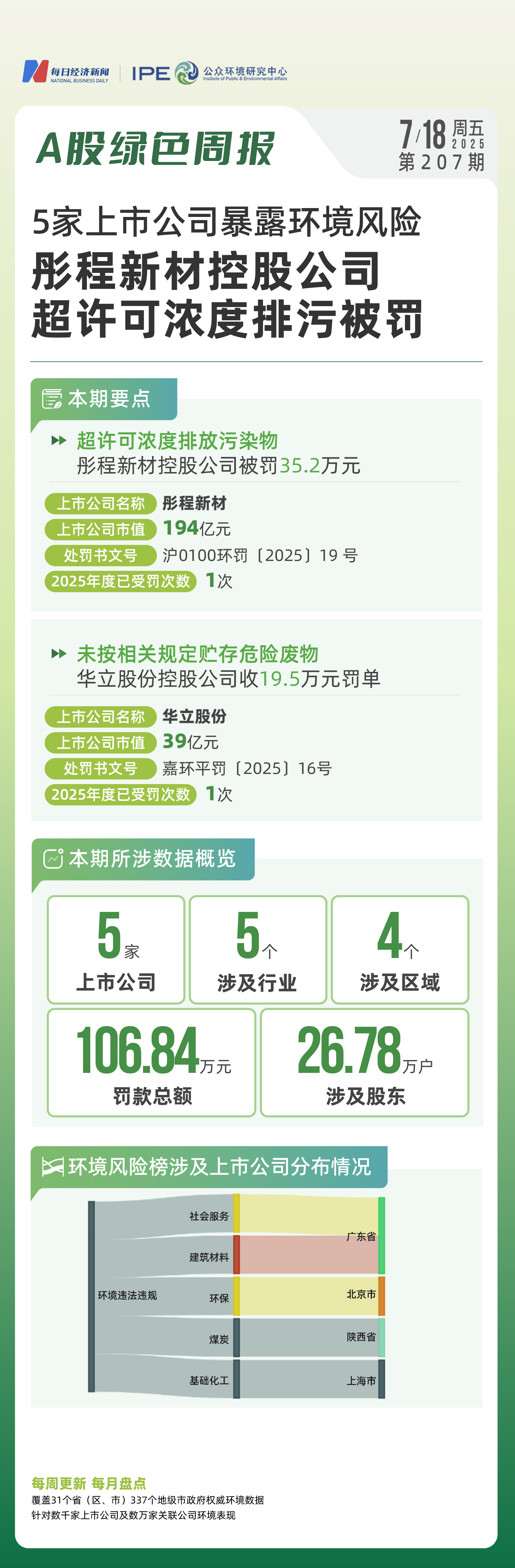
A股绿色周报丨5家上市公司暴露环境风险 彤程新材控股公司超许可浓度排污被罚
Mei Ri Jing Ji Xin Wen· 2025-07-18 09:58
Core Viewpoint - Environmental risks are increasingly becoming a significant operational risk for listed companies, impacting their development and corporate image [12][13][14]. Group 1: Environmental Violations and Penalties - Five listed companies were recently identified for environmental violations, with a total of 26.78 million shareholders potentially facing investment risks [14]. - Tongcheng New Materials was fined 352,000 yuan for exceeding permissible pollutant discharge concentrations [15]. - Huali Co., Ltd. was penalized 195,000 yuan for improper storage of hazardous waste [17]. Group 2: Regulatory Framework and Public Disclosure - The increase in environmental risk awareness is linked to the rise of ESG (Environmental, Social, and Governance) investment principles, emphasizing the importance of sustainable development [17]. - The legal framework for environmental information disclosure has improved, ensuring public access to environmental data and enhancing oversight [18].
复星国际:提高ESG报告质量可获得更多利益相关方的认可
Bei Ke Cai Jing· 2025-07-15 11:30
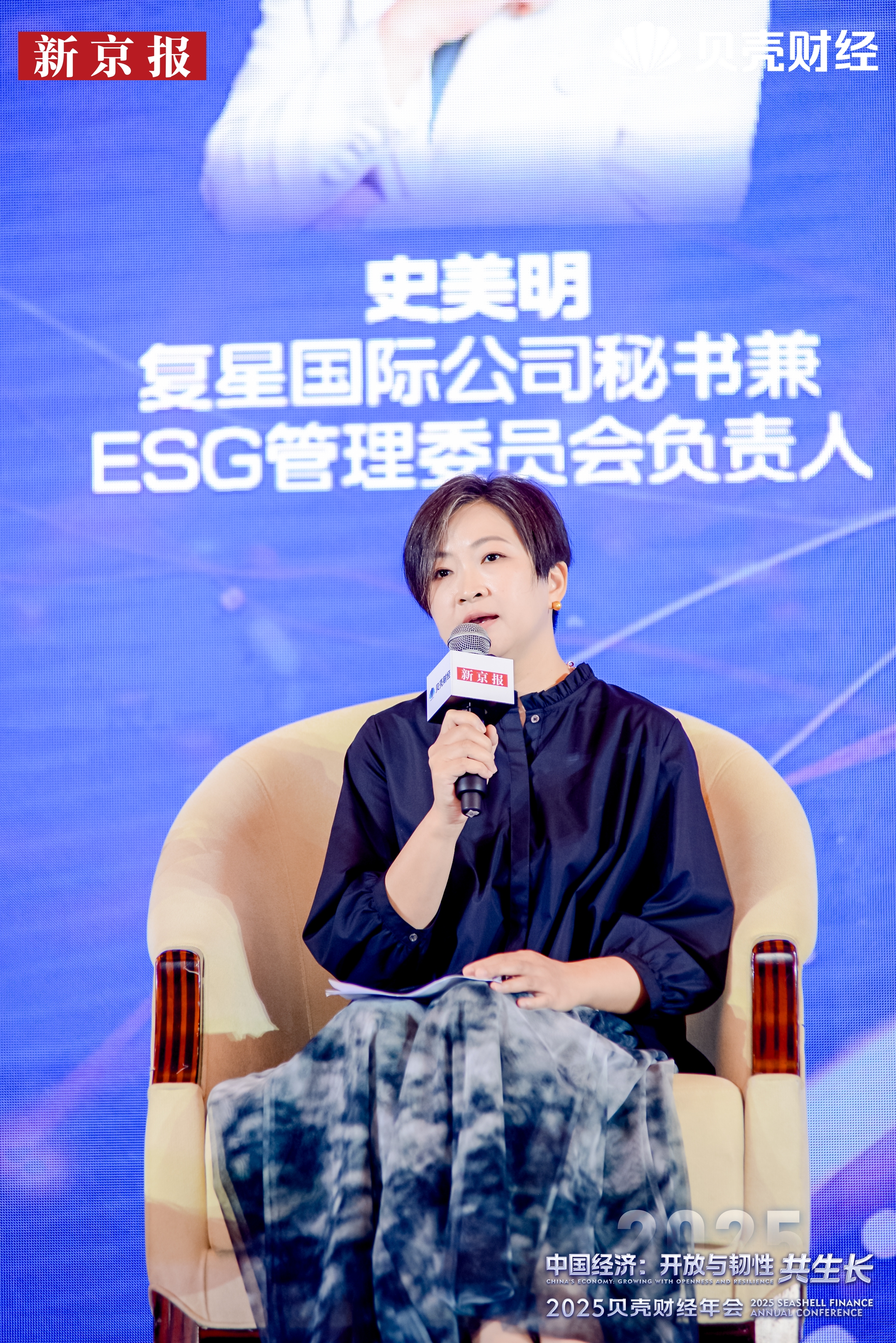
ESG融入投资体系 以高标准遵循国际责任投资原则 20世纪90年代起,ESG投资理念便在国际资本市场逐渐兴起,并形成广泛共识。ESG投资理念即在选择投资标的时,不仅关注其财务状况,还关注其社会责 任的履行,考量企业在环境、社会及公司治理等方面的表现。 复星创立于1992年,经过超30年的投资布局和稳健发展,已成为一家创新驱动的全球家庭消费产业集团。 7月15日,在2025新京报贝壳财经年会"ESG的全球实践与中国答案"论坛上,复星国际公司秘书兼ESG管理委员会负责人史美明表示,随着社会对企业的期 望越来越高,投资者和消费者对企业的ESG(环境、社会和公司治理)表现也越来越关注。 史美明认为,ESG评级是一个管理工具和平台,帮助利益相关方了解企业的ESG实践。企业重视ESG评级工作,可以促进企业ESG系统的管理,同时,借助 评级工具,不断以国际化视野,了解国际最佳实践,也可借此逐步优化内部规章制度和风险管理流程。 复星国际在ESG实践上一直走在前列。复星国际MSCI ESG评级为AA;在最新标普全球企业可持续发展评估中位列全球同业前5%,入选标普全球《可持续 发展年鉴2025》并在《可持续发展年鉴》(中国版)2 ...

ESG投资理念如何落地?
Sou Hu Cai Jing· 2025-07-10 01:18
Core Viewpoint - The ESG investment philosophy emphasizes the integration of environmental, social, and governance factors into investment decisions, aiming to promote sustainable economic development and direct funds towards socially and environmentally responsible companies [1]. Group 1: ESG Investment Philosophy - ESG stands for Environment, Social, and Governance, highlighting the need for comprehensive consideration of a company's performance in these areas alongside traditional financial metrics [1]. - A robust information disclosure system is essential for implementing ESG investment principles, requiring companies to regularly and systematically disclose their ESG-related information [1]. - Investors must enhance their ESG awareness and expertise, understanding the long-term value impacts of ESG factors, which includes analyzing carbon emissions, employee rights, and board independence [1]. Group 2: Investment Strategies - Passive screening is a basic strategy that excludes companies with severe ESG violations, such as those involved in high pollution or energy consumption without remediation [2]. - Active screening involves proactively seeking out companies with outstanding ESG performance for investment [2]. - Shareholder activism allows investors to use their rights to suggest improvements on ESG issues within their portfolio companies, thereby enhancing overall corporate value [2]. Group 3: Role of Financial Institutions - Financial institutions play a crucial role in the implementation of ESG investment principles by developing more ESG-based financial products and services, such as ESG-themed funds [2]. - They also need to strengthen research and analysis on ESG investments, providing professional consulting services and investment advice to help investors achieve their ESG goals [2]. Group 4: Regulatory Support - Regulatory bodies are encouraged to support ESG investment through the establishment of laws and policies that promote ESG practices, such as mandatory ESG disclosures for listed companies [3]. - Incentives like tax benefits for companies meeting certain ESG standards and penalties for those violating ESG principles can create a favorable market environment for ESG investments [3].
A股绿色周报|5家上市公司暴露环境风险 澄星股份控股公司超范围占用林草地被罚
Mei Ri Jing Ji Xin Wen· 2025-06-27 10:05
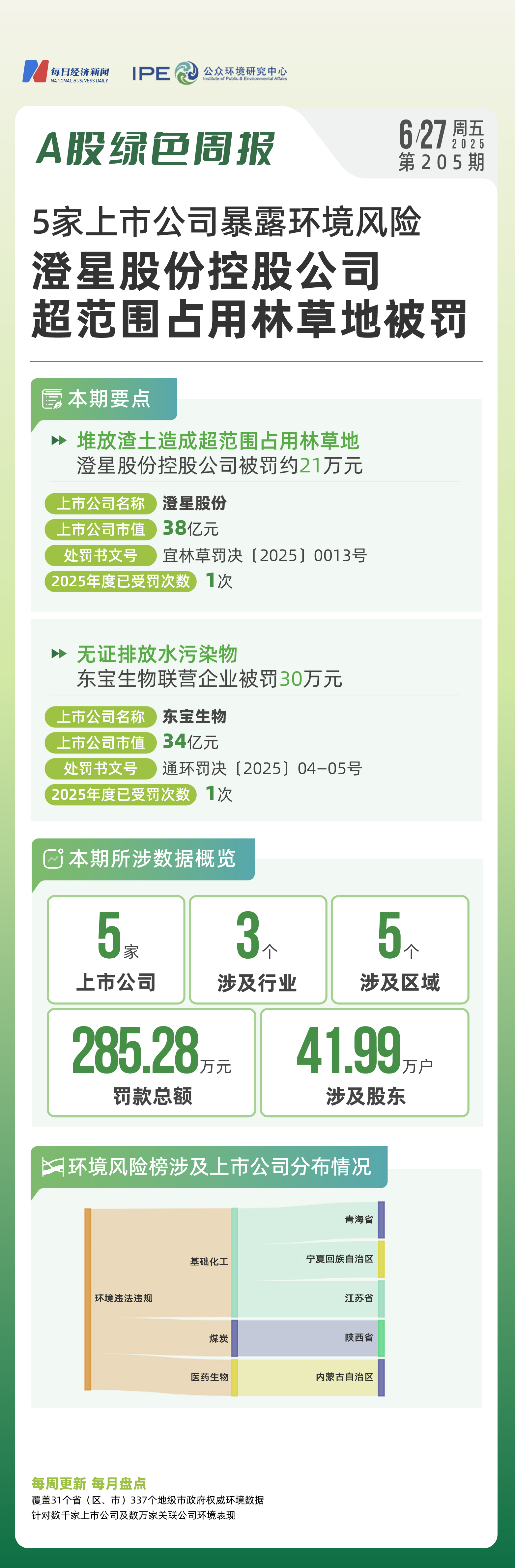
Core Viewpoint - The article highlights the increasing environmental risks faced by listed companies in China, emphasizing the importance of transparency in environmental information and the potential impact on investors [10][11][16]. Group 1: Environmental Violations and Penalties - Five listed companies were recently identified for environmental violations, with a total of 41.99 million shareholders potentially affected by these risks [12]. - Chengxing Co., Ltd. was fined approximately 206,680 yuan for illegally occupying forest and grassland during soil dumping activities [12][13]. - Dongbao Biological's joint venture, Mengbao Biotechnology, was fined 300,000 yuan for discharging pollutants without a permit [14]. - Hanjiabao Coal Company was fined 210,000 yuan for operating a coal boiler without environmental approval [15]. Group 2: Regulatory Framework and Public Awareness - The article discusses the evolution of environmental information disclosure regulations in China, highlighting the legal rights of citizens and organizations to access environmental data [16]. - The increasing emphasis on ESG (Environmental, Social, and Governance) investment principles is noted, with investors becoming more aware of companies' sustainable development capabilities [16].


活动 | 群雄逐鹿:2025第十五届福布斯·富国中国优选理财师评选正式启动!
Sou Hu Cai Jing· 2025-06-20 21:23
Group 1 - The wealth management industry is transitioning from "scale expansion" to "quality upgrade" due to improved regulatory policies and significant technological advancements [2] - Regulatory measures such as breaking the "guaranteed returns," reducing nested structures, and banning fund pools are guiding the Chinese wealth management market towards healthier development [2] - The rapid iteration of AI technology has enabled automated asset allocation services 24/7, while large model technology is reshaping investment research and analysis [2] Group 2 - The demand for skilled financial advisors is at an all-time high, as investors seek professionals who understand the market, policies, and client needs [3] - The 2025 Forbes-Fuguo China Preferred Financial Advisor Selection has been launched, continuing its mission to certify the professional capabilities and ethics of outstanding financial advisors [3][4] - The selection process includes multiple stages, culminating in a national final where top advisors compete for awards [4] Group 3 - The selection will produce a national TOP 60 list, with 14 finalists advancing to the national finals for the top awards [4] - The awards include Gold, Silver, and Bronze distinctions for the best financial advisors [9] - Winners will be recognized in Forbes magazine and will have opportunities to participate in various financial forums and strategy meetings [10] Group 4 - The wealth management market in China is projected to reach an asset management scale of 155.1 trillion yuan by 2024, indicating strong growth potential [2] - The changing demographic structure is driving a shift in retirement planning from value-added services to essential needs, alongside a rise in ESG investment concepts and cross-border asset allocation demands [2]