
主题投资

Search documents
分论坛:大类资产与指数投资|国泰海通“远望又新峰”2026春季策略会
国泰海通证券研究· 2026-03-20 03:10
Group 1 - The article discusses the upcoming Guotai Haitong Spring Strategy Conference scheduled for March 25, 2026, focusing on global monetary policy changes and asset outlook [1] - Key topics include asset allocation methodologies for 2026, thematic investment outlook, and ETF allocation strategies [1] - Notable speakers include Hu Jie, a former Federal Reserve economist, and senior analysts from Guotai Haitong [1]


铁打的宝武,流水的华宝
虎嗅APP· 2026-03-17 09:37
Core Viewpoint - The article discusses the recent talent exodus at Huabao Fund, highlighting the challenges the company faces in maintaining its competitive edge in the ETF and active equity investment sectors, as well as the implications of its management structure and strategic direction [2][4][26]. Talent Exodus - Huabao Fund has experienced significant departures of key personnel, including fund managers and investment directors, with notable figures like Qi Zhen and Hu Jie leaving for Tianhong Fund [2][3]. - The company has seen a pattern of talent loss, reminiscent of the 2021 exodus, which included several core fund managers who have since joined leading firms in the industry [3][19]. Competitive Challenges - Despite having a solid foundation in ETF and active equity investments, Huabao Fund has struggled to establish a stable competitive advantage, particularly as competition in the ETF market intensifies [4][10]. - The company’s ETF products, while initially successful, have not kept pace with industry growth, leading to a decline in its market ranking from 8th in 2024 to 11th in 2025 [10][11]. ETF Business Performance - Huabao Fund's non-cash ETF scale has grown significantly from 164 million yuan in 2019 to 130 billion yuan in 2025, but its industry ranking has fluctuated, indicating a lack of sustained competitive performance [9][10]. - The company’s focus on traditional industries in its ETF offerings has limited its growth potential in the current technology-driven market, where competitors have capitalized on more innovative products [13][14]. Management and Strategic Direction - The transition from a general manager-led structure to a chairman-led governance model has not yielded significant improvements in business performance, as the new leadership lacks deep experience in the public fund industry [26][28]. - The strategic focus on expanding into active equity and fixed income has not translated into tangible results, with the company struggling to enhance its active management capabilities [30][32]. Investment Strategy Issues - Huabao Fund's broad coverage of industry ETFs lacks focus on specific growth sectors, which has hindered its ability to capitalize on emerging market opportunities [15][16]. - The company’s reliance on a top-down investment approach has proven less effective in rapidly evolving sectors, where detailed research and agile responses are crucial for success [16][21].

赛道投资专题:主题择时方法论及主线跟踪
East Money Securities· 2026-03-04 07:49
Group 1 - The report categorizes theme investment into macro themes, industrial themes, and event themes, focusing primarily on industrial themes that are driven by policy support and industry progress [10][11] - Industrial investment targets mature fields with stable income, while theme investment focuses on emerging technologies that have not yet commercialized, relying on future expectations rather than immediate performance [10][11] - The report identifies key industrial themes to watch, including artificial intelligence, humanoid robots, quantum technology, innovative drugs, solid-state batteries, hydrogen energy, nuclear fusion energy, low-altitude economy, brain-computer interfaces, and 6G [3][10] Group 2 - The report outlines a four-dimensional stock selection framework based on future story space, policy strength, funding capacity, and verification feasibility for theme investment [3][49] - It emphasizes that the initiation of theme investment often relies on top-level policy design, with detailed measures from ministries clarifying the development path of industries [3][37] - The report discusses the importance of demand explosion in forming the main line of investment, which significantly influences performance expectations and realization [3][10] Group 3 - The report highlights the distinction between industrial investment and theme investment in terms of profit sources, driving logic, time frames, and risk-return characteristics [3][10] - It notes that successful transitions from theme investment to industrial investment occur when technological routes mature and leading companies establish competitive advantages [17][19] - The report provides examples of industries that have successfully transitioned, such as the lithium battery sector, which saw significant earnings growth post-2021, leading to a steep upward trend in stock prices [17][18]

策略行业2026年春季投资策略:从急行军到安营扎寨:牛市新节奏新打法
KAIYUAN SECURITIES· 2026-03-03 07:48
Group 1 - The report emphasizes a shift in market strategy from a rapid ascent to a more stable approach, indicating a transition from a "quick run" to a "camping and resting" phase in the bull market, with a focus on managing stamina and structure rather than speed [3][29] - The current market is characterized by a rising securities ratio, which is seen as a sign of moving from an early valuation repair phase to a deeper activation of existing assets, indicating a more cautious and structured investment environment [3][16] - The report identifies three signals indicating the failure of old investment strategies, highlighting a shift from beta-driven index performance to alpha-driven structural performance, suggesting a need for more selective investment approaches [3][36] Group 2 - The report introduces a new pricing logic for the "new rhythm bull market" based on the Dividend Discount Model (DDM), emphasizing the importance of understanding the marginal changes in profit growth (ΔG) rather than just the existence of growth [3][41] - It discusses the restructuring of the funding ecosystem, noting that the outflow from broad-based ETFs and inflow into non-broad-based ETFs reflects a healthy market dynamic, indicating a shift in investment strategies [4][62] - The report highlights the importance of AI technology in profit distribution, suggesting that sectors with stable price increase capabilities, such as non-ferrous metals and certain chemicals, will be key investment areas [4][56] Group 3 - The report provides industry allocation recommendations, focusing on sectors such as AI technology, cyclical industries benefiting from price increases, and high-dividend stocks, indicating a strategic shift towards sectors with strong growth potential and stable returns [4][5] - It emphasizes the significance of structural changes in profitability, particularly in the technology sector, where internal differentiation is crucial for investment success [4][55] - The report notes that the real estate sector's investment appeal is diminishing, leading to a shift in resident funds towards equity markets, which are becoming the new main stage for wealth management [4][67]
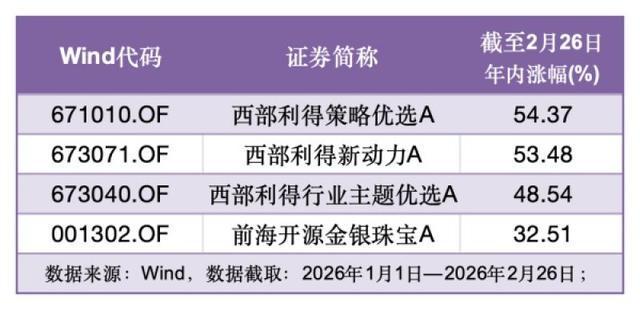
年内狂涨54%!这几只基金重仓资源股,却根本不是资源主题基金
Hua Xia Shi Bao· 2026-02-26 15:21
Core Viewpoint - The resource sector has shown strong performance in early 2026, with several funds heavily invested in this area achieving significant returns, despite not being classified strictly as resource-themed funds [1][2]. Fund Performance - As of February 26, 2026, the top-performing funds include: - Western Leading Strategy Preferred A with a return of 54.37% - Western Leading New Power A at 53.48% - Western Leading Industry Theme Preferred A at 48.54% - Qianhai Kaiyuan Gold and Silver Jewelry A at 32.51% [1]. Fund Structure and Strategy - The funds mentioned are classified as mixed funds with broad investment mandates, allowing for flexibility in stock selection and sector allocation [2][3]. - Western Leading Strategy Preferred A aims to identify companies with sustainable growth potential, with stock investments ranging from 60% to 95% of fund assets [3]. - Western Leading New Power A targets companies in consumer services and technological innovation, with stock assets also ranging from 0% to 95% [3]. Portfolio Composition - The top holdings of the Western Leading funds show significant overlap, with key stocks including Zijin Mining, Chifeng Jilong Gold, and Muyuan Foods, indicating a concentrated investment in both resource and domestic demand sectors [4]. - A notable shift in portfolio composition occurred in Q4 2025, where the funds increased their allocation to resource stocks, moving away from previous investments in aviation and brokerage sectors [5]. Fund Management Insights - The flexibility of all-market selection funds allows managers to adjust their portfolios based on market conditions, which has proven beneficial in the current resource stock rally [6]. - The distinction between all-market selection funds and thematic funds is emphasized, with the former relying on manager judgment and timing rather than strict thematic exposure [6]. Investor Considerations - Investors are advised to differentiate between a fund's temporary holdings and its long-term investment strategy, as short-term performance may not reflect the fund's intended focus [8]. - The potential for "style drift" exists if investors purchase funds based on short-term gains without understanding their contractual investment mandates [8].
资金抢筹布局军工板块,军工ETF(512660)近10日净流入近8亿元,关注商业航天与军贸方向
Mei Ri Jing Ji Xin Wen· 2026-02-26 05:00
Group 1 - The military industry sector is experiencing significant capital inflow, with the military ETF (512660) seeing nearly 800 million yuan in net inflow over the past 10 days, indicating strong investor interest in commercial aerospace and military trade [1] - Dongfang Securities highlights a positive outlook on large aircraft and military trade, noting that the current market attention and expectations for the sector are low, but advancements in core subsystems like engines and avionics are accelerating [1] - The commercial aerospace sector, despite recent adjustments, is expected to present investment opportunities in the first half of the year, with a trend of domestic and international industrial resonance remaining unchanged [1] Group 2 - The military ETF (512660) tracks the CSI Military Industry Index (399967), which selects the top ten military group companies listed on the Shanghai and Shenzhen markets, reflecting the overall performance of the military industry [2] - The index components have a large average market capitalization and cover multiple industries, focusing on aerospace equipment and military electronics [2]
券商把脉节后投资主线
Jin Rong Shi Bao· 2026-02-25 02:52
Group 1 - The Spring Festival holiday saw a record-breaking cross-regional movement of over 5 billion people, indicating strong consumer activity [1] - The average daily inbound and outbound personnel at national ports during the holiday is expected to increase by 14.1% year-on-year, reaching over 2.05 million people, nearly five times the level of the previous year [1] - The first three days of the holiday showed a year-on-year increase of 4.5% in foot traffic and 4.8% in sales for monitored pedestrian streets, reflecting a robust consumption environment [1] Group 2 - Huatai Securities noted that domestic consumption data showed an overall increase in volume with stable prices, highlighting service consumption as a new growth point [2] - Data from Meituan indicated that leisure orders in lower-tier cities grew by nearly 30% year-on-year, with a notable shift towards younger consumers [2] - The "post-Spring Festival" market outlook suggests a focus on theme investments in sectors like the export chain and service consumption, while also considering geopolitical risks [2] Group 3 - Guosheng Securities identified four key variables that may influence market trends post-holiday, including uncertainties in U.S. tariff policies and the resilience of export chain enterprises [3] - The rise of AI and robotics, validated by sales data from platforms like JD.com, is expected to attract investment in related sectors [3] - The attractiveness of assets priced in RMB is increasing, particularly in the equity market, with a trend of foreign capital inflow into Chinese assets [3] Group 4 - China Galaxy Securities recommended focusing on two main lines post-holiday: sectors benefiting from improved supply-demand dynamics and industries with structural highlights like robotics and AI [4] - Guojin Securities emphasized the importance of the "global physical assets vs. Chinese assets" theme, suggesting investment in commodities and sectors with a competitive advantage in China [4]
一批投资老将业绩重回巅峰!强势回应“尚能饭否”
Sou Hu Cai Jing· 2026-02-11 13:35
Core Viewpoint - The performance of veteran fund managers has rebounded strongly, challenging the notion that they are outdated and unable to compete with younger managers who focus on high-growth sectors [2][10]. Group 1: Performance Recovery of Veteran Fund Managers - Veteran fund managers have demonstrated a strong recovery in performance, with many achieving record highs in net value in January 2026, despite previous criticisms and market challenges [3][4]. - Notable examples include Wei Dong from Guolian An Fund, whose managed fund's annualized return has returned to over 10%, and Gu Jun from Bosera Fund, who achieved a 71.3% return in the past year [3][4]. - Other veteran managers, such as Qi Fapeng and Xu Lirong, have also seen their funds reach historical net value highs, indicating a broader trend among experienced fund managers [4]. Group 2: Challenges Faced by Veteran Fund Managers - The market has seen a significant divide, with veteran managers facing pressure from new, high-performing managers who focus on high-volatility sectors, leading to doubts about the capabilities of older managers [5][6]. - Some veteran managers have struggled with large fund sizes, which can limit their ability to adapt quickly to market changes, further intensifying scrutiny on their performance [5][6]. Group 3: Trust Restoration Among Investors - As the performance of actively managed equity funds improves, investor confidence is gradually being restored, reversing previous trends of fund redemptions [8][9]. - Investors have expressed mixed feelings about their experiences, with some reporting significant losses followed by recoveries, highlighting the importance of veteran managers in navigating complex market conditions [9]. - The resurgence of veteran fund managers is seen as a critical factor in rebuilding trust within the public fund industry, as they leverage their experience to manage risks and capitalize on opportunities [8][10].
尚能饭否?基金老将,“高分”回归!
券商中国· 2026-02-10 07:56
Core Viewpoint - The article discusses the resurgence of veteran fund managers in the public fund industry, highlighting their ability to adapt and achieve strong performance despite recent market challenges and skepticism about their relevance [2][10]. Group 1: Performance of Veteran Fund Managers - Veteran fund managers have demonstrated a strong recovery in performance, with many achieving record highs in net value and returns in early 2026, despite facing significant market fluctuations in previous years [3][4]. - Notable examples include Wei Dong from Guolian An Fund, whose fund's annualized return has returned to over 10%, and Gu Jun from Bosera Fund, who achieved a 71.3% return in the past year [3][4]. - Other veteran managers, such as Qi Fapeng from Guotou Ruijin Fund and Zhou Weiwen from China Universal Fund, have also seen their funds reach historical highs, showcasing the effectiveness of their long-term investment strategies [4]. Group 2: Challenges Faced by Veteran Fund Managers - The market has seen a significant style divergence, leading to periods where veteran managers underperformed compared to newer managers who focused on high-growth sectors, resulting in a loss of investor patience and confidence [6]. - Some veteran managers faced criticism for their performance and were perceived as outdated, especially when managing larger funds that limited their flexibility in adjusting portfolios [6][7]. - Despite these challenges, many veteran managers have maintained their investment philosophies and adapted their strategies to align with market changes, demonstrating resilience and a commitment to continuous learning [7]. Group 3: Rebuilding Investor Trust - As the performance of actively managed equity funds improves, investor confidence is gradually being restored, reversing previous trends of fund redemptions and skepticism towards the public fund industry [8][9]. - The article highlights that veteran fund managers, through their stable and predictable performance, are helping to mend the trust gap that had developed among investors due to past volatility [8][9]. - Feedback from investors indicates a renewed faith in veteran managers, as many have seen their investments recover from significant losses, reinforcing the value of experienced fund management [9].

工银瑞信年度策略解读:把握传统产业升级、新兴产业扩张与前沿领域投资机遇
Jiang Nan Shi Bao· 2026-02-06 02:15
Core Viewpoint - The "15th Five-Year Plan" is expected to provide clear direction and policy support for the capital market, with a focus on traditional industry upgrades, emerging industry demand expansion, and thematic investments in frontier industries [1] Macro Analysis: Opportunities in Financial Assets - The liquidity environment is expected to remain relatively loose both globally and domestically, providing opportunities across various financial assets, with a particular emphasis on the A-share equity market [2] - Current A-share market valuations are considered reasonable based on historical rolling returns, suggesting that the market is not overly expensive [2] - Two core supporting factors for the A-share market include a friendly liquidity environment and an anticipated upward trend in the profit cycle due to improved supply-demand dynamics [2] Trend Assessment: Technological Self-Reliance - The "15th Five-Year Plan" emphasizes technological self-reliance as a strategic task, highlighting the importance of technological innovation and productivity improvement for sustainable economic development [4] Insight into Opportunities: Three Structural Directions - The "15th Five-Year Plan" outlines three key investment directions: 1. Traditional industries such as chemicals, shipbuilding, and metallurgy are expected to enhance profitability through supply-side policies and optimization [5][6] 2. Emerging industries like artificial intelligence and energy storage are projected to experience sustained demand growth, leading to rapid development [6] 3. Frontier industries, including embodied intelligence and quantum technology, are seen as having significant growth potential and should be monitored for breakthroughs in basic scientific research [6] Rational Layout: Understanding Industry Trends - Investors are advised to recognize industry trends and avoid frequent timing based on short-term fluctuations, particularly in the high-growth and high-volatility technology sector [7] - The investment strategy should focus on understanding industry development trends and adjusting strategies only when substantial changes occur in the underlying fundamentals [7]