
粮食安全

Search documents
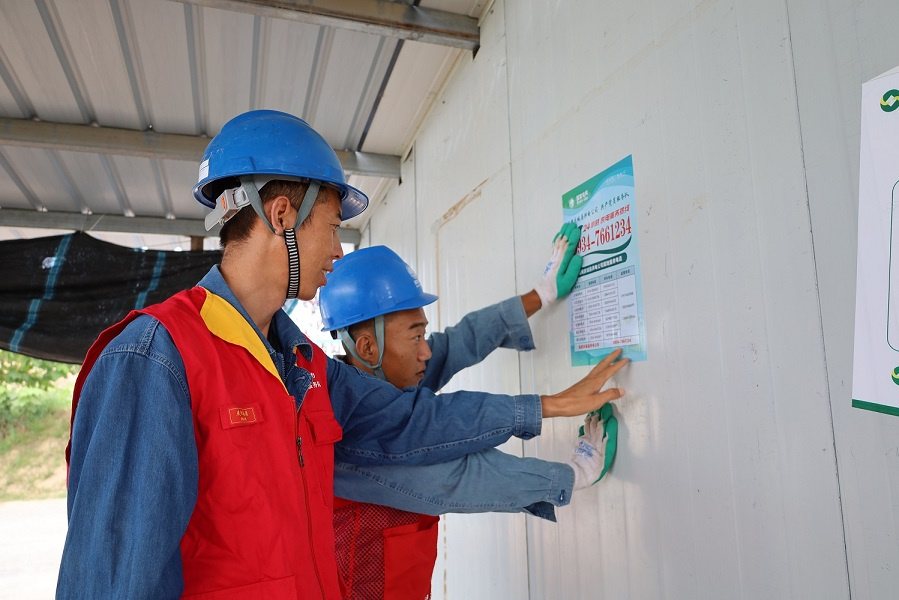
国网庆阳供电公司:电力“满格”护航复种 筑牢粮食安全根基
Zhong Guo Neng Yuan Wang· 2025-09-23 07:41
Core Viewpoint - The article highlights the proactive measures taken by the State Grid Qinyang Power Supply Company to support the agricultural replanting efforts in Qincheng County, aiming to enhance land utilization and increase farmers' income while achieving annual agricultural production goals [1][3]. Group 1: Agricultural Replanting Efforts - Qincheng County has developed a clear implementation plan for a 100,000-acre replanting project by 2025, with an annual replanting target of 115,560 acres to boost agricultural output and farmers' income [3]. - As of now, Qincheng County has successfully completed the replanting task of 115,560 acres, including 58,500 acres of food crops and 57,060 acres of economic crops such as oilseeds, vegetables, and forage, significantly enhancing land productivity [4][5]. Group 2: Power Supply Support - The State Grid Qinyang Power Supply Company has integrated power supply guarantees for replanting into its key work agenda, customizing power supply plans based on the distribution of replanting areas, crop types, and electricity demand characteristics [3]. - A special support team composed of Communist Party members and technical professionals has been established to conduct inspections in the replanting areas, ensuring the safety of power supply and addressing potential hazards [3][4]. - The company has implemented a "grid + dedicated manager" service model to streamline electricity service for farmers, significantly improving the efficiency of temporary electricity supply requests [4]. Group 3: Future Plans and Commitment - The State Grid Qinyang Power Supply Company plans to continue monitoring the growth cycle of replanting crops and dynamically adjust power supply measures for irrigation, harvesting, and processing stages [5]. - The company aims to optimize rural power grid structures and enhance service quality in alignment with rural revitalization strategies, contributing to national food security [5].

中国人寿财险扎实推进乡村全面振兴
Jin Rong Shi Bao· 2025-09-23 07:01
Group 1 - The core viewpoint emphasizes the role of China Life Property & Casualty Insurance in supporting rural revitalization and agricultural security through comprehensive insurance solutions [1][3][12] - In the first half of 2025, the company provided risk protection worth 330.6 billion yuan to 7.91 million farming households, reinforcing the risk management framework for agricultural production [1][3] - The company launched 31 cost insurance products and 11 income insurance products for staple grains across 20 provinces, covering 7.086 million acres and providing 68.5 billion yuan in risk protection to 5.2 million farming households [3][4] Group 2 - China Life Property & Casualty Insurance is expanding its insurance offerings to support the development of specialty agricultural products, with 1,711 local policy products available and 122.2 billion yuan in risk protection provided to 1.8 million farming households [6][12] - The company is innovating in green and low-carbon insurance products, with 59 carbon credit insurance products launched, providing over 100 million yuan in risk protection to support ecological industrialization [7][12] - The company has established a comprehensive service network for agricultural insurance, with over 186 county-level marketing service departments and nearly 57,000 village-level service points, facilitating online insurance services and financial support for farmers [12]


建行山东省分行:金融甘霖润泽齐鲁丰收梦
Qi Lu Wan Bao· 2025-09-23 06:51
Core Viewpoint - The article highlights the significant role of financial support from China Construction Bank (CCB) Shandong Branch in promoting agricultural development and rural revitalization in Shandong Province, showcasing various projects and their positive impacts on local economies and food security [1][3][10]. Financial Support for Agricultural Projects - CCB Shandong Branch has provided a total of 222.1 billion yuan in agricultural loans as of the end of August, with an increase of 18.65 billion yuan since the beginning of the year [1]. - The bank has actively supported high-standard farmland construction, providing 74 million yuan in loans for the transformation of 40,000 acres of farmland in Yutai County, significantly improving irrigation efficiency and crop yield [2][3]. - The bank has also issued 2.7 billion yuan in loans for high-standard farmland projects this year, emphasizing its commitment to food security [3]. Innovative Financing Solutions - CCB Shandong Branch has tailored financial solutions for salt-alkali land reclamation projects, approving 152 million yuan in loans for a project covering 63,633 acres, addressing the challenges of high initial investment and low returns [5][6]. - The bank has successfully supported two salt-alkali land improvement projects with a total credit amount exceeding 200 million yuan, with three additional projects in progress [5][6]. Support for Facility Agriculture - The bank has provided 250 million yuan in loans to modern apple orchards in Yiyuan, enhancing production quality and increasing farmers' income [7][8]. - CCB Shandong Branch has established a specialized mechanism to address financing challenges in facility agriculture, with a total facility agriculture loan balance of 3.4 billion yuan as of the end of August [8]. Integrated Financial Services for Agricultural Supply Chains - CCB Shandong Branch has implemented an industry chain financing model, providing 27 million yuan in loans to nine suppliers of a dairy farm, ensuring a stable supply of raw materials [9]. - The bank has increased its agricultural loans to 9.5 billion yuan, with a year-to-date increase of 1.33 billion yuan, focusing on key agricultural products [9][10]. - The bank has also supported new agricultural business entities with a loan balance of 17.4 billion yuan, reflecting a year-to-date increase of 4.8 billion yuan [10].
全力守护大国粮仓 农民丰收底气更足
Jin Rong Shi Bao· 2025-09-23 06:40
Core Insights - The agricultural insurance industry plays a crucial role in supporting high-quality agricultural development and ensuring food security in China, particularly as the country approaches the end of the 14th Five-Year Plan in 2025 [1][2][3] Group 1: Agricultural Insurance Development - Since the launch of the agricultural insurance premium subsidy policy in 2007, the industry has seen rapid growth, with premium income increasing from 5.333 billion yuan to 152.1 billion yuan by 2024, making China the global leader in agricultural insurance [3][6] - The coverage of agricultural insurance has expanded significantly, now covering over 500 types of agricultural products, including specialty crops, and evolving from cost insurance to income and price insurance [6][7] - The implementation of complete cost insurance for major crops like rice, wheat, and corn is set to enhance farmers' income security and reduce local fiscal pressure [3][4] Group 2: Policy Support and Innovation - The Chinese government has emphasized the importance of agricultural insurance in its policies, with recent documents advocating for the integration of insurance with local specialty agricultural products [4][5] - The insurance industry is innovating by developing tailored insurance products for local specialties, which supports rural revitalization and economic growth [4][5] - The establishment of a comprehensive financial insurance service system for the entire agricultural supply chain is being pursued, as seen in Guangdong's insurance coverage for lychee production [4][5] Group 3: Technological Integration - The agricultural insurance sector is leveraging technology to enhance risk management, transitioning from post-disaster compensation to proactive risk prevention and real-time monitoring [7][8] - Advanced technologies such as satellite remote sensing and AI are being utilized to improve the efficiency of claims processing and disaster response, significantly reducing the time taken for farmers to receive compensation [7][8] - The integration of technology in agricultural insurance is creating a modern safety net that ensures timely recovery and support for farmers during adverse weather events [7][8]
中国建设银行高质量做好县域乡村金融服务
Jin Rong Shi Bao· 2025-09-23 05:41
Core Viewpoint - The article emphasizes the critical role of financial services in supporting rural revitalization and agricultural modernization in China, highlighting the initiatives taken by China Construction Bank to enhance its rural financial service capabilities and support national food security [1][2]. Financial Services for National Food Security - China Construction Bank has prioritized food security as a key focus for its rural revitalization financial services in 2024, implementing the "善建粮安" financial service plan to support various agricultural financing needs [2][3]. - The bank has introduced a series of financial products such as "种业贷" (Seed Industry Loan), "粮食收储贷" (Grain Storage Loan), and "高标准农田贷款" (High-Standard Farmland Loan) to enhance support for the agricultural sector [2][3]. Support for County-Level Prosperity Industries - The bank has developed tailored financial products to support the honey pomelo industry in Fujian, which is a significant agricultural sector in the region, facilitating a comprehensive financial service approach [4][5]. - As of the second quarter, the bank's "裕农产业" platform has engaged with 66 core enterprises and over 500 chain enterprises, serving more than 70,000 farmers [5]. Agricultural Ecosystem Service Model - China Construction Bank has adopted a "圈链群" (Circle-Chain-Group) service model to enhance agricultural service levels, focusing on various agricultural clusters and supply chains [6][7]. - The bank has established digital platforms to connect agricultural production and supply chain participants, exemplified by its collaboration with Dunhuang Seed Industry in Gansu [7]. Financial Performance Metrics - As of the second quarter, the bank's agricultural loan balance reached 36,153.25 billion yuan, with an increase of 2,722.67 billion yuan year-to-date, reflecting an 8.14% growth [1]. - The bank's rural household operating loan balance was 5,543.87 billion yuan, with a year-to-date increase of 506.39 billion yuan, marking a growth rate of 10.05% [5].

严打危害粮食安全犯罪 公安机关今年共立案侦办相关案件4800余起
Zhong Guo Xin Wen Wang· 2025-09-23 02:07
Core Viewpoint - The Chinese government is intensifying efforts to combat crimes that threaten food security, with over 4,800 cases investigated this year, including illegal land occupation and the sale of counterfeit agricultural products [1][2]. Group 1: Crime Statistics and Actions - More than 4,600 cases of illegal occupation of agricultural land and destruction of black soil resources have been filed this year [1]. - Over 200 cases related to the production and sale of counterfeit agricultural materials have been reported [1]. - The Ministry of Public Security has taken action on 13 major cases to enforce strict measures for protecting arable land and ensuring food production [1]. Group 2: Specific Cases of Agricultural Crime - In Jilin, 20 suspects were arrested for illegally mining black soil, with 23,000 cubic meters stolen and an estimated value of over 6 million yuan [3]. - In Heilongjiang, 3 individuals were apprehended for illegally occupying 9.66 acres of permanent basic farmland, leading to severe damage [3]. - In Liaoning, a gang was dismantled for producing and selling counterfeit corn seeds, with over 1 million yuan involved [4]. - In Harbin, 12 suspects were caught selling counterfeit corn seeds, with 134,000 jin seized and a value exceeding 6 million yuan [5]. - In Anhui, 4 individuals were arrested for producing and selling substandard fertilizers, with over 500 tons confiscated and a value of over 15 million yuan [6]. - In Sichuan, 8 suspects were arrested for selling counterfeit pesticides containing banned substances, with 330 kg seized [6]. - In Yunnan, 5 individuals were caught selling substandard fertilizers, with 690 tons confiscated and a value of 10.8 million yuan [6].
公安机关依法严厉打击危害粮食安全犯罪 今年共立案侦办相关案件4800余起
Di Yi Cai Jing· 2025-09-23 01:45
Core Viewpoint - The Ministry of Public Security has been actively combating agricultural crimes, particularly those related to illegal occupation of farmland and the destruction of black soil resources, through various initiatives and actions, achieving significant results in the current year [1] Group 1: Actions Taken - Various operations such as "Kunlun" and "Jinfeng" have been organized to address agricultural crimes [1] - A total of over 4,600 cases related to illegal occupation of farmland and destruction of black soil resources have been filed this year [1] - More than 200 cases concerning the production and sale of counterfeit agricultural materials, including seeds, have been reported [1] Group 2: Enforcement and Results - The Ministry has overseen 13 major cases to ensure strict enforcement of laws protecting farmland [1] - The initiatives aim to safeguard grain production and supply while protecting the interests of farmers [1]
习近平总书记的节日祝贺和诚挚问候在我省引发热烈反响
Da Zhong Ri Bao· 2025-09-23 01:43
Group 1 - The article highlights the positive response from farmers and agricultural workers in Shandong Province to General Secretary Xi Jinping's holiday greetings, emphasizing their commitment to rural revitalization and modernization of agriculture [2][3] - Farmers like Pang Haiyun, who cultivates over 400 acres of corn, report a successful harvest year, attributing their success to high-standard farmland construction and government support in terms of subsidies and technical guidance [2][5] - The establishment of cooperatives in villages, such as in Xingwangzhuang, has led to increased income for villagers through guaranteed returns and profit sharing, aligning with the government's emphasis on promoting employment and income growth for farmers [3][4] Group 2 - Shandong Province has made significant advancements in agricultural technology, with a contribution rate of agricultural technology progress reaching 67.4%, and a coverage rate of improved varieties at 98%, positioning the province as a leader in agricultural productivity [6] - The province's summer grain yield reached 547.4 billion jin, an increase of 4.1 billion jin year-on-year, with a per-acre yield of 452.8 kg, the highest in the country, indicating strong agricultural performance [5][6] - The focus on enhancing agricultural production capacity through technological support is evident, with plans to promote the application of good seeds, equipment, and techniques to further strengthen Shandong's agricultural output [6]
齐心协力共绘“三农”新画卷
Xin Hua She· 2025-09-23 00:58
Group 1 - The celebration of the "Chinese Farmers' Harvest Festival" highlights the importance of agricultural modernization and rural revitalization, with a focus on enhancing farmers' livelihoods and food security [1][2][3] - The agricultural sector is experiencing a positive trend, with summer grain production stable and early rice yield increased, indicating a potential for another bumper harvest [1][2] - The introduction of high-protein corn varieties and modern agricultural machinery is expected to significantly boost grain production capabilities [2][4] Group 2 - The emphasis on improving rural living conditions includes transforming existing houses into high-quality accommodations to attract tourism and enhance local economies [3][4] - The government is implementing various policies to support farmers, including promoting employment opportunities and developing local industries to ensure sustainable income for rural populations [4][5] - The integration of e-commerce and local agricultural products is being leveraged to expand market reach and enhance the economic vitality of rural areas [4][5]

欢庆丰收 共享美好
Jing Ji Ri Bao· 2025-09-23 00:04
Core Insights - The article highlights the importance of agriculture in China, emphasizing the government's commitment to rural development and food security during the "Chinese Farmers' Harvest Festival" [1][2]. Group 1: Agricultural Achievements - China has achieved significant agricultural milestones, including a grain self-sufficiency rate and a stable increase in food production, with summer grain harvests and early rice yields showing positive trends [1]. - The "14th Five-Year Plan" has seen the establishment of over 100 million acres of high-standard farmland, with agricultural modernization levels improving, including a mechanization rate exceeding 75% and a seed coverage rate over 96% [2]. Group 2: Economic and Social Progress - The income of farmers has been growing rapidly, with the urban-rural income ratio decreasing from 2.56:1 in 2020 to 2.34:1 in 2024, indicating a narrowing gap between urban and rural incomes [2]. - The article notes the successful transition from poverty alleviation to rural revitalization, with over 30 million people maintaining stable employment and income growth in poverty-stricken counties outpacing the national average [2]. Group 3: Future Outlook - The article calls for collective efforts to enhance agricultural efficiency, increase farmers' income, and invigorate rural areas, aiming to turn the vision of comprehensive rural revitalization into reality [3].