公募基金高质量发展

Search documents
基金公司发展趋势:回归投研本身,大而全和小而美均值得期待
Zheng Quan Ri Bao· 2025-12-02 11:27
Core Viewpoint - The Chinese economy is transitioning from high-speed growth to high-quality development, with public funds playing a crucial role in supporting the real economy and stabilizing the market [1] Group 1: Strategic Positioning of Fund Companies - The development landscape of public funds will further optimize, with a clear differentiation between large comprehensive fund companies and small specialized fund companies [1][2] - Large fund companies will focus on being "big and comprehensive," while small fund companies will adopt a "small and beautiful" strategy [1] Group 2: Industry Structure and Trends - The public fund industry will continue to concentrate towards the top, highlighting a "Matthew Effect" where strong companies become stronger [2] - Large fund companies will benefit from brand effects, research resources, and sales channels, leading to increased concentration in equity and index products [2] Group 3: Development Strategies for Comprehensive Fund Companies - Comprehensive fund companies should maintain their strengths while expanding into other product types, as demonstrated by E Fund and Huaxia Fund, which have seen significant growth in non-monetary management scale [3] - E Fund's non-monetary scale growth rate is approximately 79% since the end of 2020, while Huaxia Fund's growth rate is around 147% [3] Group 4: Development Strategies for Specialized Fund Companies - Small fund companies should pursue differentiated development strategies, focusing on their unique strengths, as seen with Guojin Fund and Pengyang Fund [4] - Guojin Fund's non-monetary management scale grew from 10.2 billion to 37.2 billion, a 265% increase, by focusing on quantitative and fixed-income investments [4] Group 5: Research and Investment System Construction - Strengthening research and investment capabilities is essential for fund companies to enhance investor returns, with a push towards a "platform-based, integrated, multi-strategy" research system [5] - Fund companies are shifting from relying on star fund managers to building a comprehensive research brand [6] Group 6: Enhancing Efficiency through AI - Talent development is crucial for fund companies' core competitiveness, with a focus on long-term assessment and a robust training system [7] - Employee stock ownership plans are still in early stages in China, and enhancing these plans can improve team stability and operational efficiency [8] - AI is becoming essential for optimizing workflows, enhancing customer experiences, and improving investment performance across the entire business chain of fund companies [9]
基金产品审批或启动逆周期调节!主动控制规模 不追求爆款
Zhong Guo Ji Jin Bao· 2025-12-01 13:24
Core Viewpoint - The regulatory body is implementing a counter-cyclical adjustment mechanism for fund product approvals to better protect investor interests, emphasizing a cautious approach towards new equity fund approvals amid high valuation benchmarks [1][2][6]. Group 1: Regulatory Actions - The approval process for new equity funds has become more stringent, with requirements for performance benchmarks to be below the 90th percentile for the last five years and the 80th percentile for the last three months [2][3]. - The regulatory framework encourages fund companies to focus on quality over size, promoting a rational and restrained approach during market highs and increasing counter-cyclical investments during market lows [2][6]. Group 2: Market Trends - Despite a bullish A-share market, fund companies are limiting the scale of new equity fund launches, with many setting initial fundraising caps at 2 billion to 3 billion yuan [1][4]. - A significant portion of newly established equity funds this year has set fundraising limits, with 57% of these caps below 3 billion yuan [5]. Group 3: Fund Management Practices - Fund companies are actively controlling the scale of new products and limiting large subscriptions for existing high-performing funds to protect investor interests and maintain stable fund operations [5][6]. - The focus is on aligning fund size with strategy capacity to avoid increased transaction costs and ensure a fair investment experience for all investors [5]. Group 4: Long-term Investment Ecosystem - The deepening implementation of the counter-cyclical adjustment mechanism is shifting the public fund industry from a focus on scale to one on quality, which is expected to attract more long-term capital and enhance investor satisfaction [7]. - Regulatory measures are designed to create a balanced approval rhythm that avoids excessive capital inflow into popular sectors while supporting key areas like hard technology during market corrections [7].
招商基金 新帅到任
Shang Hai Zheng Quan Bao· 2025-11-26 15:16
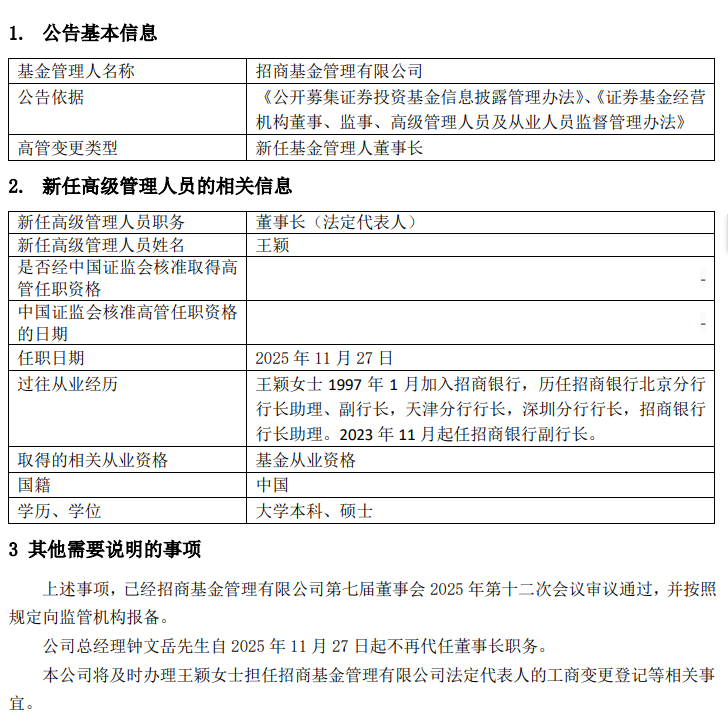
11月26日晚间,招商基金正式宣布,自11月27日起,王颖任招商基金董事长(法定代表人) 。同日, 公司总经理钟文岳不再代任董事长职务。 | 基金管理人名称 | 招商基金管理有限公司 | | --- | --- | | 公告依据 | 《公开募集证券投资基金信息披露管理办法》、《证券基金经营 | | | 机构董事、监事、高级管理人员及从业人员监督管理办法》 | | 高管变更类型 | 新任基金管理人董事长 | 头部公募官宣换帅! | 新任高级管理人员职务 | 董事长(法定代表人) | | --- | --- | | 新任高级管理人员姓名 | 王颖 | | 是否经中国证监会核准取得高 | | | 管任职资格 | | | 中国证监会核准高管任职资格 | | | 的日期 | | | 任职日期 | 2025年11月27日 | | 过往从业经历 | 王颖女士 1997年 1 月加入招商银行,历任招商银行北京分行 | | | 行长助理、副行长,天津分行行长,深圳分行行长,招商银行 | | | 行长助理。2023年11月起任招商银行副行长。 | | 取得的相关从业资格 | 基金从业资格 | | 国籍 | 中国 | | 学历、学 ...

突破10000亿!2026年布局思路来了
Zhong Guo Ji Jin Bao· 2025-11-23 14:17
Core Insights - The public fund issuance market in China has reached a scale of 1.0728 trillion yuan in 2025, marking the seventh consecutive year of exceeding one trillion yuan, with equity funds becoming the main force in this growth [1][2][4] - The growth is attributed to a combination of policy guidance, a shift in capital allocation, and a favorable market environment, indicating a long-term trend of residents transferring assets from real estate to financial assets [1][6][7] Fund Issuance Trends - The issuance of new funds has maintained a high level, with equity funds (stock and mixed funds) accounting for over 50% of the total issuance, surpassing bond funds which have dropped from over 70% to 40% [4][5] - The strong performance of the A-share market and favorable economic data have boosted investor confidence, leading to increased fund inflows [2][3] Market Dynamics - The shift towards equity funds reflects a significant change in market risk appetite and asset allocation logic, with investors now favoring equity funds to share in the benefits of economic transformation [5][6] - The public fund industry is expected to continue innovating with new products such as credit bond ETFs and floating rate funds, which will drive high-quality development in the sector [8][10] Future Outlook - The trend of maintaining a trillion yuan issuance scale is likely to become the norm, supported by the ongoing transition of residents' assets towards financial investments [6][7] - The public fund industry is planning to focus on innovative products in 2026, including equity funds centered on technology and high-dividend assets, as well as optimizing fixed-income products [10][15] Product Innovation - The introduction of innovative products such as credit bond ETFs and multi-asset ETFs is seen as a catalyst for the public fund industry's high-quality development [8][18] - Fund companies are increasingly focusing on differentiated product offerings to meet the diverse needs of both institutional and individual investors [16][19]
中国36万亿公募基金破解多重困局!走出转型迷雾 ,新机遇在何方
Sou Hu Cai Jing· 2025-11-21 18:01
Core Insights - The public fund management scale has surpassed 36 trillion yuan, marking a significant shift from a focus on scale to prioritizing quality in the industry [1] - The implementation of the "Action Plan for Promoting High-Quality Development of Public Funds" signifies the end of a long-standing growth model that emphasized scale over returns, prompting a reevaluation of core values across the industry [1] Industry Evolution - The public fund ecosystem is undergoing a profound transformation against the backdrop of changes in household wealth allocation, with a decline in the proportion and growth rate of money market funds reflecting an upgrade in investor demand towards stable and value-added returns [4] - The continuous increase in the proportion of equity assets not only indicates the maturity of the capital market but also reflects a return of investor trust in professional asset management capabilities [4] Investment Strategies - A complementary relationship between active and passive investments has emerged, breaking the long-standing debate of either-or within the industry, indicating a shift from meeting singular financial needs to covering comprehensive asset allocation scenarios [6] - The true value of the 36 trillion yuan milestone lies not in the number itself but in its representation of the industry's responsibility as a core link between household wealth and the real economy, which is essential for high-quality development [6] Innovation and Upgrades - Policy guidance acts as a directive for industry transformation, while product innovation and research upgrade serve as dual engines driving high-quality development, with their deep collaboration reshaping the core competitiveness of public funds [9] - The promotion of floating fee rate funds establishes a binding mechanism between managers and investors, representing a fundamental reform of traditional fee structures [9] Research and Development - The transition away from a star manager dependency model is crucial for the industry's maturity, as reliance on star fund managers has led to performance instability and a vicious cycle of talent loss and scale shrinkage for smaller institutions [13] - Industrialized research and development driven by leading firms aims to convert individual capabilities into sustainable core competitiveness for institutions, ultimately protecting investor interests [13] Challenges and Solutions - High-quality development is not without challenges, as the industry faces multiple issues, including a misalignment between investor behavior and fund performance, which highlights a lack of investor service [18] - Fund companies have historically focused too much on product sales while neglecting post-investment support, making it difficult for investors to establish a long-term investment mindset [20] - Risk management challenges are escalating due to global geopolitical uncertainties and asynchronous policy cycles, necessitating a proactive approach to risk management that integrates risk forecasting into the entire research process [22] Future Outlook - The high-quality development of the public fund industry must ultimately return to the core of creating value for investors, with product innovation, research upgrades, and investor service optimization centered around this principle [24] - The 36 trillion yuan milestone is not an endpoint but a new starting point for industry transformation, where only those institutions that adhere to professionalism, prioritize investor interests, and possess risk control capabilities will thrive in the long term [24]

守护投资者利益 深耕价值创造
Zhong Guo Zheng Quan Bao· 2025-11-20 20:08
Core Viewpoint - The public fund industry in China is undergoing a critical transformation aimed at enhancing quality and efficiency, with Shenzhen leading the charge through comprehensive reforms and initiatives to support high-quality development [1][2]. Group 1: Industry Reform and Development - Shenzhen's public fund market is characterized by strong vitality and innovation, with a leading number of institutions and management scale in the country [1]. - The China Securities Regulatory Commission (CSRC) has issued a systematic work plan to guide the industry towards high-quality development, focusing on serving the real economy and protecting investor interests [1][2]. - A comprehensive reform covering product, sales, and evaluation aspects is being implemented to align the interests of investors, fund managers, sales institutions, and evaluation agencies [2]. Group 2: Investor Interest and Performance - Industry institutions are incorporating investment performance and investor returns into core assessment indicators, promoting a shift from short-term speculation to long-term value creation [2]. - Nine fund companies in Shenzhen have launched 14 floating fee rate products, amounting to 14.87 billion, to share benefits and risks with investors [2]. - Since the fee reform in July 2023, 31 public fund companies in Shenzhen have significantly reduced management and custody fees, benefiting investors by over 6 billion [2]. Group 3: Long-term Investment and Institutional Capability - The public fund industry is transitioning from a focus on scale to prioritizing investor returns, with efforts to enhance long-term capital market participation [3][4]. - As of September, the scale of pension products managed by Shenzhen public fund companies exceeded 2 trillion, reflecting a growth of over 10% compared to the end of last year [4]. - Institutions are investing in research capabilities and exploring differentiated development paths to improve investor returns [5]. Group 4: Product Innovation and Strategic Focus - Shenzhen's public fund industry is actively directing funds towards key areas such as technology innovation, green finance, and regional collaboration [6][7]. - The number of technology-themed funds in Shenzhen reached 495, with a total scale of 506.09 billion, marking a growth of 60.94% since the second quarter [6]. - The scale of green-themed funds in Shenzhen reached 112.33 billion, with a quarter-on-quarter growth of 22.33% [6]. Group 5: Future Outlook and Strategic Goals - Shenzhen's regulatory body emphasizes risk prevention, strong regulation, and promoting high-quality development as key work priorities [7]. - The industry aims to enhance core research capabilities and better serve national strategies and wealth management needs of residents [7]. - Shenzhen is positioned as a core engine city in the Guangdong-Hong Kong-Macao Greater Bay Area, with a vibrant capital market and deep integration of technology and finance [7].
北京证券业协会 向公募基金行业 发出高质量发展倡议书
Zhong Guo Zheng Quan Bao· 2025-11-18 20:14
● 本报记者张凌之 自9月8日启动以来,"北京公募基金高质量发展系列活动"开展了形式多样、内容丰富的主题活动,四十 余家行业机构和主流媒体参与其中。系列活动以"新时代.新基金.新价值——北京公募基金高质量发展在 行动"为主题,通过多场景、多层次的深度互动,形成立体化、广覆盖的传播格局。 倡议书还提出,各机构要以建设现代一流投资机构为目标,全面提升市场竞争力与行业影响力。基金管 理人要积极发挥行业引领作用,构建良性互动、协同发展的行业新格局。 此次倡议书的发布,标志着"北京公募基金高质量发展系列活动"圆满落下帷幕。通过为期一个多月的系 列活动,北京辖区公募基金行业进一步凝聚了高质量发展共识,展现了积极响应政策号召、主动拥抱行 业变革的新风貌。 在"北京公募基金高质量发展系列活动"圆满收官之际,北京证券业协会近日向辖区各公募基金管理人、 基金销售机构、基金托管人、基金评价机构及相关行业机构发出《北京公募基金行业高质量发展倡议 书》,号召全行业深入贯彻落实党中央决策部署和证监会工作要求,推动北京辖区公募基金业在新时代 展现新作为。 倡议书从七个方面对北京公募基金行业高质量发展提出明确要求。在强化使命担当方面,倡议书 ...
北京证券业协会向公募基金行业发出高质量发展倡议书
Zhong Guo Zheng Quan Bao· 2025-11-18 20:04
此次倡议书的发布,标志着"北京公募基金高质量发展系列活动"圆满落下帷幕。通过为期一个多月的系 列活动,北京辖区公募基金行业进一步凝聚了高质量发展共识,展现了积极响应政策号召、主动拥抱行 业变革的新风貌。 倡议书提出,要加大权益投资,构建科学完善的权益资产配置体系。恪守合规底线,坚持"合规创造价 值"理念。深入践行"五要五不"中国特色金融文化,不断提升行业公信力和社会认同度。 倡议书还提出,各机构要以建设现代一流投资机构为目标,全面提升市场竞争力与行业影响力。基金管 理人要积极发挥行业引领作用,构建良性互动、协同发展的行业新格局。 ● 本报记者 张凌之 在"北京公募基金高质量发展系列活动"圆满收官之际,北京证券业协会近日向辖区各公募基金管理人、 基金销售机构、基金托管人、基金评价机构及相关行业机构发出《北京公募基金行业高质量发展倡议 书》,号召全行业深入贯彻落实党中央决策部署和证监会工作要求,推动北京辖区公募基金业在新时代 展现新作为。 倡议书从七个方面对北京公募基金行业高质量发展提出明确要求。在强化使命担当方面,倡议书明确, 各机构要胸怀"国之大者",主动融入国家发展大局,聚焦科技金融、绿色金融、普惠金融、养 ...
万亿公募官宣,陈宇履新博时基金总经理
2 1 Shi Ji Jing Ji Bao Dao· 2025-11-13 11:29
Core Viewpoint - The appointment of Chen Yu as the new General Manager of Bosera Fund marks a significant leadership change, aligning with the evolving trends in the public fund industry and aiming to enhance the company's investment management capabilities [1][2][5]. Group 1: Leadership Changes - Chen Yu has officially taken over as General Manager of Bosera Fund, following the appointment of Zhang Dong as Chairman [1][2]. - Chen Yu has extensive experience in various financial sectors, including banking, insurance asset management, and insurance companies, which is expected to bring synergistic benefits to Bosera Fund [2][3]. - The new leadership team is seen as well-rounded, with expertise in wealth management and asset management, which will help Bosera Fund leverage its resources for high-quality development [2][5]. Group 2: Company Performance and Strategy - As of the end of Q3, Bosera Fund manages 399 public funds with total assets exceeding 1.8 trillion RMB, serving over 180 million clients [2][6]. - The company is optimistic about the long-term growth of the Chinese economy and capital markets, aiming to adapt to the ongoing transformation in the public fund industry [5][6]. - Bosera Fund plans to focus on high-quality development, aligning its strategies with market demands and prioritizing investor interests [5][6]. Group 3: Market Context - The public fund industry is undergoing significant changes, with regulatory bodies emphasizing the need for improved asset management and comprehensive wealth management capabilities [5][6]. - The new management team is expected to drive innovation and development within Bosera Fund, particularly in the context of increasing market competition [6].
官宣!博时基金总经理定了
中国基金报· 2025-11-11 16:09
Core Viewpoint - The appointment of Chen Yu as the new General Manager of Bosera Fund is expected to positively impact the company's future development and inject new vitality into its ongoing growth [2][4][8]. Management Change - Bosera Fund has completed a core management adjustment with Chen Yu officially taking over as General Manager, following the appointment of Zhang Dong as Chairman [2][4]. - This change marks a significant leadership transition for the company, which manages over 1.8 trillion RMB in assets [2][11]. Chen Yu's Background - Chen Yu has a rich background in finance, having worked in various sectors including banking, insurance asset management, and insurance companies [8]. - His previous roles include positions at China Industrial Bank, Huaxia Bank, and Taikang Asset Management, among others, showcasing a diverse and comprehensive skill set [7][8]. Current Status of Bosera Fund - As of September 30, 2025, Bosera Fund manages 399 public funds with a total asset scale exceeding 1.8 trillion RMB and has served over 180 million clients [11]. - The company expresses confidence in the long-term growth of the Chinese economy and capital markets, aiming for high-quality development in alignment with national strategies [11]. Strategic Focus - Bosera Fund aims to create value for clients by prioritizing their interests and maintaining a long-term perspective in investment decisions [11][12]. - The company plans to enhance its investment research capabilities and provide multi-asset allocation solutions to discover investment value [12]. - Bosera Fund is committed to contributing to the construction of a "financial power" by actively participating in public fund reforms and innovations [13].