
深空探测

Search documents
深空物质成分光谱探测联合实验室揭牌
Zheng Quan Shi Bao Wang· 2025-12-15 09:39
Core Viewpoint - The collaboration between the Chinese Academy of Sciences, Macau University of Science and Technology, and the Chinese University of Hong Kong aims to establish a joint laboratory for deep space material composition spectral detection, focusing on key scientific issues in deep space exploration [1] Group 1 - The three parties signed an agreement on December 14 to jointly build the "Joint Laboratory for Deep Space Material Composition Spectral Detection" [1] - The joint laboratory will initiate the collaborative development of the Tianwen-3 payload "Laser Heterodyne Spectrometer" [1] - The laboratory will focus on developing high-sensitivity and high-resolution spectral detection technology for in-situ and remote sensing studies of material composition on celestial bodies such as Mars and the Moon [1] Group 2 - The collaboration aims to cultivate interdisciplinary talents in planetary science and space technology with a global perspective [1]
【中国新闻网】天问三号载荷研制项目启动 携手港澳高校共探深空
Zhong Guo Xin Wen Wang· 2025-12-15 05:42
Group 1 - The core project of the "Tianwen-3" laser heterodyne spectrometer aims to achieve high-precision and wide-coverage detection of Martian atmospheric water vapor and its isotopes, as well as three-dimensional detection of Martian global atmospheric wind fields [3] - The project is part of China's Mars sample return mission and is crucial for the development of China's deep space exploration efforts, providing scientific and technical support [3] - The establishment of the Deep Space Material Composition Spectroscopy Detection Joint Laboratory, which includes the Chinese Academy of Sciences, the University of Macau, and now the Chinese University of Hong Kong, focuses on key scientific issues in deep space exploration [3][4] Group 2 - The joint laboratory will prioritize the development of high-sensitivity and high-resolution spectral detection technologies, conducting in-situ and remote sensing research on the material composition of celestial bodies such as Mars and the Moon [3] - The collaboration aims to cultivate interdisciplinary talents in planetary science and space technology with a global perspective [3]

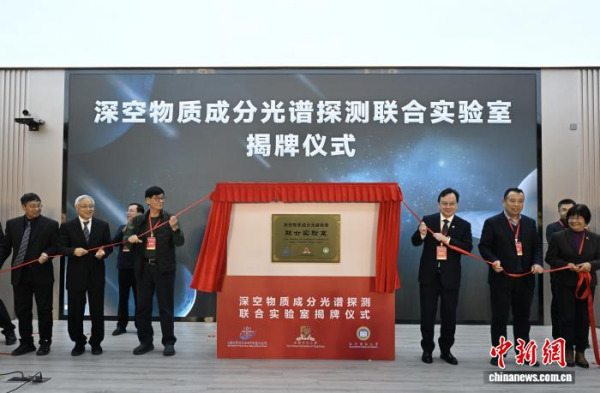
天问三号载荷“激光外差光谱仪”研制启动
Zheng Quan Shi Bao· 2025-12-14 18:34
Core Viewpoint - The establishment of the "Deep Space Material Composition Spectroscopy Detection Joint Laboratory" aims to address key scientific issues in deep space exploration through collaboration among institutions in China [1] Group 1 - The joint laboratory is a collaboration between the Hefei Institute of Physical Science, Macau University of Science and Technology, and the Chinese University of Hong Kong [1] - The laboratory will focus on the joint development of the "Laser Heterodyne Spectrometer" for the Tianwen-3 mission [1] - This initiative highlights the increasing emphasis on international collaboration in space exploration and scientific research [1]
“皖”约未来——安徽加快建设三大科创引领高地
Shang Hai Zheng Quan Bao· 2025-12-04 20:06
Core Insights - Anhui is focusing on building a future industry system that is innovative, self-controlled, and competitive, with a goal to exceed 200 billion yuan by 2027 and reach 500 billion yuan by 2030 [3] - The province is establishing three major innovation-led high grounds: quantum information, fusion energy, and deep space exploration, positioning itself as a significant source of innovation and industry leadership globally [2][12] Quantum Information - Over a hundred quantum industry chain enterprises have gathered in Anhui, with core companies accounting for one-third of the national total, forming a collaborative ecosystem [2][7] - Hefei aims to develop the quantum industry into a 100 billion yuan cluster by 2027 [2][7] - Hefei ranks second globally in the quantum technology field, with three local companies in the top 20 worldwide [5] - The "Qianzi" action plan aims to implement over 1,000 application scenarios by 2027 and over 3,000 by 2030 [6] Fusion Energy - Anhui has made significant strides in fusion energy, achieving a world record with the EAST device, which completed high-quality burning at 100 million degrees Celsius for 1,000 seconds [8] - The BEST project is expected to be completed by the end of 2027, aiming to demonstrate energy output exceeding consumption [8] - The international community is closely watching China's progress in fusion energy, with over 160 fusion devices currently in operation, construction, or planning [9] Deep Space Exploration - The deep space exploration laboratory in Hefei is a key research base for advancing critical technologies and implementing large-scale missions [10] - The laboratory is transitioning from government-led investments to a model that encourages market participation, fostering a collaborative ecosystem for deep space economy [11] - The establishment of the International Deep Space Exploration Society headquarters in Hefei further solidifies the province's role as a global innovation hub in this field [11]
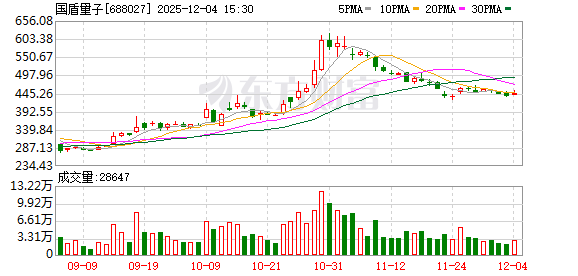
2025年九章论坛系列活动收官
Huan Qiu Wang Zi Xun· 2025-12-03 03:27
Core Insights - The event focused on deep space exploration and the search for life beyond Earth, highlighting advancements in planetary science and international collaboration in space missions [1][3] Group 1: Deep Space Exploration - The report discussed historical perspectives on the universe, from ancient Greek philosophy to modern space exploration, emphasizing humanity's quest for understanding its origins and future [3] - Key achievements in solar system exploration were presented, including findings from Venus, Mars, Europa, and Titan, as well as China's lunar and planetary exploration missions, such as the Chang'e and Tianwen series [3] Group 2: Future Directions - The dialogue session engaged the audience on topics like the origin of the universe, the possibility of life on Mars, challenges in deep space exploration technology, and future international cooperation plans [3] - The forum aims to enhance collaboration with domestic and international universities, research institutions, and societies to promote the popularization of scientific innovation resources [3]
影石助力浙大探月微型探索机器人项目,影像技术赋能中国航天事业
Zheng Quan Shi Bao Wang· 2025-11-28 03:03
Group 1 - The Zhejiang University Aerospace College held a donation ceremony and prototype release for the lunar exploration micro-robot project, with YingShi Innovation as a core supporter [1][2] - YingShi Innovation will apply advanced imaging technologies such as extreme environment imaging and real-time stabilization to support space exploration, which will also drive further iterations of imaging technology [1][2] - The project aims to enhance the academic development and research capabilities of Zhejiang University, providing technical support for China's deep space exploration missions [2] Group 2 - YingShi Innovation has invested a total of 1.48 billion yuan in R&D from 2022 to 2024, holding nearly a thousand domestic and international patents, establishing a strong technological barrier in key areas such as panoramic image processing and stabilization algorithms [3] - The company's panoramic cameras have maintained the largest global market share for eight consecutive years, and its innovations have earned recognition, including the 2025 Emmy Award for panoramic image stitching algorithms [3]


【新华社】“观天逐日”——探秘四川稻城大科学装置
Xin Hua She· 2025-11-19 02:04
Core Insights - The article highlights the significant advancements in cosmic ray observation and solar monitoring technologies in China, particularly through the establishment of the LHAASO (High Altitude Cosmic Ray Observatory) and the Ring Array Solar Radio Telescope [9][10][12][14]. Group 1: LHAASO Developments - LHAASO, located at an altitude of over 4,400 meters, covers an area of 1.36 square kilometers and has made a groundbreaking discovery regarding the formation of cosmic ray "knee," providing key observational evidence [9][10]. - The observatory is equipped with nearly 10,000 detectors utilizing four advanced detection technologies, enabling it to capture cosmic ray particles effectively [12][13]. - LHAASO has achieved significant milestones, including the observation of the highest energy gamma photons and the identification of the first super cosmic ray source, marking a leap in China's cosmic ray research capabilities [18][21]. Group 2: Ring Array Solar Radio Telescope - The Ring Array Solar Radio Telescope, consisting of 313 six-meter antennas, is designed to monitor solar activities that impact space weather, providing critical forecasting capabilities [14][15]. - In September 2023, the telescope successfully predicted a solar eruption event, demonstrating its ability to provide timely warnings with an error margin of less than 1.16 hours [14]. - The telescope's construction reflects significant technological advancements, including real-time monitoring of thousands of optical fiber interfaces to ensure precise alignment of antennas [18][21]. Group 3: Research Environment and Infrastructure - The high-altitude location of Daocheng County offers optimal conditions for astronomical observations, attracting numerous scientists and researchers to the area [10][12]. - The construction of these large scientific facilities has faced challenges due to harsh environmental conditions, but the rapid development has showcased China's commitment to advancing scientific research [20][21]. - The collaborative efforts among various research institutions and universities have led to significant technological innovations, enhancing the capabilities of both LHAASO and the Ring Array [21].
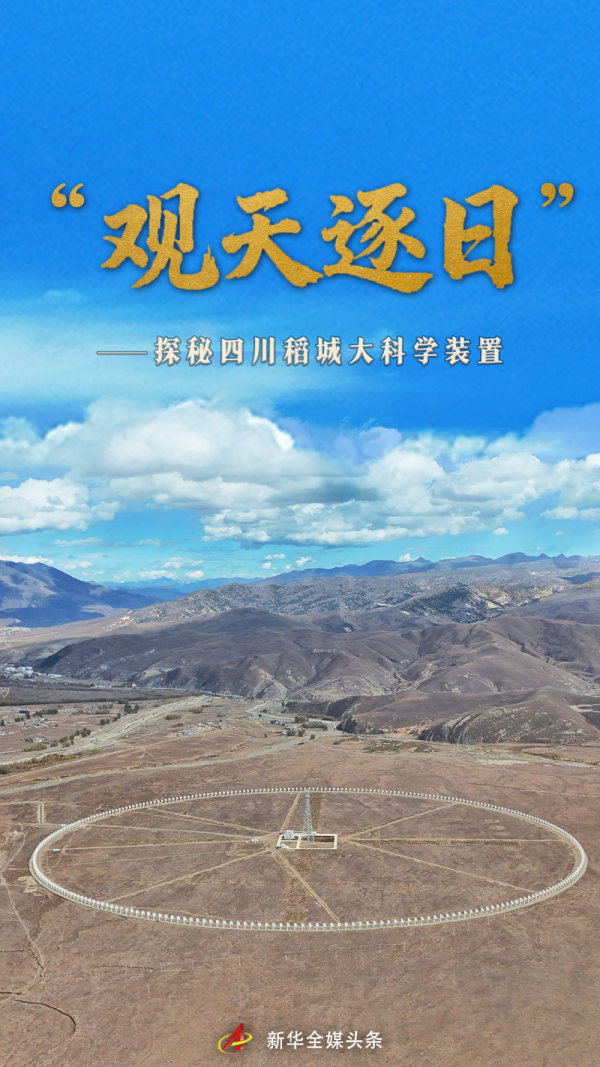
新华全媒头条|“观天逐日”——探秘四川稻城大科学装置
Xin Hua She· 2025-11-18 14:11
Core Insights - The article highlights the significant advancements in cosmic ray research facilitated by the LHAASO (Large High Altitude Air Shower Observatory) located in Daocheng, Sichuan, which has made key discoveries regarding cosmic ray origins and acceleration mechanisms [1][2][8] Group 1: LHAASO Overview - LHAASO is the world's highest and largest gamma-ray detection facility, built to address the long-standing mystery of cosmic ray "knee" formation [2][3] - The observatory covers an area of 1.36 square kilometers and employs nearly 10,000 advanced detectors using four different detection technologies [3][6] - The facility has successfully captured the highest energy gamma photons and confirmed the first super cosmic ray source, marking a leap in China's cosmic ray research capabilities [7][10] Group 2: Technological Innovations - The observatory's design and construction involved collaboration among over 50 research institutes, universities, and enterprises, overcoming numerous technical challenges [10] - The addition of 32 new large-scale imaging atmospheric Cherenkov telescopes is expected to enhance the observatory's spatial resolution by over five times [3][5] - The Ring Array Solar Radio Telescope, another major scientific installation in the region, has demonstrated its capability to predict solar events with high accuracy [5][10] Group 3: Research Impact - LHAASO's findings have revolutionized the understanding of cosmic rays and challenged traditional theories regarding their origins [8][9] - The observatory has recorded significant cosmic events, including the brightest gamma-ray burst to date, GRB 221009A, leading to new insights into gamma-ray bursts [7][8] - The advancements in cosmic ray research are part of China's broader strategy to enhance its scientific capabilities and achieve technological self-reliance [9][10] Group 4: Future Prospects - Daocheng is becoming a hub for major scientific installations, attracting more research projects and enhancing its capacity for sustainable development in scientific research [11] - The ongoing developments in the region are expected to further elevate China's position in deep space exploration and scientific research [11]
我国深空探测不断探索新高度 天问一号成功观测到星际天体
Yang Shi Wang· 2025-11-06 06:43
Core Insights - The Tianwen-1 mission successfully observed the interstellar comet Atlas, marking the first time a Chinese spacecraft has observed an interstellar body, which is estimated to be between 3 billion and 11 billion years old [1][3]. Group 1: Mission Details - Tianwen-1 is China's first Mars probe, originally designed to capture images of the bright Martian surface, but it has now successfully attempted to photograph a much fainter target, Atlas, which is 10,000 to 100,000 times dimmer than Mars [3]. - The probe was approximately 30 million kilometers away from Atlas during the imaging process, making it one of the closest spacecraft to observe this interstellar object [3][7]. Group 2: Scientific Significance - Atlas follows a hyperbolic trajectory, indicating it originated from outside the solar system, unlike celestial bodies within the solar system that follow elliptical orbits [5]. - Continuous imaging of Atlas allowed the research team to gather information about its flight path through the solar system and its position relative to Mars [7][9]. - The research team deduced that Atlas likely originated near an ancient star in the center of the Milky Way galaxy, with its discovery initially made by a ground-based telescope in Chile [9][11]. Group 3: Composition and Future Research - The imaging analysis revealed that Atlas has a significant tail, potentially containing water ice and carbon dioxide, which requires further confirmation [13]. - The unique nature of Atlas means that every particle of dust and ice it carries is different from those found in the solar system, providing an opportunity to compare its composition with solar system comets to gain insights into the origins of the solar system [13]. Group 4: Future Missions - The successful observation of Atlas by Tianwen-1 lays a technical foundation for the upcoming Tianwen-2 mission, which will also focus on detecting small, faint celestial bodies [15]. - The experience gained from this mission is expected to contribute to future deep space exploration efforts [15].

力争为月球研究补上“关键拼图”(迈向“十五五”的创新图景)
Ren Min Ri Bao· 2025-10-23 22:10
Core Insights - The article emphasizes the importance of enhancing independent innovation capabilities to seize the high ground in technological development and continuously generate new productive forces [1] Group 1: Research Achievements - The first batch of research results from the Chang'e 6 lunar sample was published in the journal "Science" on November 15, 2024, revealing that the volcanic lava in the landing area formed 2.83 billion years ago, indicating young magma activity on the moon's far side [2] - Key findings include insights into the moon's early impact history and the formation time of the Apollo Basin, providing critical evidence for understanding the late heavy bombardment of the moon [2] - The discovery of carbonaceous spherules in the lunar soil, which are rich in water and organic matter, offers new clues for exploring the sources of water on the moon's surface [2] Group 2: Future Research Directions - The team plans to continue research on the differences between the moon's near and far sides, leveraging existing technological advancements to deepen lunar sample studies [3] - The goal is to achieve further breakthroughs in understanding the moon's evolutionary history, contributing to planetary science and deep space exploration [3] Group 3: Challenges in Lunar Research - Lunar soil samples are extremely limited and precious, with Chang'e 6 returning only 1935.3 grams, and distribution among research institutions is strictly controlled [4] - Analyzing lunar samples requires optimized research methods due to the unique lunar environment, which poses high demands on instrument precision and technical accumulation [4] - A multidisciplinary team of over 30 researchers has been established to tackle these challenges and has already achieved significant results in the first batch of sample studies [4][5]