
生态产业化

Search documents
精心呵护草原生态环境
Jing Ji Ri Bao· 2025-05-29 22:20
Core Viewpoint - The article emphasizes the historical progress and significant achievements in grassland ecological protection in China, highlighting the government's commitment to ecological governance and sustainable development [1] Group 1: Ecological Protection Achievements - China has nearly 4 billion acres of grassland, which is crucial for national ecological security and regional economic development [1] - Since the "14th Five-Year Plan," central government investment in grassland protection and restoration has reached 110 billion yuan, with an average annual restoration of over 4.6 million acres and pest control over 10 million acres [1] - The comprehensive vegetation coverage of grasslands has stabilized above 50% for several years, indicating significant progress in high-level protection and quality development [1] Group 2: Regional Initiatives and Challenges - Inner Mongolia has implemented a dual-track system of "forbidden grazing and rest grazing," reducing the grassland livestock balance index from 23.9% to below 10% [2] - Qinghai Province has achieved a vegetation coverage of 58.56% in high-altitude grasslands, with fresh grass production exceeding 10 million tons [2] - Challenges in ecological protection include high artificial intervention, insufficient understanding of natural laws, and barriers to cross-regional cooperation [2] Group 3: Technological Empowerment - The article discusses the shift from experience-based to smart management in grassland protection, emphasizing the integration of traditional wisdom and modern technology [3] - A comprehensive monitoring network utilizing satellite remote sensing and drones is proposed to track dynamic changes in vegetation, animals, soil, and climate [3] - The use of IoT sensors and AI for intelligent management of grassland ecosystems is highlighted [3] Group 4: Economic Integration and Collaboration - The development of "ecological industrialization and industrial ecology" is encouraged, promoting models like "grass-solar complementary" and "forest-grass composite" [4] - Establishing a carbon trading market for grasslands is suggested to convert ecological benefits into economic gains for herders [4] - The article calls for enhanced regional cooperation and international collaboration in grassland ecological protection, sharing experiences and technologies [4]
绵阳平武“绿” 为“熊猫家园”加速发展注入澎湃动力
Zhong Guo Fa Zhan Wang· 2025-05-29 06:11
Core Viewpoint - The press conference highlighted the high-quality development of Pingwu County's economy, emphasizing ecological preservation and cultural heritage as key drivers for sustainable growth [1] Group 1: Ecological and Cultural Development - Pingwu County is recognized as a biodiversity hotspot with 335 wild giant pandas, making it the "first county of giant pandas" in China [1] - The county has implemented strategies to enhance ecological and cultural assets, including the protection of the Baoning Temple and the promotion of the White Horse culture [2] - Pingwu has been selected as a national model for ethnic unity and a national-level cultural protection experimental zone for the Qiang ethnic group [1][2] Group 2: Economic Growth and Investment - Pingwu has established a project reserve with a total investment exceeding 500 billion yuan, with an average investment growth rate of over 22% in the past three years [3] - The county's fixed asset investment reached 50% in the first quarter of this year, with a target of increasing various funding sources by 103.7% in 2024 [3] Group 3: Tourism and Industrial Development - Pingwu is enhancing its tourism sector by investing nearly 2 billion yuan in key projects, aiming for a 44% increase in tourist arrivals and a 67% increase in tourism revenue in 2024 [4] - The county is focusing on the "Tianfu Forest Four Libraries" initiative, with over 950,000 acres of agricultural production bases and a forestry output value of 4.3 billion yuan [5] - Pingwu is developing a clean energy industry, with a hydropower capacity of 890,000 kilowatts and an annual generation of 3.656 billion kilowatt-hours [6] Group 4: Social Welfare and Infrastructure - The county has invested 330 million yuan in upgrading schools and hospitals, establishing a collaborative education model and enhancing healthcare resources [7] - Pingwu has implemented 46 urban construction projects, achieving a 94% renovation rate for old neighborhoods and a 43.5% green coverage rate [7][8] - The county has developed a comprehensive transportation network, with over 5,200 kilometers of roads, facilitating investment and trade [8]
“四两博千金”,辽宁彰武防沙治沙突出产业化路径
Di Yi Cai Jing· 2025-05-22 02:35
Core Viewpoint - The article discusses the ongoing efforts in the Khorchin Sandy Land, particularly in Zhangwu County, to combat desertification through a comprehensive approach that integrates ecological and economic development [1][2] Group 1: Environmental Initiatives - A large-scale project for planting sea buckthorn has commenced in Zhangwu County, aiming to achieve a combination of windbreak and sand fixation with economic forestry [1] - Zhangwu County is recognized as a key battlefield in the fight against desertification and is designated as a national comprehensive demonstration area for sand control [1] Group 2: Economic Development Strategies - The local government emphasizes the importance of developing forestry industries as a fundamental strategy to transform ecological benefits into economic gains, supporting high-quality economic development [1] - The "Two Forests" (under-forest economy and forestry economy) and "Two Transformations" (ecological industrialization and industrial ecology) are central to the county's development strategy [1] Group 3: Government Support and Planning - The approach taken by Zhangwu County has received recognition from the Liaoning Provincial Government, highlighting the need for sustainable resource utilization and the development of economic forestry [2] - The "Five-Year Plan for Under-Forest Economy Development (2025-2029)" focuses on diverse economic models, including medicinal herbs, seedlings, flowers, vegetables, fungi, and silkworm farming, to promote a full industrial chain [2] - By 2025, the plan aims to establish a "one land, two parks, and a hundred villages" initiative, which includes a large-scale medicinal herb planting project and a courtyard economy project across multiple villages [2]
科技赋能“百千万工程”:华南农大与从化共筑湾区生态经济走廊
Nan Fang Nong Cun Bao· 2025-04-29 05:47
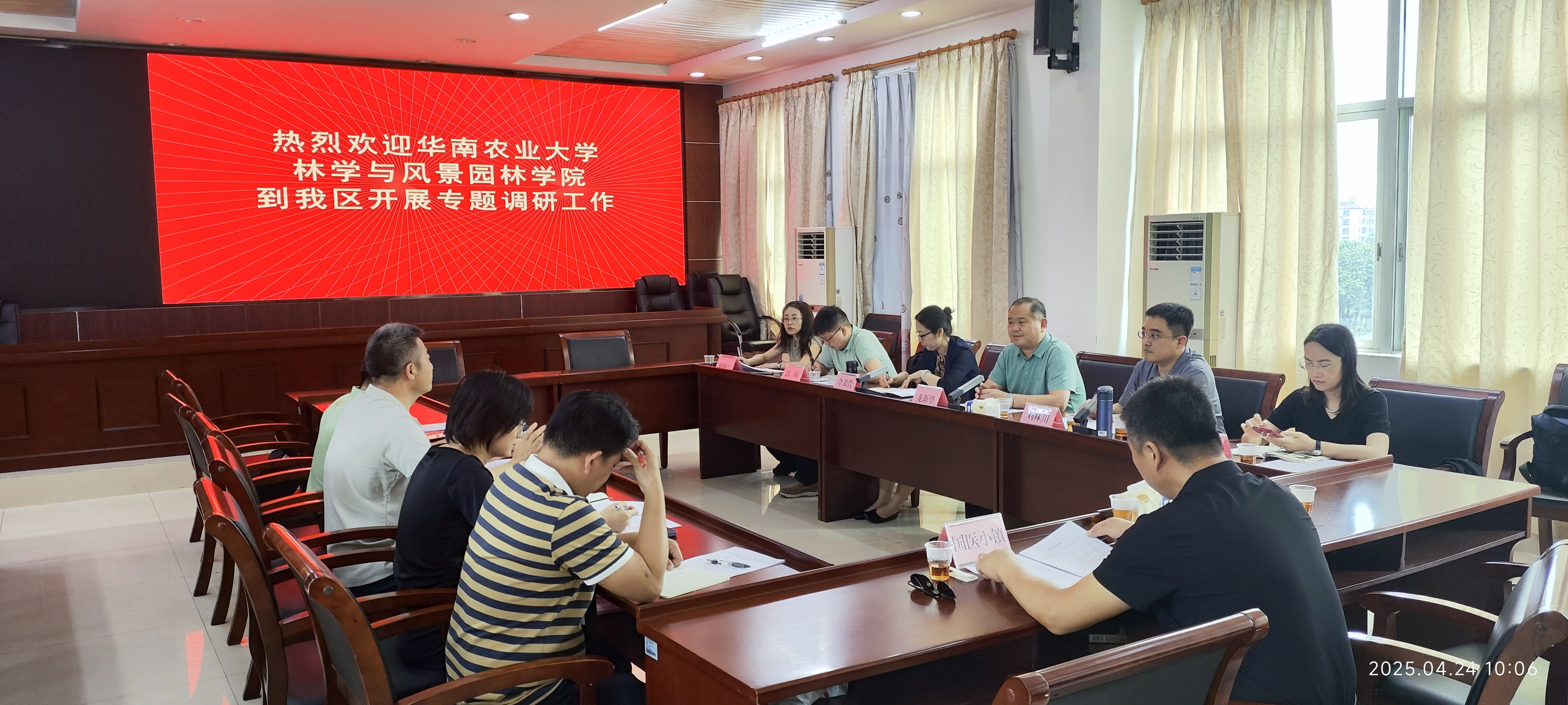
Core Insights - The collaboration between South China Agricultural University and Guangzhou Conghua District aims to enhance the green development demonstration zone, positioning it as a benchmark for ecological industrialization in the Greater Bay Area [1][2] Group 1: Collaboration and Initiatives - The recent activity marks a significant step in the journey towards establishing a modern agricultural technology county in collaboration with the local government [2] - The event featured a report by Professor Liu Linchuan, highlighting the college's history, discipline development, talent cultivation, and social services [2] Group 2: Ecological and Economic Development - Conghua District is leveraging its rich natural resources to innovate an "ecological restoration—product development—value conversion" closed-loop model, transforming ecological assets into economic benefits [5] - The district is implementing a comprehensive land consolidation pilot project, aiming to create a high-quality development area and accelerate the integration of the South China National Botanical Garden [5] Group 3: Technological Advancements - The college plans to integrate six national and provincial platforms to form interdisciplinary teams focused on ecological protection and industrial upgrades, enhancing the conversion rate of scientific achievements [6] - The emphasis is on addressing critical technological challenges and promoting the development of the forest economy, including beekeeping and medicinal plant cultivation [7] Group 4: Future Goals and Community Engagement - The district aims to conduct a comprehensive survey of wild plant resources and develop ecological education points, enhancing the green landscape and promoting the forest economy [7] - The university is committed to supporting the "Hundred-Thousand Project" and fostering agricultural productivity through continuous engagement and collaboration with local stakeholders [7][8]

沙漠披“绿围脖”,发展添“金钥匙”
Huan Qiu Wang· 2025-04-29 03:15
Core Viewpoint - The Akesu region in Xinjiang has made significant progress in combating desertification and promoting afforestation, achieving a forest coverage rate of 9.08% through large-scale tree planting and ecological restoration efforts [1][4]. Group 1: Ecological Transformation - The Akesu region has implemented a persistent sand control campaign, utilizing the "Three North" shelterbelt program and an innovative "engineering + biological + sand industry" model to transition from passive sand damage resistance to proactive ecological management [2][7]. - Since the 1980s, the region has initiated various ecological governance projects, including the "Five Million Mu" project, to establish a green barrier along the edge of the Taklamakan Desert, resulting in a green protective belt that is 60 kilometers wide and 386 kilometers long [3][4]. Group 2: Sand Industry Development - The establishment of a demonstration base for the cultivation of Haloxylon ammodendron in Shaya County has led to significant economic benefits, with the company involved reporting annual revenues exceeding ten million yuan from the cultivation and processing of the plant [5][6]. - The Akesu region has developed a comprehensive sand industry, with 59.03 million mu of desert-adapted plants cultivated and a production value of nearly 58.93 million yuan, creating over 5,000 jobs [6][8]. Group 3: Innovative Sand Control Models - The region has explored new technologies and models for sand control, including the integration of photovoltaic power generation with sand control efforts, which has helped address water scarcity for irrigation [7][8]. - A new development plan for the desert economy has been introduced, aiming to create a distinctive industrial system that enhances ecological, economic, and social benefits while promoting sustainable development in desert areas [8].
新疆为塔克拉玛干沙漠“扩边”增绿
Xin Hua She· 2025-04-21 09:42
Group 1 - The Xinjiang Uygur Autonomous Region is focusing on greening key areas, particularly the edge of the Taklamakan Desert, through various projects such as photovoltaic sand control and biological sand control [1] - The "Locking Edge Project" of the Taklamakan Desert has entered a high-quality and normalized phase since its completion on November 28, 2024, with plans to complete 11.94 million mu of the "Three North" project this year, including 8.44 million mu for the desert edge [1] - Local communities are actively participating in afforestation efforts, with drought-resistant and economically valuable tree species being planted to enhance both ecological and economic benefits [1] Group 2 - The Xinjiang government has implemented nine measures to support the desert control efforts, focusing on policies, funding, and technology [2] - In the Aheler Township, the government covers infrastructure costs to encourage farmers to participate in sand control planting, with over 230 households cultivating more than 29,000 mu of land [2] - The Aksu region is utilizing small distributed photovoltaic systems to address water and electricity challenges for desert reclamation, achieving an 80% survival rate for planted trees over 63,000 mu [2] Group 3 - The Shaya County is exploring brine water desalination technology to further enhance sand control results, with a demonstration base showing good growth of crops like wheat and cabbage [3]