大数据

Search documents
润和软件(300339)参股成立海西数智(厦门)能源科技研究有限公司,持股比例39%
Xin Lang Cai Jing· 2026-01-04 06:36
Core Insights - Recently, Haixi Smart (Xiamen) Energy Technology Research Co., Ltd. was established with a registered capital of 10 million yuan [1][2] - The company is involved in various sectors including emerging energy technology research, energy management, and renewable energy services [1][2] Company Overview - The legal representative of the company is Gao Yongyu [1][2] - The business scope includes: - Emerging energy technology research - Contract energy management - Energy-saving management services - Power generation technology services - Online energy measurement and monitoring technology research [1][2] Technological Focus - The company focuses on several technological areas such as: - Energy storage technology services - Wind and solar power generation technology services - Key technologies for waste heat power generation - Research and development in engineering and technology [1][2] Artificial Intelligence and Data Services - The company also engages in artificial intelligence software development, including: - Theoretical and algorithm software - Basic and application software - AI public service platform consulting [1][2] - Additionally, it provides big data services and data processing support [1][2] Ownership Structure - The company is jointly held by Runhe Software, Beijing Nengjian Technology Development Co., Ltd., and Xiamen Foxin Zhongshu Technology Co., Ltd. [1][2]

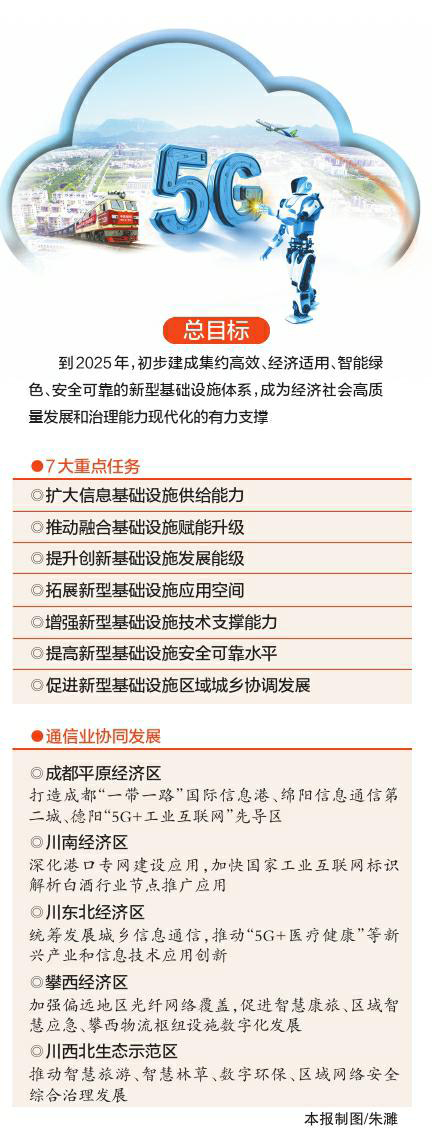
建成5G基站25万个、取消川渝座机通话长途费、已成功发射14颗AI卫星…… 四川“新基建”还有哪些大动作?
Si Chuan Ri Bao· 2026-01-04 03:58
Core Viewpoint - The Sichuan Provincial Government has issued the "14th Five-Year Plan for New Infrastructure Construction," aiming to establish a high-efficiency, economical, intelligent, green, safe, and reliable new infrastructure system by 2025, supporting high-quality economic and social development and modern governance capabilities [3][5][6]. Group 1: Key Tasks - The plan outlines seven key tasks, including expanding information infrastructure supply capacity, promoting integrated infrastructure upgrades, enhancing innovation infrastructure development capabilities, expanding application space for new infrastructure, strengthening technical support for new infrastructure, improving safety and reliability, and promoting coordinated urban-rural development [6][8]. - Specific focus areas include accelerating the construction of communication networks, data center systems, intelligent computing systems, industrial internet systems, and future networks, as well as smart transportation, smart energy, smart water conservancy, and smart logistics [6][9]. Group 2: Information Infrastructure Investment - Sichuan plans to invest a total of 100 billion yuan in building a leading information infrastructure, including the construction of 250,000 5G base stations to achieve widespread coverage in townships and administrative villages [8]. - The province aims to create a "Belt and Road" international information port in Chengdu, a second city for information communication in Mianyang, and a "5G + Industrial Internet" pilot area in Deyang [8]. Group 3: Industrial Internet Development - The plan emphasizes the construction of an industrial internet system as a crucial task, with Sichuan's data centers and 5G base stations ranking among the top in the country [9]. - The province has already established nearly 40 provincial-level industrial internet platforms and has facilitated over 240,000 enterprises to transition to cloud services [9]. Group 4: Innovation Infrastructure - The plan aims to enhance the development level of innovation infrastructure, focusing on source innovation and industrial innovation capabilities [11]. - Sichuan will create a world-class cluster of major scientific and technological infrastructure, including advanced nuclear energy, aerodynamics, and biomedical fields, and will establish a national laboratory base in Tianfu New Area [11].

海南解决一批营商环境历史遗留问题
Hai Nan Ri Bao· 2026-01-04 01:06
二是"遏新增",强化问题源头防控和治理。积极构建促进企业高质量发展的统筹性服务机制和促进 企业全生命周期合规经营的服务机制。持续强化干部法规政策的学习培训,指导促进企业依法合规经 营,强化实质性决策合法性审查,提升政府依法行政水平。加强诚信政府建设,不断完善和推广政府合 同履约监管机制,从源头避免产生新的营商环境问题。 三是"治根本",持续推进"一个问题"到"一类问题"解决。利用大数据、云计算、人工智能等科技手 段,建立分析研判机制,聚焦破解制约企业行业高质量发展中的深层次矛盾、基础性问题和制度性障碍 等共性问题,定期形成"一类问题"专报,推动各市县和各职能部门举一反三,完善制度,补齐短板,实 现从"一个问题"到"一类问题"的解决。 四是"建机制",健全问题核实处置制度体系。贯彻落实《营商环境问题核实处置工作意见》,建立 健全营商环境问题核实处置制度机制。强化重大疑难复杂问题法治会诊机制运用,提升解决问题的法治 能力;健全涉企紧急诉求快速直通会商机制,搭建对企业紧急诉求联合会商处置的"快车道",推动问题 快速响应解决;建立园区营商环境问题高位推动"呼应"机制,形成对园区企业发展突出问题、历史遗留 问题的攻坚合 ...
智能制造助力陕西工业转型升级
Shan Xi Ri Bao· 2026-01-04 00:42
据了解,该智能工厂总投资6.9亿元,实现了工艺设计数字化、制造设备网联化、生产流程自动 化、管控和决策智能化,是国内一流的数字化、自动化智能制造工厂,已累计突破40项关键技术,形成 18项国家和企业标准,申请专利60余项,智能制造取得新突破;深度参与陕西省及国家智能制造梯度培 育计划,通过数字化、网络化、智能化方式重构业务,成功打造了20余个智能制造场景并部署了9项AI 模型。 陕汽新能源商用车车架制造智能工厂的高效运转,是陕西智能制造助力工业转型升级的一个缩影。 智能制造已成为陕西转变工业增长方式、重塑工业增长动力的重要抓手。截至目前,全省共有16个 卓越级智能工厂、143个先进级智能工厂、402个基础级智能工厂。 "随着人工智能和大数据等新技术的创新应用,陕西智能制造快速发展,智能制造水平稳居西部前 列,智能工厂总数居西北第一、西部第三。"省工信厅相关负责人介绍,汽车、航空航天、输变电装 备、水泥建材、石油化工、消费品等行业重点企业广泛采用数控机床、工业机器人、增材制造、物联 网、智能物流仓储等装备技术以及人工智能、工业互联网等先进信息系统,开展智能制造标准化与新模 式应用,企业产品设计周期、劳动生产率、 ...
2025中国大数据产业白皮书
Sou Hu Cai Jing· 2026-01-04 00:31
Core Insights - The "2025 China Big Data Industry White Paper" emphasizes that big data has become a core driving force for transformation in the digital age, characterized by its scale, diversity, speed, and value [1][9][38] - The global big data market is expected to grow steadily, with IDC predicting a total IT investment of approximately $413.4 billion by 2025, with the Asia-Pacific region leading at a 22% growth rate [1][11] - China's big data industry is projected to exceed 3 trillion yuan by 2025, accounting for 65% of the Asia-Pacific market [1][11] Industry Growth and Trends - By 2025, global data traffic is expected to reach hundreds of exabytes (EB), with a tenfold increase in storage capacity over the next decade [1][11] - The integration of technologies such as 5G, IoT, cloud computing, and AI is enhancing the efficiency of data collection, storage, and processing [1][11][20] - The Chinese big data industry has formed 38 sub-sectors with 49,248 companies, including leading firms like Alibaba Cloud, Huawei, and Hikvision, indicating a rising market concentration [1][11] Applications Across Sectors - Big data applications are penetrating various industries, including finance, healthcare, agriculture, manufacturing, and transportation, addressing core pain points [1][11][19] - In finance, big data enables precise risk control and inclusive finance, while in healthcare, it supports accurate diagnosis and health management [1][11][19] - The retail sector benefits from big data through enhanced marketing strategies, inventory management, and supply chain optimization [1][29][30] Future Outlook - The future of big data will see deeper integration with AI, driving transformations across production paradigms, social structures, and cultural prosperity [1][11][38] - Ethical norms and governance systems will be essential to address challenges associated with big data, supporting high-quality development of the digital economy [1][11][38]

严把网售工业品质量安全关
Jing Ji Ri Bao· 2026-01-03 22:04
从家用电器、儿童玩具到建筑材料、汽车配件,工业产品线上交易量连年攀升,但其质量安全问题频 发。在此背景下,市场监管总局等14部门联合印发《网售工业产品质量安全专项治理行动方案(2025— 2027年)》,为3年期的监管攻坚行动划定路线图,彰显了国家强化网售工业产品质量安全监管的决心与 系统思维。 质量是发展的生命线。唯有以制度为基、以责任为要、以科技为翼,让合规经营成为行业共识,让专项 治理成效可感可知,才能有力遏制网售工业产品质量安全乱象,真正守护好人民群众的生命财产安全, 护航数字经济的持续健康发展。 网售工业产品质量安全问题频发,根源在于责任落实的缺位与监管机制的滞后。部分平台经营者漠视合 规要求,销售不符合强制性标准的产品、伪造认证证书等行为屡禁不止;一些平台为追求流量与交易 额,对入驻商家资质审核宽松,对商品信息核验不力;更有甚者借助直播带货等新模式,通过虚构功效 等方式误导消费者。这些问题不仅侵害了消费者权益,更破坏公平竞争的市场秩序,亟需加大质量安全 监管治理力度。 (文章来源:经济日报) 筑牢网售工业产品质量安全防线,关键是压实多元主体责任。专项治理行动明确要求平台与经营者落实 质量安全第一责 ...
新年开局起好步,乘势而上启新程
Xin Lang Cai Jing· 2026-01-03 14:06
Core Viewpoint - The Guizhou provincial government emphasizes the importance of "three major focuses" on industry, projects, and investment attraction as the top priority for economic work in 2025, aiming for high-quality development through effective investment expansion [1]. Group 1: Industry Development - Guizhou's industrial development strategy includes transforming "six major industrial bases" into "six major industrial clusters" and enhancing "three major characteristic industries," with industrial added value growing by 7% year-on-year, contributing 36.4% to economic growth [8][16]. - The Guizhou Aluminum Group's project utilizes energy-efficient technology, reducing energy consumption by 15% compared to traditional equipment, aligning with national carbon neutrality goals while improving production efficiency [11]. Group 2: Investment Attraction - In 2025, Guizhou plans to attract strong enterprises through targeted investment strategies, with 863 major projects identified, aiming for a total investment of 5,486.9 billion yuan, of which 652 projects have been signed with a contract amount of 3,371.2 billion yuan [6][4]. - The province's investment promotion bureau highlights the importance of a favorable business environment, with companies relocating to Guizhou due to its advantages in the big data sector [3]. Group 3: Project Implementation - Major projects are seen as crucial for economic stability, with the "5+3" work mechanism being implemented to ensure effective project execution, contributing 71.8% to provincial investment in the first three quarters of 2025 [15][13]. - The successful completion of significant projects, such as the coal-coke-chemical-electricity circular economy base, fills gaps in the industrial chain and enhances supply chain resilience [15].

研判2025!中国共享经济行业发展环境、产业链图谱、交易规模、市场集中度及前景展望:技术驱动与社会需求共振,共享经济交易规模有望达到4.8万亿元[图]
Chan Ye Xin Xi Wang· 2026-01-03 02:43
Core Insights - The sharing economy is an innovative economic model that enhances resource utilization efficiency, promotes economic development, and creates job opportunities [1][14] - In the transportation sector, models like bike-sharing and car-sharing have gained widespread adoption, alleviating urban traffic congestion and environmental pollution [1][14] - The market size of China's sharing economy is projected to reach 4.46 trillion yuan in 2024, with a year-on-year growth of 9.05% [1][14] - By 2025, the market size is expected to grow to 4.8 trillion yuan, driven by diverse consumer demands and the application of big data and artificial intelligence [1][14] Sharing Economy Overview - The sharing economy utilizes modern information technology to share usage rights, integrating vast and decentralized resources to meet diverse needs [2][8] - It represents a new economic form emerging from the information revolution, emphasizing sustainable development and optimal resource allocation [2][8] Development Environment - China's large population and expanding internet user base provide a robust market for the sharing economy, with the number of internet users growing from 688 million in 2015 to 1.108 billion in 2024 [7] - The internet penetration rate increased from 50.3% to 78.6% during the same period, supporting the innovation and market deepening of sharing economy models [7] Industry Evolution - The sharing economy began with the commercialization of the internet in 1993, evolving through various stages, including the rise of knowledge-sharing platforms and the impact of the 2008 financial crisis [8][9] - The period from 2013 to 2015 marked a golden age for the sharing economy in China, with increasing consumer acceptance and capital market interest [8][9] Industry Chain - The sharing economy industry chain consists of three main components: supply side, platform side, and client side [9][10] - The supply side focuses on renting usage rights and providing services, while the platform side integrates demand from providers and consumers to optimize resource allocation [9][10] Market Segmentation - The sharing economy includes various sectors such as transportation, healthcare, accommodation, and knowledge sharing, each with distinct market dynamics and growth potential [19][20] - The transportation sector is dominated by platforms like Didi and Hello Chuxing, while accommodation services are led by Meituan and Tujia [20] Future Trends - The market landscape of the sharing economy is expected to evolve, with competition shifting from scale and traffic to user lifecycle value and service ecosystem construction [23] - Compliance capabilities will become a core competitive advantage, with platforms integrating data security and consumer protection into their operations [24] - Governance models will transition from external regulation to platform autonomy and collaborative governance, leveraging technology for better risk management [26]



民生为大 书写健康中国新答卷
Xin Lang Cai Jing· 2026-01-02 18:29
Group 1: Core Insights - The article emphasizes the importance of prioritizing public health and improving the quality of life for citizens through various reforms and initiatives aimed at building a healthier China by 2025 [1] - Key reforms include increasing public health service funding, enhancing maternal and child care subsidies, and expanding access to innovative medications [1] - The Central Economic Work Conference has identified improving public health and optimizing healthcare systems as key tasks for 2026, indicating a commitment to deepening existing reforms [1] Group 2: Grassroots Healthcare Development - Strengthening grassroots healthcare is crucial for ensuring a solid foundation for public health, with community health centers providing specialized services and facilitating easier access to higher-level medical care [2] - In 2025, community health centers have improved their services through digital platforms, allowing for easier appointment scheduling and personalized medication management [2] - Over 90% of residents can access healthcare services within 15 minutes, highlighting the effectiveness of grassroots healthcare initiatives [2] Group 3: Healthcare Reform Implementation - Significant progress has been made in healthcare reforms, with 25 provinces establishing provincial-level imaging clouds and over 3.5 billion instances of data retrieval [3] - The introduction of the "Strong Foundation Project" aims to enhance the capabilities of grassroots healthcare institutions through the integration of new technologies like AI and big data [3] - The Guangxi region is leading efforts to create a unified healthcare information system, facilitating better data sharing and improving diagnostic capabilities [4] Group 4: Medical Insurance Payment Reform - The Central Economic Work Conference has prioritized optimizing drug procurement and reforming medical insurance payment methods as key components of improving public welfare and economic stability [5] - The reforms in drug procurement and insurance payment methods have shifted from broad cost control to more precise management strategies, enhancing the efficiency of healthcare spending [6] - The introduction of a new payment model emphasizes value-based care, encouraging healthcare providers to focus on patient outcomes and the quality of care [8] Group 5: Future Directions in Healthcare - The upcoming 3.0 version of the disease-based payment grouping will refine classifications based on disease type and severity, ensuring more accurate payment standards [9] - The reforms aim to support genuine innovation in healthcare by aligning insurance payments with the clinical and social value of new treatments [10] - The establishment of a commercial insurance directory for innovative drugs is expected to enhance the multi-tiered healthcare system and support the development of high-value treatments [10]
机器人“跑”起来助推物流“加速跑” 数万快递开启新年之旅抵达千家万户
Yang Shi Wang· 2026-01-02 10:33
Core Viewpoint - The logistics industry experiences a peak during the New Year holiday, with significant advancements in automation and efficiency in smart warehouses, exemplified by the operations in Beijing Daxing. Group 1: Warehouse Operations - The smart warehouse spans over 3,000 square meters and utilizes nearly 200 robots to handle over 30,000 packages daily, showcasing a fully automated process from storage to delivery [5][21] - The warehouse contains approximately 1 million items organized on 12-meter high shelves, demonstrating the scale and efficiency of automated logistics [5] - The role of the "smart warehouse operator" has been recognized as a new profession, highlighting the industry's shift towards automation and the need for skilled personnel [11] Group 2: Efficiency and Technology - The implementation of intelligent scheduling algorithms has increased logistics efficiency by two to three times compared to traditional methods [8] - Operators must possess knowledge in various technologies such as IoT, big data, AI, and cloud computing, along with skills in execution, optimization, and decision-making [22] - The surge in orders during peak times has led to a significant increase in operational demands, with current order volumes reaching two to three times the usual levels [15] Group 3: Problem-Solving and Maintenance - Operators act as "general practitioners" for the robots, requiring quick troubleshooting and adjustments to ensure smooth operations during high-demand periods [13] - Rapid response to equipment malfunctions is critical, as demonstrated by the swift repair of a malfunctioning robot, which was completed in under 15 minutes [19] - Continuous monitoring and adjustments are necessary to maintain optimal performance, ensuring timely delivery of packages [19][21]