
中华文明

Search documents
被特批在故宫拍照,气场全开,网友:中国美绝了
凤凰网财经· 2025-05-23 12:51
Core Viewpoint - The article emphasizes the cultural and historical significance of the Forbidden City, highlighting its architectural beauty and the rich history behind its artifacts, while promoting a special book that encapsulates this heritage. Group 1: Cultural Significance - The colors red, yellow, and blue symbolize the grandeur and history of the Forbidden City, representing 600 years of imperial legacy and timeless craftsmanship [2][4]. - The Forbidden City is not just an architectural marvel but a living history of Chinese civilization, housing 1.86 million artifacts that reflect the aesthetic values and artistic achievements of ancient China [15][18]. Group 2: Historical Narratives - The article recounts poignant historical moments, such as Emperor Shunzhi's grief for his wife and Emperor Yongzheng's dedication to his work, illustrating the human stories behind the palace [6][9][11]. - It critiques the portrayal of the Forbidden City in media, which often focuses on sensationalized narratives, overshadowing the true historical depth and the significance of its collections [14][15]. Group 3: Book Promotion - A special book titled "The Most Beautiful Forbidden City" is introduced, featuring a comprehensive collection of artifacts from four major palaces, aiming to provide an immersive experience of Chinese art and history [27][28]. - The book is presented as a lifelong treasure, designed to enhance understanding of architectural aesthetics and Eastern art, making it suitable for both personal enjoyment and as a gift [30][71]. Group 4: Visual and Artistic Value - The book includes over 400 representative works, showcasing the evolution of Chinese aesthetics from various dynasties, and is described as a visual feast that captures the essence of Chinese culture [115][139]. - It features high-quality reproductions and detailed photography, allowing readers to appreciate the intricate details of the artifacts and artworks [142][146]. Group 5: Accessibility and Pricing - The book is offered at a promotional price of 399 yuan, significantly lower than its original price of 1298 yuan, making it more accessible to a wider audience [63][160]. - Additional gifts are included with the purchase, enhancing the value proposition for potential buyers [67][164].

180余件夏商周时期一级文物将亮相“安徽文明史陈列”展
Zhong Guo Xin Wen Wang· 2025-04-30 01:31
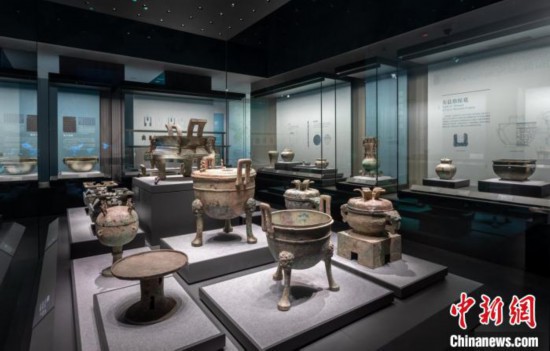
Core Viewpoint - The exhibition "Anhui Civilization History Exhibition - Anhui in the Xia, Shang, and Zhou Dynasties" will showcase over 900 artifacts, including more than 180 first-class cultural relics, highlighting the significance of Anhui's contributions to Chinese civilization during these periods [1][2]. Group 1 - The exhibition will officially open on May 18, following a public preview starting May 1, during which feedback will be collected for further optimization [2]. - The exhibition covers an area of 1,400 square meters and is organized into five thematic units: "Tracing the Summer," "Brilliant Shang Domain," "Eyi Standing on Huai Soil," "Feudal States," and "Chu's Radiance," presenting the evolution of civilization in Anhui during the Xia, Shang, and Zhou dynasties [2][5]. - The artifacts include bronze, gold, jade, and pottery, reflecting the rich cultural heritage and historical significance of the Anhui region in the context of Chinese civilization [2][5]. Group 2 - The curator, Cheng Lu, emphasizes that the Anhui region played a crucial role in the development of bronze culture, which marked a significant stage in social development during the Xia, Shang, and Zhou dynasties [5]. - The exhibition illustrates the historical importance of Anhui as a key area for the establishment of the Xia dynasty and its subsequent cultural influence during the Shang and Zhou periods, particularly in the context of regional interactions and cultural exchanges [5][6]. - The exhibition also highlights the cultural diversity of the region during the Spring and Autumn periods, showcasing the interactions between various cultures such as Huaiyi, Wu, Yue, Chu, and Central Plains cultures, culminating in the flourishing of Chu culture by the end of the Warring States period [6].
文化主体性是文化自信的根本依托
Jing Ji Ri Bao· 2025-04-02 00:59
文化自信是文化主体对自身创造或拥有的文化所具有的信心和信念,是一种积极、稳定的心理状 态,对于国家、民族的文化发展和人的全面发展具有重要支撑作用。习近平总书记指出,文化自信是更 基础、更广泛、更深厚的自信,是更基本、更深沉、更持久的力量。这是对文化自信特点和作用的诠 释,阐明了文化自信的独特地位。在"四个自信"中,文化自信深刻影响着道路自信、理论自信、制度自 信,为其提供强有力支撑。认清文化自信的特点和作用,既是文化发展自觉意识的表达,也是文化自信 生成的认知基础。 中华民族是敢于创新、善于创新的民族,在漫长历史发展过程中,创造了辉煌灿烂的中华文明,为 人类文明进步发展作出了杰出贡献。特别是火药、指南针、印刷术西传之后,产生了文化增殖效应。中 华文明具有突出的连续性、创新性、统一性、包容性、和平性,为中国特色社会主义奠定了厚实的文明 基础。没有中华文明的历史积淀和文化底蕴,就难有中国特色可言。中华文明历经数千年而绵延不绝、 迭遭忧患而经久不衰,这是人类文明的奇迹,也是我们自信的底气。中华文明为文化自信的生成提供了 历史支撑。同时,中国共产党团结带领人民在革命、建设、改革过程中形成的革命文化、社会主义先进 文化 ...