新能源集成融合发展

Search documents
刚刚 新能源利好消息来了!
Zhong Guo Ji Jin Bao· 2025-11-12 14:09
Core Viewpoint - The National Energy Administration has released guidelines to promote the integrated development of renewable energy, aiming for significant improvements in reliability and market competitiveness by 2030, thereby supporting China's green transformation and modernization efforts [1][13][15]. Summary by Sections Overall Requirements - The guidelines emphasize a systematic and integrated approach to renewable energy development, focusing on large-scale development and high-level consumption, enhancing supply reliability and system stability, and promoting technological innovation and industrial collaboration [14][15]. Accelerating Multi-Dimensional Integrated Development - The plan includes optimizing the energy structure and storage configurations of renewable energy bases, encouraging the construction of integrated wind-solar projects, and exploring new types of integrated water-solar bases [16][17]. - It also highlights the need for efficient land use in wind and solar projects, promoting the development of renewable energy in abandoned mining areas, and advancing offshore wind power cluster development [17][18]. Promoting Integrated Operation of Renewable Energy - The guidelines call for improving the accuracy of renewable energy power forecasting, adopting advanced network technologies, and enhancing the controllability of renewable energy systems [19]. - There is a push for the development of virtual power plants to enhance the aggregation and coordination of distributed energy resources [19]. Promoting Synergistic Development with Multiple Industries - The guidelines encourage the integration of renewable energy with traditional industries, promoting green manufacturing processes and optimizing energy consumption in high-energy industries [20][21]. - It also emphasizes the collaboration between renewable energy and emerging industries, particularly in the context of the "East Data West Computing" initiative [21]. Promoting Non-Electric Utilization of Renewable Energy - The guidelines focus on enhancing the development of wind-solar-hydrogen storage systems and establishing comprehensive industrial bases for green hydrogen and ammonia [22]. - There is an emphasis on the application of renewable energy in heating and cooling systems across various industries, promoting a multi-energy coupling approach [23]. Strengthening Organizational Support - The National Energy Administration will prioritize support for regions with high renewable energy penetration and optimize project management processes to facilitate the development of integrated renewable energy projects [24][25].

国家能源局发文促进新能源集成融合发展
Xin Hua Wang· 2025-11-12 13:49
Core Viewpoint - The National Energy Administration of China has issued guidelines to promote the integrated development of renewable energy, aiming for significant improvements in reliability and market competitiveness by 2030 [1]. Group 1: Integrated Development of Renewable Energy - The guidelines emphasize a shift from traditional isolated renewable energy projects to an integrated development model that considers the synergy between different energy types, production and consumption, and the entire supply chain [1]. - The integrated development approach aims to enhance the reliability of renewable energy generation and expand non-electric utilization pathways, thereby reducing dependence on the power system [1]. Group 2: Policy Measures - The guidelines outline three main aspects of integrated development: multi-dimensional integrated development of renewable energy, collaborative development with multiple industries, and diversified non-electric utilization of renewable energy [2]. - Specific measures include enhancing the complementary development of various renewable energy types, promoting compact and efficient use of development space, and advancing distributed renewable energy integration across multiple fields [2]. - The National Energy Administration will support local governments in the orderly construction of integrated renewable energy projects and optimize investment management for these projects [2].
国家能源局: 促进新能源集成融合发展
Yang Shi Wang· 2025-11-12 11:49
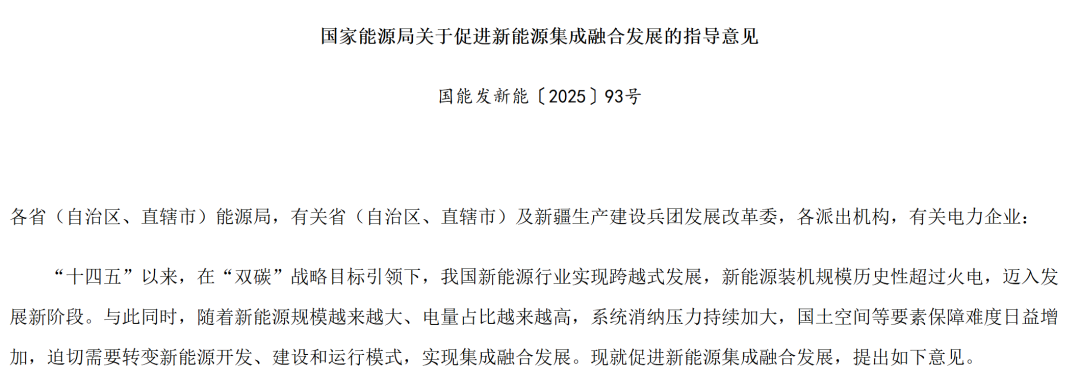
据国家能源局网站消息,日前,国家能源局发布关于促进新能源集成融合发展的指导意见。其中提出, 到2030年,集成融合发展成为新能源发展的重要方式,新能源可靠替代水平明显增强,市场竞争力显著 提升,有力支撑经济社会发展全面绿色转型,为加快中国式现代化建设提供更加安全可靠的绿色能源保 障。详情如下: 国家能源局关于促进新能源集成融合发展的指导意见 国能发新能〔2025〕93号 各省(自治区、直辖市)能源局,有关省(自治区、直辖市)及新疆生产建设兵团发展改革委,各派出机 构,有关电力企业: "十四五"以来,在"双碳"战略目标引领下,我国新能源行业实现跨越式发展,新能源装机规模历史性超 过火电,迈入发展新阶段。与此同时,随着新能源规模越来越大、电量占比越来越高,系统消纳压力持 续加大,国土空间等要素保障难度日益增加,迫切需要转变新能源开发、建设和运行模式,实现集成融 合发展。现就促进新能源集成融合发展,提出如下意见。 一、总体要求 力自主、可靠供应能力,促进农村地区新能源就地就近消纳利用。支持在海岛等地区推动海洋能多能互 补发展,提升海洋能消纳保障服务能力。 (四)推动新能源一体化聚合运营。持续提升新能源发电功率预测精 ...
促进新能源集成融合发展 国家能源局划重点
Bei Jing Shang Bao· 2025-11-12 11:48
Core Viewpoint - The National Energy Administration has released guidelines to promote the integrated development of renewable energy, aiming for significant improvements in reliability and market competitiveness by 2030, which will support a comprehensive green transition in China's economic and social development [2][3]. Group 1: Integrated Development of Renewable Energy - By 2030, integrated development will become a crucial approach for renewable energy, enhancing its reliability and market competitiveness [2]. - The guidelines emphasize the need to shift from "single-point development" to "system integration," treating wind, solar, energy storage, and grid as a cohesive system for better planning and construction [5]. - The guidelines propose three main strategies: accelerating multi-dimensional integrated development, promoting collaboration with various industries, and encouraging diversified non-electric utilization of renewable energy [3][4]. Group 2: Industry Collaboration and Infrastructure - In resource-rich areas, the focus will be on enhancing the application of green electricity in renewable equipment manufacturing and creating competitive manufacturing bases [4]. - The guidelines encourage the construction of integrated energy facilities at transportation hubs, utilizing technologies like flexible aggregation and smart microgrids to improve local energy utilization [4]. - There is a push for high-energy-consuming industries to relocate to areas abundant in renewable resources, optimizing infrastructure layout to achieve local consumption of renewable energy [6]. Group 3: Systematic Solutions for Energy Consumption - The guidelines address the increasing pressure on renewable energy consumption, proposing optimization of traditional industry layouts to align with renewable energy characteristics [6]. - Advanced grid technologies will be adopted to enhance the controllability and efficiency of renewable energy systems, creating a new type of energy system that is friendly to integration [6]. - The integration of renewable energy in heating applications is encouraged, particularly in industries with high thermal demands, promoting a multi-energy coupling approach [7].
新能源升级版来了!国家能源局发文,集成融合发展撬动新产业
2 1 Shi Ji Jing Ji Bao Dao· 2025-11-12 11:04
Core Viewpoint - The National Energy Administration has issued guidelines to promote the integrated development of renewable energy, emphasizing multi-dimensional integration, collaboration with various industries, and diversified non-electric utilization of renewable energy [1][2][5]. Group 1: Renewable Energy Development - Since the "14th Five-Year Plan," China's renewable energy sector has achieved significant growth, surpassing thermal power in installed capacity, marking a new development phase [2]. - The guidelines aim to create a more resilient, efficient, and sustainable renewable energy development model, addressing key issues such as high ratio consumption and high-quality development [2][5]. - By 2030, integrated development will become a crucial approach for renewable energy, enhancing reliability and market competitiveness, supporting a comprehensive green transition in the economy [5][6]. Group 2: Integration and Collaboration - The guidelines propose a structured action framework focusing on "integrated development," which includes breaking the limitations of wind and solar resources through collaboration with other energy types [5]. - The integration aims to convert renewable energy's resource advantages into industrial and economic benefits, synchronizing energy transition with industrial upgrades [5][6]. - Priority will be given to regions with high renewable energy penetration for integrated project construction, encouraging tailored implementation plans based on local resources and industrial characteristics [6]. Group 3: Smart and Emerging Industries - The guidelines highlight the importance of "intelligent" empowerment in fostering new industrial clusters, promoting the synergy between renewable energy bases and computing facilities [7]. - The integration of "power networks" and "computing networks" is encouraged to expand intelligent development scenarios, particularly in manufacturing regions [7]. - New business models such as green electricity direct connection and smart microgrids are proposed to create low-carbon parks, enhancing local load stability and supporting industrial upgrades [7]. Group 4: Non-Electric Utilization - A significant focus of the guidelines is on promoting diversified non-electric utilization of renewable energy, particularly in sectors like transportation, chemicals, and textiles [8]. - The development of green hydrogen and ammonia, as well as renewable heating applications, is emphasized as a key breakthrough direction for integrating supply and consumption [8]. - The guidelines support the construction of hydrogen-based energy industries and the exploration of renewable heating models in various scenarios, aiming to reduce reliance on the main power grid [8].

国家能源局:到2030年集成融合发展成为新能源发展的重要方式
Bei Jing Shang Bao· 2025-11-12 09:32
Core Viewpoint - The National Energy Administration of China has released guidelines to promote the integrated development of renewable energy, aiming for significant advancements by 2030 in reliability and market competitiveness, thereby supporting a comprehensive green transition in economic and social development [1] Group 1 - The integrated development will become a crucial method for renewable energy advancement by 2030 [1] - There will be a notable enhancement in the reliability of renewable energy substitutes [1] - The market competitiveness of renewable energy is expected to significantly improve [1] Group 2 - The guidelines aim to provide a safer and more reliable green energy guarantee for the acceleration of China's modernization [1] - The integrated development of renewable energy is positioned as a key support for the comprehensive green transformation of the economy and society [1]
国家能源局:推动新能源与多产业协同发展 统筹传统产业协同优化升级
智通财经网· 2025-11-12 09:26
Core Viewpoint - The National Energy Administration (NEA) has issued the "Guiding Opinions on Promoting the Integrated Development of New Energy," which emphasizes the need for a shift from isolated development to integrated and collaborative approaches in the new energy sector [2][3]. Group 1: Background and Objectives - The issuance of the "Guiding Opinions" is a response to the rapid growth of new energy in China, with wind and solar power capacity reaching 1.708 billion kilowatts by September 2025, accounting for 46% of the national power generation capacity [3]. - In the first three quarters of this year, wind and solar power generation totaled 1.73 trillion kilowatt-hours, representing 22.3% of the total electricity consumption [3]. - The document aims to enhance the autonomy of new energy development and improve market competitiveness, transitioning from a "single combat" model to an integrated development model [3]. Group 2: Integrated Development of New Energy - Integrated development of new energy involves considering the integration of various energy types, the production and consumption of new energy, and the entire industrial chain [4]. - The guiding opinions categorize integrated development into three areas: multi-dimensional integrated development of new energy, collaborative development with multiple industries, and diversified non-electric utilization of new energy [4]. Group 3: Multi-Dimensional Integrated Development - The NEA aims to enhance the complementary development of various new energy types, optimize the energy structure and storage configuration of renewable energy bases, and promote integrated development of water, wind, and solar energy [5]. - It emphasizes the need for compact and clustered development of new energy, ensuring shared use of space, infrastructure, and regulatory capabilities [5]. - The promotion of distributed new energy development across sectors such as transportation, construction, and agriculture is also highlighted [5]. Group 4: Collaborative Development with Multiple Industries - The NEA plans to accelerate the green manufacturing of new energy equipment and support the establishment of low-carbon and zero-carbon parks [7]. - It aims to optimize the collaboration between new energy and traditional industries, guiding traditional sectors to utilize more renewable energy through process optimization and green design [7]. - The integration of new energy with emerging industries, such as advanced manufacturing and environmental protection, is also a focus, promoting collaborative planning between new energy bases and computing facilities [7]. Group 5: Non-Electric Utilization of New Energy - The NEA seeks to enhance the collaborative development of wind, solar, hydrogen, and storage technologies, promoting integrated control and self-balancing capabilities [8]. - It plans to establish comprehensive industrial bases for green hydrogen, ammonia, and methanol, facilitating their application in coal chemical, metallurgy, and shipping industries [8]. - The use of geothermal energy, biomass, and renewable electricity for heating applications is also encouraged to leverage the flexibility of thermal systems [8]. Group 6: Implementation and Future Steps - The NEA will strengthen coordination and policy dissemination to support local projects in integrated development and will optimize project investment management [9]. - The NEA aims to promote the sharing of best practices from successful projects and enhance the optimization of power dispatch and market transaction mechanisms [9]. - Integrated development is positioned as a key direction for the future of new energy development in the new era [9].
刚刚,利好来了!
中国基金报· 2025-11-12 09:25
Core Viewpoint - The article discusses the recent guidelines issued by the National Energy Administration of China aimed at promoting the integrated development of renewable energy, emphasizing the importance of enhancing market competitiveness and supporting the green transformation of the economy by 2030 [1][5]. Summary by Sections Overall Requirements - The guidelines aim to achieve integrated development of renewable energy, enhancing reliability and market competitiveness, and supporting the green transformation of the economy by 2030 [6]. Accelerating Multi-Dimensional Integrated Development of Renewable Energy - The focus is on optimizing the energy structure and storage configurations in renewable energy bases, encouraging deep collaboration between renewable and traditional energy sources, and promoting the development of integrated water and wind energy bases [7][8]. Promoting Integrated Operation of Renewable Energy - The guidelines emphasize improving the accuracy of power generation forecasts, enhancing the collaborative control of various renewable energy types, and promoting the development of virtual power plants to aggregate distributed energy resources [10]. Promoting Synergistic Development with Multiple Industries - The guidelines encourage the integration of renewable energy with traditional industries, promoting green manufacturing processes, and enhancing the collaboration between renewable energy and emerging industries such as high-end equipment manufacturing and new materials [11][12]. Promoting Diverse Non-Electric Utilization of Renewable Energy - The guidelines focus on enhancing the development of hydrogen production from renewable energy, establishing green hydrogen and ammonia production bases, and promoting the use of renewable energy for heating applications in various industries [13][15]. Strengthening Organizational Support - The guidelines call for improved project organization and management, optimizing investment processes, and enhancing the coordination of energy departments to support the construction of integrated renewable energy projects [16][17].

国家能源局关于促进新能源集成融合发展的指导意见
国家能源局· 2025-11-12 08:58
Core Viewpoint - The article emphasizes the need for integrated and collaborative development of renewable energy in China, aiming to enhance energy security and support the country's green transformation by 2030 [4][5]. Overall Requirements - The development of renewable energy should align with Xi Jinping's thought and the new development philosophy, focusing on system integration, technological innovation, and multi-dimensional utilization [4]. Accelerating Multi-Dimensional Integrated Development of Renewable Energy - Enhance the complementary development of various renewable energy sources, optimizing energy structures and storage configurations [5]. - Strengthen the intensive and composite utilization of renewable energy development space, promoting co-construction of wind and solar projects [6]. - Promote distributed renewable energy integration across various sectors, including transportation and rural energy systems [7]. - Advance integrated operation of renewable energy, improving forecasting accuracy and operational efficiency [8]. Promoting Synergistic Development with Multiple Industries - Accelerate the green manufacturing of renewable energy equipment and establish competitive manufacturing bases [9]. - Optimize the collaboration between renewable energy and traditional industries, enhancing energy efficiency and reducing costs [10]. - Foster the integration of renewable energy with emerging industries, such as computing power and advanced manufacturing [10]. Promoting Diversified Non-Electric Utilization of Renewable Energy - Enhance the collaborative development of wind, solar, hydrogen, and storage technologies [11]. - Establish comprehensive industrial bases for green hydrogen and ammonia, focusing on resource-rich areas [12]. - Encourage the application of renewable energy in heating and cooling systems across various industries [13]. Strengthening Organizational Support - Organize and prioritize the construction of integrated renewable energy projects in regions with high penetration rates [13]. - Optimize project investment and management processes to facilitate the development of integrated projects [14]. - Improve power dispatch mechanisms to ensure the stability and efficiency of renewable energy integration [14].

国家能源局有关负责同志就《关于促进新能源集成融合发展的指导意见》答记者问
国家能源局· 2025-11-12 08:58
近日,国家能源局印发了《关于促进新能源集成融合发展的指导意见》(国能发新能〔2025〕93号,以下简称《指导意 见》)。国家能源局有关负责同志就此接受了记者采访。 问:《指导意见》出台的背景是什么? 答: 一是提升新能源多品种互补开发水平,优化"沙戈荒"新能源基地电源结构和储能配置比例,积极推进主要流域水风光 一体化开发,推进省内集中式新能源项目风光气储等互补开发。二是强化新能源开发空间集约复合利用,推动新能源集约 化选址、集群化开发,实现场区空间、基础设施、调节能力等方面共用。三是推进分布式新能源多领域融合开发,推动交 通、建筑、农业农村等领域的分布式新能源开发利用。四是推进新能源多品种协同联合优化控制,鼓励新能源在调控运 行、参与市场、运营维护等方面实现一体化,提升系统友好性和市场竞争力。 问:《指导意见》将从哪些方面推动新能源与多产业协同发展? 答: 一是加快推动新能源产业链"以绿制(造)绿",提升新能源装备制造绿电应用水平与空间集聚效能,支持构建多能互 补、高度自给的低碳零碳园区。二是统筹推进新能源与传统产业协同优化升级,以新能源资源引导重大生产力和基础设施 布局优化,引导传统产业通过生产工艺优化、科 ...