
智能体AI

Search documents
高盛:智能体AI将重塑软件业格局 2030年市场规模激增超20%
智通财经网· 2025-06-18 09:33
Group 1 - Goldman Sachs reports that the next phase of generative AI, termed "Agentic AI," will significantly transform the enterprise software ecosystem [1][2] - Over the next three years, Agentic AI is expected to unlock productivity gains at the application layer, with the global software market projected to expand by at least 20% by 2030 [2][3] - The customer service software market could see growth rates between 20% to 45%, driven by the integration of traditional SaaS and AI agents [2][3] Group 2 - SaaS companies are anticipated to capture a substantial share of the new Agentic AI market, but their innovation pace is critical, and the transition may not be linear [3][4] - By 2030, Agentic AI is expected to account for over 60% of the total software market, potentially becoming the new user interface for knowledge workers [3][4] - Existing SaaS leaders are showing signs of enhancing execution capabilities, indicating a clear strategic market awareness [3][4] Group 3 - The technological architecture for generative AI applications will require a new tech stack, leading to significant changes in existing architectures [4] - The rise of AI platform layers and the improvement of key middleware will be crucial for the development of AI-native applications [4] - SaaS companies must adapt to emerging AI standards and adjust their architectures to successfully integrate into the generative AI enterprise application ecosystem [4][5] Group 4 - Despite current limitations in SaaS giants' transitions due to generative AI technology maturity, these factors are expected to translate into sustained growth momentum after 2027 [5] - Investors are advised to focus on companies such as Microsoft, Google, Salesforce, ServiceNow, HubSpot, Adobe, and several private firms as potential investment opportunities [5]
「AI新世代」联想集团抛出超级智能体矩阵!大厂纷纷加码,AI智能体混战升级
Hua Xia Shi Bao· 2025-05-08 09:32
Core Insights - The emergence of Agentic AI is recognized as a significant technology trend, with Lenovo launching a comprehensive super-agent matrix to enhance its AI strategy [2][3] - Lenovo's AI initiatives are driving substantial revenue growth across its business segments, with a notable increase in sales and profits attributed to its AI strategy [5] Group 1: Lenovo's AI Strategy - Lenovo has introduced a super-agent matrix that includes personal, enterprise, and city-level intelligent agents, redefining productivity paradigms [3] - The super-agent is described as a "cognitive operating system," capable of performing complex tasks and integrating various functions across devices and sectors [3] - The company aims to leverage AI to enhance customer experience and optimize business processes, which is expected to contribute to revenue growth [5] Group 2: Market Demand and Competition - Despite the technological advancements, the current market demand for AI agents is still developing, particularly in the B2B sector [4] - Competitors like Baidu and ByteDance are also entering the AI agent space, indicating a growing interest in this technology across the industry [4] - Lenovo's hardware-centric approach provides a unique advantage in deploying AI agents, as it can integrate these technologies into its existing product lines [5] Group 3: Financial Performance - Lenovo reported a revenue of $18.796 billion for Q4 2024, marking a 20% year-on-year increase and the highest quarterly sales in three years [5] - The net profit reached $0.693 billion, reflecting a 106% increase, primarily driven by the company's AI strategy [5] - The introduction of AI agents is expected to enhance Lenovo's market competitiveness and open new revenue streams [5] Group 4: Global Manufacturing and Trade Strategy - Lenovo has established a global manufacturing base with 33 factories in 11 countries, allowing it to mitigate the impact of high tariffs [6] - The company emphasizes its ability to quickly adjust to policy changes, which is seen as a competitive advantage in maintaining market share and profitability [6] - Lenovo's "ODM+" model and global-local delivery strategy enable it to effectively manage production and distribution in response to market conditions [6]


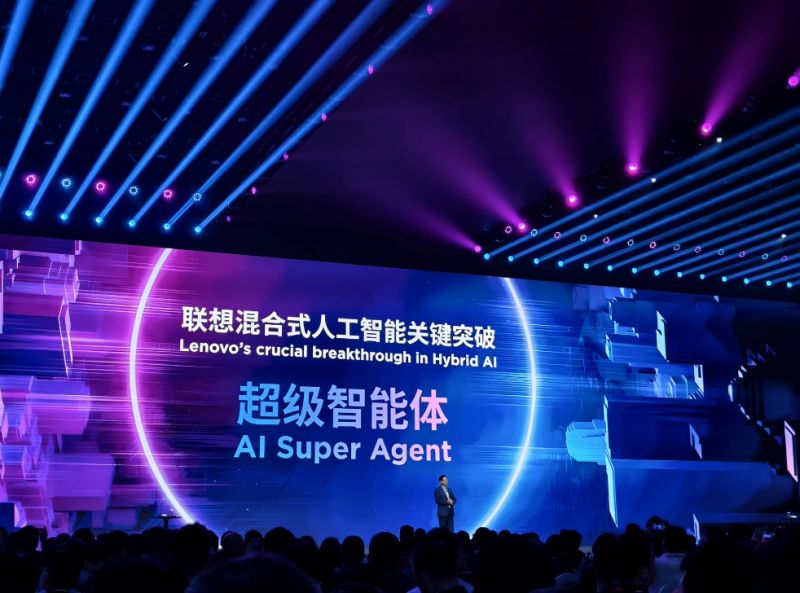
联想刘军:聚焦混合式AI,以智能体AI普惠每个人和每家企业
Xin Hua Cai Jing· 2025-05-07 12:25
Group 1 - Lenovo's Executive Vice President Liu Jun emphasized that AI is transitioning from a conceptual stage to practical applications, focusing on hybrid AI to provide individuals with their own "intelligent twins" and businesses with their own "silicon-based teams" [2][3] - Lenovo has been enhancing its IT systems since 2017, evolving from traditional IT to a cloud-native and middle-platform approach, with the current upgrade to "Sky 4.0" featuring a matrix of super intelligent agents [2] - Over the past eight years, Lenovo's "Sky" system has empowered over one million Chinese customers, including major companies like PetroChina and Yili, in their digital transformation efforts [2] Group 2 - The strategy for personal intelligence involves Lenovo's AI terminal approach, which includes the Tianxi personal super intelligent agent and various devices such as AIPC, AI phones, and AI tablets [3] - Since the launch of the first AIPC in China last year, Lenovo has sold over one million units, with the Tianxi's daily active users experiencing exponential growth [3] - The newly announced Lenovo LeXiang super intelligent agent is the first enterprise-level super intelligent agent, designed to assist various business functions and will be utilized by Lenovo as its "zero customer" [3]
智能体引领下一波AI浪潮 联发科“兵分三路”布局
2 1 Shi Ji Jing Ji Bao Dao· 2025-04-24 02:31
Core Insights - The AI industry is experiencing rapid growth, with a new wave of intelligent AI experiences emerging, particularly in mobile chip manufacturing [1] - MediaTek is focusing on three main areas: chip development, development tools, and ecosystem building to leverage the opportunities presented by intelligent AI [1] Chip Development - MediaTek launched the Dimensity 9400+ flagship 5G mobile chip, featuring a second-generation all-large core architecture and enhanced AI capabilities [1] - The Dimensity 9400+ integrates MediaTek's eighth-generation AI processor NPU 890, supporting the DeepSeek-R1 inference model and enhanced decoding technology (SpD+), improving inference speed for intelligent AI tasks by 20% [1][2] Development Tools - The Dimensity AI Developer Suite 2.0 supports four key technologies: Mixture of Experts (MoE), Multi-Token Prediction (MTP), Multi-Head Latent Attention (MLA), and FP8 Inferencing, doubling token generation speed and reducing memory bandwidth usage by 50% [2] Ecosystem Collaboration - MediaTek has initiated the "Dimensity Intelligent Experience Leadership Program" in collaboration with major companies like Alibaba Cloud, Motorola, OPPO, and Xiaomi to enhance the AI ecosystem [2] Financial Performance - MediaTek's revenue for 2024 is projected to reach NT$530.586 billion, a year-on-year increase of 22.4%, with a consolidated gross margin of 49.6% [2] - The revenue from the Dimensity flagship chip business exceeded expectations, reaching $2 billion, and the ASIC business is expected to surpass $1 billion in revenue by 2026 due to AI demand [2] Industry Trends - The focus in AI development is shifting from large-scale parameters to efficiency, with smaller language models gaining attention for their ability to perform complex tasks without extensive computational resources [3] - The mobile chip industry is evolving towards heterogeneous computing, energy efficiency optimization, and multi-task integration, with AI models being trained and inferred on the device side to meet local computing, data privacy, and energy efficiency requirements [5]