
资本补充

Search documents
金融中报观|江苏银行全面超越,城商行“一哥”易主
Bei Jing Shang Bao· 2025-08-31 14:37
Core Insights - Jiangsu Bank has surpassed Beijing Bank to become the largest city commercial bank in China, with total assets of 4.79 trillion yuan and a growth rate of 21.16% in the first half of 2025, compared to Beijing Bank's 4.75 trillion yuan and 12.53% growth rate [1][3][5] - The shift in leadership reflects a broader trend of differentiation within the city commercial banking sector, where 17 listed banks have formed a clear three-tier competitive structure [1][11] Group 1: Historical Context - Beijing Bank, established in 1996, held the top position in city commercial banks for many years, leveraging its geographical advantages and early market entry to grow from 354.22 billion yuan in 2007 to 4.75 trillion yuan [3][4] - Jiangsu Bank, founded later in 2007, has focused on regional economic development and retail banking, leading to significant growth in its asset scale [3][5] Group 2: Growth Trajectory - Jiangsu Bank's asset growth has accelerated in recent years, with total assets reaching 2.34 trillion yuan at the end of 2020, 2.62 trillion yuan in 2021, and 2.98 trillion yuan in 2022, ultimately surpassing Beijing Bank in 2025 [4][5] - In 2022, Jiangsu Bank achieved operating income of 70.57 billion yuan and net profit of 25.39 billion yuan, exceeding Beijing Bank's figures [5] Group 3: Business Strategy - Jiangsu Bank's rapid growth is attributed to its deep integration with regional economic development, particularly in sectors like smart manufacturing and new energy vehicles, which have generated strong deposit and credit demand [6][7] - The bank has shifted its focus from a broad retail strategy to targeting specific customer segments and industries, enhancing its competitive edge [7][11] Group 4: Financial Performance - As of mid-2025, Jiangsu Bank's corporate loans reached approximately 1.63 trillion yuan, with significant growth in manufacturing and infrastructure loans [7][8] - Retail deposits and assets under management (AUM) have also seen substantial increases, although credit card loan growth has declined [8] Group 5: Competitive Landscape - The city commercial banking sector is increasingly competitive, with Jiangsu Bank, Beijing Bank, Ningbo Bank, and Shanghai Bank forming the first tier, all exceeding 3 trillion yuan in assets [11] - Smaller banks are encouraged to adopt differentiated strategies and collaborate with larger institutions to enhance their market position [12][13]




中国银行:新一轮增资将提升信贷服务能力
Zhong Guo Jin Rong Xin Xi Wang· 2025-08-29 12:13
Core Viewpoint - China Bank has successfully completed a capital replenishment of 165 billion yuan, enhancing its core tier 1 capital adequacy ratio to 12.57% and total capital adequacy ratio to 18.67%, which is an increase of 0.75 percentage points and 0.69 percentage points respectively compared to the previous quarter [1][2] Summary by Categories Capital Replenishment - The bank's core capital injection will strengthen its capital base, optimize financial services, and improve risk management, thereby continuously injecting vitality into the real economy [1] Credit Investment Focus - The bank plans to focus on six key areas for credit investment in the next phase: 1. Building core capabilities in technology finance, enhancing network coverage, equity investment, differentiated credit support, and market-oriented risk sharing [1] 2. Supporting infrastructure project construction and participating in major projects to aid the transformation and upgrading of the manufacturing sector [2] 3. Strengthening green finance development by expanding into clean energy, energy conservation, and green transportation, and innovating new green products [2] 4. Providing financial services to stabilize foreign trade and investment, supporting enterprises in adapting to new international trade conditions [2] 5. Improving the quality and efficiency of consumer loans, including initiatives to stimulate consumption through government-backed loan policies [2] 6. Implementing policies for real estate financing and small and micro enterprise financing, enhancing competitiveness in first-hand and second-hand housing loans [2]

青岛银行拟向不特定对象发行总额不超过48亿元的A股可转换公司债券
Zhi Tong Cai Jing· 2025-08-28 14:55
Core Viewpoint - Qingdao Bank plans to issue A-share convertible bonds to raise up to RMB 4.8 billion, pending approvals from shareholders and regulatory authorities [1] Group 1: Capital Adequacy - As of June 30, 2025, the bank's core tier 1 capital adequacy ratio is 8.45%, and the consolidated core tier 1 capital adequacy ratio is 9.05% [1] - Although the bank meets regulatory capital adequacy requirements, the growth in risk-weighted assets necessitates proactive capital replenishment [1] Group 2: Strategic Objectives - The issuance of convertible bonds aims to strengthen the bank's capital base, enhance service quality to the real economy, and improve risk resilience [1] - The initiative is expected to maintain stable operations and increase market competitiveness while achieving strategic goals [1]

青岛银行(03866)拟向不特定对象发行总额不超过48亿元的A股可转换公司债券
智通财经网· 2025-08-28 14:54
Core Viewpoint - Qingdao Bank plans to issue A-share convertible bonds to raise up to RMB 4.8 billion, pending approvals from shareholders and regulatory bodies [1] Group 1: Capital Adequacy - As of June 30, 2025, the bank's core tier 1 capital adequacy ratio is 8.45%, and the consolidated core tier 1 capital adequacy ratio is 9.05% [1] - Although the bank meets regulatory capital adequacy requirements, the growth in risk-weighted assets necessitates proactive capital replenishment [1] Group 2: Strategic Objectives - The issuance of convertible bonds aims to strengthen the bank's capital base, enhance service quality to the real economy, and improve risk resilience [1] - The initiative is expected to maintain stable operations, increase market competitiveness, and achieve strategic goals [1]
万亿级盛京银行今日正式退市/东北城商行“巨无霸”挥别港交所:从恒大危机到国资接管的十年嬗变
Xin Lang Cai Jing· 2025-08-28 03:37
Group 1 - The article outlines the timeline of Shenyang Bank's delisting, highlighting the capital game and risk clearance over a decade [1][2][3] - During the period from 2016 to 2019, Evergrande Group became the largest shareholder of Shenyang Bank, significantly influencing its resource allocation [1][2] - The intervention of state-owned assets management in 2021 marked a critical phase in addressing the financial crisis and restructuring the bank's ownership [2][3] Group 2 - The delisting was driven by multiple pressures, including the bank's loss of financing capabilities and a significant decline in its market valuation [4][5] - Shenyang Bank's performance deteriorated, with a 59% drop in revenue from its peak in 2019 and a net profit that was only 8% of its 2017 level [6][7] - Regulatory constraints and rising operational costs further narrowed the bank's operational space, with a net interest margin close to the regulatory limit [7] Group 3 - Governance failures were highlighted, including widespread corruption among senior management, leading to significant financial misconduct [8][9] - Evergrande's control over the bank's governance structure turned it into a financing tool for its own interests, straying from its original mission [9][10] - The bank's management underwent a significant overhaul in 2023 to address governance issues and restore order [10] Group 4 - The bank's strategy post-delisting focuses on regional market engagement, with 89% of its revenue now derived from Northeast China [14] - Despite efforts to mitigate risks, unresolved legacy issues and economic pressures pose ongoing challenges for the bank's stability [15] - The case of Shenyang Bank serves as a cautionary tale for smaller banks regarding governance, risk management, and the potential for state intervention [16][17]
加码定向募股,地方中小银行外源性“补血”提速
Bei Jing Shang Bao· 2025-08-27 11:36
Core Viewpoint - Local small and medium-sized banks in China are accelerating capital replenishment through targeted fundraising, which has become a key choice for external capital injection [1][3][4] Group 1: Targeted Fundraising Activities - In Shaanxi, the Xi'an Yanta Hengtong Village Bank has been approved to raise 11.23 million shares through targeted fundraising, with Zhejiang Wenzhou Longwan Rural Commercial Bank as an investor [3] - The Cuiping Hengtong Village Bank in Tongchuan also received approval for a targeted fundraising plan to raise 3.68 million shares, with the same investor [3] - The Baoding Regulatory Bureau approved the targeted fundraising plan for the Quyang Rural Credit Cooperative, allowing it to raise no more than 70 million shares within six months [3] Group 2: Involvement of Local State-owned Enterprises - The Jingmen Regulatory Bureau approved the entry of local state-owned enterprises as shareholders in the Hubei Jing Shan Rural Commercial Bank, with two companies holding 30 million shares and 20 million shares respectively [4] - The involvement of local state-owned shareholders not only provides new capital but also enhances operational efficiency and risk resistance through resource integration and policy alignment [4] Group 3: Challenges and Governance Issues - Local small and medium-sized banks face challenges in capital replenishment compared to larger banks, making targeted fundraising a more suitable option due to their smaller scale and local ownership structure [4] - Analysts emphasize the importance of optimizing capital structure and governance through targeted fundraising, while also highlighting the need for refined equity management and standardized shareholder behavior to prevent risks [5] - Regulatory bodies have mandated banks to strengthen equity management, optimize ownership structure, and control related party transactions to mitigate risks [5]

这家银行再现大额罚单!信贷业务屡次违规,资本“渴求症”难解?
券商中国· 2025-08-25 05:13
Core Viewpoint - Hengfeng Bank has faced significant regulatory penalties for multiple violations, particularly related to concealing non-performing loans, indicating ongoing issues with asset quality and compliance [1][2][3]. Regulatory Penalties - Hengfeng Bank's Chongqing branch was fined 2.6 million yuan for covering up non-performing loans and other violations, marking the third penalty exceeding one million yuan this year [1][2]. - The total fines for Hengfeng Bank in 2025 have reached 17.56 million yuan, an increase of nearly 80% compared to the entire year of 2024 [2]. - Previous penalties include a 1.06 million yuan fine for eight violations, including account management and customer identification failures [3]. Asset Quality and Non-Performing Loans - Hengfeng Bank's non-performing loan ratio stands at 1.49%, ranking 9th among 12 joint-stock banks, which is higher than the average of 1.22% [6]. - The bank's credit impairment losses reached 8.613 billion yuan in 2024, a year-on-year increase of 19.5% [6]. - The bank has a significant historical loss, with undistributed profits amounting to -27.401 billion yuan as of the end of 2024 [6]. Asset Disposal Strategies - Hengfeng Bank is actively disposing of non-performing assets, with a recent transfer of non-performing assets valued at 5.465 billion yuan to its major shareholder, Shandong Financial Asset Management [5]. - The bank has been involved in disposing of over 77 asset packages, totaling more than 23.6 billion yuan, with many assets linked to its branches in Chengdu, Hangzhou, and Kunming [5]. Capital Needs and Challenges - Hengfeng Bank has been struggling with capital adequacy, having issued perpetual bonds totaling 28 billion yuan from 2020 to 2022 and 15 billion yuan in subordinated debt in 2024 [8][9]. - Despite these efforts, the bank's capital adequacy ratios have declined significantly in early 2025, indicating ongoing capital pressure [8]. - The bank plans to conduct a private placement to raise core tier one capital, but faces uncertainties due to historical losses and compliance issues [9].

十年A股IPO长跑未竟,天津银行新班子能否破局?
2 1 Shi Ji Jing Ji Bao Dao· 2025-08-22 09:43
Core Viewpoint - Tianjin Bank has been in the process of preparing for its A-share IPO for ten years, facing challenges such as slowing profit growth and uncertain listing prospects, while also working on capital replenishment and asset expansion [1][2]. Group 1: IPO Progress and Challenges - The A-share IPO guidance for Tianjin Bank began on August 18, 2015, and the main bottleneck currently is the lack of external approvals required for listing [1]. - The latest guidance report indicates that the bank's corporate governance is now "effectively operational" after continuous due diligence and improvement suggestions from the advisory institutions [1][2]. Group 2: Capital Replenishment and Financial Performance - Tianjin Bank successfully issued 7 billion yuan in financial bonds in June 2025 to optimize its liability structure and support business development [2]. - The bank plans to issue up to 20 billion yuan in perpetual bonds and 20 billion yuan in subordinated bonds from 2024 to 2026 to enhance its capital structure and risk resilience [2]. - As of the end of Q1 2025, the bank's total assets reached 945.78 billion yuan, a 2.14% increase from the beginning of the year, with customer loans growing by 4.19% [2][3]. Group 3: Profitability and Asset Quality - In 2024, Tianjin Bank's operating income was 16.71 billion yuan, a 1.5% year-on-year increase, while net profit grew by 1.1%, indicating a slowdown in profit growth compared to 2023 [3]. - In Q1 2025, the bank's operating income was 4.217 billion yuan, up 2.43% year-on-year, and net profit was 1.1 billion yuan, an increase of 3.77% [3]. - The non-performing loan ratio stood at 1.70% as of March 2025, unchanged from the beginning of the year, with a provision coverage ratio of 169.97%, indicating stable risk resistance [3]. Group 4: Business Diversification and Governance - In 2024, Tianjin Bank made significant strides in consumer finance by acquiring a stake in Tianjin JD Consumer Finance Co., marking its entry into the consumer finance market [4]. - The bank has also initiated a public recruitment process for key executive positions, aiming to enhance its governance structure with a younger leadership team [5]. - The recent board restructuring in March 2025 has resulted in a management team with an average age of 52, which is considered relatively young compared to industry peers [5].
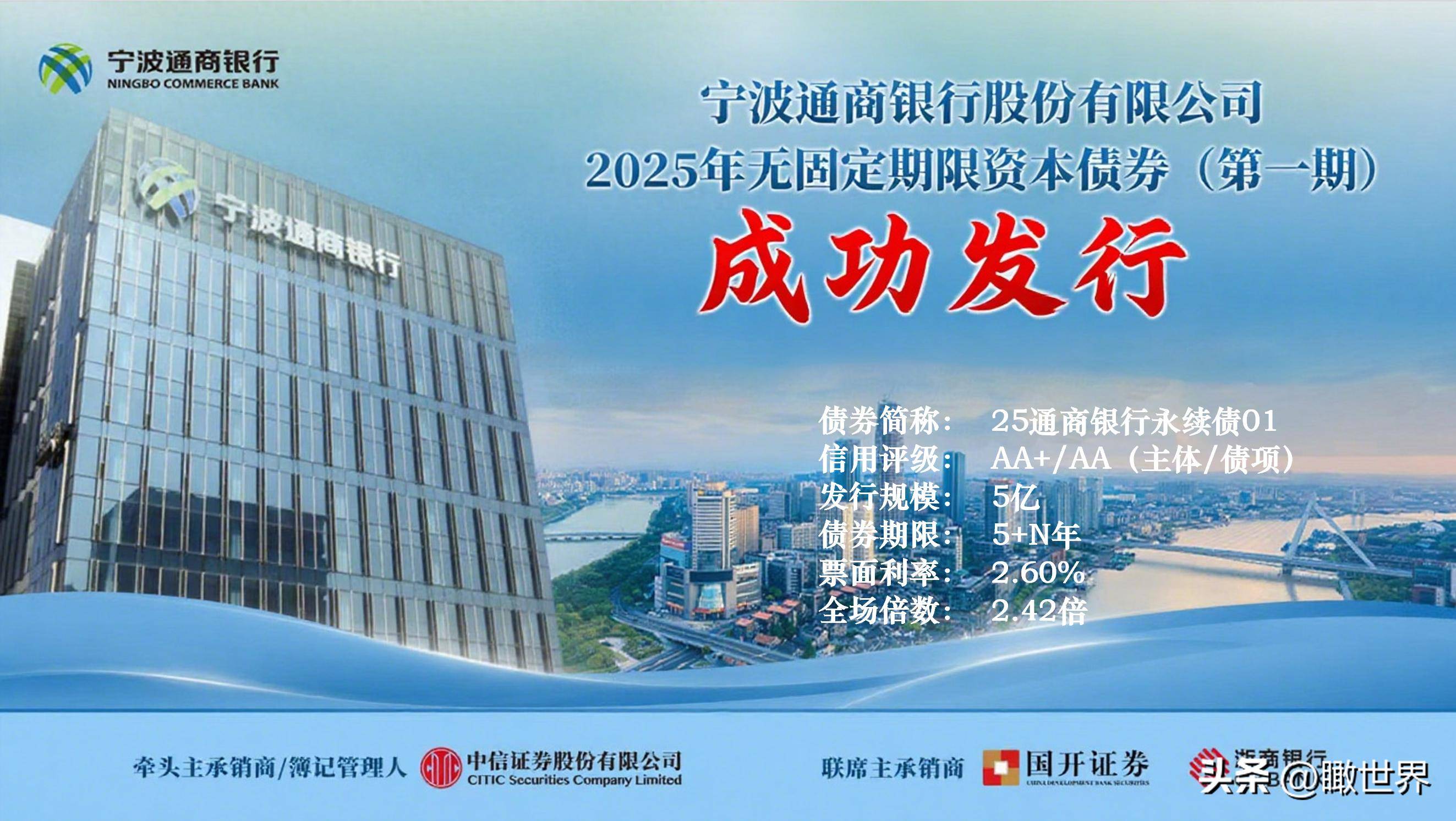
宁波通商银行2025年第一期无固定期限资本债券成功发行
Sou Hu Cai Jing· 2025-08-15 16:31
Group 1 - The company successfully issued its first perpetual capital bond in 2025, with a total issuance size of 500 million RMB and a coupon rate of 2.6%, achieving a subscription multiple of 2.42 times [1][2] - The issuance was pre-planned by the company's party committee and received necessary approvals from the People's Bank of China and the Ningbo Regulatory Bureau of the National Financial Supervision Administration in February and May 2025 [2][3] - The funds raised from this perpetual capital bond will be used to supplement the company's other Tier 1 capital, optimizing its capital structure, alleviating capital replenishment pressure, and enhancing its ability to resist risks and serve the real economy [2][3] Group 2 - The issuance process involved active organization by the finance department, close monitoring of approvals, early marketing by the funds operation center, and efficient collaboration among relevant departments, leading to a successful issuance [3]
青岛银行:资本工具计划发行额度获得监管机构批复
Zhi Tong Cai Jing· 2025-08-15 10:01
Group 1 - The core point of the article is that Qingdao Bank has received approval to issue capital supplement tools up to 2 billion RMB [1] - The bank's annual shareholders' meeting scheduled for May 28, 2025, will review the proposal for the issuance of capital supplement tools [1] - The approval from the Qingdao Regulatory Bureau allows the bank to independently decide on the specific types, issuance timing, batches, and scale of the tools within the approved limit [1]