
超级人工智能

Search documents
阿里巴巴港股涨超3%
Zheng Quan Shi Bao Wang· 2025-09-24 02:46
人民财讯9月24日电,阿里巴巴港股拉升,现涨超3%。消息面上,9月24日,阿里巴巴集团CEO、阿里 云智能集团董事长兼CEO吴泳铭在云栖大会上表示,为了迎接ASI(超级人工智能)时代的到来,对比 2022年这个GenAI的元年,到2032年阿里云全球数据中心的能耗规模将提升10倍。这意味着阿里云算力 投入将指数级提升。 ...

阿里吴泳铭:AGI只是起点,终极目标是超级人工智能
第一财经· 2025-09-24 02:39
通往超级人工智能之路分为三个阶段:1、智能涌现,AI通过学习人类知识具备泛化智能;2、"自主行 动",AI掌握工具使用和编程能力以"辅助人",这是行业当前所处的阶段;3、"自我迭代",AI通过连 接物理世界的全量原始数据,实现自主学习,最终能够"超越人"。 9月24日,阿里巴巴集团CEO、阿里云智能集团董事长兼CEO吴泳铭在云栖大会演讲中表示,实现AGI 已是确定性事件,但这仅是起点,终极目标是发展出能自我迭代、全面超越人类的超级人工智能 (ASI),以解决气候、能源、星际旅行等重大科学难题。 ...


云栖大会十周年,阿里巴巴CEO吴泳铭首提“超级人工智能”:不仅会放大我们人类的智力,还将解放人类的潜能
Sou Hu Cai Jing· 2025-09-24 02:36
Group 1 - The core viewpoint of the article emphasizes that the intelligent revolution will exceed human imagination, with general artificial intelligence (AGI) set to enhance human intelligence and unlock human potential, paving the way for super artificial intelligence (ASI) [1] - The CEO of Alibaba Group, Wu Yongming, stated that achieving intelligent systems with human-like cognitive abilities is now seen as a certainty in the industry, marking a new beginning rather than an endpoint [1] - The Cloud Habitat Conference has been held for ten years since its inception in 2015, highlighting the ongoing evolution and significance of cloud technology and AI in the industry [1]
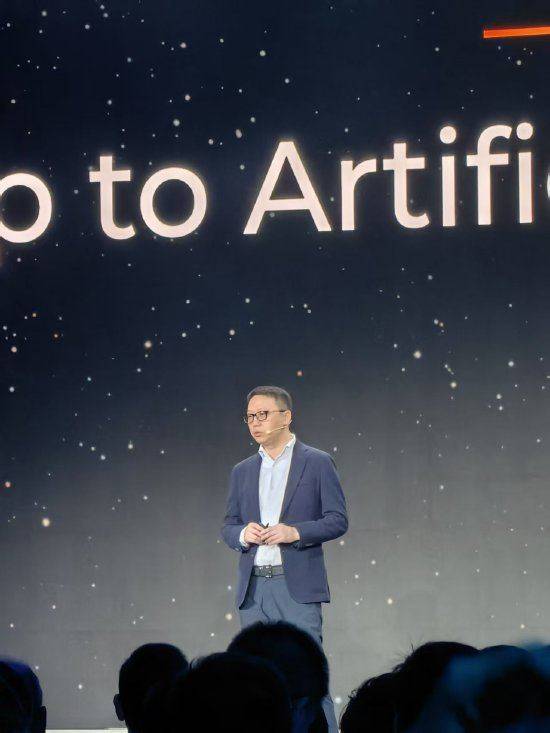
阿里吴泳铭:AGI只是起点 终极目标是超级人工智能
Di Yi Cai Jing· 2025-09-24 02:29
9月24日,阿里巴巴集团CEO、阿里云智能集团董事长兼CEO吴泳铭在云栖大会演讲中表示,实现AGI 已是确定性事件,但这仅是起点,终极目标是发展出能自我迭代、全面超越人类的超级人工智能 (ASI),以解决气候、能源、星际旅行等重大科学难题。 (文章来源:第一财经) 通往超级人工智能之路分为三个阶段:1、智能涌现,AI通过学习人类知识具备泛化智能;2、"自主行 动",AI掌握工具使用和编程能力以"辅助人",这是行业当前所处的阶段;3、"自我迭代",AI通过连接 物理世界的全量原始数据,实现自主学习,最终能够"超越人"。 ...
阿里吴泳铭:AGI只是起点,终极目标是超级人工智能
Di Yi Cai Jing· 2025-09-24 02:25
通往超级人工智能之路分为三个阶段:1、智能涌现,AI通过学习人类知识具备泛化智能;2、"自主行 动",AI掌握工具使用和编程能力以"辅助人",这是行业当前所处的阶段;3、"自我迭代",AI通过连接 物理世界的全量原始数据,实现自主学习,最终能够"超越人"。 9月24日,阿里巴巴集团CEO、阿里云智能集团董事长兼CEO吴泳铭在云栖大会演讲中表示,实现AGI 已是确定性事件,但这仅是起点,终极目标是发展出能自我迭代、全面超越人类的超级人工智能 (ASI),以解决气候、能源、星际旅行等重大科学难题。 终极目标是发展出能自我迭代、全面超越人类的超级人工智能(ASI)。 ...
云栖大会十周年,阿里巴巴CEO吴泳铭首提“超级人工智能”
Xin Lang Ke Ji· 2025-09-24 02:20
Core Insights - The CEO of Alibaba Group, Wu Yongming, emphasized that the intelligent revolution will exceed human imagination, with general artificial intelligence (AGI) set to enhance human intelligence and unlock human potential, paving the way for super artificial intelligence (ASI) [1] - Wu stated that achieving intelligent systems with human-like cognitive abilities is now seen as a certainty in the industry, marking not the end of development but a new beginning, as AI will progress towards self-evolving super artificial intelligence [1] Summary by Categories Company Developments - Alibaba Group has been hosting the Yunqi Conference since 2015, celebrating its ten-year anniversary this year [1] Industry Trends - The concept of general artificial intelligence is gaining traction, with expectations that it will lead to advancements beyond current AI capabilities [1]
马斯克访谈:科技项目与投资启示
Sou Hu Cai Jing· 2025-09-23 05:13
Group 1 - The core focus of Musk's recent interview at a technology summit revolves around advancements in Tesla's robotics, AI chip development, and SpaceX's strategic acquisitions [1] - Tesla aims to produce 1 million robots with a cost reduction target of $20,000 to $25,000, emphasizing the need for complex robotic hands and understanding of the physical world for mass production [1] - Musk reiterated the commitment to a vision-based approach for autonomous driving, highlighting the current lead in data and computational power for AI chip development [1] Group 2 - SpaceX's acquisition of EchoStar for $17 billion is expected to position the company as a global operator within two years, with Starlink potentially revolutionizing the communications industry [1] - The challenge of achieving full reusability for the Starship is acknowledged, with a projected timeline for completion between 2027 and 2028 [1] - Musk anticipates the emergence of superintelligent AI within the next three years, urging investors to analyze directions and opportunities carefully [1]


下一个10年,这3个能力最重要
3 6 Ke· 2025-09-17 00:40
Group 1 - AI is reshaping the world and human self-perception, but humans remain irreplaceable due to unique capabilities [1][2] - Humans possess three core abilities that AI cannot replicate: accountability, creativity and adventurous spirit, and self-drive [3][4] - Continuous self-drive, learning, and dialectical decision-making are fundamental drivers of human societal progress [4] Group 2 - The rise of AI has caused anxiety among people, with some rejecting it and others feeling overwhelmed [5] - Even if AI technology stagnates, existing models can still trigger profound societal changes, particularly with the emergence of AGI and ASI [5][6] - Humans must remain the decision-makers, especially in specific contexts where AI lacks understanding [6][9] Group 3 - Humans' accountability stems from their unique existence and ability to provide credible experiences, which AI cannot do [9][10] - Decision-making by humans is a concentrated act of judgment and responsibility, which AI cannot replicate [10][11] - The essence of human decision-making is rooted in personal experience and the ability to be held accountable [10][12] Group 4 - Creativity and the ability to take risks are uniquely human traits that AI cannot fully emulate [11][12] - AI can generate solutions based on existing information but lacks the ability to create entirely new concepts [12][13] - The ideal collaboration between humans and AI involves humans making final decisions based on AI-generated options [12][14] Group 5 - Continuous learning and self-driven exploration are essential for personal growth and adaptation in the AI era [28][30] - Reading is crucial for personal development, as it shapes neural connections and influences one's perspective [28][29] - The process of learning and searching for knowledge is scalable, leading to greater personal and professional growth [30][31] Group 6 - In the AI era, humans should embrace their role as decision-makers, particularly in micro-decisions that require personal accountability [23][24] - AI should be viewed as an enhancement to human capabilities rather than a competitor [25][26] - The future of work will involve leveraging AI to improve decision-making and creativity, allowing humans to focus on unique contributions [24][25]
软银20亿入股英特尔背后:芯片巨头的破局与投资教父的新赌局
Sou Hu Cai Jing· 2025-08-19 13:01
Core Viewpoint - SoftBank Group announced a $2 billion investment in Intel, reflecting its strategic positioning in the AI chip sector and providing Intel with crucial funding during its transformation phase [1][2]. Group 1: Investment Details - SoftBank will purchase newly issued Intel shares at $23 each, slightly below the previous closing price [1]. - Following the announcement, Intel's stock rose over 5% in after-hours trading, indicating positive investor sentiment towards the funding [1]. - Conversely, SoftBank's stock fell 5.4% in Tokyo, marking its largest single-day drop since April [1]. Group 2: Strategic Implications - The investment is seen as a response to the rapidly growing global AI chip market, which is projected to exceed $100 billion by 2029 [2]. - Intel is launching AI chips like Gaudi 3 to compete in the data center market and plans to deliver millions of devices with Neural Processing Units (NPU) for localized AI applications [3]. - SoftBank's investment extends its AI strategy from chip design (via Arm) to chip manufacturing, aiming to create a more comprehensive industry ecosystem [5]. Group 3: Market Context - The investment follows a recent meeting between Intel's CEO and U.S. President Trump, suggesting potential political influences on the decision [2]. - Analysts express concerns that if the investment is politically motivated, it may not be a sound business decision [2]. - The competitive landscape includes major players like NVIDIA, which currently holds over 60% of the AI chip market share [2]. Group 4: Future Outlook - The $2 billion investment may be insufficient for Intel, which requires hundreds of billions for technological advancements [5]. - The success of this investment hinges on Intel's ability to achieve technological breakthroughs and navigate the complex interplay of technology, capital, and geopolitics [5].


“AI登月时刻”,OpenAI模型摘取奥数金牌
Hu Xiu· 2025-07-20 01:41
Core Insights - OpenAI's general reasoning model achieved a gold medal level performance in the recently concluded International Mathematical Olympiad (IMO), solving 5 out of 6 problems under the same conditions as human participants [1][22][21] - This achievement signifies a major breakthrough in AI capabilities, demonstrating that the model can perform complex reasoning tasks without relying on specialized systems or verified reward signals [1][6][24] Group 1: Model Performance and Achievements - OpenAI's model, o3 alpha, secured second place in the AtCoder World Tour 2025 finals, showcasing its strength in programming and physics [2] - The model's performance in the IMO, scoring 35 out of 42 points, indicates its ability to match human mathematicians in rigorous proof writing [1][22] - OpenAI's advancements have positioned it ahead of competitors like DeepMind and Anthropic, as well as open-source models led by China [3] Group 2: Research and Development - OpenAI is testing a new reasoning model, with the IMO gold medal performance being a preliminary demonstration, and a formal release is expected by the end of this year [4] - The research led by Alexander Wei emphasizes the model's ability to engage in sustained creative thinking, a significant leap from previous benchmarks [5][27] - The model's development involved general reinforcement learning techniques, allowing it to tackle complex problems without task-specific training [7][20] Group 3: Future Implications - The success in the IMO raises expectations for AI's potential to solve significant mathematical problems, with an 81% market prediction that AI could address a Millennium Prize Problem by 2030 [12][28] - OpenAI's chief research officer noted that the model's broad reasoning capabilities extend beyond competition-specific tasks, indicating a shift towards more generalized AI applications [10][24] - The rapid progress in AI, from elementary to advanced mathematical problem-solving, suggests that AI may soon play a substantial role in scientific discovery [28][29]
