
AI视频生成

Search documents
阜博集团午后涨超17% AI视频生成技术再迎突破 公司受惠版权保护需求爆发
Zhi Tong Cai Jing· 2026-02-10 06:26
Group 1 - The core viewpoint of the article highlights the significant rise in the stock price of Fubo Group (03738), which increased over 17% in the afternoon and is currently trading at 5.13 HKD with a transaction volume of 1.123 billion HKD [1] - ByteDance has launched a new AI video generation model, Seedance 2.0, which is gaining attention for its breakthrough performance in the global internet space [1] - According to a report from Open Source Securities, the launch of Seedance 2.0 may signify a "singularity" moment in the AI film and television sector, with potential for large-scale application in short content creation such as AI dramas and short films [1] Group 2 - Fubo Group is recognized as a leading platform and service provider for digital content asset protection and trading globally [1] - CITIC Securities has noted that the explosion of AI video applications worldwide is accompanied by a rise in copyright issues, which is driving content providers to invest more in copyright protection [1] - The firm emphasizes that Fubo Group's deep engagement in overseas markets, along with its leading technology, API channels, and top-tier client resources, positions it to benefit significantly from these trends [1]
港股异动 | 阜博集团(03738)午后涨超17% AI视频生成技术再迎突破 公司受惠版权保护需求爆发
智通财经网· 2026-02-10 06:26
Group 1 - The core viewpoint of the article highlights the significant rise in the stock price of Fubo Group (03738), which increased by over 17% in the afternoon and is currently trading at 5.13 HKD with a transaction volume of 1.123 billion HKD [1] - ByteDance has launched a new AI video generation model, Seedance 2.0, which is gaining attention for its groundbreaking performance and may signify a pivotal moment in the AI film industry, particularly in short content creation [1] - Citic Securities has indicated that the global explosion of AI video applications is driving increased investment in copyright protection, benefiting companies like Fubo Group that are deeply engaged in overseas markets and possess leading technology and client resources [1] Group 2 - Fubo Group is recognized as a leading provider of digital content asset protection and trading services globally, positioning itself to capitalize on the growing demand for copyright protection in the context of AI video applications [1] - The report from Citic Securities maintains a "buy" rating for Fubo Group, suggesting confidence in the company's ability to leverage its technological advantages and client relationships to benefit from the evolving market landscape [1]
游戏科学发布黑神话贺岁短片,CEO冯骥发文:别这么严肃,差不多得了
Xin Lang Cai Jing· 2026-02-10 04:42
Core Insights - Game Science released the first gameplay video of "Black Myth: Wukong," focusing on the theme of "cooking ghosts" and showcasing technical details related to Chinese culinary processes rather than combat demonstrations [1][3] - The video was specifically recorded for the Spring Festival and is not related to the actual game storyline, as clarified in the pinned comment [1][3] - CEO Feng Ji expressed a light-hearted approach to the video release, encouraging viewers to enjoy the unique blend of surprise and curiosity rather than overanalyzing it [1][3] Company and Industry Summary - The gameplay video emphasizes atmosphere and technical quality, highlighting the importance of visual and thematic elements in game development [1][3] - Feng Ji's comments reflect a broader industry trend of integrating cultural elements into gaming, particularly during festive seasons, to enhance engagement [1][3] - The mention of AI video generation technology, specifically praising the capabilities of Seedance 2.0, indicates the company's interest in leveraging advanced technologies while also acknowledging potential challenges such as misinformation [1][3]

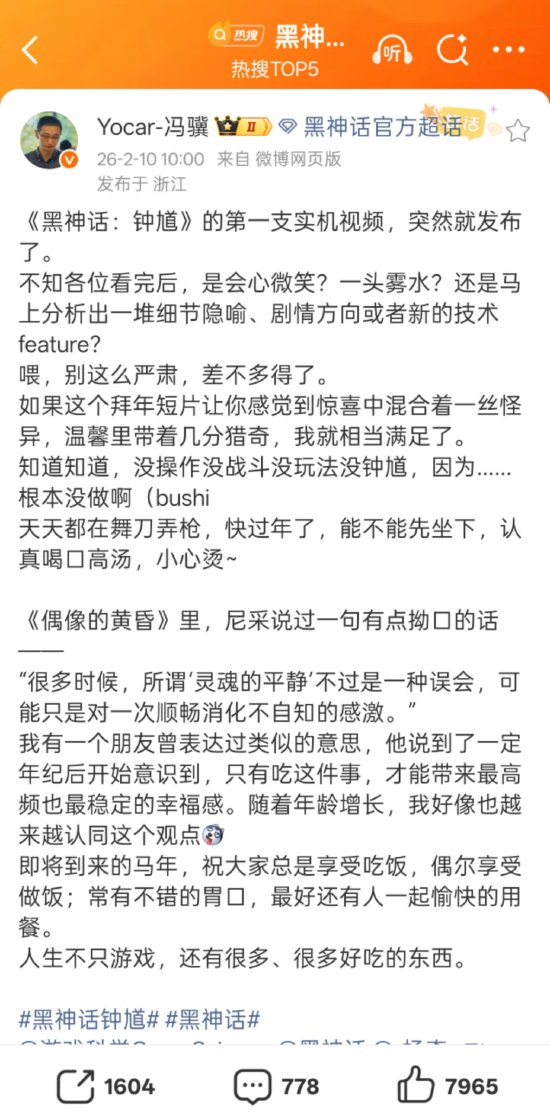
字节,再出爆款!引爆A股涨停潮
证券时报· 2026-02-10 04:19
Core Viewpoint - ByteDance's AI video generation model Seedance 2.0 has gained significant attention both domestically and internationally, leading to a surge in AI application themes in the A-share market [1][4]. Market Overview - On February 10, the A-share market exhibited a fluctuating trend with noticeable structural differentiation. AI application themes saw widespread increases, particularly in sectors such as short drama games, cultural media, online games, virtual humans, and cybersecurity, while the photovoltaic industry experienced a pullback [1]. - The Shanghai Composite Index closed at 4122.34, down 0.02%, and the Shenzhen Component Index closed at 14206.26, also down 0.02% [2]. Cultural Media Sector - The cultural media sector experienced a significant surge, with multiple stocks hitting the 20% limit up, including Readkey Culture, Jiecheng Co., Rongxin Culture, Light Media, and Chinese Online. Other stocks like Happiness Blue Sea rose over 10% [4][5]. - The cultural media index rose by 6.76%, indicating strong market performance [5]. AI Video Technology Impact - Seedance 2.0 is expected to lead the way in the short content field, such as AI comic dramas and short dramas, by significantly reducing production costs and shortening production cycles. This advancement is anticipated to drive industry capacity expansion [6]. - The model's capabilities include self-storyboarding, multi-modal references, audio-visual synchronization, and multi-camera narrative capabilities, which are expected to enhance video usability and lower production costs [6]. Gaming Sector Performance - The gaming sector also saw widespread gains on February 10, with stocks like Wento Holdings and Perfect World reaching their daily limits [8]. - The gaming index increased by 4.71%, reflecting positive market sentiment [9]. Regulatory Environment and Market Growth - In January 2026, 182 game licenses were issued, continuing a trend of normalized issuance since 2025, indicating regulatory support for the industry's healthy development. The gaming market's actual sales revenue is projected to reach 350.79 billion yuan in 2025, marking a 7.68% year-on-year growth [9][10]. - The gaming sector is expected to benefit from AI applications, with both established and new games leveraging AI to enhance user engagement and content creation [10]. Hong Kong Market Trends - The Hong Kong market mirrored the A-share surge, particularly in cultural media and innovative drug services, with notable gains in stocks like WuXi Biologics and WuXi AppTec [11].




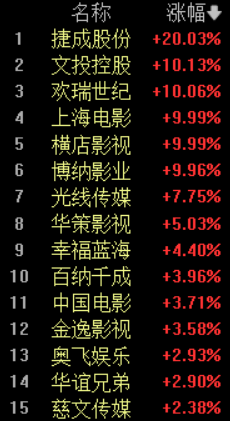
影视板块持续走高!博纳影业等多股涨停,字节Seedance2.0引爆AI语料需求
Jin Rong Jie· 2026-02-10 01:57
Group 1 - The film and entertainment sector continues to rise, with stocks such as WenTou Holdings, Huanrui Century, Shanghai Film, Hengdian Film, and Bona Film reaching their daily limit [1] - Notable stock price increases include: Jiecheng Co. (+20.03%), WenTou Holdings (+10.13%), Huanrui Century (+10.06%), Shanghai Film (+9.99%), Hengdian Film (+9.99%), and Bona Film (+9.96%) [2] - As of February 9, the pre-sale box office for new films during the 2026 Spring Festival has exceeded 70 million yuan, with total box office projections for the festival estimated between 6.5 billion and 8.5 billion yuan [2] Group 2 - Six films have been scheduled for release on the first day of the Lunar New Year, including "Fast Life 3" and "Panda Plan: Tribal Adventure" [3] - ByteDance's Seedance 2.0 AI video generation model has gained significant attention, capable of creating movie-quality videos based on text or images, which may enhance the demand for specialized multimedia databases in the film and advertising industries [3] - Multiple brokerage reports highlight that Seedance 2.0 represents a breakthrough in multimodal generation, potentially leading to a surge in demand for AI-generated content and specialized corpora [3]


马斯克携SpaceX剑指“外星造城”:月球10年内完工!我国首次完成脑机接口太空在轨验证;字节Seedance2.0灰度测试爆火——《投资早参》
Mei Ri Jing Ji Xin Wen· 2026-02-10 00:12
Market News - On Monday, major US stock indices closed higher, with the Dow Jones up 0.03%, Nasdaq up 0.90%, and S&P 500 up 0.45%. Notable stock movements included Nvidia rising over 2%, Apple falling over 1%, and Microsoft increasing over 3% [1] - The European stock indices also saw gains, with Germany's DAX up 1.19%, France's CAC40 up 0.6%, and the UK's FTSE 100 up 0.16% [1] Currency and Commodity Updates - The US dollar index fell by 0.85% to 96.808, while the onshore RMB appreciated against the dollar, closing at 6.9208, up 146 points from the previous Friday [2] - Silver prices surged by 6.98% to $83.2699 per ounce, while gold rose by 2.01% to $5064.10 per ounce. WTI crude oil increased by 1.27% to $64.36 per barrel [2] Industry Insights - Elon Musk announced that SpaceX is shifting its focus to building a "self-expanding city" on the Moon, with a projected timeline of less than 10 years. This shift is due to the faster launch cycles to the Moon compared to Mars, which could take over 20 years [3] - The space economy is expected to grow significantly, with the satellite communication industry projected to reach between 200 billion to 400 billion by 2030, with a compound annual growth rate of 10%-28% [3] - ByteDance's AI video generation model, Seedance 2.0, has entered gray testing, allowing for advanced video editing capabilities that could disrupt the film industry by automating many roles [4][5] - A research team from Northwestern Polytechnical University has achieved a milestone in aerospace engineering with a flexible brain-machine interface that successfully operated in space, indicating significant potential for medical applications [6] Stock Reduction Announcements - Zhongzhou Special Materials announced that a major shareholder plans to reduce its stake by up to 642,520 shares, representing 1.4% of the total share capital [7] - Youde Precision and other companies have also announced plans for share reductions by various shareholders, indicating potential shifts in ownership dynamics [7][8][9]
字节与OpenAI的战争,摆在了桌面上
3 6 Ke· 2026-02-09 23:43
Core Viewpoint - The release of ByteDance's Seedance 2.0 marks a significant shift in the AI video generation landscape, indicating that Chinese AI has reached a level of parity with global leaders like OpenAI, moving from a phase of catching up to one of direct competition [2][11]. Group 1: Route Dispute - There are two main approaches in global AI video generation: the physical simulation approach represented by OpenAI's Sora, which focuses on realistic physics, and the narrative logic approach represented by ByteDance's Seedance 2.0, which emphasizes storytelling and creative direction [3]. - Seedance 2.0 utilizes ByteDance's extensive experience in video content and user engagement, allowing it to generate videos that resonate with audiences by understanding emotional pacing and narrative structure [3][7]. Group 2: Capital Investment - ByteDance has committed over $12 billion to AI infrastructure by 2025, with plans for an additional capital expenditure of up to 160 billion RMB for 2026, surpassing the total investments of some tech giants [4][5]. - Approximately half of this investment is directed towards core computing chips, with over 40 billion RMB allocated to domestic suppliers like Huawei, aiming to establish a self-sufficient computing infrastructure for AI [6]. Group 3: Ecological Competition - The unique ecosystem surrounding ByteDance, characterized by a vast and active short video industry, provides a competitive advantage that is difficult for others to replicate [7]. - Seedance 2.0 benefits from a rich training environment, with over 220 million new related videos and nearly 10 million live streams on Douyin each month, allowing it to learn from real user interactions [7]. Group 4: Democratization of Creative Expression - Seedance 2.0 lowers the barriers to video creation, enabling anyone with basic skills to produce professional-quality content, thus democratizing storytelling capabilities [9]. - This technology not only represents a tool innovation but also contributes to a broader movement towards technological equity, allowing ordinary individuals to express themselves more effectively [9]. Group 5: Future Considerations - The success of Seedance 2.0 signifies a transition in the AI landscape, where the focus shifts from mere technical replication to embedding AI deeply into human life and experiences [12][14]. - However, this advancement also raises ethical concerns regarding the authenticity of generated content and the potential for misuse, necessitating a collective effort to establish guidelines and standards in the industry [12][15].
AI视频生成“分水岭”?字节跳动Seedance2.0到底有多强
Sou Hu Cai Jing· 2026-02-09 15:34
【CNMO科技】近日,字节跳动正式推出新一代AI视频生成模型Seedance 2.0。该模型能够根据用户一 句描述,自动生成包含多镜头切换、连贯叙事和同步音效的电影级视频。游戏科学CEO冯骥惊叹于 其"多模态信息理解能力的飞跃"。券商报告也表示,这标志着"AI影视'奇点'时刻"的到来。 对于普通消费者来说,AI生成视频已经在短视频平台十分常见,但是无论是Sora还是其他AI视频生成模 型,似乎除了视频质量越来越高外,并没有新奇的地方。那么,为什么Seedance 2.0能够引起这么大的 讨论呢? 技术优势 随着字节跳动Seedance 2.0的发布,全球AI视频生成领域已形成三条清晰的技术路线。其中。Seedance 2.0专注于叙事连贯性与音画一体化,其核心优势在于能够理解复杂的长提示词,自动拆解出"全景-中 景-特写"的分镜逻辑,并确保角色细节在不同镜头中保持一致。 以OpenAI的Sora为代表的是"物理模拟派"路线。该路线以极致的物理规律还原(光影、重力、碰撞)和 高保真画质著称,致力于精准模拟现实世界的物理规则。快手的可灵(Kling)代表的"运动控制派"则 通过Motion Control功能让用 ...
对Seedance2.0们的伦理敲打正当时
Hua Er Jie Jian Wen· 2026-02-09 15:03
字节的视频生成模型 Seedance 2.0刷屏了。 2月9日一经发布,虽无大规模预热,却把行业的上限往前推了一大截。 画面稳定性、空间连续性、人物动作与镜头语言的完整度,都已经明显超出玩具阶段。哪怕放在全球范 围比榜,它都站在第一梯队,甚至可以说是目前最接近可用级的视频生成模型之一。 而在发布后不久,字节便对部分能力做出了紧急收紧:真人生成需要更严格的活体校验条件,真人素材 不再被支持作为主体参考,涉及名人或知名 IP 的生成均受严格限制。 这些调整来得紧急、低调但及时。因为当下的模型本身的能力,正在快于现有的规则体系。 Seedance2.0发布的2月9日凌晨,影视飓风创始人Tim发布的公开评测尤其耐人寻味。 在测试中,仅提供照片、不提供声音或视频素材的情况下,模型却能够生成带有高度相似个人音色的内 容,甚至复现出熟悉的空间画面。 如此超预期的表现,很难单纯用巧合来解释,Tim据此推测模型可能学习了其团队或其他博主的公开内 容。 但Tim没有把话题推向情绪,只是留下了一句非常克制的判断——法理上可能是合规的,但多少有点恐 怖。 这其实也是对当下许多AI视频模型黑箱过程的拷问,即当一个模型能够生成超出当前输 ...
视频全民化来了?Seedance2.0爆火出圈
2 1 Shi Ji Jing Ji Bao Dao· 2026-02-09 14:31
2026年2月,字节跳动旗下AI视频生成模型Seedance2.0在小范围内测阶段便席卷海内外互联网,凭 借"文本/图片生成电影级视频"的突破性能力成为行业内外焦点。 而影视飓风创始人Tim(潘天鸿)发布的实测视频,更让这款模型的技术实力广为人知,《黑神话:悟 空》之父冯骥也评价说,Seedance 2.0是当前地表最强视频生成模型,没有之一。 (文章来源:21世纪经济报道) ...