通义万相

Search documents
中金公司 _ 阿里云深度:AI驱动下的全栈布局与全球扩张机遇
中金· 2026-01-19 02:29
Investment Rating - The report estimates that Alibaba Cloud's revenue CAGR is expected to exceed 30% over the next three years [5]. Core Insights - Alibaba's Tongyi series models lead globally through an open-source strategy and continuous investment in iteration, enhancing its model engineering capabilities [4][15]. - The company has announced a capital expenditure plan of 380 billion RMB over three years to enhance its infrastructure, which is currently distributed across 29 regions and 92 availability zones globally [4][60]. - Alibaba Cloud is building a developer ecosystem through the Bailian platform and the Modao community, creating a unique business model that integrates model open-sourcing, computing power monetization, and ecosystem value addition [4]. Summary by Sections Full-Stack Technology and Infrastructure - Alibaba Cloud's full-stack technology establishes a strong competitive moat in the AI era, with significant investments in infrastructure and self-developed GPU chips [4][15]. - The company aims to enhance its overseas infrastructure layout, leveraging its global data center expansion and AI product internationalization [7]. Revenue Growth and Profitability - The report anticipates a significant increase in profitability, with profit margins expected to exceed 15% due to the rising proportion of AI revenue and high-margin overseas business [6]. - The domestic market is experiencing accelerated intelligent transformation across industries such as internet, finance, and automotive, allowing Alibaba Cloud to continuously increase its market share [7]. Competitive Positioning - Alibaba Cloud maintains a leading position in model iteration, scenario adaptation, and understanding of B2B customers, with a robust global infrastructure that supports its AI development [15]. - The Tongyi series models have established a comprehensive technology matrix, serving over 1 million enterprise customers globally and demonstrating strong commercial viability [23][29]. AI Ecosystem and Applications - The report highlights the importance of open-source strategies in building a robust AI ecosystem, with Alibaba's Tongyi models being the most downloaded globally [26][45]. - Alibaba is advancing its C-end applications and hardware ecosystem, aiming to create a super app that integrates various services and enhances user engagement [47].


跳出手机屏幕,千问正在改变物理世界
经济观察报· 2026-01-12 11:48
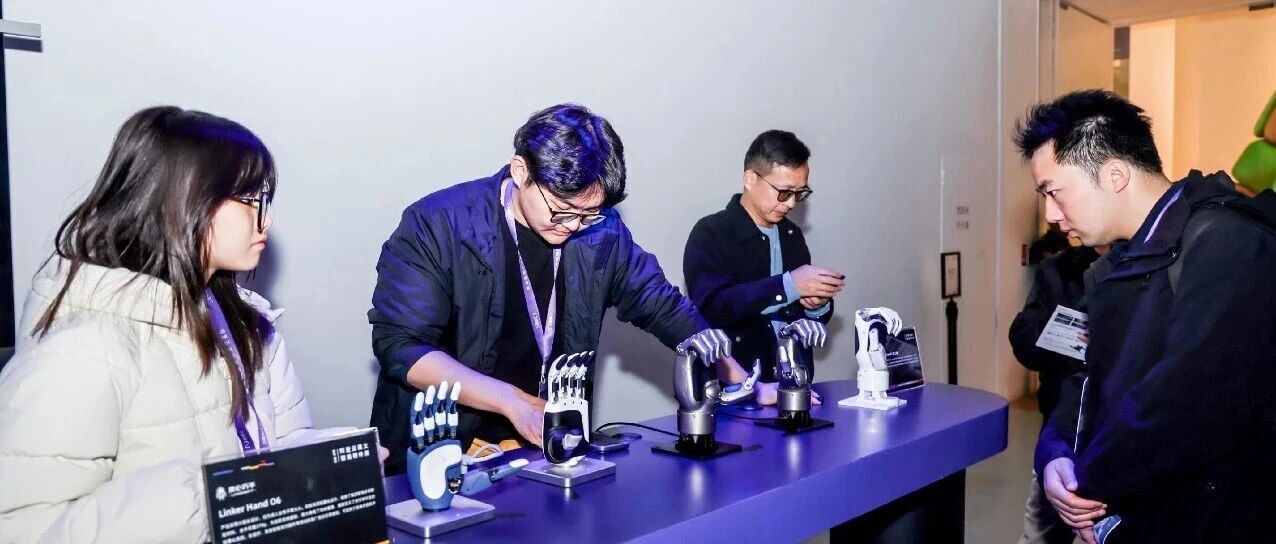
Core Viewpoint - The article emphasizes the emergence of "Physical AI," which signifies the integration of AI into various hardware products, moving beyond traditional mobile applications to interact with the physical world [1][4][22]. Group 1: AI Hardware Development - The CES (Consumer Electronics Show) is highlighted as a global technology trendsetter, where the focus is shifting from conceptual displays to practical, mass-produced AI hardware products [2][6]. - The AI hardware showcased at the Aliyun Tongyi Intelligent Hardware Exhibition includes over 1,500 diverse products, indicating a significant shift towards practical applications of AI in everyday devices [1][2]. - Companies are now focusing on integrating AI capabilities into their products to enhance user experience, rather than just showcasing hardware specifications [2][6]. Group 2: Innovations in AI Applications - New AI hardware products, such as AI translators and health monitoring devices, are being developed to provide real-time insights and recommendations based on user data [7][9]. - The article mentions the introduction of AI hardware that can operate independently without the need for mobile applications, showcasing a trend towards more user-friendly designs [9][10]. - The integration of AI into various sectors, including automotive and health, is transforming how users interact with technology, making it more intuitive and responsive [16][17]. Group 3: Market Dynamics and Competitive Landscape - The article discusses how the Chinese hardware industry is leveraging its supply chain advantages to rapidly innovate and bring AI products to market [6][19]. - The shift from traditional business models to a more open-source approach with the Tongyi Qianwen model is enabling smaller companies and individual developers to participate in the AI hardware ecosystem [15][19]. - The competitive landscape is evolving, with companies focusing on practical applications of AI that address specific user needs, rather than just competing on technical specifications [13][21]. Group 4: Future of AI in Physical World - The article posits that the future of AI lies in its ability to seamlessly integrate into everyday objects, enhancing their functionality and user interaction [22][23]. - The concept of "AI as the new electricity" is introduced, suggesting that AI will become a fundamental part of various industries, similar to how electricity transformed society [19][22]. - The ongoing development of AI hardware is expected to lead to a significant transformation in productivity and user experience across multiple sectors [17][22].

为什么深圳硬件圈都在谈论千问?
雷峰网· 2026-01-12 03:34
Core Viewpoint - The article emphasizes that AI has transitioned from being a mere functional plugin to a fundamental system capability, marking a significant shift in the hardware innovation landscape as large models become the default capability in smart devices [2][9]. Group 1: AI Hardware Landscape - The AI hardware landscape is witnessing a resurgence, with over 200 mainstream hardware manufacturers participating in events like the Alibaba Cloud Tongyi Intelligent Hardware Expo and CES, showcasing a variety of AI applications [3][4]. - The integration of large models, such as Qianwen, into over 1,000 smart devices across 76 categories indicates a strong industry signal that AI is moving beyond screens into the physical world [4][12]. Group 2: Historical Challenges - The AI hardware sector has faced significant challenges over the past decade, including uncontrollable model capabilities, difficult commercial logic, and high engineering complexity, which have hindered the successful implementation of AI in hardware [8][9]. Group 3: Turning Point in AI Hardware - Recent exhibitions signal a turning point for AI hardware, shifting the focus from showcasing model capabilities to system engineering, indicating that AI is now a reliable and efficient foundational capability [9][10]. - Alibaba Cloud's development of a multimodal interaction development kit allows manufacturers to integrate core model capabilities with various interaction technologies, significantly lowering the barriers for hardware selection and adaptation [10][11]. Group 4: Qianwen as a Universal Foundation - Qianwen has emerged as a universal foundation for AI hardware, with Alibaba Cloud collaborating with all AI hardware categories, indicating a shift from single-function AI to comprehensive system capabilities [14][15]. - The comprehensive AI capabilities provided by Qianwen address key pain points in AI hardware implementation, creating a complete ecosystem from models to tools and platforms [16][21]. Group 5: Market Impact and Future Outlook - The AI hardware market in China has surpassed 1.1 trillion yuan, marking a transition from conceptual exploration to large-scale implementation [12]. - The integration of over 1,000 smart devices with Qianwen signifies a clear signal that AI is deeply connecting with the physical world, transforming hardware into intelligent systems that continuously learn and evolve [23][24].
拓宽百年奥运「赛场边界」,阿里云AI让人人皆可上场
机器之心· 2026-01-08 09:34
Core Viewpoint - The article discusses the rapid evolution of AI video generation technology and its integration into daily life, highlighting a global AIGC competition initiated by Alibaba Cloud in collaboration with the International Olympic Committee for the 2026 Milan Winter Olympics, marking a significant milestone in AI's role in the Olympics [4][6][10]. Group 1: AI Video Generation Technology - AI video generation technology has advanced to a point where the distinction between real and AI-generated content is increasingly blurred, leading to discussions about how to coexist with these technologies [2][4]. - Alibaba Cloud's "Wan2.6" model showcases impressive capabilities in video generation, including high-quality visuals, sound, and the ability to create multi-angle narratives, making it a powerful tool for participants in the AIGC competition [13][18][35]. Group 2: AIGC Competition Details - The AIGC competition invites participants to create videos based on classic winter sports using Alibaba Cloud's "Wan2.6" model, with the best entries being included in the Olympic Museum's collection [9][10]. - The competition aims to democratize participation in the Olympics, allowing ordinary individuals to engage in a more immersive experience through AI technology [39][42]. Group 3: Technical Innovations of Wan2.6 - Wan2.6 achieves ultra-realistic rendering by accurately simulating physical laws and ensuring temporal consistency, allowing for a high degree of detail and coherence in generated videos [35][36]. - The model supports seamless multi-angle video output and maintains narrative continuity, enabling creators to produce cohesive storytelling without disjointed transitions [36][37]. - Wan2.6 can generate complete narrative videos up to 15 seconds in 1080P, making it suitable for professional applications such as short film production [37][38].

外卖大战升温 消息称阿里将引入视觉AI降低餐馆成本
Feng Huang Wang· 2026-01-05 00:59
Core Insights - Alibaba Group is set to launch a service that helps restaurants utilize AI to showcase their in-store environment, aiming to compete with Meituan in the food delivery sector [1] - The new feature from Alibaba's mapping and local services division, Amap, will allow restaurants to generate 3D images by simply uploading videos or photos, leveraging the Tongyi Wanxiang visual generation model [1] - Alibaba plans to offer this technology for free to select merchants for a trial period, as part of its broader AI strategy to integrate AI across all its businesses [1] Industry Context - Chinese companies are increasingly exploring AI to enhance existing operations and enter new markets, with Amap's initiative indicating Alibaba's intent to expand in areas dominated by Meituan [1] - Meituan currently leads the local services market, including food delivery, reviews, and restaurant reservations, while Alibaba has faced challenges from smaller competitors in recent years [1] - To counter competition from Meituan and JD.com, Alibaba is investing hundreds of billions of yuan in incentives and subsidies for its popular online services by 2025, amidst a "three-way competition" that is squeezing industry profit margins [1]

北京大学:AI视频生成技术原理与行业应用 2025
Sou Hu Cai Jing· 2025-12-09 06:48
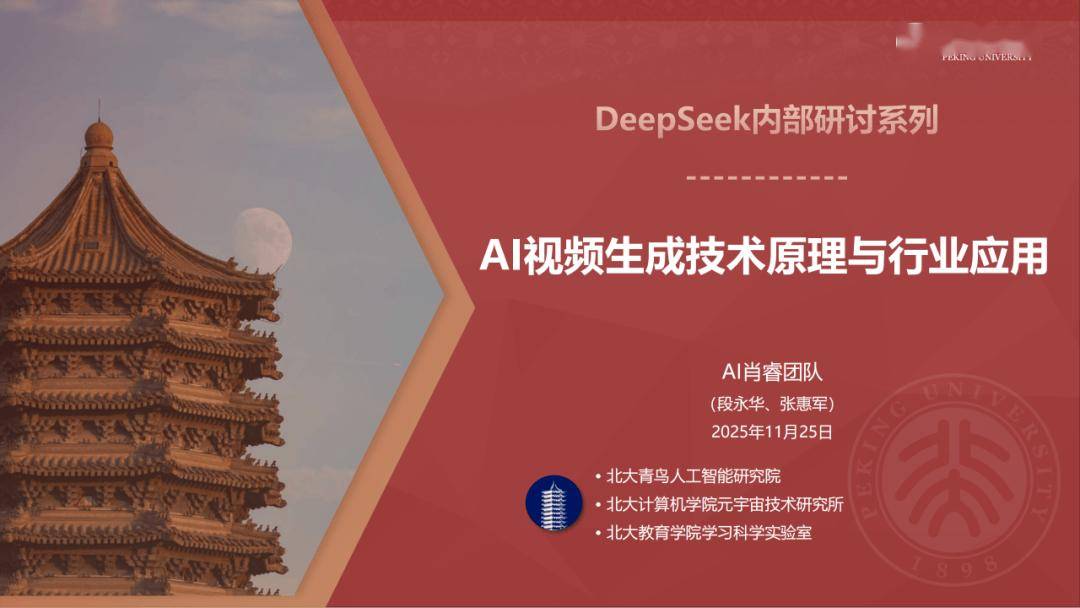
Group 1: AI Video Technology Overview - AI video technology is a subset of narrow AI focused on generative tasks such as video generation, editing, and understanding, with typical methods including text-to-video and image-to-video [1] - The evolution of technology spans from the exploration of GANs before 2016 to the commercialization of diffusion models from 2020 to 2024, culminating in the release of Sora in 2024, marking the "AI Video Year" [1] Group 2: Main Tools and Platforms - Key platforms include OpenAI Sora, Kuaishou Keling AI, ByteDance Jimeng AI, Runway, and Pika, each offering unique features in terms of duration, quality, and style [2] Group 3: Technical Principles and Architecture - The mainstream paradigm is the diffusion model, which is stable in training and offers strong generation diversity, with architectures categorized into U-Net and DiT [3] - Key components include the self-attention mechanism of Transformers for temporal consistency, VAE for compression, and CLIP for semantic alignment between text and visuals [3] Group 4: Data Value and Training - The scale, quality, and diversity of training data determine the model's upper limits, with prominent datasets including WebVid-10M and UCF-101 [4] Group 5: Technological Advancements and Breakthroughs - Mainstream models can generate videos at 1080p/4K resolution and up to 2 minutes in length, with some models supporting native audio-visual synchronization [5] - Existing challenges include temporal consistency, physical logic, and emotional detail expression, alongside computational cost constraints [5] - Evaluation frameworks like VBench and SuperCLUE have been established, focusing on "intrinsic authenticity" [5] Group 6: Industry Applications and Value - In the film and entertainment sector, AI is involved in the entire production process, leading to cost reductions and efficiency improvements [6] - The short video and marketing sectors utilize AI for rapid content generation, exemplified by Xiaomi's AI glasses advertisement [6] - In the cultural tourism industry, AI is used for city promotional videos and immersive experiences [7] - In education, AI facilitates the bulk generation of micro-course videos and personalized learning content [8] - In news media, AI virtual anchors enable 24-hour reporting, though ethical challenges regarding content authenticity persist [9] Group 7: Tool Selection Recommendations - Recommendations for tool selection include using Runway or Keling AI for professional film, Jimeng AI or Pika for short video operations, and Vidu for traditional Chinese content [10] - Domestic tools like Keling and Jimeng have low barriers to entry, while overseas tools require VPN and foreign currency payments [11] - A multi-tool collaborative workflow is advised, emphasizing a "director's mindset" rather than reliance on a single platform [12] Group 8: Future Outlook - The report concludes that AI video will evolve towards a "human-machine co-creation" model, becoming a foundational infrastructure akin to the internet, with a focus on creativity and judgment [13]



易点天下联袂阿里云 共筑AI漫剧出海新引擎
Zheng Quan Shi Bao Wang· 2025-11-24 02:15
Core Insights - The partnership between Yidian Tianxia and Alibaba Cloud aims to create a comprehensive solution for the "AI Manhua Going Global" sector, addressing challenges such as high technical barriers and limited monetization channels [1][3] - The AI content industry is experiencing explosive growth, with weekly AI Manhua productions exceeding 110 since 2025, and a total of 3,000 works launched, reflecting a 603% increase [1] - China's animation export scale is projected to surpass 20 billion yuan by 2025, with overseas user numbers rising from 20 million in 2020 to 50 million, capturing a 35% market share in Southeast Asia [1] Company Overview - Yidian Tianxia has over a decade of experience in overseas marketing and has successfully served major clients like ReelShort and Dreame, accumulating valuable content creation and advertising experience [2] - The company’s AI-driven programmatic advertising platform, zMaticoo, enhances overseas advertising monetization efficiency through data mining and innovative SDK technology [2] - Alibaba Cloud, a leading global cloud service provider, has established a strong foundation in AI computing power and compliance services, with advanced models for video generation and multilingual support [2] Strategic Implications - The collaboration is expected to systematically address key challenges in AI Manhua production and commercialization, leveraging both companies' strengths in technology and market resources [3] - The partnership signifies a shift in the Chinese AI content industry from isolated breakthroughs to ecosystem collaboration, enhancing competitiveness in the global content market [3] - As the AI Manhua export engine develops, Yidian Tianxia is positioned to gain a competitive edge in the rapidly growing global AI content sector [3]
世界互联网大会博览会开幕,阿里巴巴展出全栈AI成果和最新智能硬件
Sou Hu Cai Jing· 2025-11-06 10:25
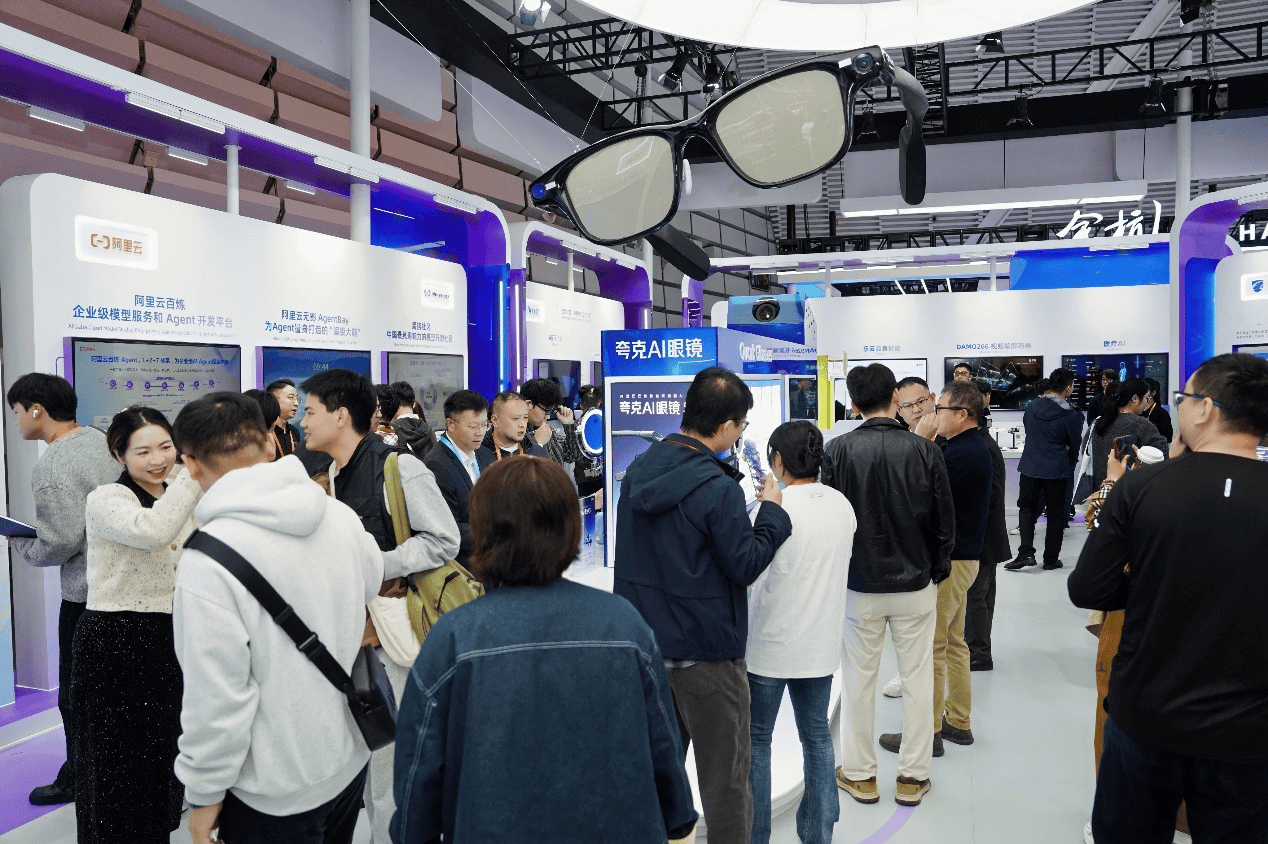
Core Insights - The 2025 World Internet Conference "Internet Light" Expo opened in Wuzhen, Zhejiang, with a focus on AI innovations, particularly from Alibaba, showcasing advancements in AI applications such as cancer screening and smart hardware like AI glasses [2] Group 1: AI Innovations - Alibaba unveiled its first self-developed Quark AI glasses, featuring dual chips and adjustable dual-display technology, enabling various functions such as navigation, payment, translation, and more [3] - The AI glasses introduce a replaceable battery design, allowing users to swap batteries easily for all-day use [3] - The DingTalk A1, a new AI recording card, was also showcased, capable of recording, transcribing, translating, and summarizing communications, with a continuous recording capability of 45 hours [3] Group 2: Medical AI Solutions - Alibaba's DAMO Academy presented a "Plain CT + AI" medical examination solution, which enhances the detection of diseases by identifying subtle differences in CT images that are often missed by the human eye [6] - This solution aims to facilitate early disease detection and reduce the economic and physical burdens on patients, with breakthroughs in diagnosing various cancers and chronic diseases [6] - The medical AI products have successfully partnered with over 30 top medical imaging information vendors, serving more than 1,000 medical institutions and over 50 million patients globally [6] Group 3: Cloud Infrastructure and Open Source Models - Alibaba Cloud has established 8 new AI cloud data centers and availability zones this year across multiple countries, enhancing its global infrastructure [7] - The company operates 29 public cloud regions and 92 availability zones worldwide, with over 3,200 edge nodes, covering more than 70 countries [7] - Alibaba has released over 300 open-source models under the "Tongyi Qianwen" family, achieving over 600 million downloads, with flagship model Qwen3 ranking among the top three globally in various benchmark tests [7]
Wan2.2-Animate又火了,5分钟让抠脚大汉秒变高冷女神。
数字生命卡兹克· 2025-10-30 01:33
Core Viewpoint - The article discusses the capabilities and implications of the open-source model Wan2.2 Animate, which allows users to create highly realistic face-swapping videos and animations, highlighting its potential in various creative fields while also addressing the ethical concerns associated with such technology [1][25][26]. Group 1: Technology and Features - Wan2.2 Animate can generate natural face-swapping videos by using a combination of user-uploaded videos and images, achieving impressive results in mimicking expressions and movements [1][4][6]. - The model allows for voice modulation alongside visual changes, enhancing the realism of the generated content [9]. - It supports both action imitation and character replacement, enabling users to create videos with different characters while maintaining the original background [14][15][16]. Group 2: Accessibility and Open Source - Wan2.2 Animate is notable for being open-source, which differentiates it from other similar models that are not publicly available [14][25]. - The model can be easily accessed and utilized by anyone, significantly lowering the barrier to entry for animation and video creation [25][26]. - It can be deployed in various settings, including enterprises and film productions, allowing for cost-effective animation and special effects [25]. Group 3: Creative Applications - The technology can be used for various creative projects, including recreating classic film scenes or generating dance videos with different characters [12][26]. - It opens up new possibilities for independent animators and filmmakers, enabling them to bring their characters to life with minimal investment [25][26]. - The potential for reviving deceased actors in new films through AI-generated likenesses is also discussed, showcasing the transformative impact of this technology on the film industry [26]. Group 4: Ethical Considerations - The article raises concerns about the misuse of such technology, particularly in creating misleading or harmful content that could undermine trust in digital media [26]. - It emphasizes the importance of responsible use of technology, likening it to fire that can either warm or destroy [26].

Sora2生成已故名人视频引亲属不满,OpenAI面临版权麻烦
21世纪经济报道· 2025-10-11 12:25
Core Viewpoint - The article discusses the ethical and copyright issues surrounding AI-generated videos of deceased celebrities, particularly focusing on the case of Robin Williams and the implications of OpenAI's Sora 2.0 release, which has sparked significant controversy and backlash from family members and industry stakeholders [1][2][3]. Group 1: AI Video Generation and Controversy - The release of Sora 2.0 has led to a surge in AI-generated videos featuring Robin Williams, raising concerns about the manipulation of his image and voice without consent [1][3][5]. - Robin Williams' daughter has publicly condemned the creation of AI videos of her father, emphasizing the emotional distress it causes to the family and the disrespect it shows to his legacy [5][6]. - The rapid adoption of Sora 2.0, which reportedly surpassed one million downloads within five days, highlights the growing demand for AI-generated content, but also the challenges of regulating its use [5][6]. Group 2: Legal and Ethical Implications - The article outlines the legal framework in China regarding the posthumous rights of deceased individuals, indicating that family members can claim rights over the deceased's image and voice, which complicates the use of AI in recreating these figures [8][9]. - OpenAI has faced pressure from various stakeholders, including Hollywood unions and family members, to establish clearer boundaries regarding the use of deceased individuals' likenesses in AI-generated content [13][14]. - OpenAI has adjusted its copyright policy from an opt-out to an opt-in mechanism, allowing public figures to control the use of their likenesses in Sora-generated videos, although this does not address the rights of deceased individuals [14][15]. Group 3: Industry Response and Future Directions - The article notes that the backlash against AI-generated content is not isolated, as other companies in the industry have faced similar legal challenges and public outcry regarding copyright infringement [13][16]. - There is a call for a more structured approach to the ethical use of AI in recreating public figures, with suggestions for obtaining explicit consent from deceased individuals' estates and establishing clearer guidelines for AI platforms [9][16]. - The ongoing debate highlights the tension between artistic expression and the rights of individuals, suggesting that the industry is still in the process of finding a balance between innovation and ethical responsibility [16].